


 Login
 Blog
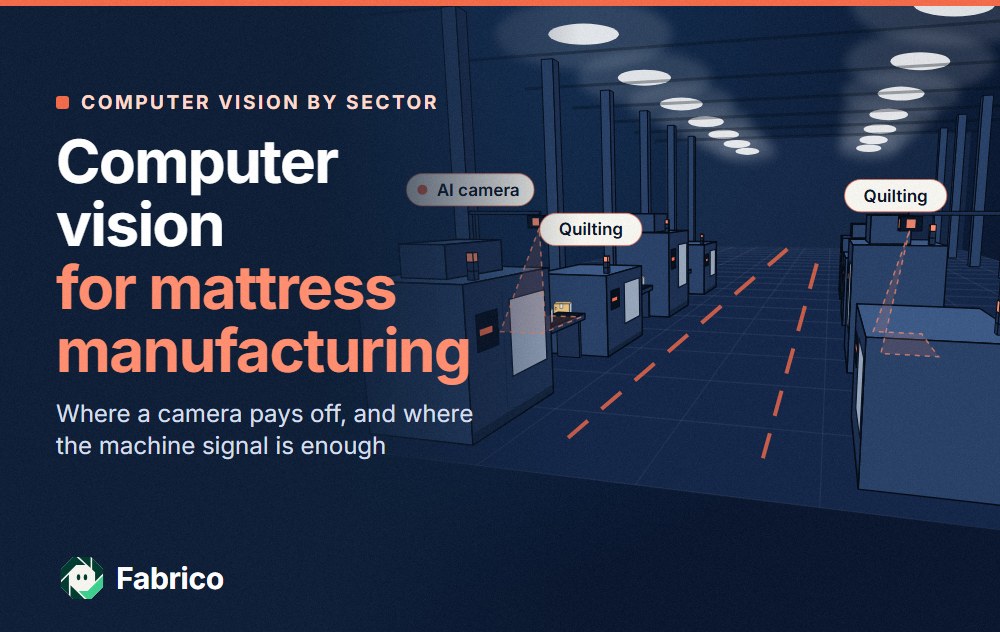
Computer Vision for Mattress Manufacturing: Tape-Edge, Bonding and Boxing

In short: computer vision for mattress manufacturing pays for itself at the tables people work: tape-edge closing, mattress assembly, foam bonding and boxing. A camera counts each mattress or box that leaves, and you can replay the minutes a table stood empty.
- Spring unit assemblers, quilting machines and roll pack machines usually know their own cycles. Read their signal first.
- Tape-edge closing is the station to look at first: it is manual, physically hard work and often the pace setter for the plant.
- Open seams, quilt faults and law label checks belong to QC checkers or an inspection system, not to a counting camera.
- Mattress losses hide in size changeovers, waiting for bodies at tape-edge, re-taping, and a mix of sizes that hides slow running.
- Fabrico's camera add-on counts closed, rolled and boxed mattresses; the tape-edge operator books why the table stopped, and a minute of video is streamed only when someone asks for it on the timeline.
Your quilting machine knows how many panels it ran today. Your tape-edge tables and your boxing area usually do not.
It follows a mattress from the spring assembler to the box: where a camera count helps, where the quilter or roll pack controller already counts, and which questions to put to a supplier.
Computer vision for mattress manufacturing: checking seams or counting mattresses
A mattress plant buying cameras is usually buying one of two things. A seam or quilt inspection camera judges the product. An OEE camera counts closed, rolled or boxed mattresses and lets you open the video of a stop.
| Job in a mattress plant | Inspection system | OEE camera |
|---|---|---|
| Tape-edge seam: open seam, skipped stitch | Yes, or a trained checker | No |
| Quilt pattern and panel faults | Yes, or the operator | No |
| Law label and size label check | Yes, or a scanner | No |
| Count closed or boxed mattresses | Only those it checks | Yes, at tape-edge, assembly and boxing |
| Why the tape-edge table stood | Defect images only | Video of the table for that minute |
| What it gives OEE | Re-tapes and rejects | Mattresses closed per hour |
Write them as two lines in the spec, with two budgets. Re-tapes and rejects booked by QC set the quality figure, and a mattress that goes round the tape-edge table twice is still one mattress. Before you trust a camera count, check it the way how accurate camera OEE is describes.
How a mattress plant runs, and where the signals are
Unit shipments of U.S.-produced mattresses and stationary foundations fell 9.0% to 26.3 million in 2023, according to ISPA's 2023 Mattress Industry Trends Report as reported in ISPA's journal BedTimes, in its report on the 2023 US mattress decline.
The machine end: springs, foam and quilting
Pocket spring units come from coiling and assembly machines that pocket each coil in fabric and glue the rows into a unit. These machines have controllers that know their cycles, and often their unit count.
Foam arrives as large blocks or is poured on site. It is cut to size on horizontal and vertical cutters or CNC contour cutters, then bonded into cores or layered onto spring units. Cutting usually has a controller. Bonding and lamination are often manual: an operator sprays adhesive and lays the layers.
Quilting machines stitch the ticking, fibre and foam into top and bottom panels. Modern multi-needle and single-needle quilters are computer controlled, so the pattern and the run state are there to read, and the panel count too where a panel cutter is fitted.
The manual middle: borders, assembly and tape-edge
Border panels are sewn to length, with handles, vents and labels added, often by hand on a sewing station. Then the mattress is built: the spring unit, the foam layers and the panels come together on an assembly table. On innerspring mattresses, a flanging machine sews a flange strip to the quilted panel first, and the flange is clipped or hog-ringed to the spring unit at assembly.
Next comes closing. On a tape-edge station, an operator guides the sewing head around the edge of the mattress to join the top panel to the border, then flips the mattress and closes the other side. Many all-foam mattresses skip this step and get a zip or sock cover instead. The cycle changes with size and height, and with the operator.
This is also the hardest work in the plant. The UK Health and Safety Executive, in its mattress handling initiative, found that bed manufacturing had around twice the manufacturing average rate of manual handling injuries, and ranked tape-edging as the highest risk of the tasks it studied. A 2015 study of mattress sewing workstations in The Open Mechanical Engineering Journal looked at how workers position themselves at workstations that sew the edges of mattresses, recorded the work with video cameras, and used the results to plan a redesign of the station.
The packing end: roll pack, compression and boxing
Flat mattresses are bagged and stacked. Foam and many hybrid mattresses go through roll pack: a vacuum or press compresses the mattress, film seals it, and a roller rolls it into a tube. A bed-in-a-box line then boxes the roll, often at a manual table, before labelling and dispatch.
Five losses that hide between the quilter and the box
Size and model changeovers
A mattress plant can run singles, doubles, queens and kings of several models in one shift. A change can mean a new quilt pattern and thread, new ticking, a new border length, a new tape colour and a new film size at roll pack.
Book changeovers with their own codes, by type: size, quilt pattern, ticking, tape colour, film. A filmed changeover at the quilter is a good SMED starting point; see changeover video analysis for SMED.
Waiting for bodies at tape-edge
A tape-edge station with no built mattress in front of it stops, even if every machine upstream ran well.
Book "waiting for bodies" as a reason of its own, and note whether panels, borders or a built unit were missing. The cause sits upstream at quilting, borders or assembly, not with the closing team.
Re-taping and rework
An open seam or a wavy tape edge found at final QC sends the mattress back to the tape-edge table. Counted only at packing, that second pass just looks like a slow afternoon.
Record re-taping as a quality loss at the tape-edge station, and do not count the mattress as new output when it closes again.
A mix of sizes that hides slow running
A king hybrid with a tall border takes longer to close than a single foam mattress. One ideal cycle per station makes the performance figure meaningless.
Set ideal cycles by size and height class at tape-edge, assembly and roll pack.
Stops at roll pack and boxing
Film changes, a mattress off centre at the infeed, and waiting for boxes all stop the end of the line. The roll pack machine logs its own stops. The boxing table does not, so its waits land nowhere unless the operator books them.
A pocket spring and roll pack plant, mapped
Here is one example: a pocket spring and foam plant with a roll pack line.
For machines outside a mattress plant, see camera or sensor, by machine type.
Which mattress stations need a camera count
Plants differ. An automated border line or a newer tape-edge machine with an auto-flipper may already give a count, so check the controller first.
| Mattress station | Where the count comes from | Camera add-on's part |
|---|---|---|
| Pocket spring assembler | Machine controller | Little. Read the controller. |
| Foam cutting | Machine controller | Little. Read the controller. |
| Foam bonding and lamination | Often nothing | Count of bonded cores |
| Quilting machine | Machine controller | Video of thread breaks and panel jams |
| Border sewing and handles | Nothing, or a hand tally | Count of finished borders |
| Mattress assembly | Nothing, or a hand tally | Count of built bodies |
| Tape-edge closing | Nothing, or a hand tally | Count of closed mattresses |
| Roll pack and compression | Machine controller | Video of film and infeed stops |
| Boxing and dispatch | Label printer or nothing | Count of boxed mattresses |
| Why a table stood | Closer, assembler or packer, tablet or phone | Video of the table when the reason is argued |
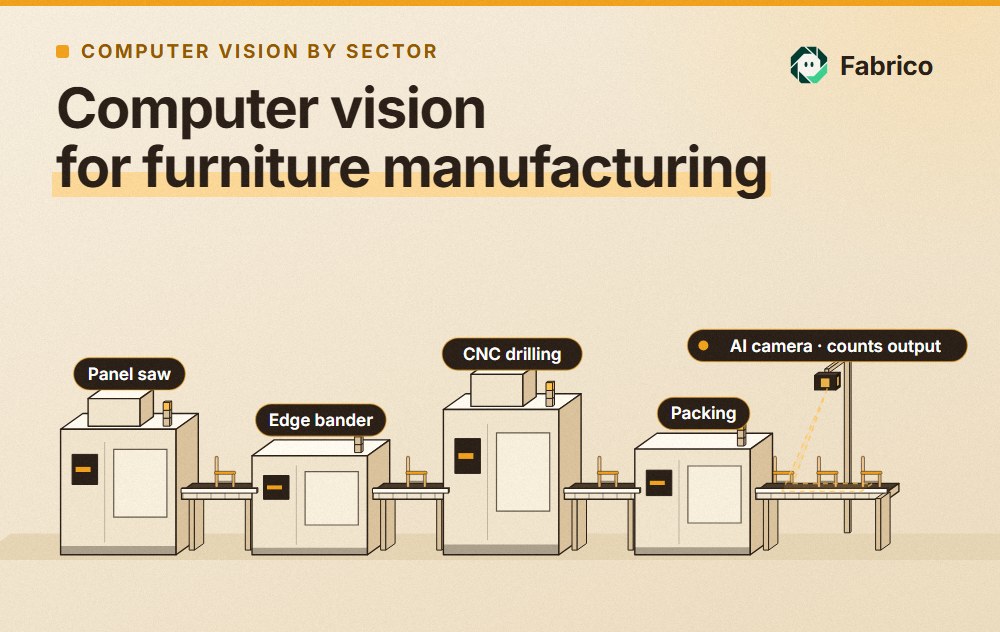
The method for hand work such as assembly and closing is in computer vision for OEE in manual assembly. If your plant also makes beds, sofas or other upholstered pieces, see computer vision for furniture manufacturing.
Before a demo, mark which quilters and roll pack machines you can already read; we will spend the time on the tables that have no count.
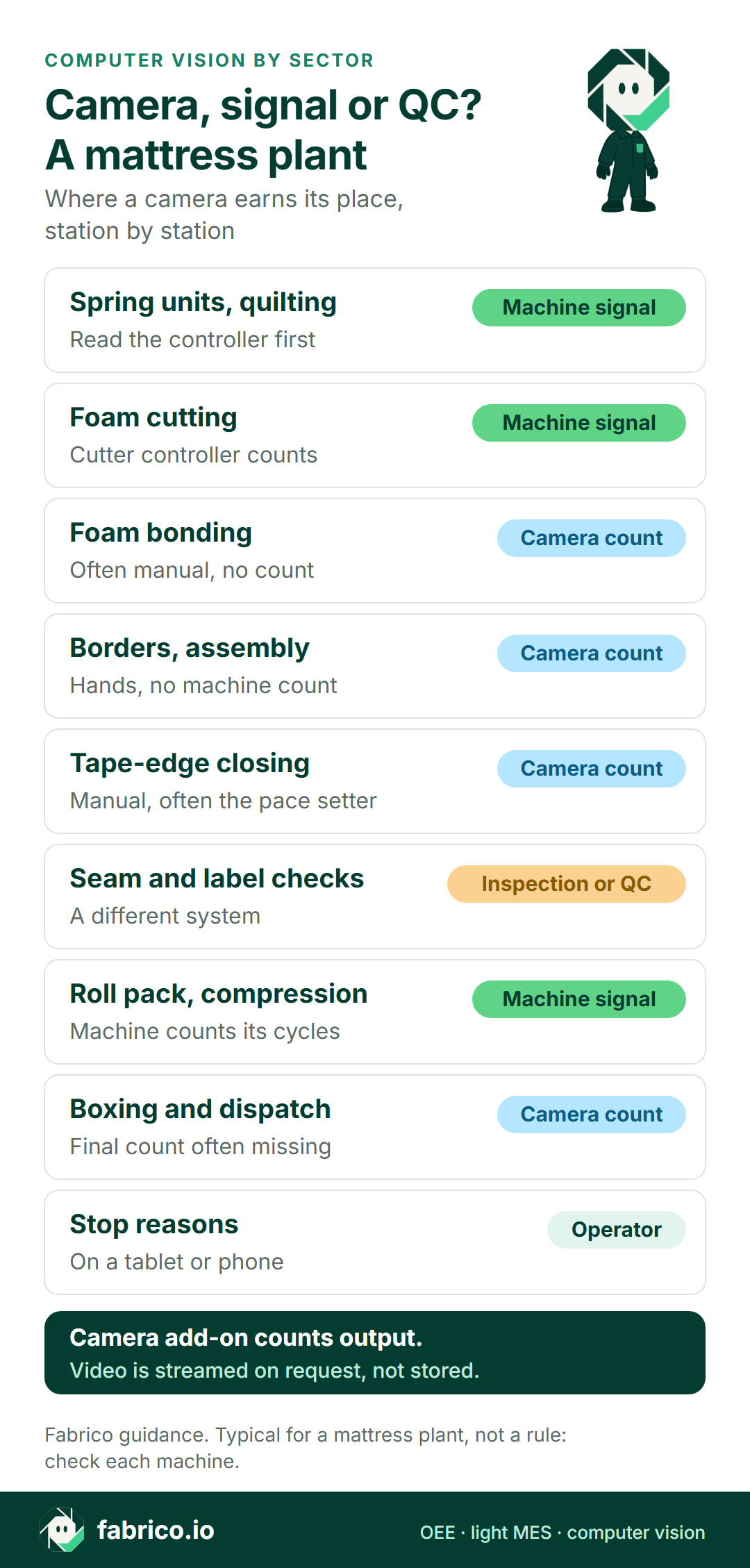
Text version of this infographic
- Spring units
- Foam cutting
- Quilting and roll pack use the machine signal
- Tape-edge closing
- Assembly
- Foam bonding
- Borders and boxing get a camera count
- Seam and label checks stay with QC
Worked example: queen mattresses through one tape-edge station
The numbers below are a sample, not from any plant. One tape-edge station closes tall queen hybrids, at an ideal cycle of 5 minutes a mattress. The plant works 10-hour days, four days a week; after two 15-minute breaks and a 30-minute lunch, the day has 540 planned minutes.
Nothing upstream counts what this station closes. A camera add-on above the outfeed counts each mattress as it slides off the table. The closer logs stops and their reasons on a tablet, and QC marks the mattresses sent back for re-taping.
The table stood for 105 minutes: 50 waiting for bodies from assembly, 30 on two size changeovers, and 25 on tape roll and thread changes. It ran 435 of 540 minutes, an availability of 80.6%.
At 5 minutes a mattress, 435 running minutes could close 87. The camera add-on counted 79: performance is 90.8%. The missing 8 mattresses are 40 minutes of slower closing, most of it on the second size after each changeover.
QC found an open seam on three of the 79 and sent them back for re-taping. That leaves 76 closed right first time, a quality of 96.2%; the three cost 15 minutes of table time.
OEE: 80.6% x 90.8% x 96.2% = 70.4%. The short way agrees: 76 good mattresses x 5 minutes is 380 of 540 minutes, also 70.4%.
Nearly half the stop time was waiting for bodies, so the fix sits upstream at assembly and quilting. Without an outfeed count and a waiting code, the closers would carry the blame for a quilting problem.
Eight vendor questions on tape-edge, roll pack and size mix
Ask us the same questions, and take last week's busiest mixed-size day, with its tape-edge stop sheets, as the test.
| Ask | How to test the answer |
|---|---|
| Does it count closed mattresses, rolls or boxes? | Ask how a mattress that goes round the tape-edge table twice is counted, then check a day's count against the closers' tally sheet. |
| How does it handle many sizes and heights? | Ask to see ideal cycles by size and height class, and a shift that mixes singles and kings. |
| Can it read the quilters, spring assemblers and roll pack machines? | Ask which of them connect directly, and whether quilt pattern changes and panel counts come through as well as run state. |
| How are changeovers booked? | Ask for codes by type: size, quilt pattern, ticking, tape colour. |
| Where does waiting for bodies show? | Ask for a waiting-for-components stop reason at tape-edge and packing, and a report by station and shift. |
| How is re-taping counted? | Ask how a mattress sent back to the table shows as a quality loss at tape-edge, and not as a second closed mattress. |
| Does the camera cope with a wide, busy station? | Ask where the camera goes over a tape-edge table, and what happens when two mattresses sit in view. |
| Can it count roll pack and boxing apart? | Ask for a shift where the rolled count and the boxed count differ, and where the gap shows on the timeline. |
Start with one tape-edge table and the boxing area behind it; the pilot steps are in computer vision OEE pilot.
Cameras over tape-edge tables: staff and the works council
Tape-edge and assembly teams work within arm's reach of the mattress, so a camera there will see them. Talk to the team, and in many European countries the works council, before the bracket goes up.
Aim at the mattress on the outfeed or the box on the table, not at the closer, and keep reports at station and shift level. Ask each supplier, and us, which privacy masking already works on a busy tape-edge table, where the closer leans over the mattress, and which is still roadmap.
The add-on counts mattresses; who closed them is not its business. How to brief people and set the rules is in production line cameras without surveillance.
What Fabrico does in a mattress plant today
Fabrico is cloud OEE and light MES for the whole mattress flow, from spring units and quilting to the boxing table, on one shift timeline.
- Spring assemblers, quilters, roll pack: cycles, counts and run state from the machine PLC, or from a sensor or counter where a machine has no port.
- Why a table stood: the closer, assembler or packer picks the reason on a tablet or phone, for example waiting for bodies, tape roll change or no boxes.
- Daily results: OEE, downtime and losses by line and shift, with lost mattresses priced in money, on the web, iOS and Android.
- Tape-edge, assembly, bonding and boxing (camera add-on, on request): the add-on counts mattresses, bonded cores, borders and boxes where no machine does. Tap a moment on the timeline and that table's video is streamed on request; in the standard setup Fabrico does not keep it.
- Into your ERP: counts, stops and reasons can be pulled over the REST API, pushed by webhooks, or downloaded as Excel or CSV.
Roadmap, not live today: automatic stop detection from the camera add-on's video, jam zones, and suggested stop reasons.
What Fabrico does not do: inspection of seams, quilting or labels, which stays with QC or your inspection systems; their reject count or signal can feed Fabrico's quality figure. Cutting lists and sewing room plans are worth a separate look on the call, with a week of them in hand.
More on the product: Fabrico computer vision for OEE. Our guide to OEE software covers the wider market, and OEE with computer vision shows how a tape-edge count becomes an OEE figure. Put the eight questions above to us as well.
Mattress camera questions
Which mattress station should get the first camera?
Usually tape-edge closing. It is manual, it often sets the pace of the plant, and in many plants nothing counts what leaves it. Mattress assembly and boxing come next. Quilting machines, spring unit assemblers and roll pack machines with a signal you can read come last. In an all-foam plant that fits zip or sock covers instead of tape-edging, start at cover fitting or boxing.
Can a camera check tape-edge seams and quilting?
Yes, but that is an inspection camera or a trained checker, not an OEE camera. Open seams, skipped stitches, quilt pattern faults and label checks are inspection work. Fabrico does not sell inspection. The re-tapes and rejects that QC books are what set the quality part of OEE.
Do I need a camera on the roll pack machine?
Usually not for the count. Most roll pack and compression machines have a controller that knows its cycles, so read it. A camera is worth it only if you keep arguing about film jams or an off-centre infeed and want to replay those minutes.
Can a camera count mattresses of different sizes and heights?
Yes. Fabrico's camera add-on counts finished mattresses as they leave a table; in the pilot, check its view with a king hybrid and a single foam mattress side by side. For OEE to mean something, set ideal cycles by size and height class, so a king hybrid and a single foam mattress are not held to the same cycle.
Does the camera work for bed-in-a-box lines?
Fabrico's camera add-on can count rolled mattresses or boxes at a manual boxing table, where the roll pack machine count ends and nobody counts what is boxed. Mount it over the table or the outfeed, framed on the box, not the packers, and compare a day's count with the dispatch labels printed.
Want to know what your tape-edge tables really close? Bring one week of tape-edge and boxing stop sheets to a demo, and we will rebuild one day of closing from them.











Real Fabrico tiles, sample data.