


 Login
 Blog
42Q MES Alternatives: Cloud MES Suites or OEE First

In short: a good 42Q MES alternative depends on what the system has to own first. If you need shop orders, routes and a unit history record across several plants, compare 42Q with other electronics-grade MES platforms such as Aegis FactoryLogix, Critical Manufacturing, iTAC.MOM.Suite and Siemens Opcenter Execution Electronics. If the first question is how much line time is lost and why, a light MES with OEE, such as Fabrico, starts there and can sit beside an MES later.
- 42Q describes itself as a full featured, cloud-based MES, sold by Sanmina, with route control, unit history and multi-plant views.
- Every vendor fact links to that vendor's own page, read on 13.11.2026.
Picture a contract manufacturer with SMT lines in two countries, manual box-build stations and a test bench. Its medical and automotive customers want component history per shipped unit, and a 42Q proposal covers that. The operations director asks something else first: why did one plant's SMT lines put out less than the other's last quarter?
Those questions can need different tools. Below: what 42Q's pages say, then five alternatives grouped by first job. We make Fabrico, one of the five, so read our section as critically as the rest.
What 42Q MES is, per its own pages (as of 13.11.2026)
Sanmina's 42Q page calls 42Q a business unit of Sanmina Corporation, with its product site at 42-q.com. The 42Q home page describes it as "a full featured, cloud-based MES solution" and names medical systems, automotive, industrial and electronics manufacturing as its industries. The product pages add:
- Core MES. The 42Q Smart Manufacturing page calls its MES 101 module the fundamental building blocks for shop order management and route control.
- Unit history. The same page describes a unit history record that tracks components, product changes, repairs and upgrades, plus an MES+ module for tracking and control of purchased serialized items.
- Quality tools. Digital signage and Statistical Process Control (SPC) are listed on that page.
- Equipment performance. The same page lists OEE among the additional Smart Manufacturing modules, describes an Asset Performance module built around Overall Equipment Effectiveness (OEE) and Total Effective Equipment Performance (TEEP), and says that combined with the IIoT module it takes uptime and downtime signals from the asset.
- Several plants. 42Q Connected Manufacturing unifies individual MES instances across sites into one view of production, with API-based integration and event-based data transfer.
- Equipment and ERP. The 42Q products overview says existing and new devices connect using industry standard protocols, and the Smart Manufacturing page says 42Q integrates with ERP systems.
- Analytics and AI. OMNI Analytics offers self-service dashboards, Global Ops Live adds real-time KPI aggregation and multi-plant visualization, and the Arthur AI Agent page presents Arthur as an assistant inside the 42Q MES.
Worth raising with 42Q: which modules a first site starts with, and whether the OEE figure comes from the Asset Performance module or the multi-plant view.
In ISA-95, the ISA model of plant and business layers, an MES like 42Q sits at Level 3, between line control and the ERP. The international text of that model is IEC 62264-1:2013. For the OEE figure itself, ask each vendor to show the calculation against the OEE formula in ISO 22400-2, so two plants' numbers mean the same.
Product record first, or line time first?
An MES like 42Q owns the product: which order, which route, which components went into serial number X. A light MES owns the clock: how many minutes each line ran, stopped or ran slow, and why. Some plants need both from day one. Many start with one and add the other. Our page on light MES vs full MES walks through that split.
42Q and five alternatives at a glance
Rows restate each vendor's page as read on 13.11.2026; links sit in the sections below. 42Q is the reference, Fabrico follows as the page author, and the rest are in no set order.
| Tool | Built around, per its site | Named strengths | Question to ask |
|---|---|---|---|
| 42Q (reference) | Cloud-based MES | Route control, unit history, OEE module, multi-plant view | Which modules does site one need? |
| Fabrico | Light MES and OEE | Stops and counts from the machine signal | How is the manual box-build counted? |
| Aegis FactoryLogix | MES for electronics and assembly | Unit-level tracking, SaaS or on site | Which deployment model fits our IT? |
| Critical Manufacturing | MES platform for complex discrete | Component traceability, multi-site baseline | How is the site baseline kept in step? |
| iTAC.MOM.Suite | MES plus MOM functions | Single-part traceability | Cloud, on premises or hybrid? |
| Siemens Opcenter Execution Electronics | MES for PCB and box build | Machine connectivity, as-built data | Which Opcenter modules come together? |
To see the line-time side with real screens, bring one SMT line's last month of stop notes to a Fabrico demo.
Fabrico: line time for the plant that asks why output differs
We make Fabrico, a cloud light MES and OEE platform. For the contract manufacturer above, it would leave orders, routes and unit history to the MES or ERP and take the job of measuring line time in both plants. Per our MES and OEE overview:
- SMT and test lines. Placement machines and test benches report cycles, output and stops through their controllers (machine connectivity), with the start and duration of a stop. Micro-stops at the placer, too short for anyone to log by hand, come from the same signal and are listed apart from long stops.
- Older equipment without a usable controller. A Fabrico IoT device with external sensors supplies the production signal, and the existing controller is not touched.
- Box-build benches. Hand assembly gives no machine signal, so the camera add-on counts finished units there. In the standard setup the video is streamed when someone opens a moment of the shift and is not stored in Fabrico (how the camera add-on works).
- Reasons from the line crew. The SMT operator picks a reason from the plant's own list on a tablet or phone. If the stop needs a repair, a technician opens a work order from it on the same machine record.
- Plant A against plant B. The multi-plant view puts both sites side by side, with OEE broken into availability, performance and quality by line and shift. Crews in different countries can use the interface in English, German, French, Polish or Bulgarian.
- Feeding the MES and ERP. Results go out through the REST API, webhooks or an Excel or CSV export, and a connection to SAP or another ERP can be scoped per customer. EU customers are hosted on AWS in Frankfurt.
Not in Fabrico: unit history, genealogy, BOMs, routings and job dispatching remain with the MES or ERP, and production planning and scheduling are on Fabrico's roadmap, not in the product yet. When the customer contract asks for serial-level history, an MES such as 42Q holds it and Fabrico runs beside it.
Sample: one 8 hour shift on an SMT line
Every figure below is made up for illustration; it comes from no customer and no product screen. The shift has 450 planned minutes after a 30 minute break. The bottleneck machine sets an ideal cycle of 30 seconds a board, so 0.5 minutes.
Stops took 54 minutes: a 26 minute product changeover, 16 minutes waiting for reels and 12 short stops at the placement machine that added up to 12 minutes. Run time is 396 minutes, so availability is 396 over 450, 88.0%. At 0.5 minutes a board, 396 minutes allow 792 boards. The line built 720, so performance is 720 over 792, 90.9%, and the 72 missing boards are 36 minutes of slow running.
Functional test rejected 16 boards, leaving 704 good: quality is 97.8%. OEE is 88.0% x 90.9% x 97.8% = 78.2%, which matches 704 good boards x 0.5 minutes over 450 minutes. Add the losses as a check: 54 + 36 + 8 = 98 minutes, and 450 minus 98 is 352 productive minutes.
Here slow running costs more than the changeover, and the 12 short stops would vanish from a hand-written log. The MES holds the 704 unit histories; Fabrico holds the minutes. The method is in OEE calculation, and our page on MES for electronics manufacturing covers the electronics plant in more depth.
Aegis FactoryLogix: an MES for electronics and assembly
Aegis's FactoryLogix electronics page says the platform helps OEMs, EMS providers and contract manufacturers keep production moving without losing control. As of 13.11.2026, Aegis's pages say:
- Every component is tracked to a single unit, not just a lot or batch.
- The same platform can run as a fully managed SaaS solution, and the FactoryLogix deployment page says its four deployment models run on one code base.
- Its manufacturing intelligence page offers throughput, yield and OEE compared across facilities from one view, with built-in SPC analysis.
Next to 42Q: both target electronics with unit-level history and a multi-site view; Aegis's pages also stress deployment choice. Our FactoryLogix alternatives page goes further.
Critical Manufacturing: one MES baseline for several sites
Critical Manufacturing describes an MES-powered Industrial Operations Platform for discrete products, with a focus on semiconductor, electronics, medical devices and industrial equipment. As of 13.11.2026, its pages say:
- The electronics manufacturing page offers traceability down to the component level aligned with IPC-1782.
- The same page says customers can create and deploy a single baseline MES across multiple sites.
- Its medical device page names FDA 21 CFR Parts 11 and 820.
Next to 42Q: both serve electronics and medical makers with several plants; Critical Manufacturing's pages lead with a shared MES baseline. See Critical Manufacturing alternatives.
iTAC.MOM.Suite: MES and MOM from one supplier
The iTAC.MOM.Suite page describes a comprehensive Manufacturing Operations Management solution on an open, service-oriented architecture. As of 13.11.2026, iTAC's pages say:
- The suite runs on premises, in the cloud or in hybrid operation, and integrates with existing ERP, PLM and automation systems.
- The iTAC traceability page gives each component a unique, serialized identifier for single-part traceability.
- The iTAC home page names automotive, e-mobility, electronics and EMS, telecommunications and medical technology among its industries.
Next to 42Q: both cover electronics, automotive and medical work with part-level traceability; iTAC's pages add planning in the same suite. See iTAC MES alternatives.
Siemens Opcenter Execution Electronics: MES for PCB and box build
Siemens's Opcenter Execution Electronics page covers PCB and box-build production. As of 13.11.2026, it says:
- It manages complexity through out-of-the-box machine connectivity, automation and operator guidance.
- It provides full traceability of PCB and box-build production with access to as-built data.
- It shows online trends, overall equipment effectiveness (OEE) and other key performance indicators, and is integrated with Opcenter Scheduling Electronics.
Next to 42Q: both aim at the electronics floor with traceability; the Siemens page ties execution to scheduling.
The six options on one card
The card sorts the six by the first job each is built for. Fabrico is the line-time option; the other five own the product record.
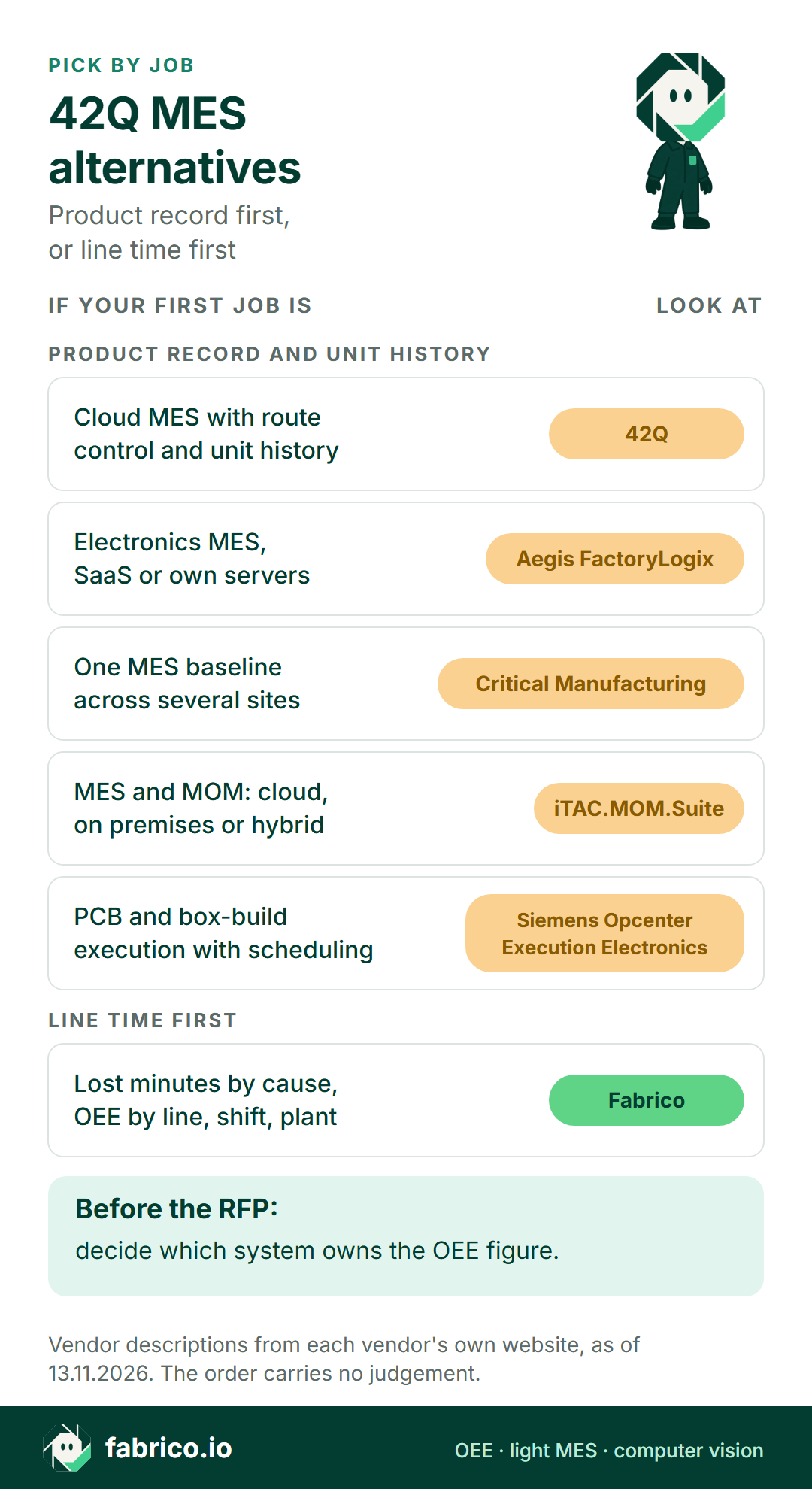
Text version of this infographic
- Pick by job: 42Q MES alternatives. Product record first, or line time first.
- Product record and unit history. Cloud MES with route control and unit history: 42Q.
- Electronics MES, SaaS or own servers: Aegis FactoryLogix.
- One MES baseline across sites: Critical Manufacturing.
- MES and MOM, cloud, on premises or hybrid: iTAC.MOM.Suite.
- PCB and box-build execution with scheduling: Siemens Opcenter Execution Electronics.
- Line time first. Lost minutes by cause and OEE by line, shift and plant: Fabrico.
- Before the RFP: decide which system owns the OEE figure.
- Vendor descriptions from each vendor's own website, as of 13.11.2026. The order carries no judgement.
Questions for 42Q and each alternative
Send every vendor, Fabrico included, the same questions.
- How does each station report? Controller, sensor device, camera or operator entry, the manual box-build included.
- Where do short stops and slow running go? Ask for the counting rule in writing.
- Which system owns the unit history, and which owns the OEE figure of record?
- How do two plants compare? Same reason list, same ideal cycle rules, same OEE formula.
What people ask next
Who makes 42Q MES?
Sanmina's page calls 42Q a business unit of Sanmina Corporation. Its product site, 42-q.com, described 42Q on 13.11.2026 as a full featured, cloud-based MES for medical systems, automotive, industrial and electronics manufacturing.
What does 42Q cover?
Per its product pages: shop order management and route control, a unit history record of components, changes, repairs and upgrades, serialized item tracking, SPC, OEE and asset performance modules, a multi-plant view through Connected Manufacturing, analytics dashboards and the Arthur AI assistant.
Does 42Q show OEE?
Yes, per its Smart Manufacturing page, which lists an OEE module and an Asset Performance module for OEE and TEEP. Global Ops Live adds real-time KPI aggregation and multi-plant visualization. Ask 42Q which of these a first site would use, and how it records line downtime.
How is Fabrico different from 42Q?
42Q, per its pages, centres on the product record: orders, routes and unit history, with OEE among its modules. Fabrico is a light MES built around line time: stops and counts from the machine signal, reasons from the operator, and OEE by line and shift in each plant. Routings and genealogy stay in your MES or ERP.
Can Fabrico run next to 42Q?
Yes. Split the records first: 42Q keeps shop orders, routes and unit history, and Fabrico keeps line stops, reasons and shift minutes and passes its results on through the REST API and webhooks. Decide before go-live which of the two publishes the OEE figure.
Book a demo to see two SMT lines from different plants compared by lost minutes, short stops and slow running.
Related articles

Latest from our blog



Real Fabrico tiles, sample data.