


 Login
 Blog
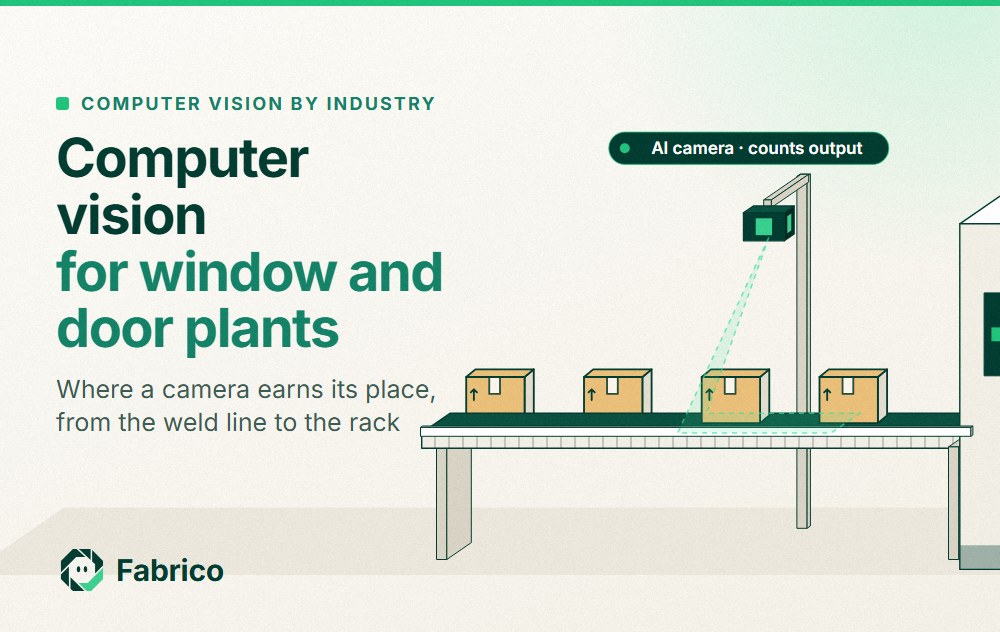
Computer Vision for Window Manufacturing: PVC, Aluminium and Doors

In short: computer vision in window manufacturing earns its place at the manual benches: cameras count frames, sashes, finished windows and doors where people fit hardware, glaze and assemble, and at the racks, while saws, welders and corner cleaners already give a machine signal.
- Weld seam checks, glass defects and missing hardware are inspection. That is a different job, done by inspection systems or people.
- Window plant losses hide in waits for glass units and sashes, hardware shortages, profile system and colour changes, remakes and full racks at dispatch.
- Read the saw, welder, corner cleaner and door press signals. Put cameras at hardware, glazing and door assembly benches and at wrap and rack, unless operators already scan there.
- Fabrico's camera add-on counts output and lets you open the video for any moment on the shift timeline. The operator adds the stop reason.
Your CNC saws and machining centres log each cut. Your four-head welder and corner cleaner know when they cycle. Your door press counts its presses.
Then the frames reach the hardware and glazing benches, and in many plants the numbers stop. Unless someone scans the label there, nobody counts what leaves them until the end of the day.
This page is for plant managers and CI leads in PVC-U, aluminium, timber and composite door plants choosing cameras to count output and get OEE: where a camera earns its place, where your signal is enough, and what to ask. We sell Fabrico, so hold this page to the same proof you would ask of any vendor.
Computer vision for window manufacturing: three different jobs
A window plant can be offered three different camera systems: one checks the product, one guides a robot, one counts output. Keep them apart in the spec.
- Inspection vision checks the product: weld seams, glass, labels, dimensions.
- Machine guidance vision steers a robot or a machine, for example a robot that finds and cleans the weld seam on a frame corner.
- OEE cameras count output at stations with no counter, and show you what happened at a stop.
| Job in a window plant | Inspection or guidance | OEE camera |
|---|---|---|
| Weld seam and corner finish | Inspection, or a person | No |
| Glass scratches, IGU seal, spacer | Inspection system | No |
| Missing hardware, labels | Inspection, or the final check | No |
| Guide a robot on a weld seam | Guidance vision | No |
| Count windows off a bench | Rarely | Yes |
| Video of a stop at a bench | Not its job | Open the video for that minute |
| Feeds OEE through | Its reject count | The output count |
They work side by side. A reject count from inspection or the final check can feed the quality part of OEE, so a remake counts once.
Where the losses hide in a window and door plant
This is a big, labour-heavy trade. In Europe, window profiles were the largest stream in the Recovinyl network of the VinylPlus programme in 2025, according to the Recovinyl 2025 PVC recycling figures: 416,889 of the 765,972 tonnes of PVC waste it recycled. Recovinyl does not say how much of that is fabricators' offcuts and how much is old windows, so read it as a sign of scale, not a count of windows.
Much of the work is still done by hand, and output per hour has been hard to move. The Bureau of Labor Statistics labour productivity index for US wood window and door manufacturing (2012 = 100) stood at 97.0 in 1987 and 100.7 in 2020, the last year in that series: almost flat over 33 years. It covers wood and clad products only, not PVC-U or aluminium.
Cutting and machining
Profiles are cut on double mitre saws or profile machining centres, in optimised batches. The same centres mill drainage slots and hardware holes, and steel reinforcement goes into PVC-U profiles here.
These controllers log pieces and programs. Losses are bar changes, waits for a profile colour and short jams. Read the signal. If you also extrude your own profiles, which most fabricators buy from a system house, see OEE for pipe and profile extrusion.
Welding and corner cleaning
PVC-U frames and sashes are welded on four-head or multi-head welders, then go to a CNC corner cleaner, often linked as one weld and clean line. Aluminium frames are corner crimped or cleated instead, after end milling and copy routing, with more hand work at cleating and gluing.
The welder knows when it cycles. Its losses are heating plate warm-up, changes between profile systems and foil colours, and the cleaner falling behind the welder.
Hardware fitting
Gearing, keeps, hinges and handles go on at benches, by hand. A tilt and turn sash takes far longer to fit out than a top-hung casement, and a fixed light skips hardware fitting altogether, so the time per unit swings with the order mix.
With no machine signal here, a camera earns its place counting frames and sashes off the bench. For the general case, read computer vision for OEE on manual assembly.
Glazing and final assembly
Sashes are hung, glass units are set on packers, beads are cut and knocked in, and the window gets a final check. Most of it is bench work, with no counter.
A camera where windows leave the glazing bench counts them. If you make your own sealed units, the IGU line has its own machine data; see computer vision for glass manufacturing.
Waiting for glass, sashes and hardware
A bench with a frame but no glass unit stops. So does a glazer waiting for the sash from the weld line, or a fitter missing one handle colour.
Too much work in progress causes its own loss. A Lean Enterprise Institute case study of a US vinyl window maker (September 2026) found "more than 40 pieces of WIP" across welders, corner cleaners and hardware stations, and staff spending "more than 50% of their process time" looking for the next part. That was the first time study, before the line was redesigned.
Give "waiting for glass", "waiting for sash" and "hardware shortage" their own stop codes. The team leader adds the reason at the bench. A camera does not know why the glass did not come.
Made to order: no two windows alike
Most windows are made to measure, so the batch size is often one. A count of windows means little if a small bathroom window and a three-panel patio door count the same.
Set the ideal time by product type: fixed light, casement, tilt and turn, sliding door, front door. Then performance stays honest when the mix moves. Some plants already weigh output in frame units or points per window type; if yours does, use that as the count. See changeover time for system and colour changes on the welder and saw.
Door lines
Composite door slabs are built from GRP skins around a timber or composite subframe with a foam core, bonded in a press, then machined for locks, hinges and glazing. The press and the machining centre have signals. If you buy slabs in, the door line starts at machining.
Fitting the lock, the glazing cassette, the letter plate and the frame is bench work, and a camera can count doors leaving it. Timber door leaf machining is close to solid wood and panel furniture work; see computer vision for furniture manufacturing.
Remakes
A window with a scratched unit, a wrong size or the wrong hardware goes back as a remake. If you count good units only at the rack, a remade window looks like a good one made once.
In OEE, a good unit is one made right the first time. Book remakes at the final check, and count them as their own number. See rework and the good count in OEE.
Wrap, rack and dispatch
Finished windows get corner protectors and film, then go onto A-frames or stillages in delivery route order. When no empty rack is there, the end of the line stops.
A camera at wrap and rack counts what was racked, unless dispatch already scans each window onto its rack.
Where a camera goes, from weld line to rack
For a longer list by machine type, see camera or sensor for OEE, machine by machine.
From saw to A-frame: camera, signal or scan
On most window lines the saw and machining centre already report; the benches do not.
| Station | Count and stops from | What a camera adds |
|---|---|---|
| Saw, machining centre | Machine controller | Little. Use the signal. |
| Welder, corner cleaner | Machine controller | Little. Use the signal. |
| Aluminium crimping | A cycle sensor, often fitted for OEE | Little, once the sensor is on. |
| Hardware benches | A label scan, if staff scan there; often nothing | Count of frames and sashes |
| Glazing, final check | Often nothing, or a paper sheet | Count of finished windows |
| Door slab press | Press PLC | Little. Use the signal. |
| Door assembly bench | A label scan, if staff scan there; often nothing | Count of finished doors |
| Wrap and rack | A dispatch scan, if there is one | Racked count if nobody scans |
| Stop reasons, all stations | The operator, on a tablet or phone | Video to check a disputed reason |
Bring your station list and a week of order mix to a demo.
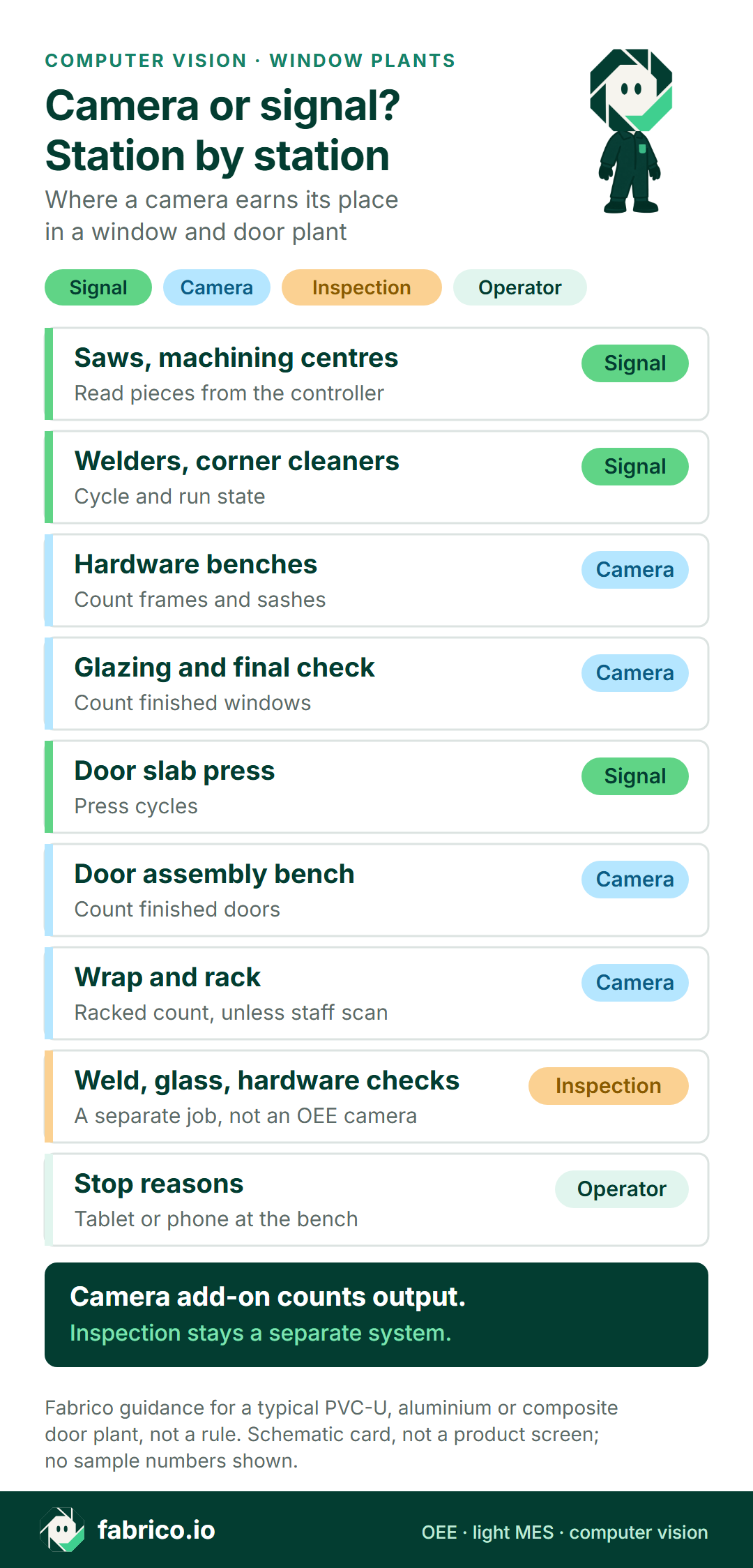
Text version of this infographic
- Saws, machining centres: signal, read pieces from the controller.
- Welders, corner cleaners: signal, cycle and run state.
- Hardware benches: camera, count frames and sashes.
- Glazing and final check: camera, count finished windows.
- Door slab press: signal, press cycles.
- Door assembly bench: camera, count finished doors.
- Wrap and rack: camera, racked count, unless staff scan.
- Weld, glass, hardware checks: inspection, a separate job, not an OEE camera.
- Stop reasons: operator, tablet or phone at the bench.
- Camera add-on counts output. Inspection stays a separate system.
Worked example: one shift on a hardware and glazing line
Example numbers, from no real plant. A hardware and glazing line builds casement windows, with an ideal time of 4 minutes a window, and runs one 480-minute shift.
The line has no counter. A camera add-on where windows leave the glazing bench for the final check counts them, and the team leader adds the stop reasons on a tablet. The final check books remakes.
The line stopped for 80 minutes: waiting for glass units 30, waiting for sashes from the weld line 20, a hardware shortage 15 and no empty rack 15. Run time is 400 of 480 minutes, so availability is 83.3%.
At 4 minutes a window, 400 minutes could make 100 windows. The camera counted 88, so performance is 88.0%. The gap is 48 minutes of slow running and waits too short to log, such as a fitter hunting for the right keeps.
The final check sent 4 of the 88 back for remake: two scratched units and two with the wrong handle. That leaves 84 good, so quality is 95.5%.
OEE is 83.3% x 88.0% x 95.5% = 70.0%. As a check, 84 good windows at 4 minutes is 336 of 480 minutes, also 70.0%.
Most of the stop time was waiting for glass and sashes, so the fix is in how glass units are called off and sequenced to the bench, not at the bench itself. The 48 minutes of small losses show up only because the bench now has a count. For short waits and slow running, see reduced speed loss vs minor stops.
Eight checks for any window plant camera or OEE vendor
Put the same eight to every supplier on one real week of orders, Fabrico included.
| Ask | How to test the answer |
|---|---|
| What exactly does the camera count? | Frames, sashes, windows or doors? Run it next to a hand count for one shift. |
| How does it handle mixed sizes? | Ask for an ideal time per product type, and how a patio door and a small window are told apart. |
| Can it use the scans you already have? | Ask how barcode scans at a station become a count, so a camera only goes where nobody scans. |
| Can it read the welder and saw? | Ask which signal it reads from the welder, corner cleaner and saw controllers, and how. |
| How do waits get a reason? | Ask how a team leader books "waiting for glass" or "waiting for sash" at the bench. |
| How are remakes counted? | Ask how a remade window is kept out of the first-time good count. |
| Where does each camera mount? | Ask for each position on a drawing, clear of overhead profile stores, A-frames and forklifts. |
| Is video kept, and who can open it? | Ask where it lives, for how long, and who sees it. |
Most window plants start with the bench that sets the day's output, often hardware or glazing. Our notes on how many cameras a line needs for OEE and on running a computer vision OEE pilot cover the rest.
Cameras, privacy and the works council
Fitters at a hardware or glazing bench will be in the picture. Brief the bench crews before a camera is mounted, and where your plant has a works council, take the bench plan there first.
Frame the camera on the window leaving the bench or the rack, not on the fitter. Ask each vendor what privacy masking runs today on a glazing or hardware bench, and what is still planned.
The add-on counts finished frames and doors; it has no use for who fitted them. For a fuller checklist, read production line cameras without surveillance.
Where Fabrico fits
Fabrico runs OEE and light MES in the cloud. In a window and door plant that means one shift picture from the saw hall to the A-frames.
- Saw hall and weld line: run state and piece counts come straight from the saw, welder, corner cleaner and door press, or from a sensor where a machine has no data port.
- Why a bench stood: the fitter or the cell lead picks the reason on a tablet or phone, for example glass not called off or hardware kit short.
- Shift results: OEE per weld line, hardware cell and glazing bench, with lost frames turned into money, on the web, iOS and Android.
- Camera add-on, on request: AI cameras count frames, sashes and doors as they leave the hardware, glazing and door benches or reach the rack. Click a moment on the timeline and the add-on streams that bench; the standard setup keeps no video in Fabrico.
- Data out: counts, stops and reasons can go to the ERP that holds the order book through the REST API, webhooks or a CSV export.
Roadmap, not live today: stops detected by the camera add-on, idle benches flagged on the video, and the add-on suggesting a stop reason.
What Fabrico does not do: inspection of welds, glass and hardware, which stays with your inspection systems and final check and feeds Fabrico's quality figure through a reject signal or count. Cutting optimisation and order sequencing stay in your window software; Fabrico reads the order mix so the ideal rate follows the product.
For the full product, see Fabrico computer vision for OEE. For how camera add-on counts turn into OEE, see OEE with computer vision. If you are still comparing platforms, read our guide to OEE software. Hold us to the same eight checks on your own hardware and glazing benches.
What people ask next
Which station in a window plant should get the first camera?
Usually the hardware benches or the glazing and final check bench, where finished frames and sashes leave by hand and nothing counts them. If operators already scan a barcode label at that station, the scan is your count, so put the camera where nobody scans.
Do welders and corner cleaners need a camera?
Rarely. Four-head welders, weld and clean lines and CNC corner cleaners have controllers that know when they cycle, so read that signal first, unless the machine is old and its data cannot be reached.
Can a camera check weld seams, glass and hardware?
Yes, but that is an inspection camera, not an OEE camera. Weld seam checks, glass defects and missing hardware are quality jobs done by inspection systems or by people. Fabrico does not sell inspection. The reject count from that check can feed the quality part of OEE.
How do you measure OEE when no two windows are the same size?
Count units, and set the ideal time by product type, for example a casement window, a tilt and turn window, a sliding door and a front door. Ask each vendor how a mixed order changes the ideal rate, and test it on one week of real orders.
Want to see it on a PVC or aluminium window line? Book a demo, with one shift from a hardware or glazing line to work through.
Related articles
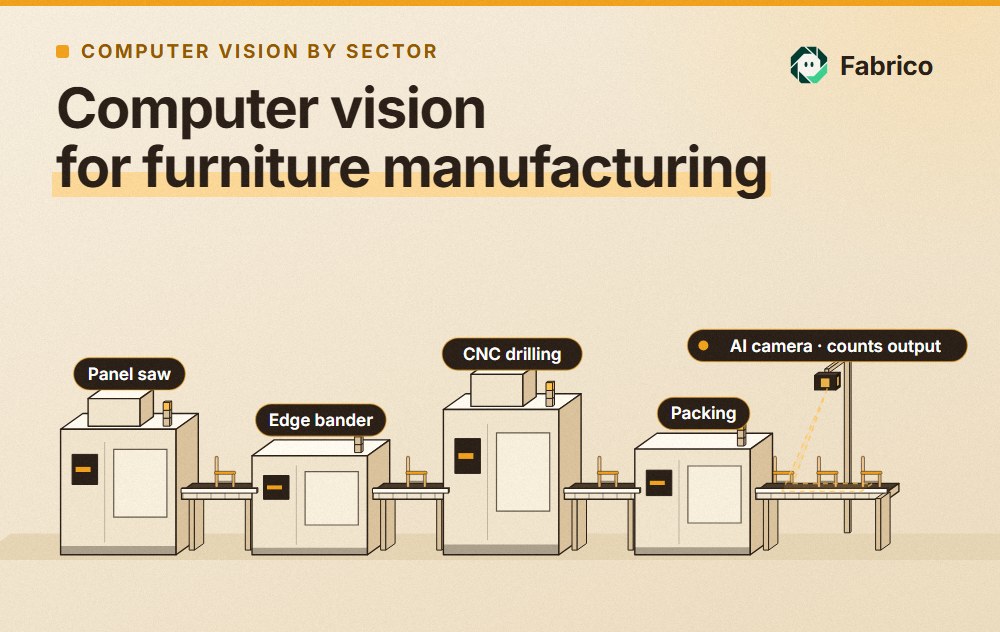
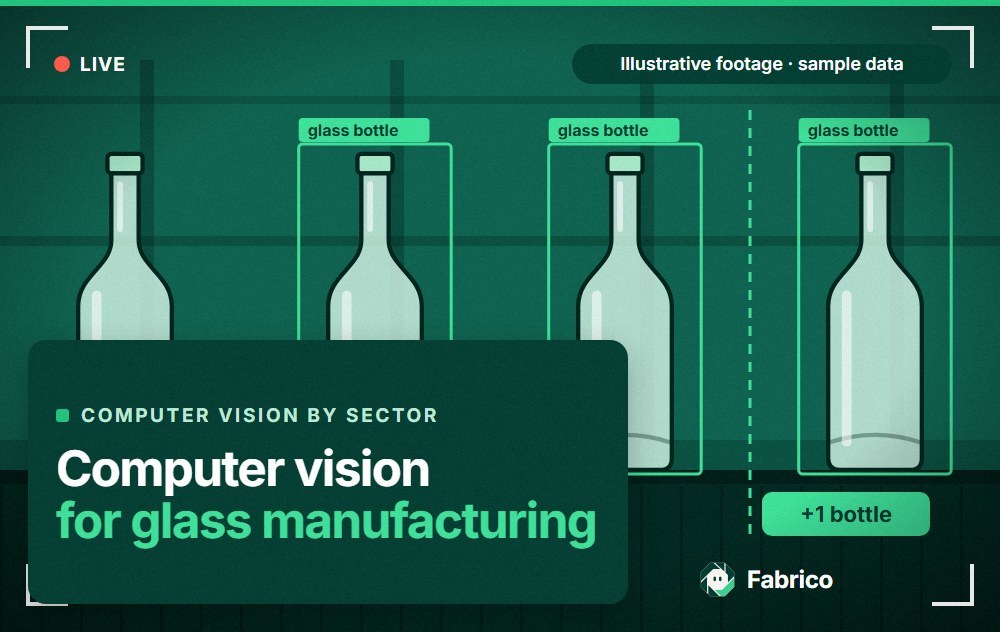










Real Fabrico tiles, sample data.