Login
 Blog
OEE for Pipe and Profile Extrusion: Die Changes and Start-Up Scrap

Key takeaways
- Pipe and profile lines are continuous. When the haul-off, saw or belling unit stops, the extruder often keeps running and the loss shows up as scrap, not as downtime.
- Measure Performance in metres at the target metre weight, so a product running heavy does not hide inside kilograms per hour.
- Die changes take the line down for a long time and end in scrap. Time them from the last good pipe to the first pipe in tolerance.
- Start-up and dimension scrap belong in Quality, counted in metres and kilograms.
- Track metre weight above target as material given away, next to OEE.
The saw on the PVC pipe line jams in the middle of the afternoon shift. The extruder keeps running, because stopping it means a long restart, so the operator cuts the pipe by hand and sends the uncut length to the grinder. The PLC shows the extruder running all shift. The OEE report shows no stop at all, and the loss sits in the regrind bin.
This guide is for plant managers, process engineers and CI leads on pipe and profile lines in PVC, PE and PP. It covers which rate to use for Performance, how to book die changes and starts, why downstream stops turn into scrap, how to count dimension losses, and what each data source can see.
The extrusion line, station by station
- Dosing and extruder. PVC usually runs from dry blend on twin-screw extruders, PE and PP on single-screw extruders. Gravimetric dosing reports kilograms per hour.
- Die head. Forms the pipe or the profile. Changing the product size often means changing die tooling, which takes heating time.
- Calibration and cooling. Vacuum calibration sleeves and tanks set the pipe diameter; profiles run through dry and wet calibrators on a calibration table. Spray or bath tanks finish the cooling.
- Haul-off. Caterpillar or belt pullers set the line speed in metres per minute.
- Marking and measuring. Inkjet or hot foil printing; inline gauges for diameter and wall thickness on many pipe lines.
- Saw or cutter. Planetary saws, chipless cutters for PE or flying saws for profiles cut to length.
- Belling, coiling and stacking. Socketing units for PVC pipe, coilers for small PE pipe, tipping tables and packing.
Because the process is continuous, the extruder is rarely the station that stops first. Most of the losses start further down the line.

Choosing the rate: kilograms per hour or metres per minute
The two rates are linked by metre weight: kilograms per hour = metres per minute x 60 x kilograms per metre. That link is where OEE can mislead.
If you measure Performance in kilograms per hour, a pipe running heavier than target looks like full speed. The extruder is busy, but the line makes fewer metres, and metres are what you sell. Measure Performance in metres instead:
- Ideal speed = rated kilograms per hour for that product / (60 x target kilograms per metre).
- Performance = metres produced / (ideal speed x run time).
- Track actual metre weight against target as a separate number: material given away, in kilograms and money.
Set the rated output per product from the best proven rate with the product in tolerance, not from a good day's average. Thick wall pipes are often limited by cooling length, not by the extruder, so the limit can differ for each size. Our guide to giveaway and overfill shows how to price material above target.
Availability: die changes, starts and breakdowns
| Event | OEE factor | Typical causes | What to record |
|---|---|---|---|
| Die change | Availability, then Quality for start-up scrap | Size or product change, die cleaning | Last good pipe to first pipe in tolerance, scrap metres |
| Extruder stop | Availability | Screw or heater faults, melt pressure, material supply | Stop length, restart time |
| Haul-off fault | Availability or Quality | Belt slip, pad wear, drive faults | Whether the extruder stopped or ran to scrap |
| Saw or cutter fault | Usually Quality | Blade wear, clamp faults, length encoder errors | Scrap metres while the saw was down |
| Vacuum or cooling fault | Availability or Quality | Pump failure, water temperature, blocked spray nozzles | Dimension scrap, stop length |
| Belling or stacker stop | Quality or Performance | Socket heater faults, tipping table jams | Pipes scrapped or slowed line speed |
A die change is planned work, but its length is still a loss. Book it in Availability with a standard time per size pair, and code the overrun. The start-up scrap after it is a Quality loss that belongs to the same event, so report the two together. Our guide to measuring changeover time covers the standard.
When downstream stops turn into scrap
On a discrete line, a stopped machine is downtime. On a pipe line, the crew often keeps the extruder running when the saw, the belling unit or the stacker stops, because a restart costs more. The line keeps making pipe, and the pipe goes to the grinder.
In OEE terms, that time is run time with zero good output. It lands in Quality, not Availability, and the PLC at the extruder never shows it as a stop. If you only read the extruder signal, the saw looks like the most reliable machine on the line.
Give these events a reason of their own, such as ran to scrap, saw fault, and log the scrap metres with them. Then the downstream station gets the blame it earned, and the Pareto shows what the saw really costs.
Quality: start-up and dimension scrap
- Start-up scrap. Pipe made after a start or a die change until diameter, wall thickness and surface are in tolerance.
- Dimension rejects. Wall thickness below minimum, diameter or ovality out of tolerance, wall sag on thick wall pipes, profile dimensions off.
- Surface and marking. Lines, voids, burn marks, missing or wrong print.
- Cut and socket faults. Wrong length, bad cut faces, poor sockets.
Count Quality in metres for OEE and weigh the scrap in kilograms. Much of it is reground and fed back, so price it at the value it loses, not at full material cost. More in our guide to the OEE Quality factor, and for restarts, how to cut start-up losses.
Data sources: what each one sees
| Source | What it gives you | What it misses |
|---|---|---|
| Extruder and dosing PLC | Kilograms per hour, melt pressure, run state | Downstream stops that end in scrap |
| Haul-off encoder | Line speed and metres produced | Whether those metres were good |
| Wall and diameter gauges | Dimensions and metre weight | Surface faults, cut faults |
| Saw counter | Pieces cut and length | Pipe cut by hand during a fault |
| Scrap and regrind scales | Kilograms scrapped by shift | Which event made the scrap |
| Operator input | Reason, product, die set | Short faults nobody records |
| Camera at a station | A clip of the saw, belling unit or stacker at the moment of a fault | What happens inside the die or the extruder |
The PLC is the clock. Where a camera watches the saw or the stacker, the clip shows the jam or the crew cutting by hand, which the extruder signal cannot. A model can suggest the reason, and the operator confirms it in one tap.
A worked day on a PVC pipe line
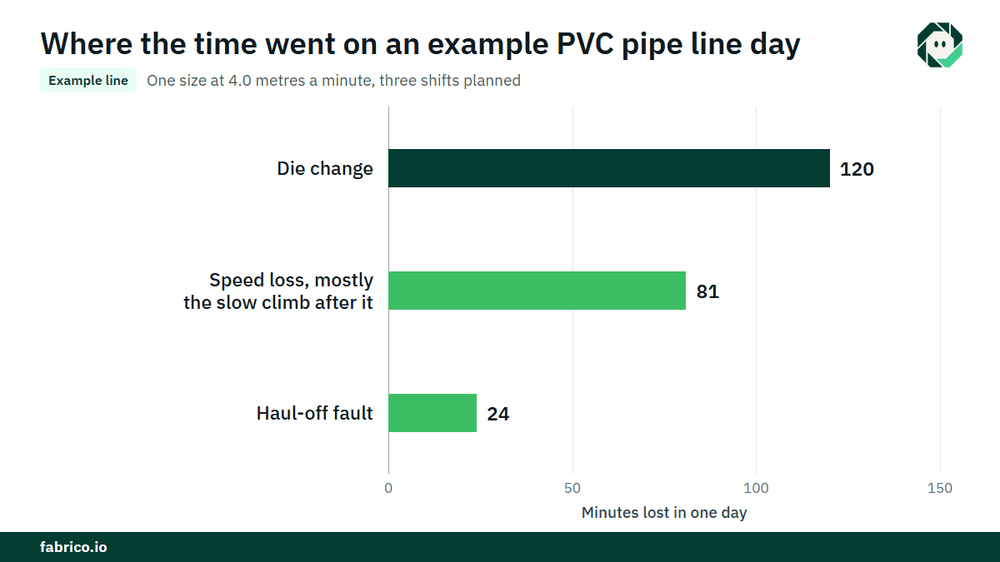
Sample line (illustrative numbers, not a customer): a PVC pipe line runs one size with a target metre weight of 2.0 kg per metre. Rated output for this product is 480 kg per hour, so the ideal speed is 480 / (60 x 2.0) = 4.0 metres a minute. The line is planned for three shifts, 1,440 minutes.
- Stops: one die change of 120 minutes and one haul-off fault of 24 minutes. Total 144 minutes, so run time is 1,296 minutes.
- Availability = 1,296 / 1,440 = 90.0%.
- Ideal metres = 1,296 x 4.0 = 5,184 m. The haul-off logged 4,860 m. Performance = 4,860 / 5,184 = 93.75%. The missing 324 m are 81 minutes at ideal speed, mostly the slow climb after the die change.
- Scrap: 180 m of start-up scrap, 45 m of wall thickness rejects, 18 m of length rejects. Total 243 m, so good pipe is 4,617 m. Quality = 4,617 / 4,860 = 95.0%.
- OEE = 0.90 x 0.9375 x 0.95 = 80.2%. Check: 4,617 / 4.0 = 1,154.25 minutes, and 1,154.25 / 1,440 = 80.2%.
Price the die change at a contribution of $1.00 a metre (€1.00 in a euro plant). The 120 minutes are 480 m not made: $480. The 180 m of start-up scrap weigh 360 kg and lose $0.80 a kg when reground: $288. One die change costs $768, or €768. At 100 die changes a year, that is $76,800, or €76,800, if the line is sold out.
Now the metre weight. If the same 4,860 m had run at 2.1 kg per metre, the line would have used 486 kg more material. At $1.20 a kg, that is $583.20 given away in one day, in pipes that still pass.
Where Fabrico fits
Fabrico is a computer vision enabled Manufacturing Performance Platform. On an extrusion line it starts with OEE and light MES: automatic downtime logging from the machine signals and OEE live by line and shift.
- Losses priced in money and ranked by money, so a die change, a saw fault that ran to scrap and a slow start are compared in one currency.
- The operator confirms the reason in one tap, including ran to scrap.
- A camera clip as evidence for a stop where a camera watches the saw, the belling unit or the stacker.
- A work order to the right technician, with its cost, when a stop is a breakdown.
- One view across plants for groups with extrusion lines in several sites.
You can start on one line, with a baseline and a decision date agreed in advance. Each plant gets a quote after a review of its lines.
Frequently asked questions
Should pipe extrusion OEE use kg per hour or metres per minute?
Use metres at the target metre weight for Performance, and track metre weight separately. Kilograms per hour hide a product that runs heavy, because the extruder looks busy while the line makes fewer metres.
How do you count a die change in OEE?
The time the line is down is Availability loss, with a standard time per size change. The scrap made after the restart, until the first pipe in tolerance, is Quality loss tied to the same event.
What if the extruder keeps running while the saw is down?
Then the time is run time with no good output, and it lands in Quality. Log it as ran to scrap with the downstream cause, so the saw gets the loss it caused.
Is regrind a quality loss?
Yes, scrapped pipe is a Quality loss even when it is reground. Price it at the value it loses, not at full material cost.
What is a good OEE for pipe extrusion?
There is no standard benchmark for pipe or profile lines. Compare each line with its own baseline, using the same rated outputs per product, and watch the trend by size. For a wider view, read OEE for plastics manufacturing.
See your extrusion line's losses in a demo
Bring one line and its shift reports. We will show where the metres go and what each loss costs.
Latest from our blog