


 Login
 Blog
Datanomix Alternatives: CNC Monitoring, OEE and Light MES Options

In short: the right Datanomix alternative depends on what your shop needs the machine data for. For CNC production monitoring with job benchmarks, compare Datanomix with other CNC monitoring tools such as MachineMetrics, MERLIN by Memex, Amper and Scytec DataXchange. If you want stop reasons from operators and OEE with losses in money across CNC cells and other machines, a light MES with OEE, such as Fabrico, fits.
- Datanomix calls its approach Data-Powered Production: CNC monitoring with no operator input, job scores, ERP insights and coaching.
- The biggest split between alternatives is where a stop's cause comes from: the machine program and signals, or the operator.
- Older machines are covered by every tool here, through adapters, current sensors or IoT devices.
- Vendor facts come from each vendor's own site, as of 12.11.2026, linked in place. No prices, no verdicts, no ranking.
A job shop runs 24 CNC machines over two shifts, plus two older machines with no network port, a saw and a deburring bench. The owner asks which jobs make money. The production manager asks why the second shift cuts less than the first.
Below: what Datanomix is, per its own pages, when it fits, and five alternatives grouped by job. Fabrico wrote this page and is one of the five. We sell Fabrico, so it is not ranked. For what to track on a CNC floor before you pick a tool, see our guide to CNC machine monitoring.
What Datanomix is (as of 12.11.2026, per its own site)
Datanomix Inc. is based in Nashua, New Hampshire. Its homepage says it sells outcomes, not dashboards, for any shop from a high-mix job shop to a high-volume OEM, and adds that buyers can call it machine monitoring, MES or production intelligence. What its pages say, as of 12.11.2026:
- Production monitoring. Automated part number and job tracking, true cycle time and part counts with cutting and touch time benchmarks, automated setup and changeover detection, and downtime insights with OEE.
- No Operator Input. A trademarked principle: data comes from the machine, not from the operator. Its production monitoring page says that by running a few parts, Datanomix creates a performance benchmark for each job and a production score shown on shop floor TVs.
- Where it shows. Web, a mobile app with notifications, and a TV app, with unlimited users. A Machine HUD lets operators see what runs next, leave notes and request help.
- ERP and money. Auto-sync of work orders, quantities and due dates with the ERP, on-time delivery predictions, and part-level profitability analysis.
- Programs and tooling. G-Code Cloud with integrated DNC, described as Gov-Cloud-native and ITAR-compliant, plus TMAC ai for automated tool monitoring limits.
- Connection. It lists all major makes and models of CNC machines and fabrication equipment, and connects via Ethernet, Wi-Fi or serial port. For older machines, its FAQ mentions an amp clamp for uptime and downtime.
- How you start. Its pilot program page says every customer starts with a pilot program, guided by a dedicated coach and playbooks.
Output and return figures on its pages are vendor-reported, so we don't repeat them.
Ask in the demo: how a job's benchmark is set on its first run, and how stops on the saw or deburring bench are reported.
When Datanomix is the right pick
Put Datanomix on your shortlist if most of these are true:
- Most of the floor is CNC, and the controls can share program and cycle data.
- You want job-level standards without engineers setting cycle times by hand.
- Operators should not log data, and the shop accepts causes worked out from the machine.
- Program files, tooling and coaching belong with the monitoring, including for defense work under CMMC 2.0.
If you also run presses, welders, assembly or packing, or want operators to name the causes, read on.
Machine-inferred causes or operator reasons
Every tool on this page knows when a machine stopped. They differ on who says why. Datanomix's FAQ says there is no reason for reason codes: its adaptive algorithm and G-code analytics set a standard and work out the cause and expected length of stoppages. Other tools ask the operator to tag the reason from a list, on a tablet or touchscreen at the machine.
Both routes have a cost. Inferred causes ask nothing of operators, but some causes, such as waiting for material or a missing gauge, live outside the program. Operator reasons capture those if tagging is quick and someone reads the list; see operator downtime reason entry for what makes that work.
Comparison table: Datanomix and five alternatives
What each vendor's own site says, in our words, as of 12.11.2026, linked in the sections below. Not a ranking. Fabrico comes first because we wrote this page.
| Tool | Built around, per its site | Older machines | Ask in the demo |
|---|---|---|---|
| Datanomix (for reference) | CNC job benchmarks, no operator input | Amp clamp | How is a first-run job scored? |
| Fabrico | Machine signal plus operator stop reasons | IoT device with external sensors | How do non-CNC machines report? |
| MachineMetrics | Discrete MES on live machine data | Connects every machine generation | Which modules come first? |
| MERLIN by Memex | Measuring manufacturing time | Hardware adapters, MTConnect | Which modules sit on Tempus? |
| Amper | Production monitoring for job shops | Universal IoT sensors | How do sensors give part counts? |
| Scytec DataXchange | Cloud or on-premise monitoring and OEE | Status Relay Controller | Which signals feed the SRC? |
Want to see the OEE side on a floor like yours? Book a demo and bring one week's downtime log.
Fabrico: OEE and light MES across CNC and other machines
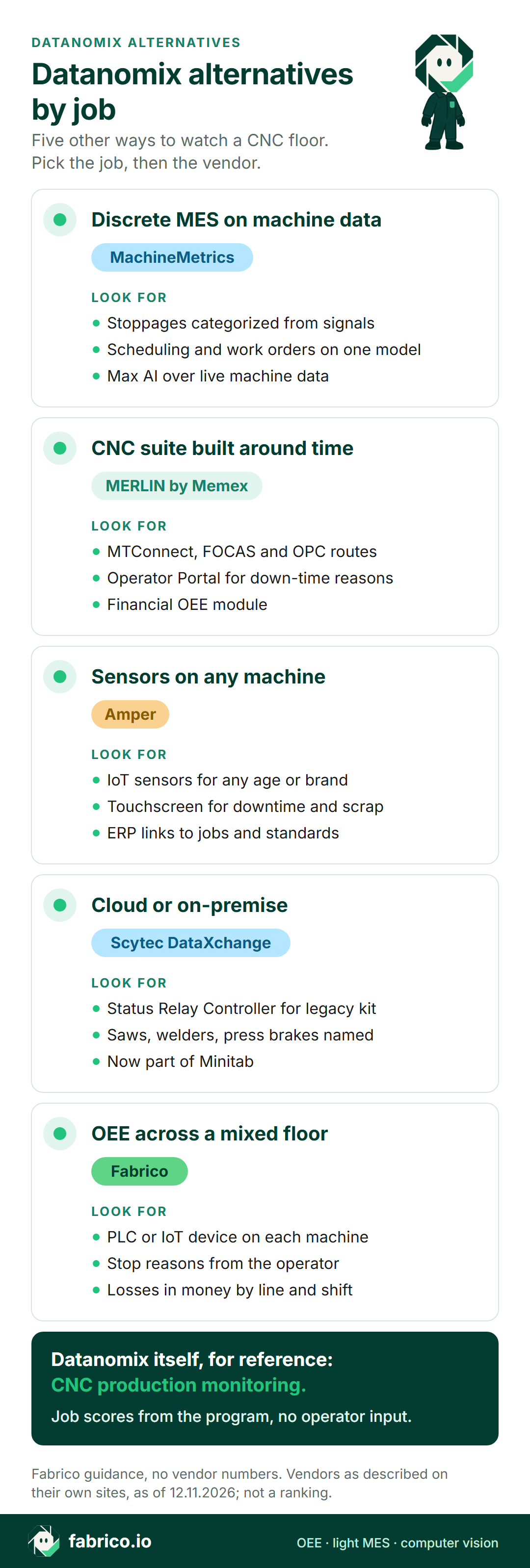
Fabrico wrote this page. It is a cloud OEE and light MES platform. Where Datanomix starts from the CNC program, Fabrico starts from machine time across the whole floor: when a machine stopped, for how long, why, and what it cost. Per our MES and OEE overview:
- Machine data, three ways. From the PLC or controller, from a Fabrico IoT device with external sensors on older machines, or from AI cameras, an add-on, where there is no usable signal. Protocols include OPC UA, Modbus, PROFINET, MQTT and EtherNet/IP (machine connectivity).
- Stops with reasons. Connected machines report their own stops with start time and length. Operators tag the cause on a tablet or phone from your own list of reason codes.
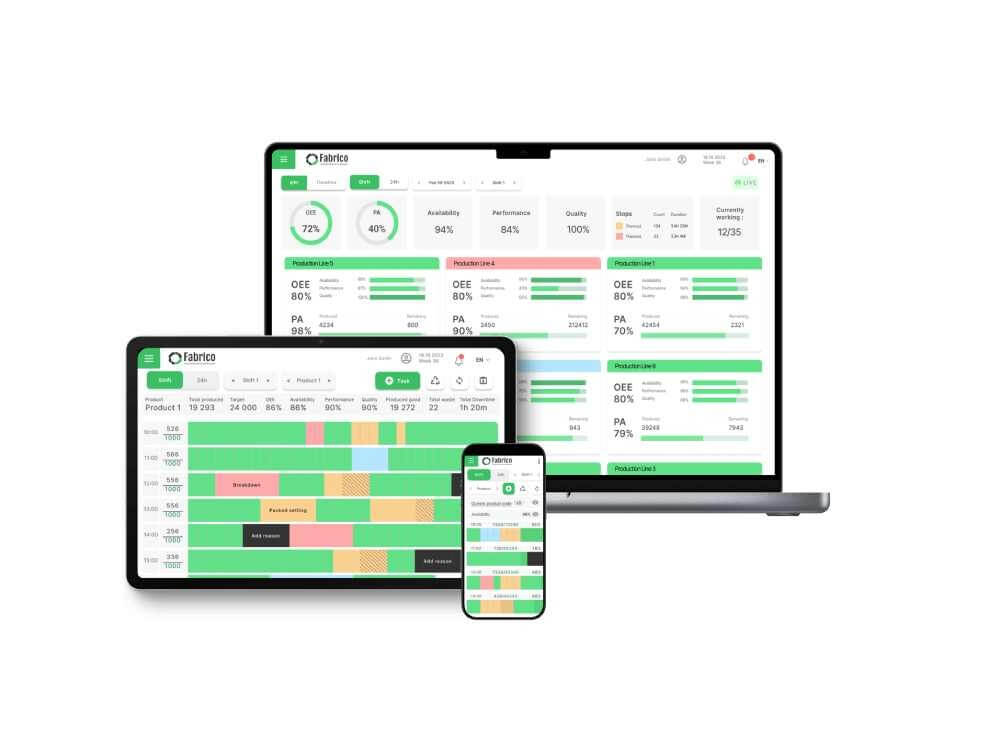
- OEE and losses in money. Availability, performance and quality by line and shift, live, with losses shown in money, on the web, iOS and Android.
- The camera add-on counts output at stations with no usable signal, such as a manual bench, and its video opens for any moment on the shift timeline. In the standard setup, video from the camera add-on is streamed on request, not stored in Fabrico (how the camera add-on works).
- Maintenance built in. When a stop needs a repair, a technician opens a work order from the stop, on the same machine record.
- Data out. REST API and webhooks, Excel or CSV export. A connection to SAP or another ERP can be scoped per customer.
- Rollout. Devices connected in about a month; full rollout in 3 to 4 months.
- Stays in your ERP: job dispatching, BOMs and routings. Roadmap, not live: production planning and scheduling, and a camera add-on that detects stops and offers a likely reason.
Ask in the demo: which route each of your CNC controls would take, and how a saw or press with no controller reports.
Fits shops that want downtime ranked by cause and priced, with operators naming the causes, on a floor that mixes CNC machines, older machines, fabrication and manual work. EU customers are hosted on AWS in Frankfurt. See our OEE software guide and MES for metal fabrication.
MachineMetrics: a discrete MES on live machine data
MachineMetrics calls its MaximaOS platform an AI-powered manufacturing operations system, purpose-built for discrete manufacturing. Its homepage names job shops, aerospace and defense, automotive, contract manufacturers and medical device makers. As of 12.11.2026, it says:
- Downtime tracking captures stoppages of any length, categorizes them from machine signals and ranks them by what they cost.
- OEE comes from machine data against real schedules, traceable to the shift, job and event.
- Scheduling, work orders, labor, tooling and quality run on the same data model, and Max AI answers plain-language questions from live machine data.
- It connects every machine generation, with open APIs and native streaming, and is ISO 27001 certified.
Compared with Datanomix: both take causes from machine data and tie it to jobs and the ERP. MachineMetrics' pages describe a next-gen MES with scheduling and work orders; Datanomix's put job benchmarks, coaching and G-code management first. Our MachineMetrics alternatives page goes deeper.
Fits shops that want monitoring and execution, such as scheduling and work orders, on one machine data platform.
MERLIN by Memex: operator reasons and a profit view on CNC data
Memex, of Burlington, Ontario, develops MERLIN, which its site places under machine monitoring and manufacturing operations management. As of 12.11.2026, its pages say:
- MERLIN Tempus, the base module, reads machine states over MTConnect, Fanuc FOCAS and OPC, and Memex sells hardware adapters for older machines.
- An Operator Portal on a Windows touch screen asks the operator for the down-time reason and records rejects.
- A Financial OEE module puts an hourly profit rate on products and machines.
- Tempus can run apart from the corporate network.
Compared with Datanomix: both read CNC controls directly and add DNC. The split is the stop cause: MERLIN asks the operator through its portal, while Datanomix works it out from G-code.
Fits shops that want CNC monitoring where operators name the stop cause, plus a profit view by machine.
Amper: sensor-based monitoring for job shops
Amper's old address now leads to ECI Software Solutions' Amper page, which describes it as a production monitoring and intelligence platform for manufacturers, including job shops, OEMs and contract manufacturers. As of 12.11.2026:
- Universal IoT sensors work on virtually any machine, regardless of age or brand, and capture uptime, downtime and cycle counts.
- A touchscreen lets operators capture downtime, scrap and setups, with live job progress and shift targets.
- Pre-built ERP and MES integrations link jobs, parts and production standards to machine signals.
- Add-on modules include Smart Scheduling, Operator Interface, Issue Management and Maintenance Management.
Compared with Datanomix: both serve job shops and link machine data to ERP jobs. Amper's pages lead with sensors that work on any machine and a touchscreen for operators; Datanomix's lead with CNC program data and no operator input.
Fits shops that run many machine types and ages and want one sensor route for all of them.
Scytec DataXchange: cloud or on-premise monitoring
Scytec describes DataXchange as a cloud and on-premise OEE and machine monitoring system, built on 25 years of data collection and OEE software work. Its site reports that Minitab acquired Scytec. As of 12.11.2026:
- Real-time dashboards show utilization, downtime and OEE as data comes in, with apps for PCs, tablets and phones.
- The Status Relay Controller connects legacy and manual machines, and sensors such as current, vibration and fill level, without programming.
- It names fabrication equipment such as band saws, welders, press brakes, punches and laser cutters.
- Minitab's announcement places it next to Statistical Process Control (SPC) and digital twins.
Compared with Datanomix: both connect CNC and fabrication equipment. DataXchange's pages offer a choice of cloud or on-premise and a hardware route for legacy machines; Datanomix's lead with job benchmarks and coaching.
Fits shops that want monitoring on their own servers or in the cloud, with a link to statistical quality tools.
Which Datanomix alternative fits your shop
- CNC job benchmarks, G-code management and coaching, with no operator input: Datanomix.
- Monitoring plus scheduling and work orders on one machine data platform: MachineMetrics.
- Operator-entered stop reasons and a profit rate per machine on CNC data: MERLIN by Memex.
- One sensor route for machines of any age or brand: Amper.
- Monitoring in the cloud or on your own servers: Scytec DataXchange.
- Downtime by cause and OEE in money across CNC, fabrication and manual work: Fabrico.
A CNC monitoring tool and an OEE layer can run side by side if one system owns the OEE figure. See light MES vs full MES.
Worked example: one CNC machining center, one shift
Sample data for one 8 hour shift on a machining center, not a customer's machine or a product screen. Planned production time is 450 minutes after a 30 minute break. The job's ideal cycle is 6.0 minutes a part.
Stops took 72 minutes, so run time was 378 minutes and availability 84.0%. In 378 minutes the ideal is 63 parts. The machine made 57, so performance is 90.5%.
Two parts failed inspection, leaving 55 good: quality is 96.5%. OEE is 84.0% x 90.5% x 96.5% = 73.3%, the same as 55 good parts x 6.0 minutes over 450 minutes.
Now the 72 minutes. The setup overrun and the alarm show in the program and the controller. The waits for material and for a first-article sign-off look like an idle machine. Ask each vendor where those 28 minutes land in the shift report. See OEE calculation for the formula and micro-stops for the short stops a paper log misses.
Questions to ask any vendor on this list
Put the same questions to every vendor, us included, for one representative cell.
- How does each machine connect? Control protocol, adapter, current sensor or IoT device, including machines with no network port.
- Where do stop causes come from? The program, the signals, the operator, or a mix, and how unexplained idle time is shown.
- How is OEE calculated? Where the ideal cycle comes from, how setups count, and how scrap is entered.
- What about non-CNC machines? Saws, presses, welders, assembly and packing benches.
- Which records stay in the ERP, and which data flows back.
What people ask next
Who makes Datanomix, and what does it do?
Datanomix Inc., based in Nashua, New Hampshire, per its site. It sells production monitoring for CNC machines and fabrication equipment: part and job tracking from the machine, cycle times, setup detection, downtime and OEE, plus ERP insights, G-code file management, tooling analytics and coaching.
Does Datanomix use reason codes for downtime?
Its production monitoring FAQ says there is no reason for reason codes. It describes an adaptive algorithm and G-code analytics that set a standard for each job and work out the cause and expected length of stoppages, with no operator input. Ask any alternative how it names a stop the program cannot explain.
Is MachineMetrics a Datanomix alternative?
Both connect to CNC machines and report downtime and OEE. MachineMetrics describes its MaximaOS platform as purpose-built for discrete manufacturing, with scheduling, work orders, labor, tooling and quality on the same machine data model. Our MachineMetrics alternatives page covers it in more depth.
What Datanomix alternatives work on older CNC machines?
Datanomix's own FAQ mentions an amp clamp for older machines. Memex sells MTConnect hardware adapters, Amper uses universal IoT sensors, Scytec offers a Status Relay Controller, and Fabrico fits an IoT device with external sensors where a machine has no usable controller.
How is Fabrico different from Datanomix?
Datanomix builds CNC job standards from the machine program and works without operator input, per its site. Fabrico takes stops and counts from the machine signal and asks the operator for the reason on a tablet or phone, then shows OEE and losses in money by line and shift, across CNC and non-CNC machines.
Can a shop run CNC monitoring and an OEE platform side by side?
Yes, if each figure has one owner. A CNC monitoring tool can keep job scores and program files while an OEE layer keeps stops, reasons and losses for the whole floor. Agree which system publishes the OEE figure before you connect them.
Want to see the OEE side of a floor like yours? Book a demo or contact us.
Related articles


Latest from our blog





Real Fabrico tiles, sample data.