


 Login
 Blog
DELMIA Apriso Alternatives: Enterprise MOM, MES or OEE First

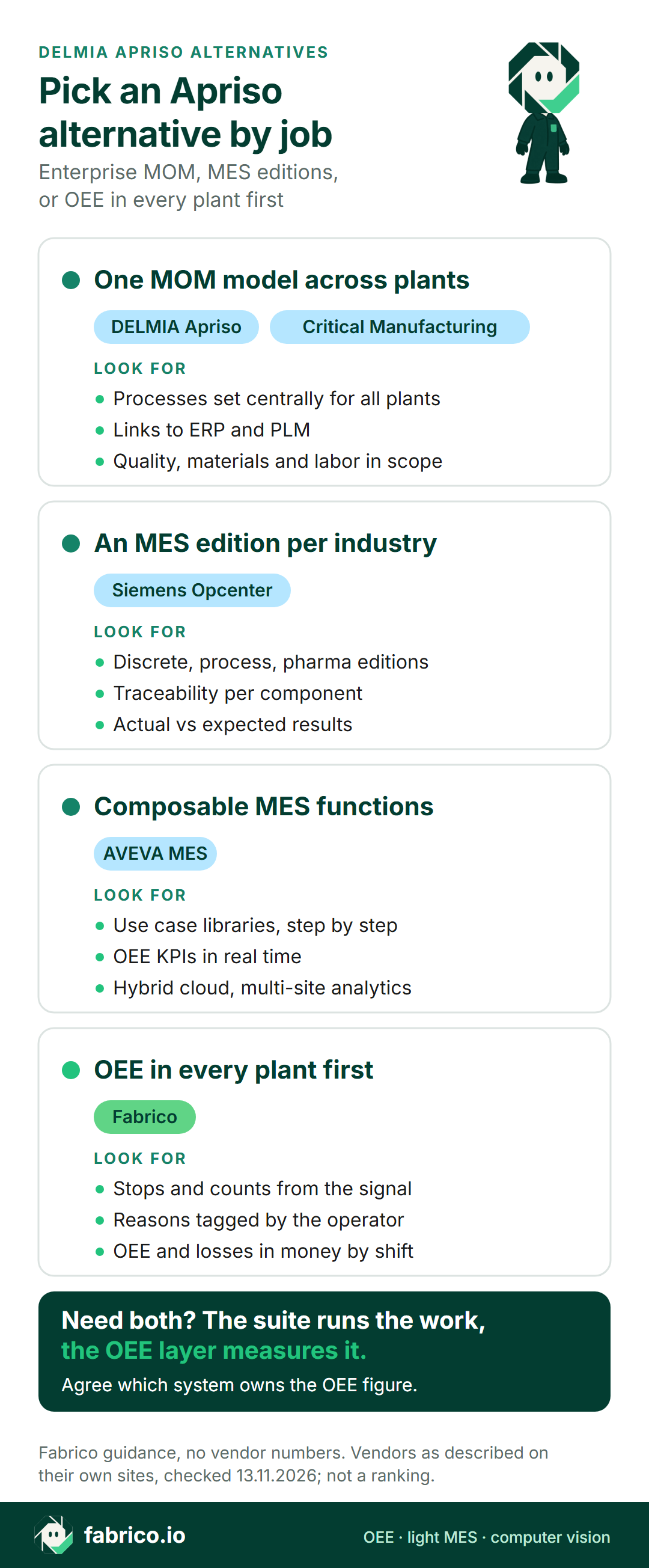
In short: the right DELMIA Apriso alternative depends on the scope you need. If you want one manufacturing operations standard rolled out across many plants, compare Apriso with other enterprise MES and MOM suites, for example Siemens Opcenter, AVEVA MES and Critical Manufacturing. If you first need to know why lines stop and what that costs in each plant, an OEE layer with light MES functions, such as Fabrico, answers that while orders stay in your ERP.
- DELMIA Apriso is Dassault Systèmes' manufacturing operations management (MOM) suite: MES plus quality, materials, warehouse, labor and maintenance.
- Its pages put global process standards first: central updates to processes for all plants.
- An enterprise MOM project and an OEE layer answer different questions, and can run side by side.
- Facts on each vendor are from its own site, checked 13.11.2026 and linked in place. Prices, verdicts and rankings are left out.
A manufacturing group runs nine plants on three continents. Head office wants one way of building, checking and shipping product in every plant, tied to the ERP and the engineering system. The plant managers want something more basic: which line lost the most time last week, and why.
Both asks are fair. They lead to different projects with different scopes. Below: what DELMIA Apriso is, per its own pages, which suites compete with it for the group-wide standard, and where a plant-level OEE layer fits. Fabrico, which wrote this page, is one of the options, and as the seller we leave it unranked.
What DELMIA Apriso is (as of 13.11.2026, per 3ds.com)
Dassault Systèmes' DELMIA Apriso page calls it an advanced manufacturing operations management (MOM) solution, built to help manufacturers modernize and optimize global production operations. MOM, in Dassault's words, includes the classic MES functions and adds integrated quality, materials management and maintenance. What the pages say, as of 13.11.2026:
- Scope. Production execution, quality control, warehouse management, time and labor tracking, equipment maintenance and enterprise system integration.
- Global standards. Processes for all plants can be monitored and updated centrally, and low-code configuration helps deploy the same processes and best practices across sites.
- Enterprise links. Over 40 standard connection points to the ERP, closed-loop synchronization with the 3DEXPERIENCE PLM platform, and OPC UA for live signals from PLCs and sensors.
- Analytics. The Analytics and Reporting page lists Intelligence Packs. The Machine Intelligence Pack covers 70+ indicators such as OEE, cycle time performance and Good-Scrap-Failed reporting, and Dashboard Builder shows OEE with its three components.
- Labor. Labor is linked to plant activities, with operator skill and certification checks. The Time and Labor page describes a KPI defined once and reported the same way across all plants.
- Hosting. The product page describes configurable on premise and private cloud solutions.
The efficiency and cycle time results on the page are vendor-reported, so this page leaves them out.
Not the same product as DELMIAworks. Per the same page, Apriso focuses on larger enterprises, while DELMIAworks combines ERP and MES for small and midsize businesses. For that product, see our DELMIAworks alternatives.
When DELMIA Apriso fits
Put Apriso on your shortlist if most of these are true:
- You run several plants and want the same execution processes in all of them, governed from the center.
- Engineering already lives in 3DEXPERIENCE, and design changes should reach the shop floor without re-entry.
- The scope is wide: warehouse, labor, quality and maintenance belong in the same program as production.
- You have a program team (internal, integrator or vendor) to model and roll out processes plant by plant.
If most are true, you are buying an enterprise suite, and the alternatives below are the other suites to compare. If the first question is how much line time is lost to stops, slow running and scrap, read the section on Fabrico, or our guide to light MES vs full MES.
Enterprise MOM, MES and an OEE layer: three scopes
Most "Apriso alternatives" searches mix three different purchases. An enterprise MOM suite runs the work and the material across plants. A plant MES runs execution in one site. An OEE layer measures line time: when lines ran, when they stopped, why, and what it cost. Our OEE vs MES guide covers the split.
Comparison table: DELMIA Apriso and five alternatives
The rows restate each vendor's own site as of 13.11.2026, with links in the row or in the sections below. No order of merit is implied, and Fabrico is listed first because this is our page. A topic absent from a row was not on the pages we read: raise it with the vendor.
| Tool | Built around, per its site | Across plants, per its site | Ask the vendor |
|---|---|---|---|
| DELMIA Apriso (for reference) | MOM: MES plus quality, materials, warehouse, labor | Processes updated centrally for all plants | Which Intelligence Pack holds OEE? |
| Fabrico | Machine signal, operator stop reasons, losses in money | Plants side by side, with comparison reports | How are plants without PLC data read? |
| Siemens Opcenter Execution | MES family with editions by industry | Visibility and control across the enterprise | Which edition fits each plant? |
| SAP Digital Manufacturing | Cloud MOM on SAP Business Technology Platform | Global and plant-level performance | How does it link to your ERP? |
| AVEVA MES | Composable, modular MES, hybrid cloud | Multi-site analytics in the cloud | Which use case library comes first? |
| Critical Manufacturing | MES-powered platform for complex discrete products | Master data defined centrally, sent to sites | Which apps come first? |
Want to see the OEE side on a line like yours? Book a demo and bring a week of stop records from one plant.
Fabrico: OEE and light MES, plant by plant
We wrote this page and make Fabrico, a cloud-based OEE and light MES platform. Where Apriso starts from the enterprise process model, Fabrico starts from line time in each plant: when a line stopped, for how long, why, and what it cost. Per our MES and OEE overview:
- Machine data, three ways. From the PLC, from a Fabrico IoT device with external sensors on older machines, or from AI cameras, an add-on, at stations with no machine signal. Protocols include OPC UA, Modbus, PROFINET, MQTT and EtherNet/IP (machine connectivity).
- Stops with reasons. Connected machines record when a stop started and how long it lasted. Operators add the cause from a tablet or phone, so downtime by cause builds up shift after shift.
- OEE and losses in money. Live OEE per line and shift, with losses shown in money, on the web, iOS and Android.
- Several plants. Plants side by side on one screen, with reports that compare them, from one central platform.
- The camera add-on counts output at manual stations, and its video opens for any moment on the shift timeline. In the standard setup, video from the camera add-on is streamed on request, not stored in Fabrico (how the camera add-on works).
- Maintenance built in. When a stop needs a repair, a technician opens a work order from the stop, on the same machine record.
- Data out. REST API and webhooks, Excel or CSV export. A connection to SAP or another ERP can be scoped per customer.
- Rollout. Devices connected in about a month; full rollout in 3 to 4 months.
- Stays in your ERP or suite: job dispatching, BOMs, routings and genealogy. Roadmap, not live: production planning and scheduling, and a camera add-on that detects stops and offers a likely reason.
Fits groups that want comparable OEE and downtime by cause in every plant before, during or instead of a long MOM program. EU customers are hosted on AWS in Frankfurt. A one-line pilot in one plant is a common start; the OEE software guide explains what to compare.
Siemens Opcenter Execution: an MES family by industry
Siemens' Opcenter Execution page describes a family of MES products for visibility, control and optimization of production across the enterprise. As of 13.11.2026, it says:
- Editions for discrete job shops and complex assembly, process manufacturing, electronics, medical devices (with eDHR), pharma (with electronic batch records) and semiconductor.
- Production tracking with forward and backward traceability of components in each end product.
- Resource use tracked by elapsed time and production quantities, so production does not outpace maintenance, plus training and certification tracking.
- Up-to-the-minute reporting that compares actual results with historical and expected ones.
Compared with Apriso: both connect design and engineering data with the shop floor. Siemens sells Opcenter as editions per industry; Dassault describes Apriso as one MOM suite with modules such as warehouse and labor.
Fits groups that want an industry-specific MES edition, often next to other Siemens software.
AVEVA MES: composable and modular
AVEVA's MES page describes a composable frontline operator interface, a modular deployment approach and a hybrid cloud architecture. As of 13.11.2026, it says:
- Performance management measures and monitors OEE KPIs and schedule adherence in real time.
- Execution data from several MES sites can be stored, visualized and analyzed in the cloud.
- Low-code and no-code workflow tools help standardize procedures across a fleet of plants.
- Its FAQ names food and beverages, consumer goods and specialty chemicals, in repetitive volume production.
Compared with Apriso: both talk about standards across plants. AVEVA's pages stress composable use case libraries and process industries; Apriso's stress one MOM model with PLM links.
Fits groups that run batch or repetitive volume lines and want to add MES functions use case by use case.
Critical Manufacturing: MES for complex discrete products
Critical Manufacturing calls itself an MES-powered industrial operations platform for manufacturers of discrete products, with a special focus on semiconductor, electronics, medical devices and industrial equipment. As of 13.11.2026, its homepage says:
- Equipment, IoT, ERP, PLM and enterprise systems share a unified data layer.
- Its Global Data Orchestrator defines core master data centrally and sends it to the sites that need it.
- AI agents answer questions, build dashboards and write shift handover summaries from natural language prompts.
Compared with Apriso: both aim at multi-site standards. Critical Manufacturing's pages center on complex discrete industries such as semiconductor and electronics.
Fits groups that build complex, highly configured discrete products in several plants.
Which DELMIA Apriso alternative fits your plants
- One MOM model across plants, linked to 3DEXPERIENCE: DELMIA Apriso.
- An MES edition built for your industry: Siemens Opcenter Execution.
- Composable MES functions for batch and repetitive lines: AVEVA MES.
- Complex discrete products with central master data: Critical Manufacturing.
- Comparable OEE and downtime by cause in every plant first, while orders stay in the ERP: Fabrico.
A suite and an OEE layer can run side by side if one system owns the OEE figure. See when a light MES is not enough and our MES software guide. For food and consumer goods plants, see computer vision for FMCG manufacturing.
Worked example: one OEE figure for three plants
Group-wide OEE means something when every plant counts it the same way. Sample data for one week, one packing line per plant, not a customer's data or a product screen. Each figure is good units times ideal cycle time, divided by planned production time.
The simple average of 73.0%, 62.0% and 84.0% is 73.0%. Weighted by planned time it is 10,620 good minutes over 15,000 planned minutes, or 70.8%. Plant C runs fewer hours, so it lifts the simple average more than it should.
Neither figure is wrong, but a board pack that mixes them is. Agree three rules before you compare plants: how the ideal cycle is set, whether changeovers count as planned time, and how the group figure is rolled up. Then look at where Plant B's lost minutes went. See OEE calculation for the formula.
Questions to ask any vendor on this list
Put the same questions to every vendor, us included, for one representative plant.
- Which scope is it for? Running the work and material across plants, measuring line time, or both.
- How does each line report? PLC, sensor, operator entry or camera, including stations with no signal.
- How is OEE defined? Ideal cycle, changeovers, planned stops, and how the group figure is rolled up.
- Who models and changes processes? Your engineers, the vendor, or an integrator.
- Which records stay in the ERP and PLM, and which data flows back.
- What does the first plant include? Ask for the scope of the first site in writing, line by line, and give every vendor the same station list.
What people ask next
What is DELMIA Apriso?
Dassault Systèmes describes DELMIA Apriso as an advanced manufacturing operations management (MOM) solution for global production operations. It covers production execution, quality control, warehouse management, time and labor tracking, equipment maintenance and enterprise system integration.
Is DELMIA Apriso the same as DELMIAworks?
No. Per Dassault Systèmes' Apriso page, Apriso focuses on larger enterprises, while DELMIAworks combines ERP and MES capabilities for small and midsize businesses.
Does DELMIA Apriso track OEE?
Its Analytics and Reporting page says the Machine Intelligence Pack covers 70+ indicators such as OEE, and that Dashboard Builder shows OEE with quality, performance and availability. Ask how stops and their reasons are captured at the line.
What are the main alternatives to DELMIA Apriso?
For an enterprise suite, buyers often compare Siemens Opcenter Execution, AVEVA MES and Critical Manufacturing. For OEE and downtime by cause first, a light MES such as Fabrico is another route.
How is Fabrico different from DELMIA Apriso?
Apriso runs execution, materials, quality and labor across plants, per its site. Fabrico works at line level: the machine signal gives stops and counts, the operator adds the reason, and Fabrico reports OEE and losses in money by line and shift, with orders, routings and genealogy left in the ERP.
Can an OEE layer run next to DELMIA Apriso?
Yes, if each record has one owner. The suite keeps orders, materials and quality records; the OEE layer keeps stops, reasons and line time. Agree which system publishes the OEE figure before you connect them.
Want to compare OEE across plants like yours? Book a demo or write to us.
Related articles


Latest from our blog


Real Fabrico tiles, sample data.