


 Login
 Blog
Solumina Alternatives: Opcenter, Apriso, Tulip or Light MES With OEE

In short: the right Solumina alternative depends on the job you need done first. If you need a complex discrete MES for as-built records, engineering changes, quality and MRO, compare Solumina with Siemens Opcenter Execution Discrete, DELMIA Apriso, Critical Manufacturing and Tulip. If your first question is why machining cells and assembly stations stop and what that costs, a light MES with OEE, such as Fabrico, measures it and can run beside the MES.
- Solumina is iBase-t's platform for complex discrete manufacturing, with MES, quality (EQMS and SQM) and MRO modules.
- Its pages name aerospace and defense first, plus satellite and space, industrial equipment, nuclear, shipbuilding and electronics.
- The alternatives split into two jobs: running and recording the build, or measuring line time and losses.
- Vendor facts come from each vendor's own site, as of 12.11.2026, linked in place. No prices, no verdicts, no ranking.
An aerospace supplier machines structural parts on ten 5-axis cells, then assembles them into kits under AS9100. Quality wants a full as-built record for every serial number. The operations director wants to know why the cells cut metal for less than two thirds of the shift.
Both are fair asks, and they point to different tools. Below: what Solumina is, per iBase-t's own pages, when it is the right pick, and five alternatives grouped by job. Fabrico wrote this page and is one of the five. We sell Fabrico, so it is not ranked. For the wider field, see our MES software guide.
What Solumina is (as of 12.11.2026, per iBase-t's site)
Solumina is sold by iBase-t. Its target buyer is plain from the iBase-t homepage, which says complex discrete manufacturing is its business and calls Solumina an industry cloud for aerospace and defense. What its pages say, as of 12.11.2026:
- MES for complex products. The Solumina MES page describes an MES built for products with multiple levels of sub-assemblies and frequent engineering changes. It pushes real-time updates to work instructions and engineering changes to work orders.
- As-built traceability. The same page says Solumina MES documents as-built information down the entire tree of production, integrates non-conformance and deviation processes, and provides serial tracking at suppliers and factories.
- Quality across the platform. Solumina EQMS is embedded across MES, supplier compliance and sustainment, and Solumina SQM manages supplier quality with suppliers.
- MRO. Solumina MRO supports the maintenance, repair and rebuilding of complex assets, from engines to airframes, and lists support for FAA A, B, C and D checks.
- Analytics. Solumina Manufacturing Intelligence feeds BI reporting tools, with preconfigured metrics for schedule, performance, quality and sustainment.
- Architecture and integration. The cloud MES page describes a cloud-native, microservices architecture, and the integration page lists ready-made interfaces for MES, MRO and SQM data flows with ERP and PLM.
- Industries named. Aerospace and defense, satellite and space, industrial equipment, nuclear, shipbuilding and electronics.
Results figures on the homepage are vendor-reported, so we don't repeat them.
Ask in the demo: which of the performance metrics in Manufacturing Intelligence come from machine signals, and which from work order transactions.
When Solumina is the right pick
Put Solumina on your shortlist if most of these are true:
- Products have deep, changing structures, with many sub-assembly levels and engineering changes that must reach the shop floor mid-build.
- Customers or regulators want an as-built record per serial number, with nonconformances and deviations tied to it.
- Suppliers are part of the quality loop, and you want supplier quality in the same platform as execution.
- You maintain what you build, or you run an MRO operation with heavy maintenance checks.
If most are true, a complex discrete MES fits your plant; see when a light MES is not enough. If your first question is about stops, speed and output on the machines, read on.
Building the product and measuring the line are different jobs
A complex discrete MES watches the product: which revision, which part, which operator signed which step, which nonconformance. A light MES watches the time: when a cell ran, when it stopped, why, and what that cost. Our OEE vs MES guide covers the split.
Comparison table: Solumina and five alternatives
This is what each vendor's own site says, in our words, as of 12.11.2026, linked in each section below. It is not a ranking. A short cell means only that we kept the table readable, so ask each vendor directly. Fabrico comes first because we wrote this page.
| Tool | Built around, per its site | Records it keeps | Ask in the demo |
|---|---|---|---|
| Solumina (for reference) | Complex discrete MES, quality, MRO | As-built, nonconformance, serials | Where do OEE inputs come from? |
| Fabrico | Machine signal and operator stop reasons | Stops, reasons, counts, OEE by shift | How is a cell with no PLC read? |
| Siemens Opcenter Execution Discrete | MES for variable BOMs and changes | Work orders, deviations, components | How does PLM feed the station? |
| DELMIA Apriso | MOM: MES plus quality, materials, maintenance | Quality, materials, labor, production | Which global templates come first? |
| Critical Manufacturing | MES for complex discrete products | Batch, lot and serialized units | Which modules come first? |
| Tulip | Composable apps for frontline work | Step data, tool readings, signatures | Who builds and maintains the apps? |
Want to see the OEE side on a cell like yours? Book a demo and bring one week's downtime log.
Fabrico: light MES and OEE beside the build record
Fabrico wrote this page. It is a cloud-based OEE and light MES platform. Where Solumina starts from the product and its as-built record, Fabrico starts from machine time: when a cell stopped, for how long, why, and what it cost. Per our MES and OEE overview:
- Machine data, three ways. From the PLC on automated machines, from a Fabrico IoT device with external sensors on older machines, or from AI cameras, an add-on, at manual steps with no machine signal (machine connectivity).
- Stops with reasons. Connected machines report their own stops, including short stops too brief to log by hand. Operators tag the reason on a tablet or phone.
- OEE and losses in money. Live OEE by line and shift, with losses shown in money, on the web, iOS and Android.
- The camera add-on counts output at manual stations, and its video opens for any moment on the shift timeline. In the standard setup, video from the camera add-on is streamed on request, not stored in Fabrico (how the camera add-on works).
- Maintenance built in. When a stop needs a repair, a technician opens a work order from the stop, on the same machine record.
- Data out. REST API and webhooks, Excel or CSV export. A connection to SAP or another ERP can be scoped per customer.
- Rollout. Devices connected in about a month; full rollout in 3 to 4 months.
- Stays in your ERP or MES: job dispatching, BOMs, routings and product genealogy. Roadmap, not live: production planning and scheduling, and a camera add-on that detects stops and offers a likely reason.
Ask in the demo: how a cell with no usable controller reports its stops, and how stop data could be passed to an MES.
Fits plants that want downtime ranked by cause and priced by cell and shift, on shop floors that mix CNC machines, older equipment and manual assembly. EU customers are hosted on AWS in Frankfurt. Start with a one-line pilot. See our OEE software guide and our OEE software for aerospace and defense page.
Siemens Opcenter Execution Discrete: MES for variable products
Siemens describes Opcenter Execution Discrete as its MES for discrete manufacturing, designed for reconfigurable equipment, extensive and variable bills of materials and process, and many work orders with dependencies. What the page says, as of 12.11.2026:
- It captures deviations found during inspections and runs exception management through a failure catalog, with protocols to correct the non-conformance.
- It handles change management across engineering or production change orders, work orders and the materials and processes they touch, even after production has started.
- It supports complex labor management and the use of augmented and virtual reality tools.
- For aerospace and defense, the page says close collaboration with PLM software helps manage flexible, complex assembly in low volume and high variance.
Compared with Solumina: both center on engineering change and nonconformance in complex builds. Ask both to run the same mid-build change on one serialized assembly. Our Siemens Opcenter review covers the wider Opcenter family.
Fits plants that already run Siemens PLM and want the station tied closely to it.
DELMIA Apriso: manufacturing operations management across sites
Dassault Systèmes calls DELMIA Apriso an advanced manufacturing operations management (MOM) solution for modernizing global production operations. What the page says, as of 12.11.2026:
- MOM covers what is traditionally part of MES and extends it to integrated quality, materials management, maintenance and other production functions.
- Low-code configurability is meant for developing and deploying the same processes and best practices across sites worldwide.
- It lists ERP integration and time and labor management.
- DELMIA Augmented Experience adds AI-enabled augmented reality to support assembly and quality inspection.
Efficiency figures on the page are vendor-reported, so we don't repeat them.
Compared with Solumina: both cover execution and quality in one platform. Apriso's page puts weight on one standard across many sites; Solumina's puts weight on complex product structures and sustainment.
Fits plants that want one operations standard rolled out across a global network of sites.
Critical Manufacturing: MES for complex discrete products
Critical Manufacturing describes an MES-powered industrial operations platform for discrete products, focused on semiconductor, electronics, medical devices and industrial equipment. It has been a subsidiary of ASMPT since 2018 (who we are). Its industrial equipment page says, as of 12.11.2026:
- One system spans process engineering, equipment engineering, quality, planning and logistics.
- Its material and resource models handle batch, lot and serialized-unit configurations, so low-volume, highly configured products get the same rigor as high-volume work.
- The ERP stays the system of record for the business, and the MES becomes the record of what happens on the floor.
Compared with Solumina: both target complex discrete builds and name industrial equipment and electronics. Ask both how a new product variant reaches the stations. For electronics plants, see MES for electronics manufacturing.
Fits plants that build highly configured products and want engineering, quality, planning and execution in one MES.
Tulip: composable apps for frontline work
Tulip calls itself a composable platform that connects equipment, enterprise systems and frontline workers (OEE tracking page), and its homepage names aerospace and defense among its industries. As of 12.11.2026, its pages say:
- Engineers build guided instructions in Tulip's App Editor without writing code, and connect torque tools, scanners and calipers so readings land in the record (work instructions).
- A barcode reader captures material, component and operator data at each step, with electronic signatures built for 21 CFR Part 11 and Annex 11 (genealogy).
- OEE combines machine and PLC data over OPC UA or MQTT with the reason codes operators enter, by line and shift.
Compared with Solumina: both guide the operator step by step and keep the record. Solumina describes a purpose-built MES; Tulip describes apps that your engineers compose. See our Tulip alternatives.
Fits plants that want their engineers to build and change station apps, one use case at a time.
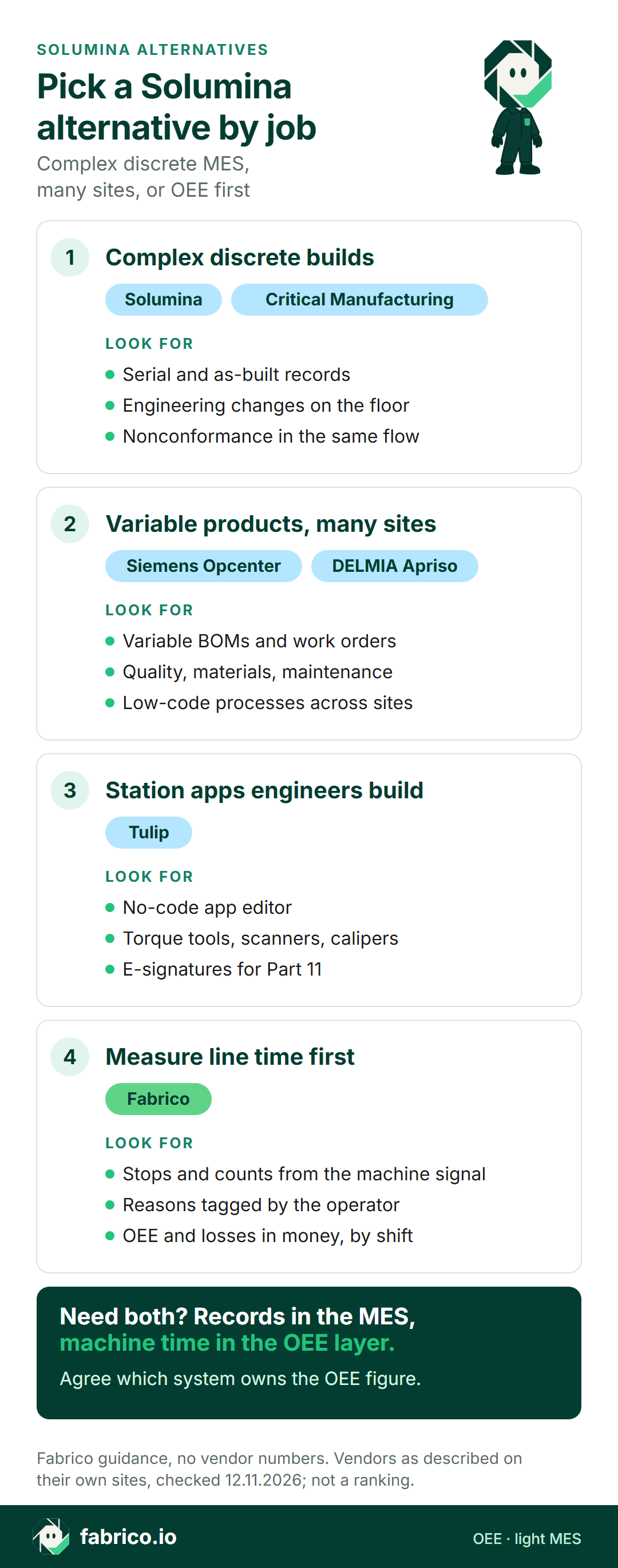
Which Solumina alternative fits your plant
- As-built records, engineering change, supplier quality and MRO for complex products: Solumina.
- An MES tied closely to Siemens PLM, for variable BOMs and frequent changes: Siemens Opcenter Execution Discrete.
- One operations standard across many sites, with quality, materials and maintenance: DELMIA Apriso.
- Engineering, quality, planning and execution in one MES for configured products: Critical Manufacturing.
- Station apps that your engineers build and change themselves: Tulip.
- Downtime by cause and OEE by cell and shift first, beside the MES or before it: Fabrico.
A complex discrete MES and an OEE layer can run side by side if each record has one owner. See light MES vs full MES.
Worked example: one machining cell, two kinds of record
Sample data for one 8 hour shift on a 5-axis machining cell, not a customer's cell or a product screen. Planned production time is 450 minutes after a 30 minute break. The ideal cycle is 18 minutes a bracket.
Stops took 63 minutes, so run time was 387 minutes and availability 86.0%. In 387 minutes the ideal is 21.5 parts. The cell made 20, so performance is 20 x 18 / 387 = 93.0%.
One bracket went to the material review board with a dimension out of tolerance, leaving 19 good: quality is 95.0%. OEE is 86.0% x 93.0% x 95.0% = 76.0%, the same as 19 good parts x 18 minutes over 450 minutes.
The MES holds 20 serial records, each with the program revision, the operator's sign-offs and, for one part, a nonconformance. The light MES holds the 63 minutes by cause, plus 27 minutes of slow running: where the time went. In this sample the biggest loss is waiting for first article inspection, a machine time question rather than a part record question. See OEE calculation for the formula and micro-stops for the short stops a paper log misses.
Questions to ask any vendor on this list
Put the same questions to every vendor, us included, for one representative cell or line.
- Which job is it for? Running and recording the build, measuring machine time, or both.
- How does each machine report? PLC, sensor, operator entry or work order transactions, including machines with no usable controller.
- How is OEE calculated? Where the ideal cycle comes from, how setups and first article checks count, and who enters stop reasons.
- How does an engineering change reach the floor, and what happens to work already in progress.
- Which records stay in the ERP or PLM, and which data flows back.
- Who configures and maintains it? Your engineers, the vendor or an integrator.
What people ask next
What is Solumina used for?
Per iBase-t's own site, Solumina is a platform for complex discrete manufacturing, with MES, enterprise and supplier quality, and MRO modules. Its pages name aerospace and defense first, plus satellite and space, industrial equipment, nuclear, shipbuilding and electronics.
What are the main alternatives to Solumina MES?
For a complex discrete MES, this page compares Siemens Opcenter Execution Discrete, DELMIA Apriso, Critical Manufacturing and Tulip. If the first need is downtime and OEE on machining cells and assembly stations, a light MES with OEE, such as Fabrico, covers that job and can run beside an MES.
Does Solumina track OEE?
Its Manufacturing Intelligence page lists preconfigured metrics for schedule, performance, quality and sustainment, shown in BI reporting tools. Ask iBase-t which of those figures come from machine signals and how stop reasons are captured.
How is Fabrico different from Solumina?
Solumina runs and records the build, per its site: as-built records, engineering changes, nonconformances and MRO. Fabrico measures the machines: stops and counts from the machine signal, reasons from the operator, and OEE and losses in money by line and shift, with dispatching, routings and genealogy left in the ERP or MES.
Can a light MES run next to Solumina?
Yes, if each record has one owner. The MES keeps the product record, work orders and nonconformances; the OEE layer keeps stops, reasons and machine time. Agree which system publishes the OEE figure before you connect them.
Is Fabrico an MES for aerospace as-built records?
No. Fabrico is a light MES: machine data, production monitoring, OEE and downtime analytics. As-built records, serial genealogy and work instructions stay in an MES such as Solumina or in your ERP.
Want to see the OEE side of a cell like yours? Book a demo or contact us.
Related articles
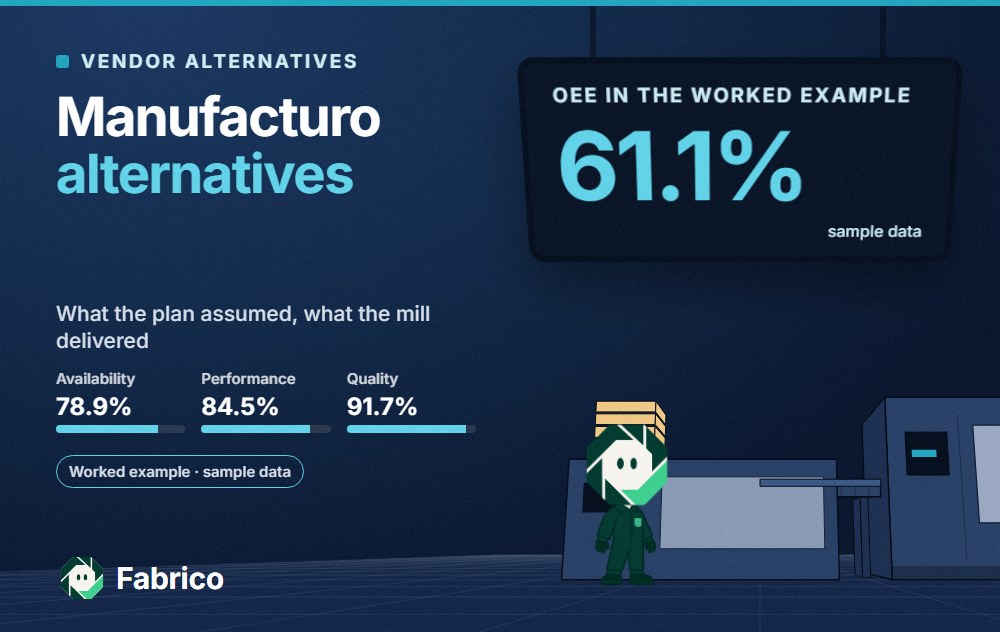


Real Fabrico tiles, sample data.