


 Login
 Blog
Robovision Alternatives: Vision AI Platforms or OEE Cameras

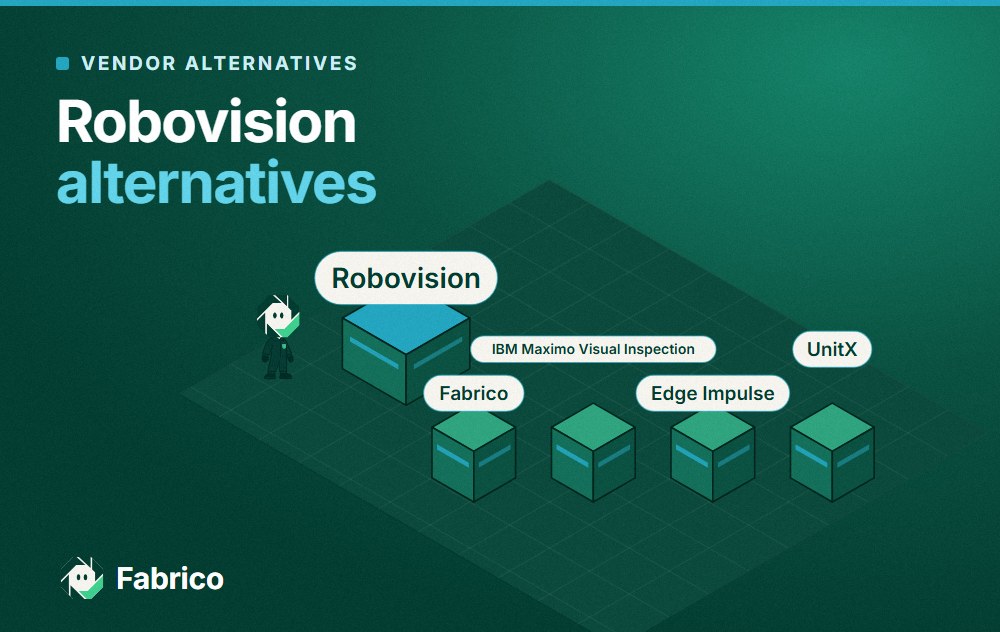
In short: choose a Robovision alternative by the job the vision system has to do. Robovision sells Indurion, software to train, deploy and govern vision AI models in production, and its site has food, packaging and manufacturing pages. To build and run models in-house, compare IBM Maximo Visual Inspection or Edge Impulse. For turnkey inline inspection equipment, look at UnitX. If the question is how much the line made and why it stopped, compare OEE software such as Fabrico, whose camera add-on counts output on request.
- Indurion runs classification and measurement on an agent on each machine, on-premises or air-gapped, per Robovision's product page.
- Robovision's pages speak to teams that build and run inspection machines: a homepage tile reads "Build machines that adapt".
- An inspection model answers "is this item good?". OEE answers "where did the shift's time go?". Many lines need both, joined by a reject count.
- We checked every vendor claim on that vendor's own site on 12.11.2026 or 13.11.2026, as dated in each section, and link the page next to it. No prices, no scores, no ranking.
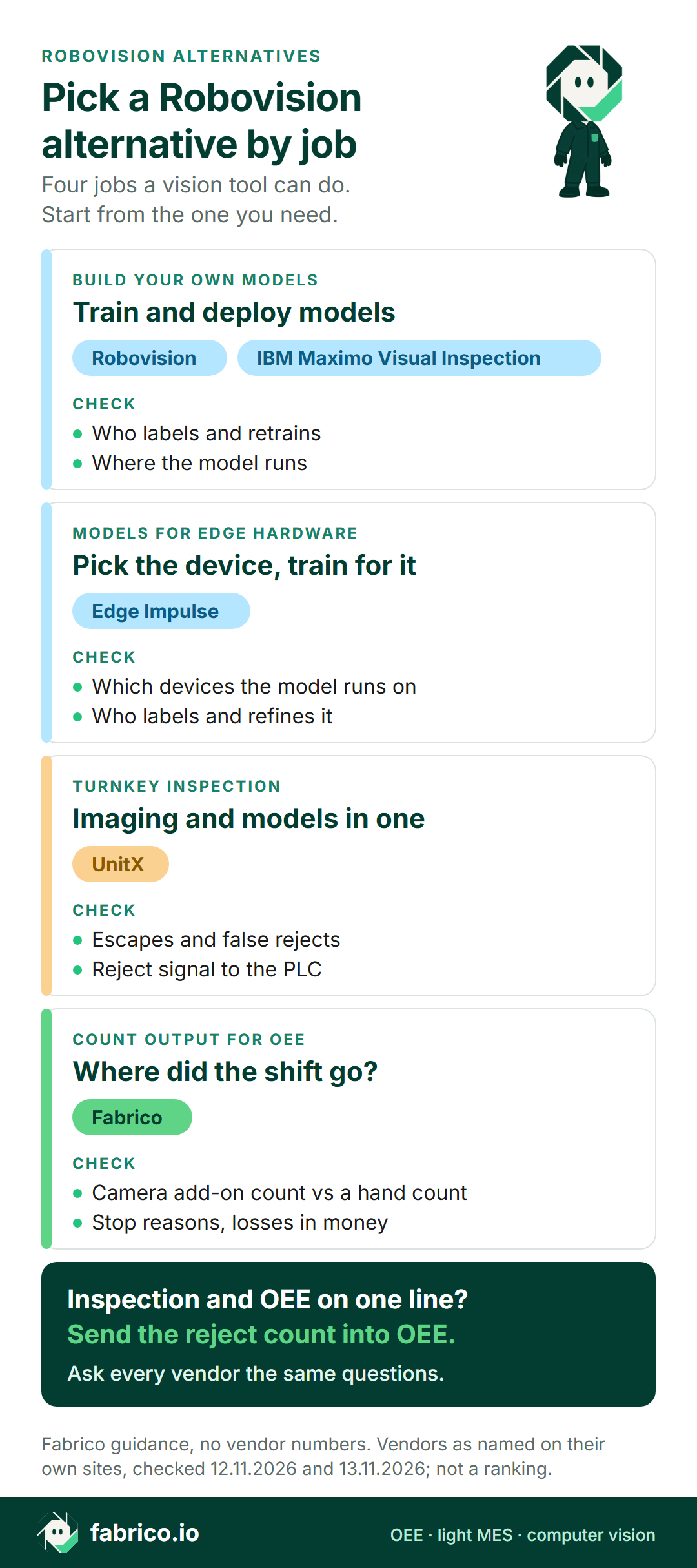
A vision AI platform is a tool for building inspection: you collect images, label them, train a model and push it to a machine. That is a different purchase from a camera that counts output for OEE, and from an inspection station that arrives ready to set up. This page sorts Robovision alternatives by that job.
We are Fabrico, one of the options below, so read this as a vendor's page and test it. Fabrico comes first below because we wrote the page, not as a ranking. If you are comparing model-building tools more widely, our Landing AI alternatives page covers a different set of vendors.
What Robovision sells (as of 12.11.2026, per robovision.ai)
Robovision's homepage headline reads "Industrial vision intelligence. Embedded in your machines and governed for the full system lifecycle." Its product is Indurion, which the same page calls the software to run and govern vision AI in production. Per the Indurion page:
- Runs at the machine. Classification and measurement happen on an agent running on each machine, on-premises or air-gapped. The page adds that inspection keeps going when the network drops.
- The plant team trains. The page says your own team can train and adjust models and that every model you build stays yours. Engineers can define a new part variant from a handful of images, and operators can add new defect classes or product variants.
- A feedback loop. After deployment, each agent sends back outliers and low-confidence samples. You set the level of uncertainty you accept, and Indurion derives a confidence threshold for each class.
- Your infrastructure, standard cameras. Indurion deploys on your own infrastructure in a single-tenant environment and works with industry-standard machine vision cameras in single or multi-camera setups.
- Results out. Per the page, Indurion exposes its results through a standard integration point.
Industry pages on the same date: the food manufacturing page describes grading and sorting, with defects that are "subtle, inconsistent, irregular, and context-dependent", and says uncertain grading decisions are flagged and logged for a person to review. It frames Indurion as keeping machines accurate across an installed base. The packaging page links packaging inspection to new sustainable materials and the EU PPWR, and the manufacturing page covers automated defect inspection and adapting to different product types.
Robovision's pages also name customers and describe results; those are vendor-reported, so we leave them out.
Ask in the demo: who on site labels new images, where the model runs, and how a result reaches the PLC, the reject gate and the reports.
When Robovision fits
Per its own pages, Robovision fits teams that want to:
- train and own their inspection models, with engineers and operators adding variants and defect classes;
- run models on the machine, including on-premises and air-gapped sites;
- keep grading steady as inputs change, with uncertain cases sent to a person and logged;
- govern one model lifecycle across many machines, for example a fleet of graders or packaging inspection systems.
Platform, station or count: what the plant has to supply
The three jobs ask different things of the plant, the team and the pilot. Code and label checks have their own guide: how code-reading vision differs from an OEE camera.
| Plan for | Vision AI platform | Turnkey inspection | OEE camera |
|---|---|---|---|
| You supply | Images, labels, a person to retrain | Sample parts, a slot on the line | A clear view of units passing |
| It answers | Good or bad, and which class? | Good or bad? | How many, and when? |
| Pilot pass mark | Escapes and false rejects | Escapes and false rejects | Count vs a hand count |
| Main owner | Quality or vision engineer | Quality lead, line engineer | Production manager, CI lead |
| Sends on | Results to PLC, MES, reports | Reject signal, results | Counts into OEE |
Robovision and four alternatives side by side
Sources for every cell sit in each vendor's section below, checked on the date given there.
| Vendor | What its site leads with | Who sets up the model | Examples on its pages |
|---|---|---|---|
| Robovision (for reference) | Indurion: run and govern vision AI in production | The plant team trains and adjusts models | Food grading, packaging, manufacturing |
| Fabrico | Line OEE and downtime, losses in money | Fabrico sets up camera add-on counting | Food and FMCG lines |
| IBM Maximo Visual Inspection | No-code inspection models, mobile and edge | Technicians, in a no-code interface | Defect detection on the production line |
| Edge Impulse | Build and deploy AI models on edge systems | Teams, with no-code tools for inspection | Defects, yield, labeling checks |
| UnitX | AI machine vision for manufacturing | CorteX trains and manages the models | Automotive, battery, PCBA, flexible packaging |
Want to see stops priced in money next to a reject count? Book a demo on our demonstration line.
Fabrico: OEE and light MES, with a camera add-on that counts
Our own entry. Fabrico is cloud software for OEE and light MES. It covers the time side of a line: running or stopped, why it stopped, how fast it ran and how much good product came off it.
- Data in: a PLC, sensor or counter reports run, stop and count, and the operator picks the stop reason on a tablet or phone.
- What you see: OEE and downtime by line and shift, with losses priced in money, in the browser or the iOS and Android apps.
- Camera add-on, on request: AI cameras count output where no machine gives a usable count, for example at a hand-pack table. Pick a moment on the shift timeline and the matching video plays; in the standard setup it is streamed on request, not stored in Fabrico.
- Data out: REST API, webhooks, Excel and CSV.
- Roadmap, not in the product today: stops detected by the camera add-on itself, jam zones drawn on its view, and a suggested stop reason for the operator to accept or change.
- Outside Fabrico: inspecting products for defects, labels, codes or fill. An inspection system does that; when its rejects arrive as a signal or counter, they go into the quality figure.
Proof, and a conflict to declare. The proof comes from Ficosota, a Bulgarian maker of hygiene, tissue and household products. Ficosota is also a Fabrico investor; our investment announcement has the details. Between June and September 2026, OEE across its 16 lines in Fabrico rose from 53.11% to 59.62%, and good output from 10.49 million to 12.92 million units a month. Unclassified stop time fell from 3.20% to 0.40%. These are OEE results at an FMCG plant; the approved figures make no claim about cameras. Read the Ficosota story.
Compared with Robovision: Robovision's Indurion runs models that judge items on the machine. Fabrico records what happened to the line's time and puts a money figure on it. If a Robovision-run machine sends its reject count to the line PLC, that count can feed the quality part of OEE.
Fits plants that rank downtime by what it costs, line by line and shift by shift, and have some stations no PLC can count. See Fabrico computer vision for the camera add-on and the OEE solution overview for the rest of the platform.
IBM Maximo Visual Inspection: no-code models from labels to the edge
As of 12.11.2026, IBM's Maximo Visual Inspection page says:
- through a no-code interface, technicians can configure, train, deploy and scale visual inspection models;
- you gather and label images, train AI models, then deploy them to mobile or edge devices, with Maximo Visual Inspection Edge for running models at scale;
- a native mobile app lets inspectors run automated inspections on an iPhone, on site or in the field;
- for manufacturing, it describes real-time end-to-end defect detection anywhere on the production line.
Compared with Robovision: IBM's page leads with a no-code interface for technicians and mobile inspection; Robovision's leads with agents on each machine, air-gapped sites and a governed model lifecycle.
Fits plants that want technicians to train inspection models without code and run them on edge devices or phones, per its page.
Edge Impulse: build models for the edge hardware you pick
As of 13.11.2026, Edge Impulse's computer vision page says it lets teams build, optimize and deploy AI models on any edge system, from industrial gateways to ultra low-power cameras. The same page describes automated data collection, labeling and validation, and an object detection model that can run on constrained devices.
Its visual inspection page, checked the same day, adds:
- guided recipe selection with no-code tools and automatic hyperparameter tuning, aimed at non-experts;
- launching a model and refining it over time for accuracy and robustness;
- uses framed as reducing defects, improving yield and speeding quality assurance, and checking labeling for product integrity and compliance.
Compared with Robovision: Edge Impulse's pages lead with running models on a wide range of edge devices; Robovision's lead with a governed model lifecycle across an installed base.
Fits teams that want to choose their own edge hardware and train inspection models for it, per its pages.
UnitX: turnkey inline inspection with its own imaging
As of 13.11.2026, the UnitX homepage leads with "AI Machine Vision For Manufacturing" and describes three parts:
- OptiX: a software-defined imaging system that captures 2D and 2.5D features inline and sends them to the edge for inference;
- CorteX: software to train, deploy and manage AI models that detect and classify variable defects, with high-speed inline decisions;
- Turnkey equipment: inline inspection equipment for high speed production.
The page describes software-defined lighting and sample-efficient AI for adapting to changing conditions. Its industry menu lists automotive, PCBA, battery, semiconductor and connectors, and its applications include flexible plastic packaging inspection. The homepage also shows customer logos and outcome figures; those are vendor-reported, so we leave them out.
Compared with Robovision: Robovision's Indurion is software that works with industry-standard machine vision cameras. UnitX pairs its own imaging and lighting with its model software and offers turnkey inline equipment.
Fits plants that want imaging, lighting and defect models from one vendor as inline equipment, per its homepage.
Pick by job, then by vendor
- Robovision fits teams that want to train, deploy and govern their own inspection models on each machine (its Indurion page).
- IBM Maximo Visual Inspection fits teams that want no-code model training with edge and mobile deployment (its product page).
- Edge Impulse fits teams that want to build and deploy models on edge hardware they choose (its computer vision page).
- UnitX fits plants that want turnkey inline inspection with the vendor's own imaging (its homepage).
- Fabrico fits plants that need the shift's lost time explained and priced, with a camera add-on count at stations that have no machine signal (the camera add-on page).
Comparing smart cameras and vision sensors instead? Our Keyence vision alternatives page covers that job.
Worked example: the grader was accurate, the line still lost an hour
Picture a fruit packing line behind an AI grader on a 450 minute shift. The numbers are invented for this page, not taken from a customer or a product screen. The tray packer's ideal rate is 40 trays a minute, so 18,000 trays is the ceiling.
Three things stopped the packer for 54 minutes in all: a tray denester jam (20), a film roll change (16) and waiting for fruit (18). With 396 of 450 minutes running, availability comes to 88.0%.
Running flat out, those 396 minutes would give 15,840 trays. The packer filled 14,850, a performance of 93.8%.
The checkweigher rejected 297 underweight trays, leaving 14,553 good ones, so quality is 98.0%. Together that is 88.0% x 93.8% x 98.0% = 80.9% OEE, which matches 14,553 out of 18,000.
Both reports are right. The grader report says the model sent 0.8% of decisions to a person. The OEE report says stops cost 2,160 trays, about seven times the rejects, and slow running another 990. The 18 minutes waiting for fruit points upstream, a question for the grading and packing teams together.
Before a camera count goes into OEE, hand-count the same station for a shift and compare; this guide on camera count accuracy explains how. Packhouses can also read the fresh produce packing camera guide.
Questions to ask any vision vendor, us included
- Which job is it? Building models, ready inspection, or counting output.
- Who retrains? Ask who labels new images when a product, recipe or supplier changes, and what that takes on site.
- Where does the model run? On the machine, on a plant server or in a cloud, and what happens when the network drops.
- How do results travel? To the PLC, the reject gate, MES and the OEE figure.
- What is the pass mark? Escapes and false rejects for inspection; a count against a hand count for OEE.
- Where are images kept? For how long, and who can see them. Bring the works council in early; see cameras without surveillance.
- What goes into the quote? Stations, cameras, lenses, lighting, mounting, integration and training. Ask each vendor for the same list.
Running the OEE half? The computer vision OEE pilot plan has the week-by-week detail. Food plants can read the food plant camera guide, and packaging and household lines the FMCG buyer's guide.
What people ask next
Where does Robovision stop and OEE software start?
Robovision describes Indurion as software to run and govern vision AI in production, and its pages focus on inspection, grading and sorting. For OEE with stop reasons by line and shift, ask how Indurion's results would reach the system that calculates OEE.
Does Robovision need the cloud?
Its Indurion page says classification and measurement run on an agent on each machine, on-premises or air-gapped, and that inspection keeps going when the network drops. It also says Indurion deploys on your own infrastructure in a single-tenant environment.
What does Robovision do in food manufacturing?
Its food manufacturing page describes grading and sorting where defects are subtle, inconsistent, irregular and context-dependent. It says uncertain grading decisions are flagged and logged for a person to review. Test with real products and defects in a pilot.
Which alternatives also let a plant team train models?
Per their own pages, IBM Maximo Visual Inspection gives technicians a no-code interface to train models and deploy them to mobile or edge devices. Edge Impulse builds, optimizes and deploys models on edge systems, with no-code tools in its visual inspection suite. UnitX's CorteX trains, deploys and manages defect models for its own inline imaging.
Does Fabrico inspect products like Robovision?
No. Robovision's Indurion runs inspection models that judge items. Fabrico is OEE software: it tracks when the line runs and stops, records the stop reasons operators enter, and prices the lost time. Its camera add-on counts output at stations without a machine signal; it does not check defects, labels or codes.
Can an inspection system's rejects feed OEE?
Yes, when the rejects reach the OEE software as a count or a signal, for example through the line PLC or a counter. OEE uses how many items failed, not why. Hand-count one shift to check that the two numbers agree.
Want one shift laid out as stops, speed and rejects? Book a demo.
Related articles


Real Fabrico tiles, sample data.