


 Login
 Blog
Computer Vision for Fresh Produce Packing: Count Packs, See Stops

In short: computer vision for fresh produce packing covers two different systems. The optical grader inspects and sorts every fruit, while an OEE camera counts packed output and gives you the video for any stop at the packers and hand-pack tables after the grader.
- Optical grading, sorting and defect detection are inspection jobs. They belong to the grader and its maker, such as TOMRA. Fabrico does not do them and does not replace them.
- The OEE camera works on pack-out: it counts cartons where nothing else does, such as at hand-pack tables, and opens the video for the minute a packer stood still.
- Intake sets the pace in a packhouse, and the fruit changes with every lot. Measure OEE at the packer, and book waiting for fruit as its own loss.
- Fabrico takes stops and counts from machine signals, and stop reasons from operators. AI cameras are an add-on; in the standard setup, video is streamed on request, not stored in Fabrico.
A packhouse often buys computer vision twice. The first time is the optical grader, which looks at every apple, citrus fruit or tomato and sends it to a lane. The second time is a camera that watches what leaves the packing lanes.
Both get sold under the same words, and that is where shortlists go wrong. A grader upgrade won't tell you why the flow wrapper lost an hour on Tuesday. OEE software won't take one bruised apple out of a 6-pack.
It is written for packhouse managers and engineers who are picking camera and OEE software for their packing lines. For the OEE rules first, such as ideal rates per pack format and how to book grade-out, read OEE for fresh produce packing. This page is about cameras.
We sell Fabrico. Test what follows the way you would test any vendor.
The grader inspects, the OEE camera counts
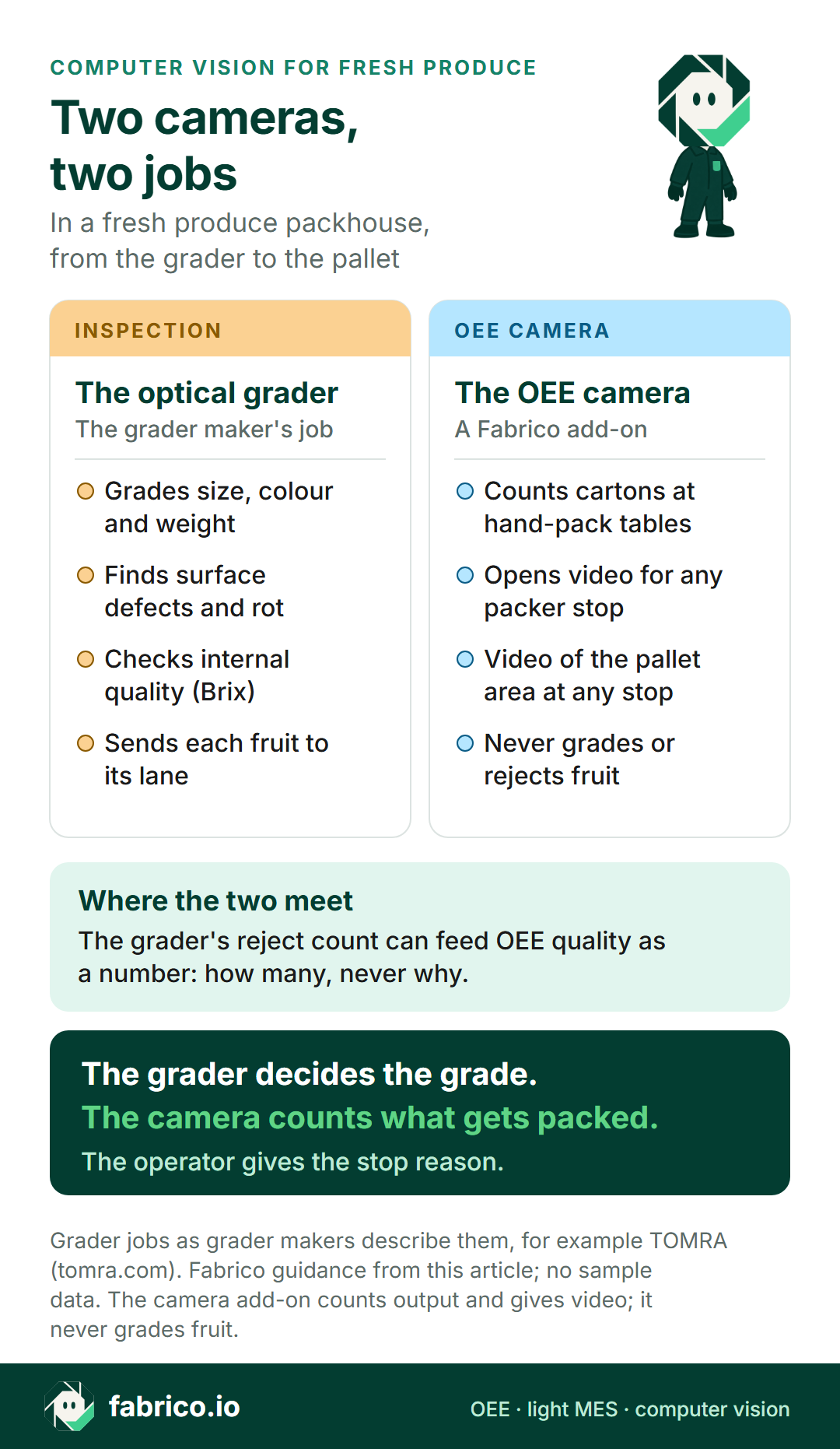
An optical grader is an inspection machine. It looks at each piece of fruit, decides its size, colour and class, and sends it to the lane for that grade. Many graders also look inside the fruit. TOMRA, for example, says its Inspectra² internal grading system uses near-infrared spectroscopy to assess Brix, dry matter and internal defects.
That job belongs to the grader and its maker. Fabrico does not grade, sort or reject fruit, and nothing on this page replaces your grader.
An OEE camera has a narrower job: it counts packed output and opens the video for any moment on the shift timeline. How many packs left this table, and why did the line stand still at 10:40?
| Job | Optical grader | OEE camera |
|---|---|---|
| Size, colour and weight grading | Yes, its main job | No |
| Surface defects and rot | Yes | No |
| Internal quality, such as Brix | Yes, on graders with that option | No |
| Sending fruit to the right lane | Yes | No |
| Counting cartons at a hand-pack table | Not its job | Yes |
| Showing why a packer stopped | No | Video for that moment |
| Label and code checks on packs | A separate inspection system | No |
The two systems meet at one number: what was taken out. If the grader or a checkweigher gives a reject signal or counter, OEE software can use it as a count. It learns how many, never why.
How to book grade-out, inside OEE quality or beside it as pack-out, is covered in the packhouse OEE guide above. For label and date code checks, see label and code vision vs an OEE camera.
Where a packhouse loses time after the grader
A packhouse runs on what the field sends. Eurostat reports that the EU harvested 62.2 million tonnes of fresh vegetables, including melons, in 2024. Some crops are packed in a harvest window of a few weeks. Others, like apples, come out of store for months.
Either way, fruit does not wait well. FAO estimates that, worldwide, fruits and vegetables lose more than any other commodity group between harvest and retail, on farms and in transport, storage, wholesale and processing: 25.4 percent in 2023, up from 23.2 percent in 2015. That covers the whole chain in every region, so it says nothing about packhouses alone. Still, fruit waiting for a stopped packer is losing shelf life.
Intake and grade mix set the pace
The bin tipper feeds the grader, and the grader feeds each packing lane by grade. When a grower's lot runs small or carries more defects, some lanes flood and others go quiet.
The packer on a quiet lane is waiting for fruit: a real loss for the packhouse, but not the packer's fault. Give it its own reasons, such as intake gap, grade mix or grader stop, so the packer's own stops stay clean.
A camera at the packer helps here, if its frame takes in the end of the fruit lane as well as the outfeed. The video for those minutes then shows an empty lane, not a jam, so the operator picks the right reason.
Punnet, tray and flow-wrap lines
Berries, cherry tomatoes and grapes go into punnets. A denester drops the punnet, a filler or weigher fills it, and a top-sealer or lidder closes it. Pepper multipacks, cucumbers and trays of stone fruit often go through a flow wrapper instead.
These machines have PLCs, so take their count and run state from the machine. Their short stops hide: a crooked punnet, film tracking off, a print fault after a reel change. The PLC often logs one broad code, such as "infeed fault" or "film fault", and the video for that minute shows the shift leader what actually happened. Machine deep dives: tray sealer OEE and flow wrapper OEE.
Weigher-baggers and net bags
Potatoes, onions, carrots and citrus often leave in bags or nets, dosed by a multihead or linear weigher. Its dose count is good, and its losses are often speed, for example when wet product sticks. A camera adds little to the count here, but its video helps with bagger stops, such as a clip or film fault.
Hand-pack tables and crews
Premium, mixed and fragile packs are often packed by hand: a row of people fills trays or cartons, which leave on a belt.
If nothing counts that belt, the count is an hourly tally sheet or a pallet count at dispatch. Here an OEE camera does the most: it counts cartons at the outfeed, so the table joins the line's OEE. Our page on manual packing stations with an OEE camera covers the setup.
Retailer changes and the end of the line
Retailers order many short runs: a different label, punnet, case count, or a promotion pack for one week. Each change is a stop on the packer, and short runs mean several in one shift.
At the end of the line, a checkweigher and a label check reject packs, then cartons are labelled and palletised, often by hand. When the pallet area backs up, the packers stop with it. A camera over the pallet area shows whether a stop started there or upstream. See checkweigher rejects in OEE quality and palletizer downtime on camera.
Line map: where a camera goes in a packhouse
A typical packhouse, bin tipper to pallet, with the system that owns each job.
Start where nothing else does the job: the hand-pack table, which nothing counts, and the pallet area, where stops get blamed on the wrong machine. The grader zone stays with the grader maker.
Camera, sensor or operator: packhouse station by station
The rule underneath this table: the machine counts and times stops where it can, the camera counts where it can't, and a person always gives the reason.
| Station | Counts and stops from | Where a camera helps |
|---|---|---|
| Bin tipper | Tipper signal, or bins logged by hand | Rarely needed |
| Optical grader | The grader itself | None. The grader inspects |
| Punnet filler, top-sealer | PLC signal and counter | Video for short stops |
| Flow wrapper | PLC signal and counter | Video for film and print faults |
| Weigher-bagger | Weigher count | Video for bagger stops |
| Hand-pack table | Nothing, or a tally sheet | Counts cartons or trays |
| Checkweigher, label check | Inspection system | None. Its rejects feed quality |
| Carton labels, pallets | Often manual | Video to tell own stops from blocked |
Want to see this for your packhouse? Book a demo and bring a sketch of your lines, with the PLC stations marked.
Worked example: one shift at a hand-pack table
Sample data for one shift at a hand-pack table packing apples into tray cartons: no customer's data, and not a product screen.
Planned time is 450 minutes. The standard crew is eight packers, and the ideal rate with that crew is 4 cartons a minute. A camera over the table counts cartons on the outfeed belt, and its frame also takes in the end of the fruit lane. We use the camera count in the arithmetic because it is the count being tested, not because it is assumed right.
Stops took 75 minutes: 40 waiting for fruit, 20 for a retailer label change and 15 with the crew back late from a break. Run time is 375 minutes, so availability is 375 of 450, or 83.3%.
At 4 a minute, 375 minutes should give 1,500 cartons. The camera counted 1,350, so performance is 90.0%. QA sent 27 cartons back for re-packing, leaving 1,323 good, so quality is 98.0%.
OEE is 83.3% x 90.0% x 98.0% = 73.5%. As a check, 1,323 good cartons of the 1,800 possible in 450 minutes is also 73.5%.
Now the tally sheet. It said 1,420 cartons for the same shift. With that number, performance reads 94.7% and OEE 77.4%, almost 4 points higher. Which count is right? Don't trust either one blind. Count one hour by hand and compare both, as our page on how accurate camera OEE is explains.
The biggest loss is the 40 minutes waiting for fruit, and the table did not cause it. The video for those minutes shows an empty fruit lane, not idle packers. The talk moves from "the packers were slow" to "the grader sent too little fruit of this grade for this pack".
Seasonal peaks and new crews
Peak season brings extra shifts, new crew members and longer days, all in the weeks with the most fruit. Two things keep the data useful through it:
- A short reason list. Six to eight reasons, in the crew's languages, on a tablet people can use with wet gloves. Long lists tend to fill up with "other".
- A standard crew per table. Set the ideal rate for the standard crew. When the crew is short, give the slow running its own reason, "crew short", so it is not read as slow packing.
Questions to ask any vendor of computer vision for fresh produce packing
Put these to every vendor, us included. Bring a tally sheet or a video clip from a real shift.
| Ask | How to test the answer |
|---|---|
| What does it read from the grader? | Only counts or signals the grader already gives out. Nothing on the grader should change; your grader maker can confirm. |
| Can it count mixed pack shapes at a hand-pack table? | Film one run, count it by hand, and compare the two counts. |
| Does it count in your customer's unit? | Ask for packs, cartons and pallets, not only "items". |
| How does it split waiting for fruit from the packer's own stops? | Take one real stop and ask which reason it gets, and who picks it. |
| Can a stop be tied to the intake lot or grower? | Ask to see waiting-for-fruit minutes by lot, so intake planning sees them. |
| Can it report cartons per crew hour per table? | Ask for it at table level, without timing or ranking individual packers. |
| Where do checkweigher rejects go? | Ask how the checkweigher's reject signal lands in OEE quality. |
| Is video kept, and who can see it? | Get the answer on where, how long and who can open it, in writing. |
| What does a pilot look like in peak season? | One line, two weeks, and a hand count to compare. Agree it before you sign. |
For a pilot plan you can reuse, read how to run a computer vision OEE pilot.
Cameras over hand-pack tables: privacy and the works council
A hand-pack table has more people in view than any other station in the packhouse. Seasonal crews may also be new to the site, and wary of a camera above them.
Agree the rules before the camera goes up, with the works council or employee representatives where you have them:
- Frame the belts, not the people. The camera needs the carton outfeed and the end of the fruit lane, not the faces of the people packing.
- Say where video goes. In Fabrico's standard setup, it is streamed on request, not stored in Fabrico.
- Say what it is for. Counting packs and giving video of line stops. Not timing or ranking packers.
- Put the camera notice in the crew's languages. A seasonal crew may not read the local one.
Automatic masking of people, beyond what exists today, is on the roadmap, so ask us for the current state. Our pages on production line cameras without surveillance and GDPR and production line cameras set out the full approach.
Where Fabrico fits in a packhouse
Fabrico is a cloud OEE and light MES platform. In a packhouse, this is what it does today, and what it does not.
- Stops and counts: from the machine signal on packers, wrappers and weighers, whether a PLC, a sensor or a counter. The operator picks the stop reason at the line, on a tablet or a phone.
- Losses: OEE, downtime and lost time in money, by line and shift. It runs on the web, iOS and Android.
- Computer vision add-on: AI cameras count output, including at hand-pack tables with no signal. Click any moment on the shift timeline to open the camera video for it. In the standard setup, that video is streamed on request and not stored in Fabrico.
- Your data: REST API, webhooks, and Excel or CSV export, so other systems can use it.
- Roadmap: cameras that detect stops on their own, mark jam zones and propose a likely stop reason for the operator to confirm. Not live today.
- Not Fabrico: optical grading, sorting, defect and internal quality checks, and label checks. Those stay with your grader and inspection systems. Planning and scheduling: ask us in the demo.
Comparing OEE platforms in general? Our OEE software guide covers the wider field. Hold us to the same nine questions, and test our claims like any vendor's.
What packhouse buyers ask next
Can Fabrico's camera grade or sort fruit?
No. Grading, sorting and defect detection are inspection jobs for your optical grader and its maker. The Fabrico camera has a different job: it counts packed cartons and trays, and opens the video for any moment on the shift timeline.
Will an OEE camera work in a cold, wet packhouse?
It can, in a housing made for chilled, wet rooms, mounted away from spray and wash-down. Watch for condensation where doors open between a cold store and the hall. Test it at your coldest station before you sign.
Can a camera count punnets on an automatic line?
It can, but on a filler, top-sealer or flow wrapper the machine's own count is usually the one to use. Put the camera where nothing counts, such as a hand-pack table, or where you need video of the stops.
Is camera video stored?
Not in Fabrico's standard setup: video is streamed on request, and Fabrico does not keep it. Ask every vendor the same, and get the answer in writing before the works council meets.
What drives the cost of computer vision in a packhouse?
The number of lines, tables and cameras, the mounting, the network in the hall, and training for the crews. Give every vendor the same station list so the quotes compare.
Want to see it on a packhouse line? Book a demo.
Related articles












Real Fabrico tiles, sample data.