


 Login
 Blog
Zebra Aurora Alternatives: Code Reading, Vision Sensors or OEE Cameras

In short: pick a Zebra Aurora alternative by the job you need done. To read barcodes and verify date and lot codes on each pack, compare code reading and vision vendors such as Keyence, Datalogic and Omron. To learn why the line stopped and how much good output it made, look at OEE software such as Fabrico, where an AI camera add-on, on request, counts output at stations with no usable signal.
- Zebra describes Aurora Focus as the on-device software for its fixed industrial scanners and smart vision sensors, with barcode reading and AI tools including AI-OCR.
- Its use-case pages cover date and lot code OCR and label verification across food, beverage, CPG, cosmetics and pharma.
- A code reader passes or fails each code. OEE software tracks stops, speed and good output. The reader's reject count is where the two meet.
- Vendor facts come from each vendor's own pages, as of 11.11.2026, linked. No prices, no ranking.
A date coder smudges a best-before date. The code reader fails the pouch, then the next few, and the line stops while an operator cleans the printhead. Quality sees rejects; the shift lead sees a stop. Both are right, reading different numbers.
Fabrico wrote this page and is one of the options below, so check our claims as you would any vendor's. Fabrico comes first below because we wrote this page, not as a ranking.
What Zebra Aurora covers (as of 11.11.2026, per Zebra's site)
Zebra Technologies' machine vision software page says the Aurora suite serves users of all experience levels for track and trace and vision inspection. It says the interfaces are designed for Zebra hardware and that the software integrates with a range of cameras, vision controllers and third-party systems. Its machine vision solutions page lists the same five parts.
| Product | What Zebra's page says | How you build with it |
|---|---|---|
| Aurora Focus | On-device software for Zebra scanners and smart vision sensors: barcodes, AI-OCR, AI classification, anomaly detection | Drag and drop, over 35 tools |
| Aurora Design Assistant | Vision app development environment, formerly Matrox Design Assistant | Flowchart, with templates |
| Aurora Vision Studio | Image processing software to create, integrate and monitor vision apps | Graphical, no code |
| Aurora Vision Library | Vision Studio's functions as a library | Code, for experienced programmers |
| Aurora Imaging Library | Vision SDK, formerly Matrox Imaging Library | C#, C++ or .NET code |
- Devices. The Aurora Focus page says Focus runs on Zebra's portfolio of smart vision sensors, smart cameras and fixed scanners, all managed in one interface: FS scanners from the compact FS10 to the high-resolution FS80, VS-Series smart cameras, and the NS42 for on-device deep learning, inspection and OCR.
- Codes and text. Focus decodes 1D, 2D and DPM barcodes. Its AI-OCR model comes pre-trained on over 200 font families, for text applied by inkjet, laser marking, dot peen and other methods. Focus can also add presence and absence checks, measurement and flaw detection.
- Food and consumer goods. Zebra's date and lot code OCR use case pairs Aurora Focus with the NS42 or FS42 and names food and beverage, CPG, cosmetics and pharma. Its label verification use case adds the Iris GTX smart camera, which checks fields such as allergens, date codes and lot numbers and gives a pass or fail at the edge.
- Records. On that label page, Aurora Design Assistant can store reject images with date and time stamps for audits and root-cause work.
- Connections. Focus sends data to PLCs and host networks. The Iris GTX lists EtherNet/IP, PROFINET, Modbus and CC-Link IE Field Basic.
- Buying. Zebra's pages route buyers to partners and a pre-sales team.
Ask in the demo: which device and which Focus tools each station needs, and how read and no-read counts reach your PLC or OEE system.
When Zebra Aurora fits
- You read codes at many points, from production to shipping, and want one software across scanners and smart cameras.
- Your packs carry printed dates and lot codes, including on rough, reflective or low-contrast surfaces, which Zebra's OCR use case says the FS42 can read.
- Your engineers or integrator build their own vision apps, from flowchart to code, on the tools formerly sold as Matrox.
Fits plants that read and verify codes across many stations on one software family, per Zebra's own pages.
Why lot codes matter more for food shipped to the US
If you ship food to the US, lot codes are also a records question. The FDA's Food Traceability Rule page (as of 11.11.2026) says the rule covers foods on its Food Traceability List and requires records of key data elements at critical tracking events, linked to a traceability lot code. It also says the rule covers domestic and foreign firms producing food for U.S. consumption.
- Records must reach the FDA within 24 hours of a request, or within a time the FDA agrees to.
- The original compliance date was 20 January 2026. Congress then directed the FDA not to enforce the rule before 20 July 2028, and the FDA says it intends to comply.
This is a US rule, and it covers listed foods only. A code reader checks that the printed code is there, readable and as expected. The lot records themselves sit in your ERP or traceability system.
Code reader, smart camera or OEE count: match the job
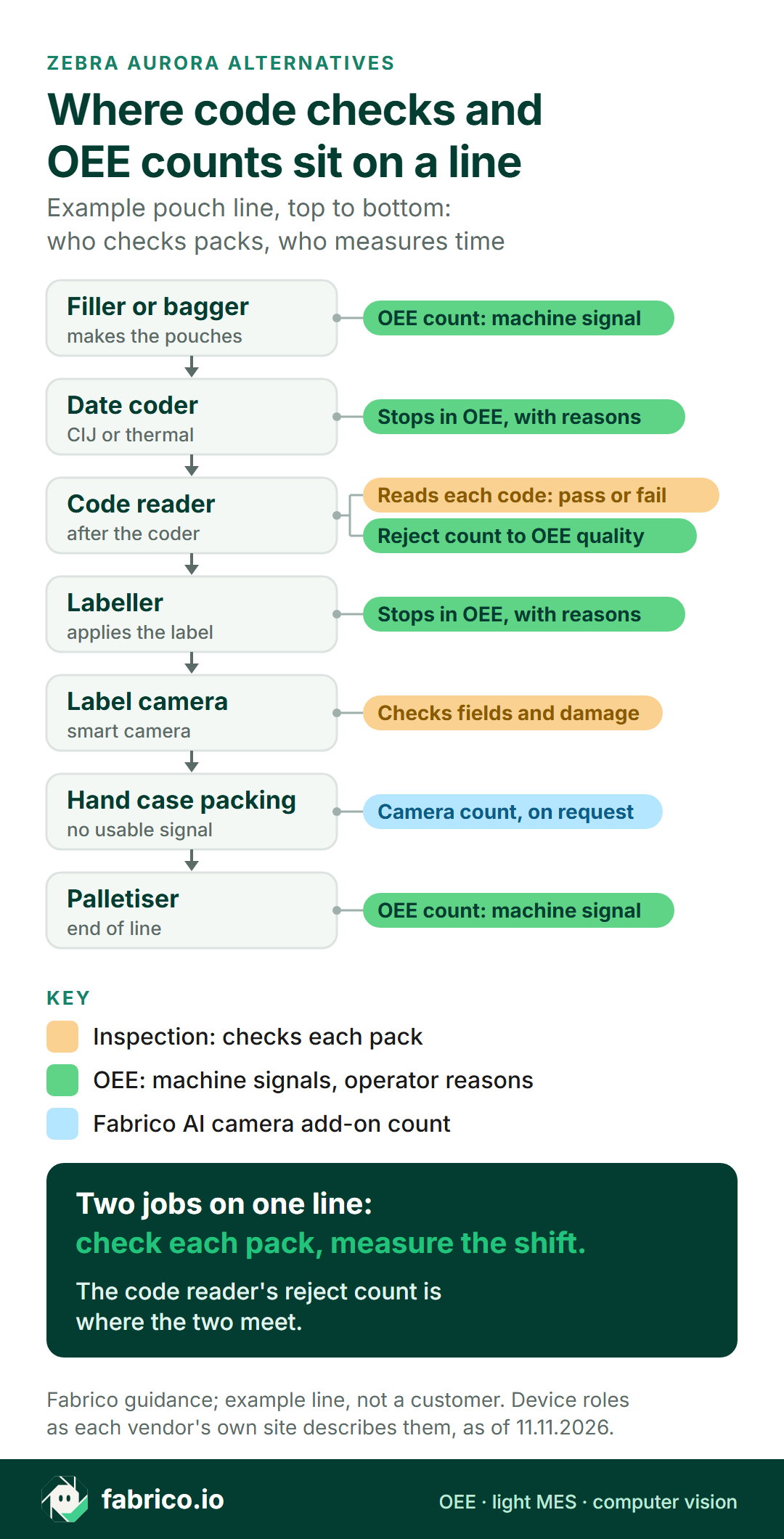
Each code job has its own device; the OEE job sits next to them. For the deeper split between pack checks and line measurement, see label and code inspection vs an OEE camera.
The same split, station by station, on an example pouch line:
Zebra and four alternatives side by side
Facts as of 11.11.2026, from each vendor's own site, linked in the sections below.
| Tool | What it is for, per its site | Codes and text, per its site | Devices |
|---|---|---|---|
| Zebra (for reference) | Track and trace, vision inspection | 1D, 2D, DPM codes; AI-OCR | FS scanners, VS cameras, NS42, Iris GTX |
| Fabrico | OEE and light MES | Not a code reader; takes reject counts | Machine signal; AI camera add-on on request |
| Keyence | Code readers and machine vision | AI code readers; OCR on IV sensors | Code readers, vision sensors, systems |
| Datalogic | Barcode reading, label checks | 1D and 2D codes, damaged labels | Matrix stationary scanners |
| Omron | FH vision system | 2D codes, OCR, digital watermarks | FH controllers and cameras |
Want to see coder and labeller stops next to rejects on a line like yours? Book a demo and bring a shift's reject log.
Fabrico: what the line lost, with code rejects in the quality figure
Fabrico, which wrote this page, is a cloud platform for OEE and light MES. A code reader asks whether each code is right; Fabrico asks what the line lost in a shift, where and why. Today, per its OEE and MES overview and camera OEE page:
- The machine signal from a PLC, a sensor or a counter gives stops and counts. A reject signal or count from your code reader can feed the quality part of OEE.
- Operators pick the stop reason on a tablet or phone at the line, so a printhead clean shows up with its own reason and minutes.
- Reports show OEE, downtime and losses in money per line and shift, on the web, iOS and Android.
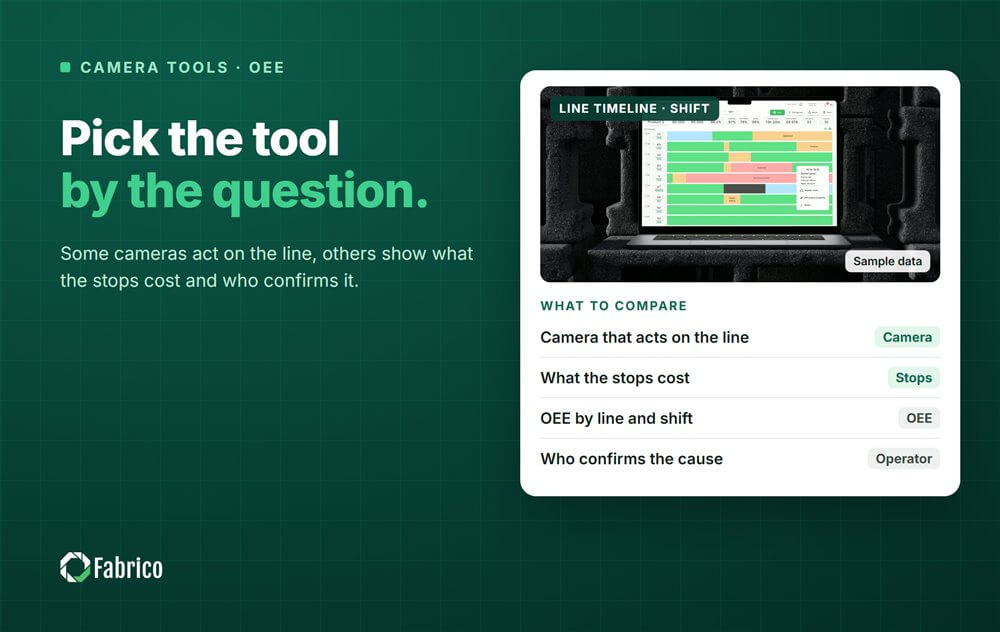
- The AI camera add-on, on request, counts output at stations with no usable signal, such as hand case packing. With the add-on, any moment on the shift timeline can be opened as camera video; in the standard setup the video is streamed on request and not stored in Fabrico.
- Exports run through a REST API, webhooks, and Excel or CSV files.
- Labelled roadmap: camera-detected stops, jam zones, and the camera suggesting a stop reason for the operator to confirm. None of these is live today.
- Not Fabrico: reading or verifying codes and labels.
For the stops a coder causes, see date coder and printer stops; for the labeller, see labeller OEE.
Fits plants that want coder, labeller and packer stops by line and shift next to their reject counts, per the product pages linked above.
Keyence: AI code readers and vision sensors that read text
Keyence's code reader page, as of 11.11.2026:
- The SR-X Series are AI-powered code readers. An AI chip, trained on a database of over 100,000 images, helps read difficult codes, per the page.
- Readers can be linked between processes, and the status and settings of readers on one network show in one list.
- Setup uses automatic focus and fully automatic tuning at the press of a button.
- For printed text, Keyence's vision sensors page says the IV Series can read characters (OCR).
Compared with Zebra: Zebra's Focus page describes one software across its scanners and smart cameras; Keyence's page describes automatic tuning on the reader and one list of networked readers. Ask each how settings are copied between lines.
Fits plants that want code readers, vision sensors and vision systems from one supplier, per Keyence's product pages.
Datalogic: Matrix scanners inside labellers and sleevers
Datalogic's primary packaging page for food and beverage, as of 11.11.2026:
- The ultra-compact Matrix 120 fits inside labelling or sleeving machines and checks labels in line on bottles, cans and jars.
- A circular array of Matrix 220 imagers, synchronised over Datalogic's ID-Net protocol, reads barcodes all the way around containers that arrive turned at random.
- Matrix 220 imagers are built to IP65 and IP67, and the Matrix 120 uses glass-free windows for food and beverage areas, per the page. The Matrix 120 includes DL.CODE configuration software.
- The Matrix 320 page says its 2MP model reads damaged labels and DPM codes, and its liquid lens models let you change focus remotely at a batch change.
Compared with Zebra: both sell fixed industrial scanners for traceability; Datalogic's food page focuses on label and sleeve checks. Ask each to test your labels and codes.
Fits plants that want barcode checks built into labellers and sleevers, or 360 degree reads on round containers, per Datalogic's food page.
Omron: code reading and OCR on the FH vision system
Omron's FH Vision System page (UK site), as of 11.11.2026:
- A dedicated algorithm reads 2D codes under changing light, or after processing or washing.
- OCR reads characters printed too close together or on curved surfaces.
- Through an alliance with Digimarc, FH and FHV7 devices decode digital watermarks, which the page says helps make sure the correct packaging is used.
Compared with Zebra: both pages cover code reading and OCR next to inspection. Ask each whether a code check and a defect check can share one camera or controller, and how the results reach your PLC.
Fits plants that want code reading, OCR and packaging checks on one vision controller, per Omron's FH page.
Which option fits your line
- One software across many Zebra scanners and smart cameras, with AI-OCR for dates and lot codes: Zebra Aurora Focus.
- Code readers and vision sensors from one supplier, tuned on the reader: Keyence.
- Barcode checks inside labellers and sleevers, or 360 degree reads on round containers: Datalogic.
- Code reading, OCR and watermark checks on one vision controller: Omron FH.
- Stops, speed and good output by line and shift, with code rejects in the quality figure: Fabrico.
For Cognex In-Sight, see our Cognex In-Sight review. For AI inspection platforms, see our Landing AI alternatives. For FMCG lines as a whole, see computer vision for FMCG manufacturing.
Worked example: two counters, one gap
Sample data for one 8 hour shift on a pouch line, not a customer's line or a product screen. Planned time is 480 minutes at an ideal 150 pouches a minute, so 72,000 pouches were possible. A CIJ coder prints the best-before date and lot code, and a code reader checks each pouch after it. The reader passes its counts to the line PLC. For the bagger's own stops, see VFFS bagger stops.
Stops took 48 minutes: a 30 minute changeover, 10 minutes of printhead cleaning and 8 minutes of film splices. Availability is 432 of 480 minutes, or 90.0%.
In 432 minutes the ideal is 64,800 pouches. The bagger counted 60,480, so performance is 93.3%.
The code reader saw 60,120 pouches, 360 fewer than the bagger made. It rejected 552: 420 with no read, 132 with the wrong code. Good output is 59,568 of the 60,480 made, so quality is 98.5%. OEE is 90.0% x 93.3% x 98.5% = 82.7%, the same as 59,568 good of 72,000 possible.
Of the 12,432 pouches lost, stops took 7,200 (1,500 of them during printhead cleaning), slow running 4,320, code rejects 552, and 360 left the line between the two counters without being seen.
Three lessons from this sample. The reader is a second counter: when it sees fewer pouches than the bagger made, packs leave between them, through samples, drops or hand removals. Split rejects by type: a no read often points at the printer or the reader set-up, a wrong code at the job setup after a changeover. And book the printhead clean as a stop with its own reason, so the coder's cost shows in minutes as well as rejects.
Before you rely on any count, compare it with a hand count for one shift; see camera OEE accuracy and the OEE calculation guide.
Questions to ask any code reading or OEE vendor
- Which codes and text must it read? 1D, 2D, DPM, printed dates, lot codes, allergen text.
- On which packs and print methods? Bring your worst samples: glossy, curved or flexible packs, and smudged codes.
- What does it send out? Pass or fail per pack, read and no-read counts, reject images: to which system, kept how long, seen by whom.
- Who changes the expected code at a changeover, and how is a wrong job caught before the first pallet?
- What does the pilot prove? Read rate and false reject rate on one line, against a manual check.
- What drives the quote? Stations, devices, licences for extra tools, mounting, network and training. Give every vendor the same list.
For camera counts instead, see AI visual counting in manufacturing.
What buyers ask next
What is Zebra Aurora Focus?
Zebra describes Aurora Focus as the on-device software that powers its fixed industrial scanners and smart vision sensors. It covers barcode reading and AI tools, including AI-OCR, AI classification and anomaly detection, set up in a drag-and-drop interface with over 35 tools.
Can Zebra Aurora read date and lot codes?
Zebra's date and lot code use case pairs Aurora Focus with the NS42 or FS42 for OCR, and its Focus page says the AI-OCR model is pre-trained on over 200 font families. Test it on your own worst-printed packs before you decide.
Is Aurora Design Assistant the same as Matrox Design Assistant?
Zebra's software page lists it as Aurora Design Assistant, formerly Matrox Design Assistant: a flowchart-based environment for building vision applications. Aurora Imaging Library was formerly Matrox Imaging Library.
How is Fabrico different from Zebra Aurora?
Zebra Aurora reads and verifies codes and runs vision tools on Zebra devices, per its site. Fabrico works on the line's time and output: stops and counts from the machine signal, reasons from operators, OEE and losses in money per line and shift, and an AI camera add-on, on request, for counts at stations without a signal. It does not read or verify codes.
How does Zebra Aurora send results to a PLC?
Zebra's Aurora Focus page says Focus sends data to PLCs and host networks, and its label verification use case lists EtherNet/IP, PROFINET, Modbus and CC-Link IE Field Basic for the Iris GTX. Ask how read and no-read counts reach your OEE system.
Want to see code rejects and coder stops on one timeline for a line like yours? Book a demo, or send us your station list first.



Real Fabrico tiles, sample data.