


 Login
 Blog
Computer Vision for Baby Food and Infant Formula: Cans, Jars, Pouches

In short: computer vision for baby food and infant formula lines, in OEE terms, means cameras that count cans, jars and pouches where no machine count exists, and camera video you can open for any moment on the shift timeline. It does not inspect, release product or keep your quality records.
- Seam, closure, vacuum, fill weight, foreign body and code checks are inspection jobs, owned by dedicated systems and QA.
- These lines lose time in validated cleans, market changeovers with line clearance, scoop and lid stops, and retort waits.
- In the US only, the infant formula rule on automatic equipment, 21 CFR 106.35, covers systems used in production or quality control, so agree the OEE system's job with QA before the pilot.
- Fabrico's AI camera add-on counts output and opens the video for any moment on the shift timeline. Stops come from the machine signal, and the operator adds the reason.
A formula can line or baby food pouch line looks like many packing lines. The difference is the rules around it, and the time that goes to cleans, clearance and checks.
This page is for engineers, plant managers and CI leads choosing cameras and OEE software for these lines. It covers counts and stops only, and makes no nutrition, health or compliance claims. Where it cites a rule, it links it, and your QA team decides how it applies.
Computer vision for baby food and infant formula: two different jobs
Two kinds of camera system get sold to these plants under one name. Inspection systems and QA checks look at the product and the packs, inline or by sample. OEE cameras count output and show you what happened at a stop. Keep them apart in the spec.
| Job on the line | Inspection or QA | OEE camera |
|---|---|---|
| Can seam and jar closure | Seam checks and closure inspection | No |
| Vacuum or headspace gas | Dud detection or gas checks | No |
| Fill weight | Checkweigher | No |
| Foreign bodies | X-ray or metal detection | No |
| Lot code and label | Code reader or vision | No |
| Count good cans, jars, pouches | Often counts what it checks | Yes, also at manual steps |
| Video of a stop | Reject images, not stop video | Open the video for that minute |
| Feeds OEE through | Its reject count | The output count |
The two work side by side. Read the inspection reject counts by signal, and they feed the quality rate in OEE, so a rejected can counts once. That rate is a performance measure, not a quality control record. For the line between the two jobs, read label and code vision vs an OEE camera.
What the rules mean for a camera project
Baby food and infant formula have rules of their own. A few of them matter for any camera or OEE project. This is not legal advice and not a full list. Rules as checked on 11.11.2026.
- EU: the European Commission says Regulation (EU) No 609/2013, on food for infants and young children, food for special medical purposes, and total diet replacement for weight control, "was adopted on 12 June 2013 and applies from 20 July 2016". It "sets general compositional and labelling rules", and delegated acts add specific ones for infant and follow-on formula and for processed-cereal based food and other baby food. The Commission's page lists no rule for line equipment.
- US only, inspections: the FDA says it "inspects facilities that make infant formulas annually".
- US only, equipment and computers: under 21 CFR 106.35, hardware means automatic equipment, computers included, "used in production or quality control of infant formula". A manufacturer "shall ensure that each system is validated prior to the release for distribution of any infant formula manufactured using the system", and that "any system that is modified is revalidated following the modification".
- US only, codes and traceability: 21 CFR 106.80 says: "Each production aggregate of infant formula shall be coded with a sequential number that identifies the product and the establishment where the product was packed and that permits tracing of all stages of manufacture of that production aggregate, including the year, the days of the year, and the period during those days that the product was packed, and the receipt and handling of raw materials used."
- US only, low-acid foods in sealed containers: for thermally processed low-acid foods in hermetically sealed containers, 21 CFR 113.60 says "regular observations shall be maintained during production runs for gross closure defects", and each container "shall be marked with an identifying code". Part 113 defines low-acid foods as foods "with a finished equilibrium pH greater than 4.6 and a water activity (aw) greater than 0.85", so QA confirms which of your products it covers.
What this means for a camera project, in plain terms:
- Decide the system's job with QA first. If the OEE system only measures stops and output for improvement work, write that down. If anyone wants its data in production or quality control, the validation rule may apply. That is QA's call.
- Ask QA about validated machines. US only: does a sensor or a PLC read on a validated filler or seamer count as a modification that needs revalidation? Settle it through change control before the pilot. Read-only PLC access keeps the change small.
- Closure checks stay with QA. OEE books their minutes under their own stop code.
- Records stay in your systems: batch records, release and traceability, in your quality system, ERP or specialised MES.
Where the losses hide on formula and baby food lines
Long validated cleans
A recipe change on a powder line can mean taking the filler apart, cleaning, inspecting and signing off. That clean is validated: measure it, never shorten it.
Book the clean with its own code inside planned production time, as an availability loss, so creep stays visible. Powder filling line OEE covers auger fillers, weight drift and dust.
Recipe, market and language changes
One can line often packs for many markets. A language, label or can size change is a changeover even when the powder stays the same, and it needs line clearance first.
See line clearance at changeover for the checklist, the photo evidence and how to time it.
Scoops, lids and the seamer
Powder cans are often flushed with nitrogen before seaming, and many get a scoop and a plastic overcap. The scoop placer and the lid applicator jam in short bursts. The seamer stops on lid supply and for seam checks.
Short, frequent stops are where video helps: open the minute before the stop and see whether the scoop, the lid or the can was at fault. The seamer's own stop modes are on can seamer OEE.
Food safety stops and holds
A foreign body alarm, a seam out of limits or a sensor fault can stop the line and put product on hold. See food safety stops in OEE for how to book the time and the held product.
Jars and pouches: waiting for the retort
On jar and pouch lines that heat treat in a retort, the filler and capper can run fast, then wait for a free basket. Book that wait as blocked time, not as a filler fault. Computer vision for canned food lines covers lines built around a retort.
Pouch lines add hand steps: loading retort trays, unloading them, packing multipacks. A hand step has no count, which is where a camera pays off. Liquid formula lines share more with dairy fillers; see computer vision for dairy processing.
Hygiene zones and camera mounts
Put OEE cameras where the product is already closed: after the seamer or capper, at the case packer, at the pouch tables. Keep them out of the open powder area unless QA asks for one there. Agree every mount, housing and cleaning method with QA before anyone drills, and check the housing against your glass and brittle plastics policy.
Where a camera goes on a formula can line and a pouch line
Here is one example: a powder can line and a baby food pouch line.
Camera, sensor or operator: station by station
Typical, not a rule: check each machine and each mount with QA.
| Station | Count and stops from | What a camera adds |
|---|---|---|
| Can infeed and cleaning | Machine PLC or a sensor | Little. Use the signal. |
| Auger filler | Filler PLC | Little. Keep the open powder area clear. |
| Seamer with nitrogen flush | Seamer PLC | Video at the lid feed, if QA agrees the mount |
| Scoop placer and overcap | Machine PLC, if it has one | Video of scoop and lid jams |
| Checkweigher, X-ray, code reader | Its own reject count | Nothing. Feed rejects to quality. |
| Case packer | PLC, if you can reach it | Count at the infeed if you cannot |
| Jar filler and capper | Filler PLC | Video of capper stops |
| Retort trays, pouch tables | Nothing, or a tally sheet | Count of pouches or trays |
| Stop reasons, all lines | The operator, on a tablet or phone | Video to check a disputed reason |
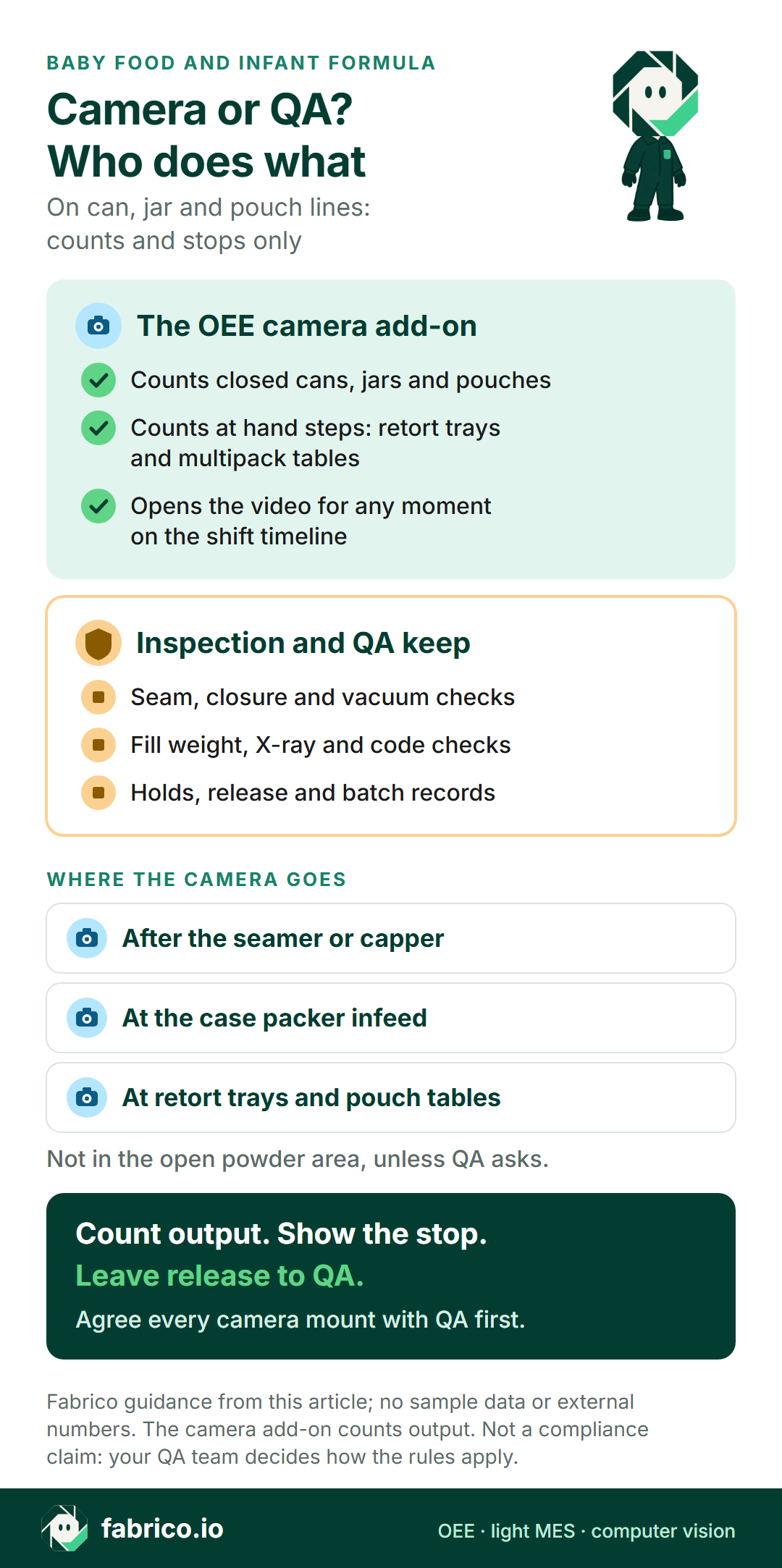
The card below sums up what the camera does and what stays with QA.
Book a demo, bring your station list and one week of stop sheets, and we will go through it station by station.
Worked example: a formula can line with a recipe change
These are example numbers, and they describe no real plant. A powder can line with an ideal rate of 60 cans a minute runs one 480-minute shift with a recipe change inside it. The seamer PLC gives the run state and the count of cans seamed. When the scoop placer jams, the seamer is blocked, and the operator codes the stop to the scoop placer. A camera at the case packer infeed counts the cans that reach it, after the inspection rejects.
Stops took 145 minutes. The recipe change took 110: 90 for the validated clean and 20 for line clearance. Short stops at the scoop placer took 22, and one seamer jam took 13. Run time is 335 of 480 minutes, so availability is 69.8%.
At 60 a minute, 335 minutes could make 20,100 cans. The seamer counted 18,060, so performance is 89.9%. The gap is 34 minutes of slow running.
The camera counted 17,700 cans at the case packer, so 360 went to reject. Quality is 98.0%.
OEE is 69.8% x 89.9% x 98.0% = 61.5%. Check it the short way: 17,700 good cans at 60 a minute is 295 minutes of perfect running, and 295 of 480 is also 61.5%.
The clean is the biggest loss, and not one you shorten. Look instead at the 20 minutes of clearance, the slow restart and the 22 minutes of scoop stops that nobody writes down. If your plant books cleans as planned downtime, say so on every report.
Eight checks for any baby food or formula camera vendor
Run these with every vendor, us included, on one real shift from last week.
| Ask | How to test the answer |
|---|---|
| What is the system for? | Ask the vendor to state in writing whether its data is meant for production or quality control. Agree it with QA. |
| Where does each camera mount? | Ask for each position on a drawing, outside the open powder area, and get QA sign-off. |
| What exactly does it count? | Cans, jars, pouches, multipacks or cases? Run it next to a hand count for a shift. |
| How is a clean booked? | Ask for a clean code inside planned production time, and minutes over standard per clean type. |
| How are changeovers timed? | Last good can to first good can at full speed, with clearance as a step. |
| How do inspection rejects get in? | Ask if reject counts feed quality by signal, so a can counts once. |
| Is video kept, and who can open it? | Ask where it lives, for how long, and who sees it. |
| How does the data leave? | Ask for an API or export, so QA can read stops next to its own records. |
Pilot one line first: see our guide to a computer vision OEE pilot.
Privacy, gowns and the works council
Gowns and hairnets do not make people anonymous, and a camera on a pouch table will see hands. Tell staff before any camera goes up, and in many European countries talk to the works council first. Frame the camera on the cans, trays or table top, and report by line and shift, not by person.
Ask each vendor, us included, what privacy masking is live today and what is roadmap. Fabrico's camera add-on counts product, not people. See production line cameras without surveillance.
Where Fabrico fits on a formula or baby food line
Fabrico is a cloud OEE and light MES platform. Here is what it does on these lines today.
- Stops and counts: from the machine signal, through the PLC, a sensor or a counter.
- Stop reasons: the operator adds them at the line, on a tablet or phone.
- OEE and losses: OEE, downtime and losses by line and shift, with losses shown in money. On the web, iOS and Android.
- Cameras, an add-on on request: AI cameras count output, including at retort tray loading, pouch tables and on machines with no usable signal. You can open the camera video for any moment on the shift timeline. In the standard setup, video is streamed on request, not stored in Fabrico.
- Your data: it leaves through a REST API, webhooks and Excel or CSV export.
Roadmap, not live today: stops detected by the camera, jam zones on the video, and a camera suggesting a stop reason.
What Fabrico does not do: inspection, product release, batch records or traceability codes. Those stay with your inspection systems and QA. Fabrico makes no compliance or validation claim. If QA decides the OEE system falls under a validation rule, raise it before you buy, with us and every vendor. Production planning is on our roadmap, with no release date. Today Fabrico does not build or schedule your plan: it shows what the lines can do.
See the Fabrico camera add-on for OEE for the product, and our guide to OEE software if you are still comparing. Other sectors start at computer vision for FMCG manufacturing and computer vision for food manufacturing. All eight checks apply to us too.
What people ask next
Can an OEE camera replace seam or vacuum checks?
No. Seam, closure, vacuum, fill weight and code checks belong to inspection systems and QA. An OEE camera counts output and shows video of stops. The reject counts from those checks can feed the quality part of OEE.
Does the camera need to sit in the open powder area?
Usually not. The output count works where the can is already closed, after the seamer or at the case packer infeed. Keep the open powder area free of OEE cameras unless QA asks for one, and agree every mount with QA.
Does an OEE system on an infant formula line need validation?
That depends on what it is used for, and QA decides. In the US only, 21 CFR 106.35 covers automatic equipment, computers included, used in production or quality control of infant formula. Write down the OEE system's job before the pilot.
Can a camera count pouches loaded into retort trays by hand?
Yes. Counting output at manual steps is a main use of Fabrico's AI camera add-on. It counts the pouches or trays at the station, and the people there add the stop reasons.
Is the camera video stored?
Not in the standard setup. Video is streamed on request, and you can open it for any moment on the shift timeline. Ask every vendor where their video lives and who can open it.
What drives the cost of computer vision on a formula or baby food line?
Pricing is set per quote. The drivers are lines and cameras, housings and mounts QA accepts, the network and training. Give each vendor the same list of lines and stations so the quotes compare.
Want to see it on a line like yours? Book a demo and bring one shift from a can, jar or pouch line.
Related articles








Real Fabrico tiles, sample data.