
Evocon and Fiix represent two of the most popular standalone platforms in their respective categories for European and international mid-market manufacturers. Evocon provides reliable OEE monitoring with a straightforward machine connectivity approach and strong European customer base. Fiix provides mature CMMS functionality with Rockwell Automation backing and a clean user interface.
See our roundup of affordable CMMS software.
Together, they form one of the most common two-tool stacks for manufacturers who have deployed OEE and CMMS separately.
The combined licensing picture for a 10-line plant with a 15-person maintenance team: an Evocon subscription priced per monitored line, plus a Fiix Professional subscription priced per user, two contracts invoiced and renewed separately, with each vendor quoting on request.
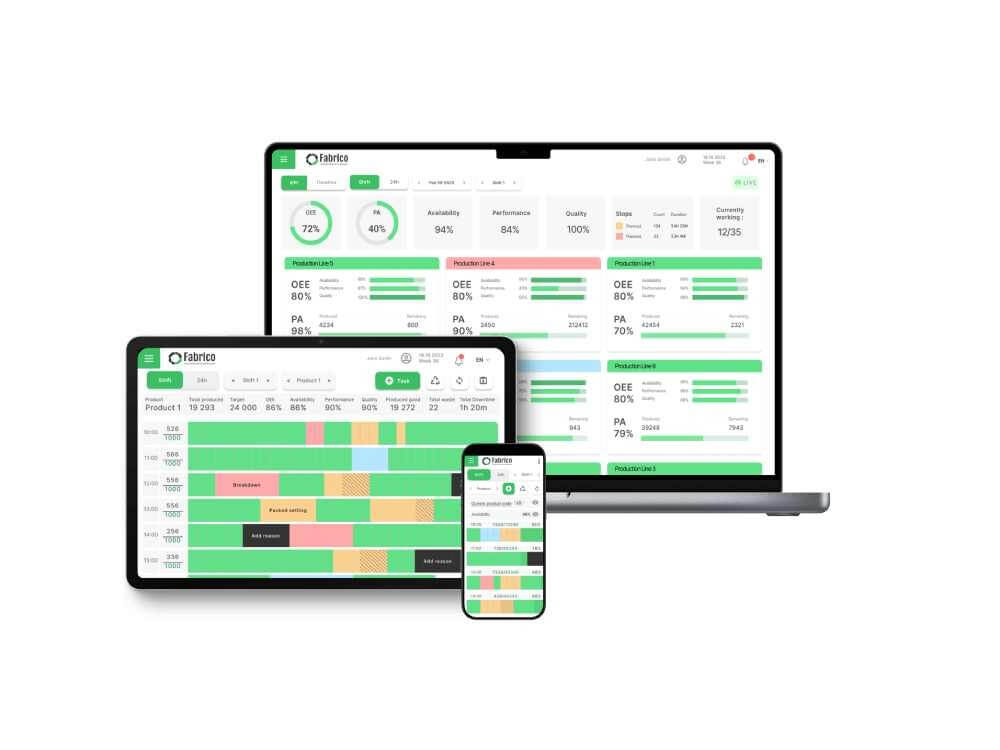
Fabrico is a cloud-based MES and OEE platform for manufacturers, with maintenance management (CMMS) built in, so at comparable scope it runs as a single subscription, one license line instead of two, before any integration cost comparison.
Connecting Evocon and Fiix for automated downtime-to-work-order workflow requires custom API integration.
Both platforms have REST APIs, but building a reliable integration that creates CMMS work orders from OEE downtime events, synchronizes asset data between systems, and presents unified OEE-maintenance reporting requires 60 to 120 hours of development work from an integrator at prevailing developer rates.
The integration must be maintained as both platforms release API updates: typically another 10 to 20 developer hours every year.
The data quality limitation that limited integration fully resolves: Evocon tracks downtime against production line and machine identifiers in its data model; Fiix tracks work orders against asset IDs in its CMMS data model.
Keeping these asset identifiers aligned requires a master data governance process that takes 1 to 2 hours per week. Over three years, the integration build plus this recurring upkeep adds up to a budget line of its own, on top of both licenses.
The three-year comparison, then: two subscriptions plus an integration budget for Evocon plus Fiix, against a single integrated subscription for Fabrico. Request current written quotes from each vendor to put numbers on it for your plant.
Despite the cost and integration disadvantages, the Evocon plus Fiix combination wins in two scenarios.
Deep existing Fiix investment: manufacturers with 3 or more years of Fiix history, high technician adoption, and a well-configured PM program should not migrate to a new CMMS just to achieve OEE integration.
The migration risk and cost (data migration, retraining, adoption risk) outweigh the integration benefit. In this case, adding Evocon with a focused integration investment is the right path.
Specific Evocon capability requirement: Evocon has particularly strong machine connectivity for specific European equipment types and a user experience that resonates with operator-level data entry in certain manufacturing cultures.
If a manufacturer has evaluated both approaches and finds Evocon provides genuinely superior OEE data quality for their specific equipment environment, the capability advantage may justify the integration cost premium.
For new deployments and manufacturers at contract renewal where both tools would be deployed or switched simultaneously, the integrated platform consistently delivers lower three-year TCO and better data quality.
See how Fabrico unifies OEE and maintenance in one platform.
Request a demo












 Login
Login
 Blog
Blog