


 Login
 Blog
Hershey's Salty Snack Demand Outruns Supply: What Plants Can Do Before New Lines Arrive

News, 11 November 2026. Every news figure below comes from a linked source, and the full list is at the end.
In short: Hershey's salty snacks are selling faster than its plants can make them. On 29 October 2026 the company reported 22.3% sales growth for the unit, about 20 points of it from the LesserEvil acquisition, while its segment income fell 17.9%. New lines are due in the first half of 2027.
- When demand runs ahead of supply, an hour lost on a running line is a lost sale, not a saved cost.
- New lines take months. The output you can win this quarter sits in the gap between what today's lines could make and what they make.
- Below: what Hershey said, what it means for any sold-out line, and three steps to take now.
What Hershey reported in late October 2026
Hershey published its third-quarter results on 29 October 2026. In its results release, North America Salty Snacks net sales were $392.7 million, up 22.3%. About 20 points of that growth came from the LesserEvil acquisition, with about 1 point each from price and volume. Organic growth at constant currency was 2.3%.
Profit went the other way. Segment income fell 17.9% to $47.4 million. The release names higher freight, logistics and manufacturing costs, higher net commodity costs and more consumer marketing. Segment margin was 12.1%, down 590 basis points. Company-wide, net sales rose 3.0% to $3,275.5 million.
The supply side came out on the earnings call. Food Dive reported on 30 October that supply constraints on Dot's Pretzels and multipacks have hurt production for at least two quarters. Service levels improved in the third quarter, but more slowly than Hershey expected.
CEO Kirk Tanner told analysts: "Demand is definitely outstripping supply, but we are catching up." Food Dive also reported that new manufacturing lines should start running in the first half of 2027, and that Hershey is investing in automation for single-serve and multipack formats.
For scale, Food Dive cites Circana data putting Dot's at $626 million in sales over the last year, and reports that Dot's third-quarter retail sales rose 9%.
What it means for plant managers
Most plants are run as if demand were the limit. Downtime then costs labour and energy, and a slow shift can be made up later.
When demand is higher than supply, that changes. An hour lost on the constrained line is product that never ships, and the margin on it is gone for good.
Chasing demand also costs money in itself: overtime, rush changeovers, expedited freight. Hershey's release names freight, logistics and manufacturing costs, along with commodity costs and marketing, without breaking them down. We do not know the causes inside its plants and make no guess about them.
The general lesson holds for any plant in this position. New lines are the long-term answer, and they are months away. The short-term answer is the lines you already run.
How much is on a running line? A worked example
Example data, not Hershey's. A pretzel bagging line is rated at 60 bags a minute. It runs three shifts with 450 planned minutes each, so 1,350 planned minutes a day.
| Line OEE | Good bags a day | Change |
|---|---|---|
| 60% (today) | 48,600 | baseline |
| 63% | 51,030 | +2,430 bags (+5.0%) |
| 65% | 52,650 | +4,050 bags (+8.3%) |
The math: 1,350 minutes x 60 bags = 81,000 bags at 100% OEE, so each OEE point is 810 bags a day on this line. Five points is +8.3% output with no new equipment, while the new line is still on order.
Three steps to take this month
- Find the constrained line and measure it first. Pick the lines whose output is already sold. Extra output elsewhere only builds stock. Our page on capacity vs throughput explains the difference.
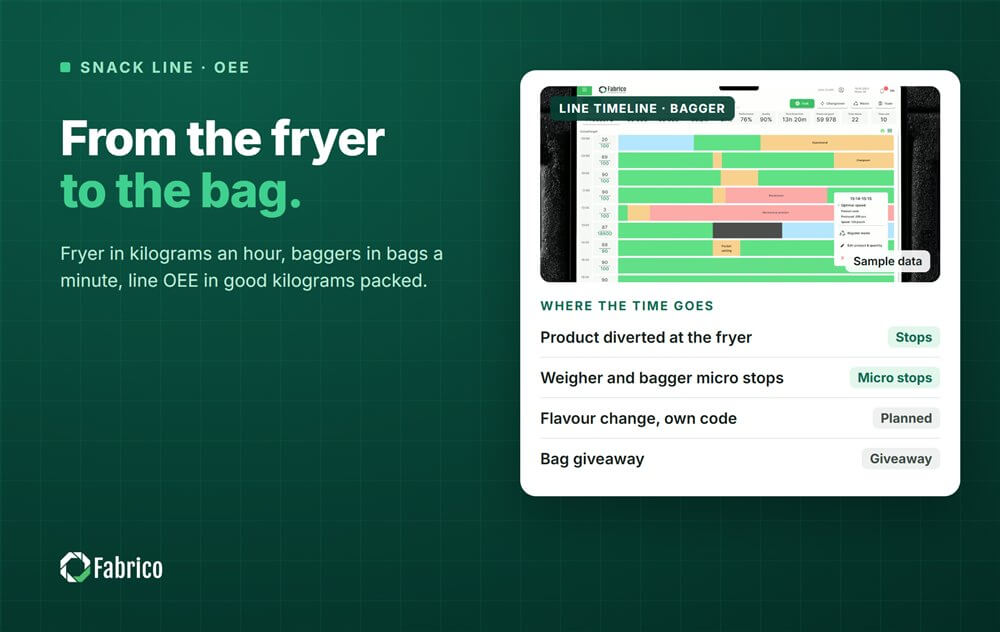
- Split the gap for two weeks, per shift. Record planned time, every stop with a reason, speed against the rated speed for each product, and rejects. On high-speed bagging and multipack lines, short stops are often the biggest hidden loss. See micro-stops on packing lines.
- Protect the constraint every shift. Keep it running through breaks and shift changes, sequence changeovers to cut their number, and give the top stop reason an owner by name. The full method is in our guide to hidden capacity before buying a production line.
Where OEE, cameras and light MES help
OEE splits the gap into three parts: availability (stops), performance (slow running and short stops) and quality (rejects). That tells you which fix to fund first.
A light MES gives each stop a reason at the line, so the shift leader sees the top loss the same day, not at month end.
Some stations have no machine count, such as a manual multipack or case-packing table. There, an AI camera (an add-on) can count output per hour, so the constrained step is measured like the rest. When the new lines arrive, the same measures give you a start-up baseline from the first week.
How Fabrico does it
Fabrico is a cloud OEE and light MES platform. Stops come from the machine signal, operators add the reason on a tablet or phone, and OEE and losses in money show by line and shift. Where a station has no count, AI cameras (an add-on) count output, and you can open their video for any moment on the shift timeline. The video is streamed on request, not stored. We have no link to Hershey and know nothing about its lines; this is simply how we would measure a sold-out line in any snack plant.
Have a line that sells everything it makes? Book a demo and bring two weeks of its stop log.
What people ask next
Why can't Hershey make enough salty snacks?
Food Dive reported on 30 October 2026 that supply constraints on Dot's Pretzels and multipacks have hurt production for at least two quarters, and that service levels recovered more slowly than Hershey expected. The sources we read give no further detail on the causes inside its plants.
When will Hershey's new salty snack lines start?
According to Food Dive's report of the earnings call, new manufacturing lines are expected to begin running in the first half of 2027.
How much output can an existing line add?
It depends on the line, so measure it. On a line rated at 60 units a minute with 1,350 planned minutes a day, each OEE point is 810 units a day. That is example data; your own stop log gives the real figure. See our guide to hidden capacity.
Sources
Checked on 11 November 2026. Dates are the publication dates shown on each page.
- Hershey, third quarter 2026 results release (SEC Form 8-K, exhibit 99.1), 29 October 2026
- Food Dive, Hershey's salty snacks can't keep up with demand, 30 October 2026
Related articles


Latest from our blog



Real Fabrico tiles, sample data.