


 Login
 Blog
Shampoo and Tube Lines on Camera: Short Stops Across Personal Care SKUs

Key takeaways
- Personal care lines run many SKUs in short runs, so changeovers and the first minutes after them carry much of the loss.
- Pumps and flip caps jam in the feed. Tubes turn, fall or fail the crimp at the filler outfeed.
- A camera at each feed marks the stop with a short clip. The operator confirms the reason in one tap.
- Report OEE by SKU: a line average hides the formats that cost most.
- On a sample line, the pump SKU did not have the lowest OEE, but it cost the most: $25,920 a week.
On shampoo, shower gel and tube lines, short stops pile up after each changeover. Most start at the cap and pump feed and at the tube filler outfeed. Track them by SKU (stock keeping unit) and rank them by money, and the formats that cost most stand out.
Fabrico is OEE (overall equipment effectiveness) and light MES (manufacturing execution system) software, with AI cameras as an add-on. A camera at each feed marks the stop and keeps a short clip, and the operator confirms the reason in one tap. For the wider picture, see our guide to MES for cosmetics manufacturing.
Why do personal care lines stop so often?
Because they change so often. One shampoo base can run in several bottle sizes, scents and closures. Runs are short, and each change resets the line.
A changeover runs from the last good unit of one SKU to the first good unit of the next at rated speed. It covers cleaning, format parts, settings and ramp-up. The trouble often goes on after it: the first part of each run brings a burst of short stops while the new parts settle.
A pump that jams for 40 seconds is cleared and rarely reaches a paper log. Our guide to changeover video analysis covers the changeover itself.
What jams at the cap and pump feed?
Each closure type jams its own way:
| Closure or station | Typical stop | What the clip shows |
|---|---|---|
| Pump dispensers | Dip tubes tangle in the sorter, pump not seated, actuator facing the wrong way | A pump stuck in the chute, or a bottle leaving without one |
| Flip caps | Lid opens in the feed, cap upside down, hinge caught in the chute | An open or turned cap at the pick-off |
| Screw caps | Misfeed, crooked cap, torque fault | A cap at an angle before the capping head |
| Tube filler outfeed | Tube falls or turns at the transfer, crimp reject | A fallen tube, or rejects piling up at the chute |
Pumps are the hardest: long, light, easy to tangle, and the actuator often has to face one way. Many lines run pump SKUs slower to keep the feed going. That is a speed loss, and it needs its own reason.
What goes wrong at the tube filler outfeed?
The full list of tube filler stops is in our guide to OEE for tube filling lines. Two matter most for a camera:
- Tube orientation. A tube turned in its holder gets its seal in the wrong place.
- Crimp and seal faults. A weak or creased crimp sends the tube to rejects, often in a run after a tube size change.
A camera at the outfeed sees tubes fall at the cartoner transfer and rejects pile up. Tie each clip to the SKU that was running, so stops can be counted by format.
Why do the first minutes after a changeover matter so much?
That is where new format parts, settings and closures meet for the first time. A sorter set for the last bottle, a guide moved by hand, a new lot of caps: each brings short stops until the line settles.
Split every run into two windows:
- The start-up window: the first 30 minutes after the first good unit at rated speed.
- The rest of the run.
Count stops per hour in each. If the start-up window carries many more, the problem sits in the changeover standard, not in the machine.
Where should the cameras point on a personal care line?
- Cap and pump feed: the chute exit and the pick-off, where the closure meets the bottle neck.
- Tube filler outfeed: the transfer to the cartoner and the reject chute.
- Look down on the product path, with faces out of the frame.
- Check the view after each format change. Clear bottles and shiny caps need steady light.
Start where the PLC (programmable logic controller) tells you least. It often logs one "closure fault" for very different stops.
How do you read OEE by SKU?
Give each SKU its own rated speed. Then calculate its OEE from its good units, its rated speed and its planned minutes, and price the lost units at that SKU's contribution.
Reporting by line and shift but never by SKU hides the formats that cause most stops. In Fabrico, losses are ranked by money, so the board shows which station and which SKU cost most this week. See our guide to the value of an OEE point by SKU.
Worked example: which SKU costs most on a sample personal care line?
Sample line (illustrative numbers, not a customer): a shampoo and shower gel bottle line, one week of 10 shifts with 450 planned minutes each, or 4,500 minutes. It runs 4 SKUs with 12 changeovers. Contribution per bottle is in the table, for example $0.60 for B (or €0.60 in a euro plant).
| SKU and closure | Planned minutes | Rated a minute | Good bottles | OEE | Lost a week |
|---|---|---|---|---|---|
| A: shampoo 250 ml, flip cap, $0.25 a bottle | 1,500 | 120 | 129,600 | 72% | $12,600 |
| B: shampoo 400 ml, pump, $0.60 a bottle | 1,200 | 80 | 52,800 | 55% | $25,920 |
| C: shower gel 500 ml, flip cap, $0.30 a bottle | 1,200 | 100 | 81,600 | 68% | $11,520 |
| D: conditioner 200 ml, flip cap, $0.25 a bottle | 600 | 120 | 36,000 | 50% | $9,000 |
| Line, total | 4,500 | 300,000 | 63.5% | $59,040 |
- OEE per SKU = good bottles / (planned minutes x rated speed). For B: 52,800 / (1,200 x 80) = 52,800 / 96,000 = 55%.
- Lost bottles = planned minutes x rated speed minus good bottles. For B: 96,000 minus 52,800 = 43,200. At $0.60: $25,920 a week.
- Line OEE = good minutes at rated speed / planned minutes = (1,080 + 660 + 816 + 300) / 4,500 = 2,856 / 4,500 = 63.5%. It hides a spread from 50% to 72%.
- D has the lowest OEE, but B costs almost three times as much.
Now the clips. B had 3 changeovers, 150 minutes in all, so its runs had 1,050 minutes. The cameras marked 120 pump feed stops of about 40 seconds: 80 minutes, or 6,400 bottles, or $3,840 a week.
- 36 of those stops fell in the 90 minutes of start-up windows: 24 stops an hour.
- The other 84 fell in the remaining 960 minutes: 5.25 stops an hour. Stops came more than 4 times as often in start-up.
- Over 48 weeks, pump feed stops on B alone cost $184,320.
Ranked by OEE, the team would start with D. Ranked by money, they start with B, and the clips point to the pump sorter after each change. The first fix is a written sorter setting per bottle size.
The money counts only if the line is sold out, or if the lost bottles cost overtime to make up. Agree that rule with your controller first.
What can a camera not do on a personal care line?
- See past its field of view. It covers one feed, not the inside of the filler.
- Work in any light. Clear bottles, shiny caps and metal tubes cause glare.
- Judge torque, fill weight or seal strength. The machine checks still do that.
- Decide the cause alone. It suggests, and the operator confirms.
Point it at the closures and the tubes, never at the crew. Report by line, shift and SKU, never by person. Our guide to line cameras without surveillance covers the works council questions.
Where Fabrico fits
Fabrico is a computer vision enabled Manufacturing Performance Platform. OEE and light MES come first, and cameras are an add-on.
- Automatic downtime logging from the filler, capper and cartoner signals.
- A camera clip as evidence for a stop at the cap and pump feed and the tube filler outfeed.
- The operator confirms the reason in one tap.
- Every loss priced in money, and losses ranked by money by station and SKU.
- OEE live by line and shift, and one view across plants.
Named results: ABB, 20% less downtime, and Ficosota (see the Ficosota story).
You start with a pilot on one line. Devices are connected in about a month, and the full rollout takes 3 to 4 months. There is no free plan and there are no tiers: each plant gets a quote. See the computer vision OEE and MES page, or our guide to OEE software for cosmetics and personal care.
Frequently asked questions
Why do pump bottles stop the line more than flip caps?
Pumps are long, light parts with a dip tube that tangles in the sorter and the chute. Many need the actuator facing one way. A new pump lot or a setting left from the last format brings a run of jams. Code pump stops apart from cap stops.
How long is the start-up window after a changeover?
No standard sets it. Pick one window, such as the first 30 minutes after the first good unit at rated speed, and use it on each line. Compare stops per hour inside and outside it. A big gap points at the changeover standard.
Should changeovers count against OEE on a personal care line?
Yes. Count them as an Availability loss, or as planned time only within a written standard per format pair, with each minute over it coded. Hiding them in planned time makes a high-mix line look better than it runs, and hides the SKUs that change most.
Does the camera check tube seals or fill weight?
No. Seal checks, checkweighers and torque checks decide what passes. A camera at the tube filler outfeed marks stops, falls and reject build-ups with a clip, and the operator confirms the reason in one tap. The machine checks stay the judge.
See your personal care line's SKU losses in a demo
Bring one line, its SKU list and last week's report. We will show which formats and which stations cost most, with the clips.
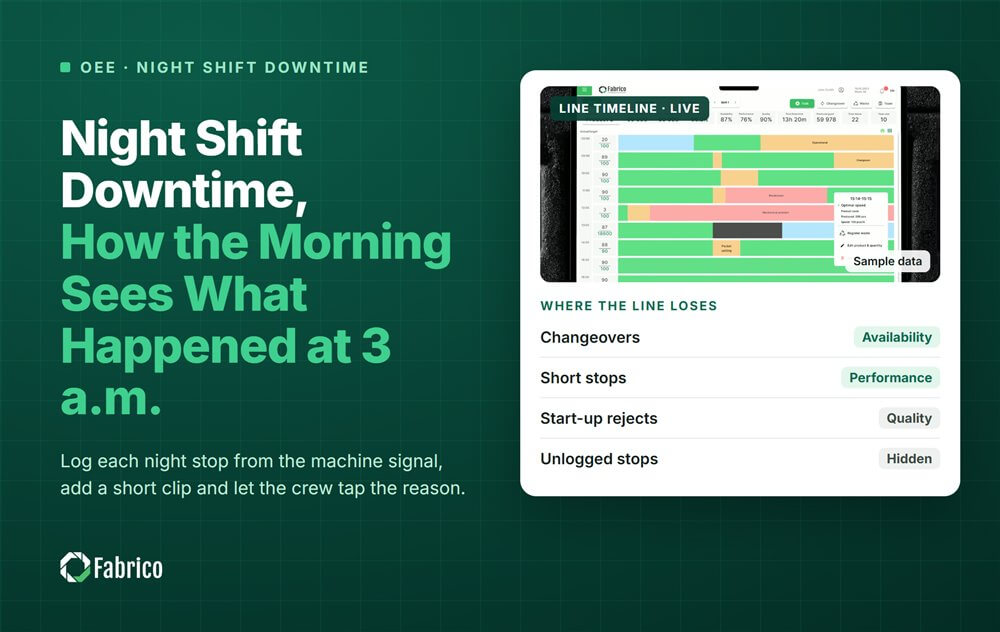


Real Fabrico tiles, sample data.