


 Login
 Blog
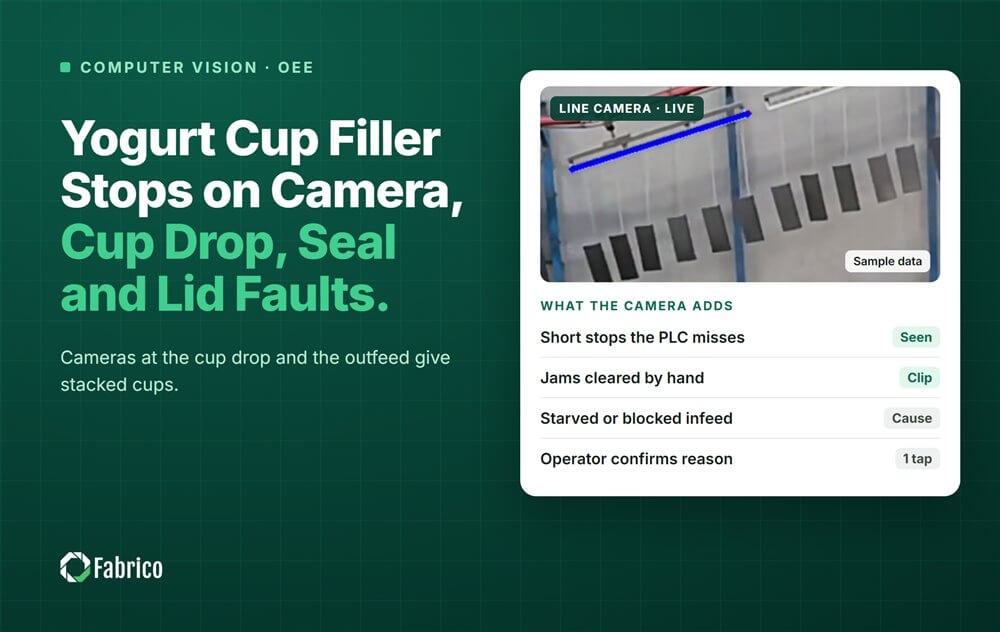
Yogurt Cup Filler Stops on Camera: Cup Drop, Seal and Lid Faults

Key takeaways
- Many short stops on a yogurt cup filler start at the cup drop: stacked cups, stuck stacks and empty pockets.
- The machine often files different seal problems under one "seal station fault".
- Cameras at the cup drop and the outfeed give each stop a short clip. The operator confirms the reason in one tap.
- In the wet filling zone, mount cameras outside the guarding and never above open cups.
- On a sample line, the cups owned the most lost minutes, and the old log never showed it.
Stacked cups, missed cup drops and seal faults cause most short stops on a yogurt cup filler. A camera at the cup drop and one at the outfeed mark each stop with a short clip. The minutes then land on the right owner: the cups, the nozzles, the foil or the multipacker.
Fabrico is OEE (overall equipment effectiveness) and light MES (manufacturing execution system) software, with AI cameras as an add-on. Each camera event joins the filler's timeline with its clip, and the operator confirms the reason in one tap. This guide covers stops on the cup machine itself, not CIP or flavour changes.
How does a yogurt cup fill and seal machine run?
Most cup machines work in cycles, with several lanes side by side. Each cycle moves a row of cups through five steps:
- Cup drop: cups leave the magazine stacks and drop into pockets on a carrier.
- Fill: dosing nozzles fill each cup.
- Foil seal: a foil lid is heat sealed onto the cup rim.
- Lid and code: a snap-on lid where the product has one, and a date code.
- Outfeed: rows of cups leave for the multipacker.
The cup filler sets the pace, so a minute lost there is a minute of cups the shift cannot get back. Machines that form cups from a plastic web are covered in our thermoforming OEE guide.
Why do cup drop and seal stops hide in the log?
- They are short. An operator lifts out a double cup or taps a stuck stack loose, and the machine restarts in under a minute. Many OEE tools filter those out.
- A missed cup is often not a stop. The machine skips the fill on an empty pocket and carries on, one cup short.
- The seal station has few sensors. Its PLC (programmable logic controller) sees foil present, temperature and pressure. A foil off center and product on the rim can both end as "seal station fault".
Our guide to micro stops and computer vision shows how short stops add up.
Where can a camera go in a wet, hygienic filling zone?
On a dairy line, camera placement is a hygiene decision first. Agree each position with the hygiene team before anything is drilled.
- Never above open cups. Nothing new should hang over open product. Mount to the side and angle in.
- Outside the guarding where you can, looking in through the panel at an angle that keeps reflections off it.
- Made for washdown. Water and foam reach every surface, so use a washdown housing with no flat tops.
- Watch for fog. Cold product and warm wash water fog a lens. Check the view after each clean.
- Tame the glare. White cups and shiny foil reflect light, so keep lamps off the foil.
Our guide to camera placement and lighting covers angle, height and distance.
What do the cup drop and outfeed views show?
The cup drop view looks at the pockets just after the drop, and the outfeed view at sealed cups leaving the machine.
| Machine code | View | What the clip shows | Owner |
|---|---|---|---|
| Cup feed fault | Cup drop | Two cups stacked in one pocket | Cup supply and storage |
| Cup feed fault | Cup drop | Cups hanging in the magazine, a lane empty | Cup stacks, magazine refill |
| None | Cup drop | An empty pocket, the fill skipped | Cups or cup drop settings |
| Seal station fault | Outfeed | Product smeared on the foil edge | Filling nozzles |
| Seal station fault | Outfeed | Foil placed off center | Foil and foil magazine |
| Outfeed jam | Outfeed | A crooked lid caught on the guide | Lid station |
| Outfeed full | Outfeed | Rows of cups backed up | Multipacker (blocked) |
Stacked cups often trace back to the cups: out of round, stuck by static, or stored damp. Without a clip, that loss lands on the filling crew.
Each stop is marked by the machine signal or the camera, and a short clip stays with it as evidence. The screen suggests a reason, and the operator confirms it in one tap. The camera also counts the cups, so empty pockets show up as lost output. Our computer vision and PLC comparison explains when each source wins.
Worked example: what do cup filler stops cost on a sample line?
Sample line (illustrative numbers, not a customer): a fill and seal machine with 6 lanes at 20 cycles a minute, so 120 cups of 150 g a minute. Planned production time is 450 minutes a shift, after CIP (clean in place). The old OEE tool ignores stops under 60 seconds.
With each reason confirmed by the operator, the two views showed this:
| What the clip showed | View | Stops | Minutes | In the old log |
|---|---|---|---|---|
| Two cups stacked in one pocket | Cup drop | 12 x 50 seconds | 10 | No |
| Cups hanging in the magazine | Cup drop | 8 x 45 seconds | 6 | No |
| Pockets left empty | Cup drop | 480 cups not made | 4 | No |
| Product on the foil edge | Outfeed | 8 x 90 seconds | 12 | Seal station fault |
| Foil placed off center | Outfeed | 6 x 90 seconds | 9 | Seal station fault |
| Crooked lid caught on the guide | Outfeed | 10 x 30 seconds | 5 | No |
| Outfeed full, multipacker stopped | Outfeed | 2 x 7 minutes | 14 | Outfeed full |
| Total | 60 | 35 |
- Availability, old log = (450 minus 35) / 450 = 415 / 450 = 92.2%.
- Availability, with the clips = (450 minus 56) / 450 = 394 / 450 = 87.6%. The 4 minutes of empty pockets sit in Performance.
- Lost output: 60 minutes x 120 cups = 7,200 cups a shift.
- At a contribution of $0.10 a cup (or €0.10 in a euro plant): $720 a shift, or $360,000 over 500 shifts a year.
Now group the 60 minutes by owner:
| Owner | Minutes | Cups | Cost a shift |
|---|---|---|---|
| Cups: stacked, stuck, empty pockets | 20 | 2,400 | $240 |
| Multipacker (blocked) | 14 | 1,680 | $168 |
| Filling nozzles | 12 | 1,440 | $144 |
| Foil | 9 | 1,080 | $108 |
| Lid station | 5 | 600 | $60 |
The old log put the seal station on top, with 21 minutes. The clips split those minutes between the nozzles and the foil. They also showed the cups as the biggest owner, with 20 minutes the old log never held.
The fixes differ too. The cups need better storage and a talk with the supplier. The nozzles need a drip check at each flavour change.
The money counts only if the line is sold out, or the lost cups cost overtime to make up. Agree that rule with your controller first.
What can a camera on a cup filler not see?
- Inside the seal head: temperature, pressure and dwell time stay with the PLC.
- Seal strength: a cup can look sealed and still leak. That is the seal check's job.
- The cause on its own: it suggests, and the operator confirms.
How do you keep the camera on the cups, not the crew?
Frame the carrier pockets and the outfeed rows, not the operator's platform. Report OEE by line and shift, never by named operator. The clip defends the crew: it shows a stacked cup or a foil off center, not a "slow" person.
In Germany and France, the works council will ask about cameras first. Agree who sees clips and why before installing anything. Our guide to production line cameras without surveillance covers the steps.
Where Fabrico fits
Fabrico is a computer vision enabled Manufacturing Performance Platform. OEE and light MES come first, and cameras are an add-on.
- Automatic downtime logging, down to short stops.
- A camera clip as evidence for a stop, from the cup drop or the outfeed.
- The operator confirms the reason in one tap.
- Losses priced and ranked by money, so the cups rise to the top when they cost the most.
Named result: ABB, a Fabrico customer, reports 20% less downtime. You start with a pilot on one line. Devices are connected in about a month, and the full rollout takes 3 to 4 months. There is no free plan and there are no tiers: each plant gets a quote. See the computer vision OEE and MES page.
Frequently asked questions
Can a camera see a missed cup drop?
Yes. An empty pocket after the cup drop is in plain view, and the cup count comes up short. Because the machine skips the fill and keeps going, the loss lands in Performance, not in downtime. The clip shows which lane is short.
Is a camera allowed near a dairy filling zone?
That is your hygiene team's call, under your own food safety rules. The safe default is outside the guarding, to the side and never above open cups, in a washdown housing. Agree the position, the housing and how it is cleaned before it goes up.
Why does the seal station show one fault for different problems?
It has few sensors: foil present, temperature and pressure. Product on the rim and a foil off center can trip the same alarm. The outfeed clip shows which one it was, and the operator confirms it in one tap, so each gets its own code.
Does the camera watch the operators?
It should not. Frame the pockets and the outfeed rows, keep faces out of view and report by line and shift. The camera marks stops and keeps the clip; it does not track people. In Germany, a works agreement comes before the first camera.
See your cup filler's short stops in a demo
Bring one cup line and a week of its downtime log. We will show where its short stops hide, who owns them and what each one costs.
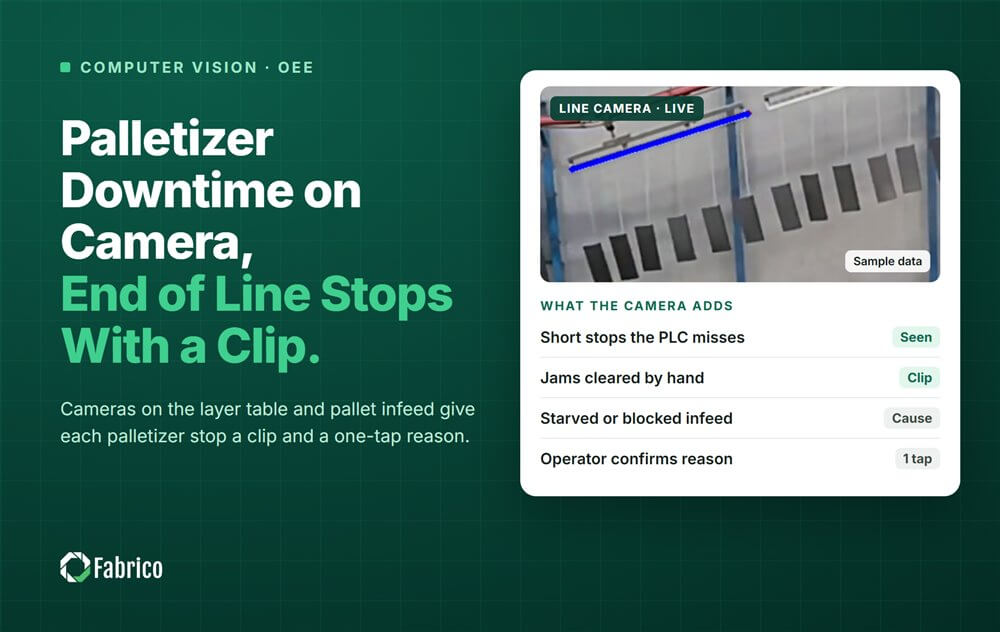
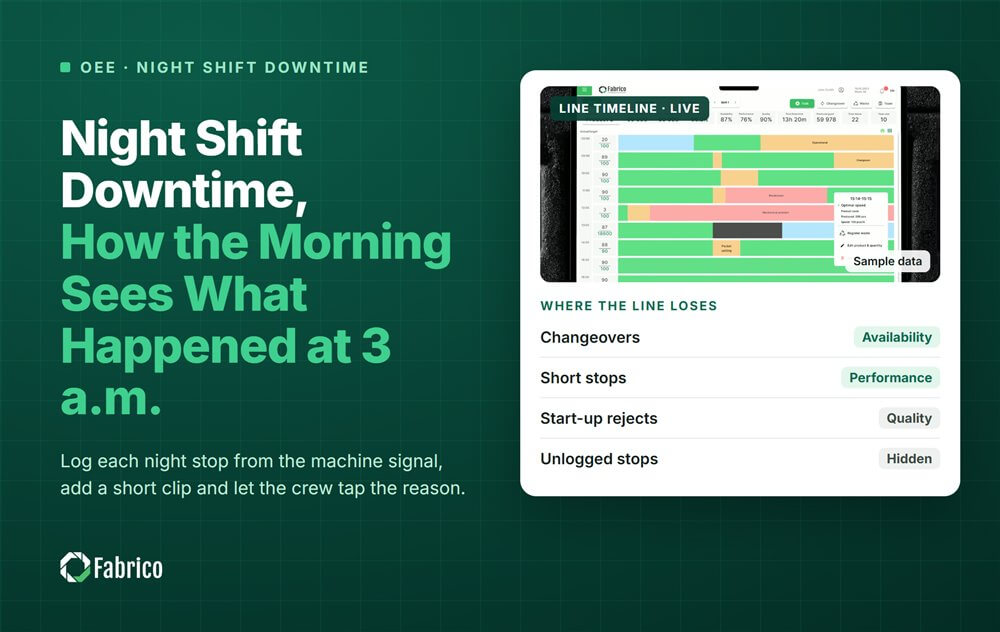
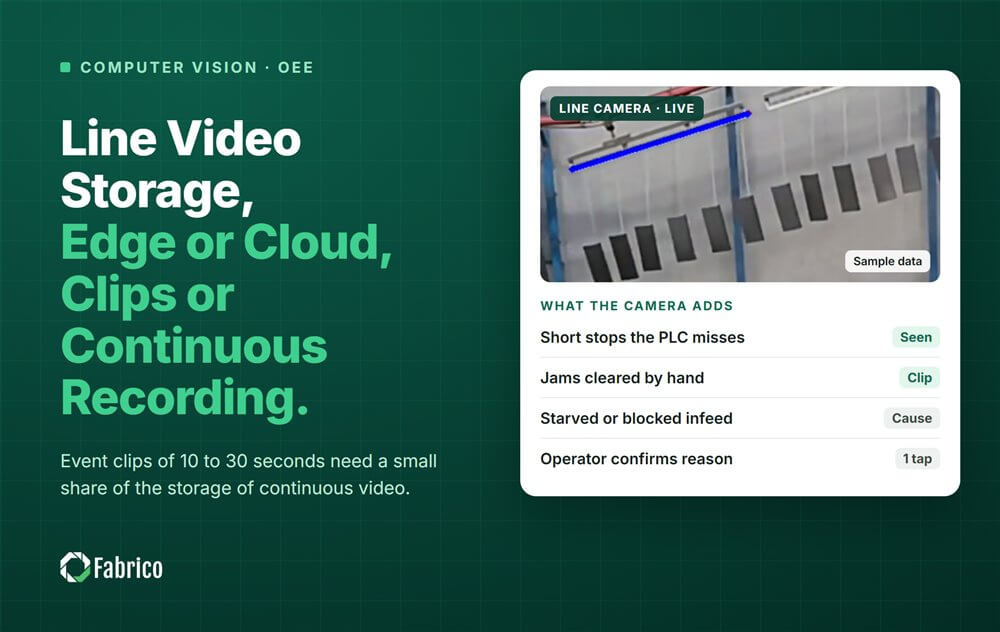


Real Fabrico tiles, sample data.