
Key takeaways
AI anomaly detection is the use of machine learning to spot abnormal behavior in production data. The model learns the normal pattern of a line: how often it stops, its cycle rhythm per product, its typical reject rate, the usual vibration and temperature signature of its machines. When live data departs from that baseline, the system raises a flag with the context attached.
The contrast is with fixed alarms. A threshold says "alert me if temperature exceeds 80 degrees". Anomaly detection says "this machine is behaving differently than it normally does on this product at this speed", which catches problems no one thought to write a rule for.
| Aspect | Fixed threshold alarm | AI anomaly detection |
|---|---|---|
| Setup | Someone hand-picks a limit per signal | The model learns a baseline from real runs |
| New products and formats | Limits must be retuned by hand | Baselines are learned per product |
| Slow drift | Invisible until the limit is crossed | Flagged as the pattern departs from normal |
| Alarm fatigue | Common: limits set tight to be safe | Lower when anomalies are ranked by severity |
| Coverage | Only the signals someone wrote rules for | Every signal the model watches |
Stop pattern changes. A line that normally has three short stops per hour suddenly has twelve. Each stop is small, so no threshold fires, but the pattern is a loud signal. Our micro-stop guide covers why these bursts are the classic hidden loss.
Cycle time drift. Cycles quietly grow from 2.0 to 2.2 seconds after a changeover. No stop, no alarm, several percent of output gone. Drift detection catches the moment the rhythm changed.
Quality drift. The visible reject rate creeps upward on one format hours before the end of run report would show it.
Sensor signature changes. Vibration or temperature departs from the machine's learned normal for that product and speed, even while staying inside absolute limits.
This distinction keeps buyers out of trouble. Anomaly detection answers "is the line behaving abnormally right now". Predictive maintenance tries to answer "when will this component fail", which demands different data, longer history, and its own validation discipline.
Anomaly flags are still valuable to maintenance: a recurring abnormal pattern on one station is a strong reason to schedule an inspection. But treat any pitch that quietly upgrades anomaly detection into failure prediction with skepticism, and ask exactly what the model was validated on.
Detection quality follows data quality. AI cameras capture the behavior a machine cannot report: real stops, real counts, real cycle rhythm, even on lines with no PLC access. IoT sensors add vibration, temperature, and energy. PLC connections contribute machine states where they exist.
All three feed the same AI production monitoring layer. In Fabrico, the AI zoom-in then surfaces where the flagged inefficiencies cluster, and the AI assistant lets you ask what changed in plain language, as part of one AI OEE software picture.
Want to see anomaly detection running against a line like yours? Book a Fabrico demo.
It is machine learning that learns the normal behavior of a production line, then flags deviations in stops, cycle times, quality, and sensor readings as they happen, with context attached.
Statistical process control monitors specific quality characteristics against control limits. Anomaly detection applies the same spirit to the whole production signal set, learning baselines instead of relying on hand-set limits. They complement each other rather than compete.
No. It detects abnormal behavior as it occurs. Failure prediction is a separate discipline; anomaly flags can justify an inspection, which is useful, but that is detection feeding maintenance, not prediction.
Enough representative running to learn what normal looks like per product and speed. A scoped pilot on one line answers this concretely for your plant, which beats any generic number.
Rank anomalies by estimated output impact, review them once per day rather than as popups, and retire flags nobody acts on. The goal is a short list the team trusts, not a feed.
See how Fabrico unifies OEE and maintenance in one platform.
Request a demo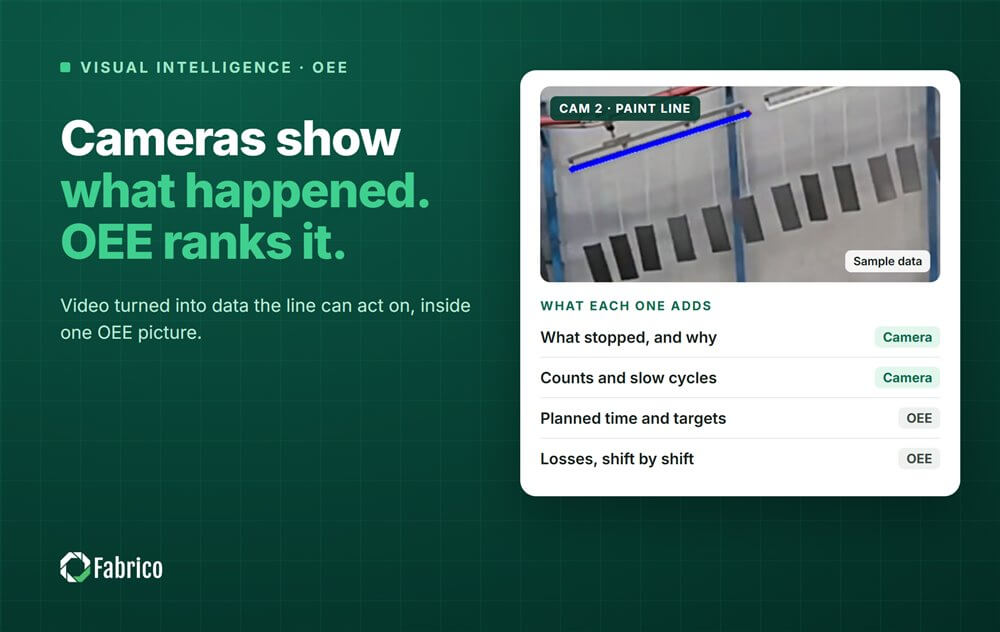








 Login
Login
 Blog
Blog