


 Login
 Blog
Poka vs Parsable: Frontline Training or Guided Procedures

In short: Poka vs Parsable comes down to which half of the frontline problem you need fixed first. Poka's pages lead with frontline training, skills and certificates tied to who may do a job; CAI's Parsable pages lead with guided digital procedures that capture data while the job runs, handed out by role and skill. Both are connected worker platforms; OEE is measured from the machine, beside either.
- Training and skills: Poka shows training modules, auto-scored assessments, certificate expiry and tasks routed to qualified operators.
- Procedures and data: Parsable shows templates built without code, with media, input fields and branching, and data recorded during the job itself.
- Shared ground: digital instructions, mobile use with offline work, AI on frontline data, and open APIs.
- Vendor facts: poka.io and caisoft.com pages, read as of 14.11.2026, each linked where used.
An operations director who searches Poka vs Parsable is usually carrying two problems at once. New operators take too long to become safe and fast on a line, and the same procedure is run three different ways across three shifts. Poka and CAI's Parsable both answer with a phone or tablet at the line, yet their own pages put the weight in different places. Below, the two are lined up by job, routed through a decision matrix, and tested on one sample shift carried through to OEE and euros.
Key takeaways
- Poka's pages lead with training, skills and certification; CAI's Parsable pages lead with guided procedures and the data they capture.
- Both hand out work by skill: Poka routes tasks to qualified operators, Parsable assigns jobs by skill and role.
- Run minutes, stop minutes and counts come from the machine signal, so decide where OEE is measured before you link either platform to it.
- In the sample shift below, a 21 minute wait for a signed-off operator and one skipped seal check cost 7,870 good sticks, about EUR 472 at a sample margin.
- Settle it with a pilot on one line: the same SOP, skills list and changeover, given to both vendors.
Two notes on names. Poka is the connected worker software company at poka.io; the lean idea of poka-yoke is a separate topic. Parsable is named on CAI's own site as "CAI's Parsable", and the Parsable links on this page all go to caisoft.com. Fabrico makes cloud OEE and light MES software and has its own section near the end. A longer shortlist sits in the best connected worker platforms review.
Poka vs Parsable at a glance
Summarised from the vendors' own pages as of 14.11.2026; each fact is linked further down.
| Job | Poka | CAI's Parsable |
|---|---|---|
| Headline | Industrial AI for connected work | Connected worker software for the frontline |
| Instructions | Filmed or photographed know-how turned into steps by AI, versioned | Templates built without code: media, input fields, branching |
| Training | Training modules, auto-scored assessments, completion tracking | Guided jobs on mobile, matched to skill and role |
| Who does the job | Tasks routed to qualified operators; certificate expiry | Recurring, scheduled or on-demand jobs by skill and role |
| Data capture | Forms with required fields, photos, scoring; out-of-spec escalation | Workflows that capture data as work happens |
| No network | Forms completed offline, synced on reconnect | Synced jobs keep running without connectivity |
| AI | Answers grounded in plant content; AI Studio agents | Applied AI on operational data; dashboard copilot |
| Data out | Open API, MCP, 1,000+ systems | REST APIs and webhooks to SAP, MES, IoT |
What Poka offers an operations director: training, skills and sign-off
Poka's home page is headed "Industrial AI for Connected Work" and presents Poka as a way for industrial teams to make work standard across shifts and sites. Its platform page says it is "Available on every device your frontline uses". As of 14.11.2026, the pages most relevant to a workforce question say this:
- Learning and development. The learning and development page says teams can "Build and assign training modules, track completion, and validate knowledge with built-in auto-scored assessments", and that workers scan a code at the machine to get the instruction or training they need. It also describes a two-way skills sync with a corporate LMS.
- Turning expert knowledge into training. The same page says Poka's AI turns a senior worker's knowledge, video or documents into step-by-step training content, and converts legacy PDFs, Word files and recorded videos.
- Skills management. The skills management page describes a skills matrix that updates as workers finish training or get certified, endorsements by subject-matter experts on the line, and "Set expirations, schedule retraining, and keep every certification current."
- Who may do the work. The same page says skills data is linked to task assignment so that work goes to qualified operators, naming centerlining, changeovers, maintenance, safety audits and inspections, with versioned records and audit history.
- Instructions. Poka's instruction page has experts record a process on a phone as video, photo or voice, after which AI drafts the steps; versions are tracked and QR codes open them where the work is done.
- Forms and checklists. The forms page lists conditional logic, required fields and scoring; photos, videos and approvals inside the form; recurring scheduling; escalation when a reading is out of spec; and forms completed offline that sync when the device reconnects. A lockout example walks operators through energy isolation with required signatures and photos.
- AI and analytics. The industrial AI page says answers are "grounded in your own work instructions, issues, and plant data" and that "agents act only with operator approval". The analytics page covers SQDCP KPIs and says "an executive can see cross-site OEE trends".
- Connections. Per the integrations page, more than 1,000 systems can link to Poka via an open API, MCP and no-code workflows. It lists LMS names such as Workday Learning and Cornerstone, HRIS names such as ADP and UKG, and ERP and MES names including SAP and Siemens Opcenter.
What CAI's Parsable offers an operations director: guided procedures and captured data
CAI's product page for Parsable describes software that converts paper procedures into guided digital workflows for frontline crews. CAI's connected worker solution page adds the operating detail. As of 14.11.2026:
- Procedure building. The product page says "The no-code builder lets non-technical users create templates with media, inputs, and conditional logic." The solution page adds that workflows can be tested before they are deployed, and that core processes can stay consistent across sites while allowing site-specific variations.
- Recording as you go. The product page describes interactive workflows that steer each task and record data while the work is under way; the solution page speaks of consistent execution with automatic data capture.
- Job management by skill. One dashboard schedules, hands out and follows jobs according to role and skill, and the solution page lists on-demand, recurring and scheduled jobs so tasks reach the right people when they are due.
- Execution on mobile. Operators work through jobs on mobile with fast user switching and collaboration. The product page says work continues on jobs already synced when the connection drops, and the solution page says data syncs once the connection is back.
- Live view. The solution page describes seeing "task completion, compliance status, and operational bottlenecks as they happen".
- Applied AI. The product page says Parsable's AI analyses operational data to surface inefficiencies, guides supervisors and workers on priorities, and offers a copilot that answers typed questions by building dashboards.
- Analytics and integrations. Floor data is turned into dashboards, exports and webhooks. For other systems, the solution page names SAP, MES platforms and IoT systems, reached through REST APIs and webhooks.
Poka vs Parsable, job by job
Getting a new operator to sign-off. This is where Poka's pages spend most of their words: modules, auto-scored exams, a skills matrix that updates as training finishes, expert endorsement on the line and certificate expiry. Parsable's pages approach the same person from the job side, assigning work by skill and role and guiding each task. A fair test is one new starter followed for two weeks on each platform, from first module to first solo changeover.
Running the procedure the same way on every shift. Parsable leads here: templates with media, inputs and conditional logic, built without code and tested before deployment, with data captured as the work happens. Poka covers the ground with version-controlled instructions and forms that carry required fields, photos and approvals. Give both the same SOP and compare the finished build line for line.
Catching a bad reading before it becomes scrap. Poka's forms page describes escalation when a reading is out of spec. Parsable's pages describe inputs and conditional logic inside the workflow. Ask each to show what the operator sees when a value falls outside its limit, and who is told.
Deciding who may do the job. Both connect skills to work. Poka routes tasks to qualified operators and names changeovers among them. Parsable assigns recurring and on-demand jobs by skill and role. Ask what happens when the qualified person is on another line.
Working where the Wi-Fi drops. Poka's forms page says forms can be completed offline; Parsable's pages say synced jobs keep running without connectivity. Test it in the corner of the plant with the worst signal.
Getting data out. Poka lists named LMS, HRIS, ERP and MES systems and an open API with MCP. Parsable lists SAP, MES platforms and IoT through REST APIs and webhooks. Ask both to show the connection to your ERP and HR system live, not on a slide.
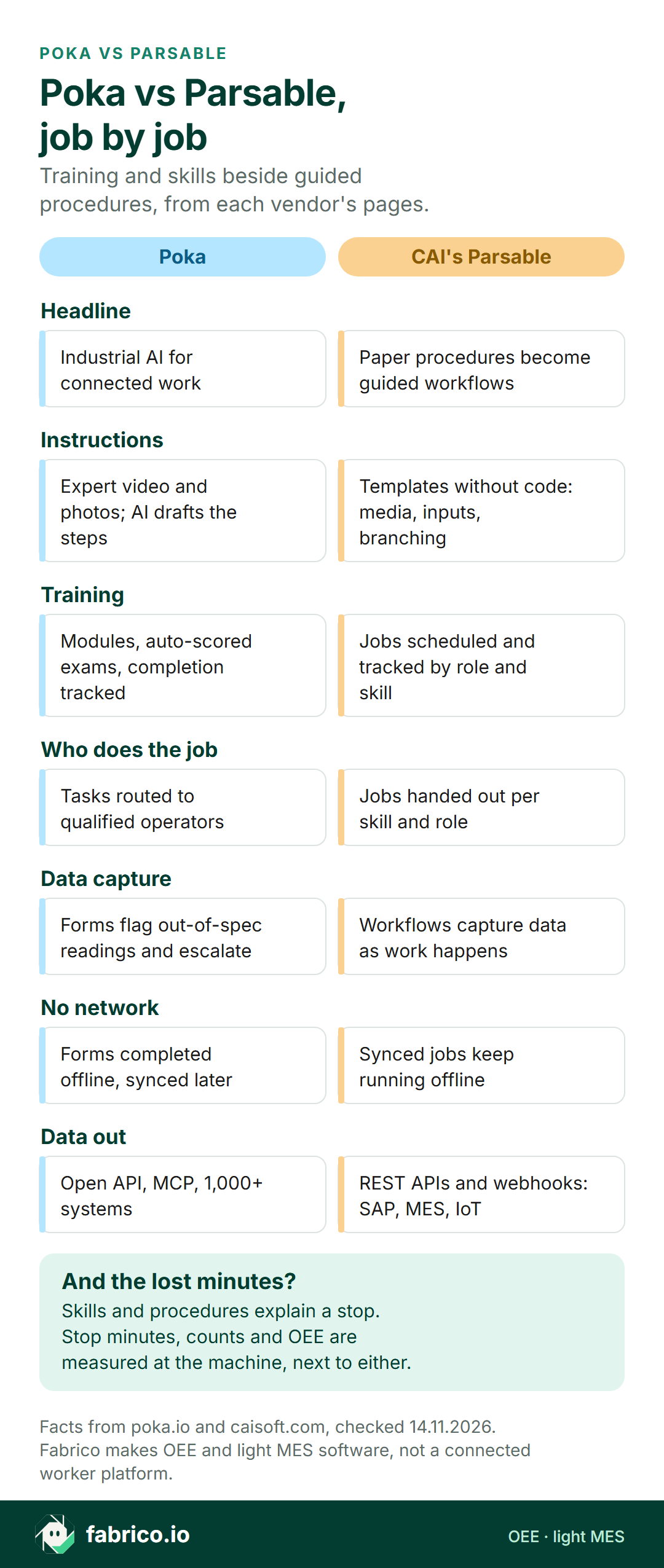
Text version of this infographic
- Headline. Poka: industrial AI for connected work. CAI's Parsable: paper procedures become guided workflows.
- Instructions. Poka: expert video and photos; AI drafts the steps. CAI's Parsable: templates without code, media, inputs, branching.
- Training. Poka: modules, auto-scored exams, completion tracked. CAI's Parsable: jobs scheduled and tracked by role and skill.
- Who does the job. Poka: tasks routed to qualified operators. CAI's Parsable: jobs handed out per skill and role.
- Data capture. Poka: forms flag out-of-spec readings and escalate. CAI's Parsable: workflows capture data as work happens.
- No network. Poka: forms completed offline, synced later. CAI's Parsable: synced jobs keep running offline.
- Data out. Poka: open API, MCP, 1,000+ systems. CAI's Parsable: REST APIs and webhooks to SAP, MES, IoT.
- And the lost minutes? Skills and procedures explain a stop. Stop minutes, counts and OEE are measured at the machine, next to either.
Decision matrix: Poka or Parsable for your plant
Read down the first column and stop at the row that describes your plant this quarter. The matrix routes a job to the vendor whose own page leads with it; it does not rank them, and several rows point to both.
| If this is you | Look first at | Why (vendor page) | Prove it in the pilot by |
|---|---|---|---|
| New hires take months to run a line alone | Poka | Training modules and auto-scored assessments | Timing one starter from first module to sign-off |
| Certificates lapse and audits find gaps | Poka | Expiry, retraining and audit history | Letting a test certificate expire and seeing who is told |
| Changeovers must go to certified people | Poka | Work routed to qualified operators | Assigning the job to an unqualified user on purpose |
| Senior operators retire within two years | Poka | AI turns expert video into training | Filming one expert changeover and timing the edit |
| Paper SOPs run differently by shift | Parsable | No-code builder with conditional logic | Rebuilding one SOP and running it on two shifts |
| Recurring checks handed out by role | Parsable | Jobs by skill and role, recurring or on demand | Scheduling one week of shift checks |
| A reading has to pass its limit before work continues | Both | Parsable: data captured as work happens; Poka: out-of-spec escalation | Entering a bad value and watching what stops |
| Parts of the plant lose network | Both | Parsable: offline on synced jobs; Poka: offline forms | Switching off Wi-Fi halfway through a job |
| Frontline records must reach SAP or an MES | Both | Poka: named ERP and MES; Parsable: REST APIs and webhooks | Seeing one record land in a test system |
| You need lost minutes by line and by shift | A separate OEE or light MES layer | ISA-95 places MES at Level 3 | Matching one shift's stops to its procedure records |
If the matrix splits your plant down the middle, that is normal: the training problem and the procedure problem usually sit on the same line. Piloting both on one line costs less than rolling the wrong one out to five. Still weighing a frontline tool against line measurement? Light MES vs connected worker platform walks through it. For the move off paper itself, read digital work instructions vs paper.
Why training and procedure records both matter to an operations director
The workforce side is not a soft issue. In a US study by Deloitte and The Manufacturing Institute, the Manufacturing Institute reports that "as many as 3.8 million additional employees could be needed in manufacturing between 2024 and 2033", and that "1.9 million jobs could remain unfilled if manufacturers are not able to address the skills and applicant gaps" (accessed 14.11.2026). The same page says 65% of respondents named attracting and retaining talent as their primary business challenge. The figures are US-only, but the pattern is familiar in European plants: more new starters, fewer people with ten years on the line.
Regulation asks for both records. OSHA's lockout/tagout standard, 29 CFR 1910.147, requires written energy control procedures that are actually used on the floor. It then adds people: "The employer shall provide training to ensure that the purpose and function of the energy control program" is understood. It also says "Retraining shall be provided for all authorized and affected employees whenever there is a change in their job assignments" (accessed 14.11.2026). That is one rule asking for a written procedure, proof of training and a retraining trigger. A plant can meet it on paper; the question is which record an auditor can find fastest.
So the choice is less about features than about which record is weakest today. If your audits find expired qualifications, the gap is on the people side. If they find steps skipped or readings missing, it sits in the procedure. Most operations directors find both, which is why the decision matrix above points so often to piloting the two side by side.
Where OEE fits beside Poka or Parsable
OEE is a machine measure: of the planned minutes, how much good output came off at the ideal rate. That number comes from the machine's run and stop minutes, not from a training or procedure record. What the frontline records give you is the explanation. A stop that took 40 minutes instead of 25 has a cause, and the cause is often a person who was not yet signed off or a step that was skipped.
Poka's analytics page talks about cross-site OEE trends for executives, and Parsable's pages talk about dashboards and operational bottlenecks. Before you rely on either for OEE, ask three things: which machine signal starts and stops the clock, what ideal rate is set for each product, and who types in the stop reason. The OEE software buyer's guide has a fuller test list.
The layers follow a familiar map. On ISA's ISA-95 page, MES sits at Level 3 and ERP at Level 4, and the standard mainly covers the interface between those two levels (accessed 14.11.2026). An OEE or light MES layer sits at Level 3 with the line; a connected worker platform works with the people on that line (see the ISA-95 guide). The three records only become useful together when they share line names, a time stamp and an operator ID.
Where Fabrico fits for a Poka or Parsable buyer
Fabrico measures the line, not the person, with OEE in the cloud and a light MES; the MES and OEE solution overview has the detail. Training, skills, SCADA, HMI and inspection are outside Fabrico's scope, and it is no stand-in for a connected worker platform such as Poka or Parsable.
- Machine signal. A PLC, counter or sensor fitted to the machine supplies run, stop and count; the operator chooses why it stopped, using a station tablet or a phone.
- Counting without a signal. At a manual packing step or an older machine, the camera add-on does the counting. Suggesting why a stop happened is Roadmap work for the camera add-on. Where a camera covers the line, the video for the minute of a stop can be opened from the shift timeline; it is streamed on request and not stored. Setup details: computer vision for OEE.
- Results. Each line gets a per-shift view of OEE, downtime and lost minutes in euros, on the web or in the mobile apps for iOS and Android.
- Work orders. A work order opens from a logged stop in one tap, and you can set chosen stop reasons to create that work order automatically as soon as the reason is logged.
- Exports. Systems pull data over a REST API or receive webhooks; managers download Excel or CSV.
Beside Poka or Parsable: Fabrico points to the changeover or wait that eats the most minutes; Poka or Parsable holds the skills and steps behind it. Each vendor publishes an open API and Fabrico sends webhooks, yet Fabrico claims no ready connector to Poka or Parsable; prove that hand-off in a pilot.
To see a sample shift's waits and stop reasons priced in euros, book a demo.
Worked example: a stick-pack machine, a missing sign-off and a skipped seal check
All figures here are sample data, made up for this page, and no real plant or product screen is shown. A supplement plant runs a multi-lane stick-pack machine filling powdered drink sticks. A shift lasts 9 hours; take off 40 minutes of breaks and 500 minutes are planned. At an ideal 300 sticks a minute, the machine could make 150,000 sticks in a shift.
Mid-shift the line changes from lemon to berry flavour. The changeover itself takes 34 minutes. Then the line waits 21 minutes, because the operator on shift has finished the training but is not yet signed off to restart after a flavour change, and the one certified colleague is on the next line. After restart, nobody records the sealing jaw temperature for the new film, and the jaws run too cool for the first part of the run. The checkweigher and leak check reject 2,200 sticks for leaking seals on top of 1,105 ordinary rejects.
| Sample data: event | Minutes or units |
|---|---|
| Flavour changeover, lemon to berry | 34 min |
| Waiting for a signed-off operator | 21 min |
| Powder bridging in the hopper | 16 min |
| Film splice | 12 min |
| Jaw cleaning | 9 min |
| Total stopped | 92 min |
| Rejects: leaking seals after restart | 2,200 sticks |
| Rejects: other causes | 1,105 sticks |
The OEE arithmetic. 92 minutes stopped leaves 408 minutes of run time, so availability is 408 / 500 = 81.6%. In 408 minutes the ideal is 122,400 sticks; the machine made 110,160, so performance is 90.0%. Rejects total 3,305, leaving 106,855 good, so quality is 97.0%. OEE is 81.6% x 90.0% x 97.0% = 71.2%, which matches 106,855 good of 150,000 possible (see how to calculate OEE).
What the machine record cannot tell you. The stop log shows 21 minutes coded as a wait and a jump in rejects. It cannot show that the operator was trained but not certified, or that the jaw temperature step was skipped. Those answers live in the people records. A skills record that routes the restart to someone qualified addresses the wait; this is the job Poka's pages lead with. A guided restart procedure that will not move on until the jaw temperature is entered and in range addresses the seal leaks; this is the job Parsable's pages lead with. Either platform covers some of both, which is why the pilot should test both losses.
What the two losses are worth. Remove the 21 minute wait and run time becomes 429 minutes. At the same speed the machine makes 5,670 more sticks (21 x 300 x 90%), so output is 115,830. Remove the 2,200 seal rejects and rejects fall to 1,105, leaving 114,725 good. That is 7,870 more good sticks than the real shift, and OEE of about 76.5% (114,725 of 150,000).
In euros. Give each stick a sample contribution margin of EUR 0.06, a figure made up for this page. The 7,870 sticks are worth about EUR 472 on this shift (7,870 x 0.06 = EUR 472.20). Assume a shift like this happens twice a week, not every day: that is 8 shifts a month, or about EUR 3,778, and 96 shifts over a 48 week year, or about EUR 45,331. Put your own margin and frequency in; the method is the point. For a running line in this example, each running minute is worth about EUR 15.71 (300 x 90.0% x 97.0% x 0.06), which is a quick way to price any wait (see the changeover time guide). Plants counting sticks or sachets at manual stations can read computer vision for supplement manufacturing.
What to do this week
Six steps an operations or CI manager can finish before the first vendor call:
- Pick one line and one job. Choose the changeover or restart that varies most between shifts, and pull last month's stop log for it.
- List who may do it. Write down, per shift, who is signed off for that job today and when each sign-off expires. Note where that list lives now.
- Collect the evidence pack. The SOP, the check sheet, the skills list and one phone video of your most experienced operator doing the job.
- Send the same pack to both vendors. Ask each for a working build on its platform from that pack, plus a note of what it had to change.
- Fix the pilot measure first. From the machine side: changeover minutes and related rejects. From the platform side: steps completed, readings entered and sign-offs. Agree both before the pilot starts.
- Book an hour with IT. Agree who owns operator IDs, line names and the stop reason list, because those three fields are what join the records later.
Questions to ask Poka and Parsable
Put the same questions to both, in writing, and ask for answers shown on screen:
- How does a new operator go from first module to signed off, and where is that recorded?
- What happens when a qualified operator's certificate expires mid-shift, and who is told first?
- Can a procedure step refuse to continue until a reading is entered and in range, and where does that reading go?
- Can you build our restart procedure from our own SOP and video, and who maintains it when the method changes?
- How are jobs assigned when the qualified person is on another line?
- If the Wi-Fi drops mid-procedure, what does the operator see, and what is lost?
- Which of our ERP, HR and learning systems connect today, shown live rather than listed?
- How would a stop event from our OEE system open the right procedure or skills check at the right station?
Already running one of the two and reviewing options? See Poka alternatives or Parsable alternatives. For counting packs with the camera add-on in packaged goods, read computer vision for FMCG manufacturing.
What people ask next
Is Poka related to poka-yoke?
No. Poka (poka.io) is a vendor of connected worker software. Poka-yoke is a lean technique for mistake-proofing a process step. The shared syllable is the whole link.
What do Poka's and Parsable's pages say about training and skills?
Poka's pages describe training modules, auto-scored assessments, a skills matrix, expert endorsement, certificate expiry with retraining, and tasks routed to qualified operators. CAI's Parsable pages describe matching jobs to each person's role and skill, whether the job recurs or is raised on demand.
Can Poka or Parsable capture data while a procedure runs?
Yes, per their own pages. CAI's Parsable describes workflows with inputs and conditional logic that capture data as work happens. Poka describes forms with required fields, photos, approvals and scoring, with escalation when a reading is out of spec.
Do Poka and Parsable work without network?
Poka's forms page says operators can complete forms offline and the data syncs when the device reconnects. CAI's Parsable pages say work continues on already-synced jobs while the network is down, and data syncs when it returns. Test both in the weakest signal spot in your plant.
Can Poka or Parsable show OEE?
Poka's analytics page says an executive can see cross-site OEE trends, and CAI's Parsable describes dashboards, exports and webhooks from frontline data. Before trusting either for OEE, check which machine signals feed run time, stops and counts, and what ideal rate each product uses.
Can Fabrico run beside Poka or Parsable?
Yes. Fabrico works on the machine side: machine signals give stops and counts, the operator adds the reason, and data leaves through webhooks, a REST API or spreadsheet exports (Excel, CSV). No ready connector to Poka or Parsable is claimed, so a pilot should prove that hand-off first.
Want to price a wait or a skipped check in euros? Book a demo.
Related articles



Latest from our blog


Real Fabrico tiles, sample data.