


 Login
 Blog
Redzone vs Parsable: Shop-Floor OEE, Skills and Digital Procedures

In short: Redzone vs Parsable comes down to where the shop-floor work starts. Redzone's pages lead with line performance: real-time OEE by line and shift, Pareto charts, digital huddles, plus training, scheduling, maintenance and quality modules. CAI's Parsable pages lead with the job itself: paper procedures rebuilt as guided digital workflows that capture data as operators work.
- Line performance: Redzone shows live OEE dashboards and auto-generated Pareto charts; Parsable turns frontline data into dashboards, exports and webhooks.
- Procedures: both offer digital work instructions; Parsable details a no-code builder with media, inputs and conditional logic.
- People: Redzone keeps a skills matrix with renewal dates; Parsable assigns jobs by skill and role, with offline work on synced jobs.
- Facts come from rzsoftware.com and caisoft.com, as of 14.11.2026, linked in place.
Searches for Redzone vs Parsable usually come from a plant that wants paper off the floor and has two pitches on the table: shift teams that hit their numbers, or procedures that run the same way every time. Both put a tablet or phone in the operator's hand, so the overlap looks bigger than it is.
Key takeaways
- Redzone's pages lead with line performance (live OEE, Pareto charts, huddles); CAI's Parsable pages lead with the procedure, rebuilt as a guided digital workflow.
- Both offer digital work instructions: Parsable details its no-code builder, Redzone ties instructions to a skills matrix with renewal dates.
- Parsable describes offline work on synced jobs; Redzone describes training on tablets in 27 languages.
- A procedure record and a stop record are different data, so agree line names and the reason list before linking them.
- In the sample bagging shift, the 8 minute gap between two clean-downs is worth about EUR 258 a shift at a made-up margin of EUR 3.00 a bag.
A note on names: Redzone here is the frontline manufacturing software at rzsoftware.com. Parsable appears on CAI's site as "CAI's Parsable", and every Parsable fact below links to a caisoft.com page. Fabrico, maker of cloud OEE and light MES software, gets one short section further down. More tools: the connected worker platform review.
Redzone vs Parsable at a glance
As of 14.11.2026, condensed from the two vendor sections below.
| Job | Redzone | CAI's Parsable |
|---|---|---|
| Headline | AI manufacturing software for frontline teams | Connected worker software for the frontline |
| Line performance | Real-time OEE dashboards, auto Pareto, digital huddles | Operational analytics: dashboards, exports, webhooks |
| Work instructions | Digital work instructions at any production station | No-code builder with media, inputs, conditional logic |
| Skills | Skills matrix, renewal dates, on-the-job verification | Jobs assigned by skill and role |
| AI | ChampionAI next-best-action guidance | Applied AI and an analytics copilot |
| Devices | iOS and Android, tablets at the point of work, 27 languages | Mobile, offline on synced jobs, fast user switching |
| Integrations | Named ERP systems, MaintainX, open REST API | SAP, MES platforms, IoT via REST APIs and webhooks |
What Redzone offers on the shop floor
Redzone's home page carries the line "AI Manufacturing Software for Frontline Teams". Its product overview says the platform "combines frontline workflows, performance data, and AI insights" and is optimised for iOS and Android. As of 14.11.2026:
- Productivity. The productivity page says downtime and throughput are "automatically collected, timestamped, and linked to line, run, and assets", that availability, performance and quality update continuously, and that Pareto charts of the top losses are generated automatically. Operators can add context from the line, and 5 Whys and fishbone tools run inside the platform.
- Huddles and handover. Structured digital huddles and handover notes the incoming shift sees at once.
- Learning. The learning page covers digital work instructions "accessible on any device at any production station", a digital skills matrix, renewal dates for certifications with warnings before a credential lapses, and training on tablets at the point of work, in 27 languages.
- Champion AI. Per the product overview, ChampionAI turns floor activity into next-best-action guidance; the learning page says it analyses OEE losses, quality events and downtime patterns.
- Scheduling, reliability, compliance. The product overview also lists interactive constraint models for scheduling, digital work orders with automated PM triggers, and a shop-floor QMS with digital checksheets and run sign-off.
- Integrations. The integrations page names QAD, SAP S/4HANA, Oracle NetSuite, Infor M3 and MaintainX, describes an open REST API, and says Redzone "complements, not replaces" an existing MES.
What CAI's Parsable offers on the shop floor
CAI's Parsable product page is headed "Parsable Connected Worker Software For the Frontline" and describes how it turns paper procedures into guided digital workflows. CAI's connected worker page adds detail. As of 14.11.2026:
- Procedure development. A no-code builder lets people who are not programmers create templates with media, input fields and conditional logic.
- Data capture. The connected worker page says teams "execute consistently and capture data automatically", replacing static documents with workflows "that guide every step".
- Job management. Jobs are scheduled, assigned and tracked by role and skill, recurring or on demand, from one dashboard.
- Job execution. Operators work through jobs on mobile devices with fast user switching and collaboration, and keep working on synced jobs without connectivity.
- Applied AI. The product page describes AI that surfaces inefficiencies and guides decisions in real time, and a copilot that builds dashboards from conversational prompts.
- Analytics and integrations. Frontline data becomes dashboards, exports and webhooks, and Parsable connects "to SAP, MES platforms, IoT systems, and your existing tech stack via REST APIs and webhooks".
Redzone vs Parsable, job by job
Measuring the line. Redzone puts OEE up front: its productivity page calls OEE software "just the cost of entry" and builds huddles, Pareto charts and problem solving around it. Parsable's pages put the procedure up front and turn what operators record into dashboards. If minutes lost per line drive the morning meeting, ask both where the run and stop signal comes from.
Writing the procedure. Both replace paper instructions. Parsable's pages say more about how a template is built: media, input fields, conditional logic, no code. Redzone frames its instructions inside training, next to the skills matrix. Give each the same sanitation SOP and compare the results step by step.
People and skills. Redzone records who is qualified, verifies skills on the job and warns before a credential runs out. Parsable routes jobs by skill and role. Ask who decides that a new operator may run a clean-down alone, and where that is stored.
Beyond the operator. Redzone's overview adds scheduling, maintenance and a shop-floor QMS. Parsable's page shows planning through a PlanetTogether link. Map both against the systems the plant already runs.
AI and integrations. ChampionAI recommends next actions; Parsable's applied AI surfaces inefficiencies and builds dashboards from prompts. Both describe REST APIs. Ask each to show the named ERP or MES connection live.
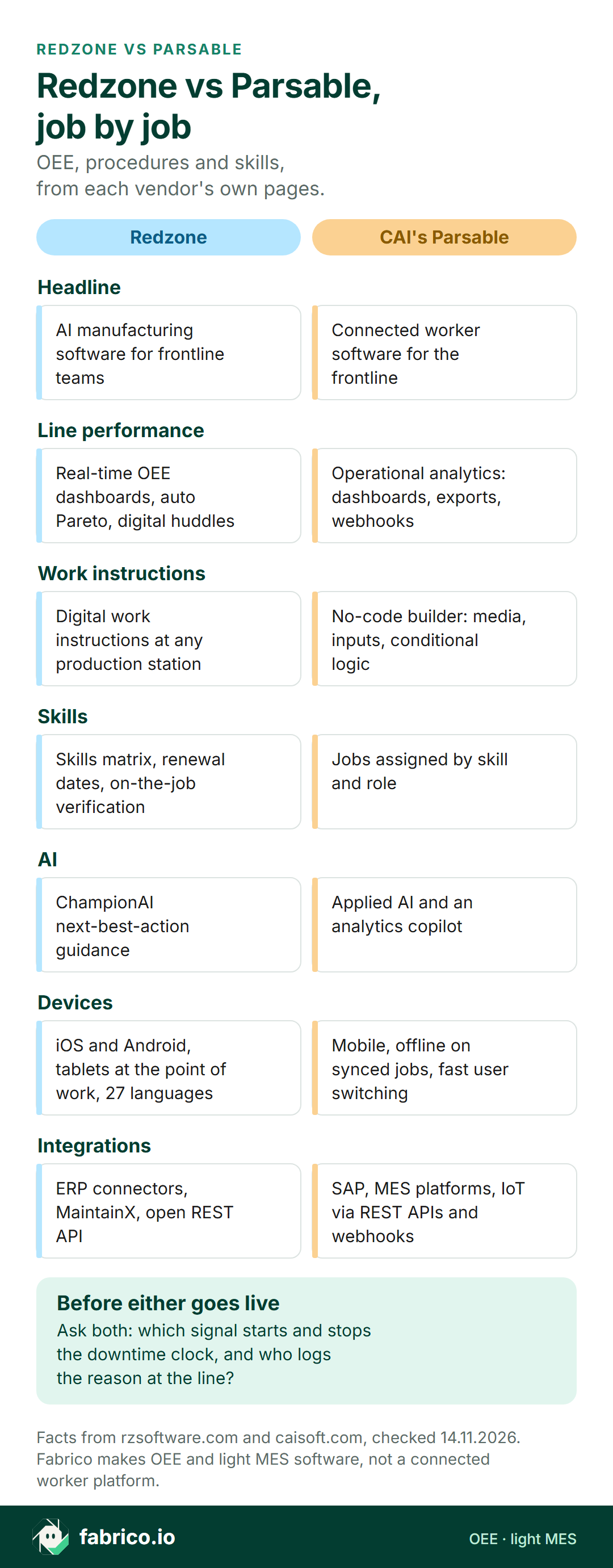
Text version of this infographic
- Headline. Redzone: AI manufacturing software for frontline teams. CAI's Parsable: connected worker software for the frontline.
- Line performance. Redzone: real-time OEE dashboards, auto Pareto, digital huddles. CAI's Parsable: operational analytics, dashboards, exports, webhooks.
- Work instructions. Redzone: digital work instructions at any production station. CAI's Parsable: no-code builder, media, inputs, conditional logic.
- Skills. Redzone: skills matrix, renewal dates, on-the-job verification. CAI's Parsable: jobs assigned by skill and role.
- AI. Redzone: ChampionAI next-best-action guidance. CAI's Parsable: applied AI and an analytics copilot.
- Devices. Redzone: iOS and Android, tablets at the point of work, 27 languages. CAI's Parsable: mobile, offline on synced jobs, fast user switching.
- Integrations. Redzone: ERP connectors, MaintainX, open REST API. CAI's Parsable: SAP, MES platforms, IoT via REST APIs and webhooks.
- Before either goes live: ask both which signal starts and stops the downtime clock, and who logs the reason at the line.
Match the first job: Redzone or Parsable first
Name the problem that hurts most this quarter. The table points to the module each vendor's pages describe for it; run one identical trial on both.
| First job to fix | Start with |
|---|---|
| Live OEE by line and shift, reviewed in daily huddles | Redzone: Productivity |
| Paper SOPs rebuilt as guided jobs that capture readings | Parsable: procedure development |
| Recurring jobs handed out by skill and role | Parsable: job management |
| Certificates with renewal dates and skills checked on the job | Redzone: Learning |
| Crews working where the network drops | Parsable: offline work on synced jobs |
| Maintenance requests and PM triggers tied to production | Redzone: Reliability |
| Guided procedures and live OEE together | Both side by side, or one plus an OEE layer |
If the decision is really between a procedure tool and line measurement, light MES vs connected worker platform lays out that choice. For the groundwork on instructions, read digital work instructions vs paper.
Decision matrix: Redzone or Parsable for your plant
Find the row that sounds most like the plant today. The second column points to the product whose page goes deepest on that job; the other may handle it as well, so the last column is how a pilot settles it. Pages checked on 14.11.2026, row by row.
| If this is you | Look first at | Why (vendor page) | Prove it in the pilot by |
|---|---|---|---|
| The morning meeting runs on minutes lost per line | Redzone | Availability, performance and quality update continuously, with automatic Pareto charts (Redzone Productivity) | Opening a real huddle with yesterday's top three losses from live data |
| SOPs live in binders and drift from shift to shift | CAI's Parsable | Paper procedures turned into guided digital workflows, built without code (Parsable product page) | Having a supervisor, not IT, rebuild one clean-down and change a step |
| A check value has to pass before the crew moves on | CAI's Parsable | Rich inputs and conditional logic in the instruction builder (Parsable product page) | Entering an out-of-range magnet check and recording what the job does next |
| Certificates expire before anyone notices | Redzone | Renewal dates tracked, with a visual warning when a credential is nearly expired (Redzone Learning) | Loading ten real certificates and checking who is warned, and how early |
| Wi-Fi drops in the packing hall or the warehouse | CAI's Parsable | Synced jobs stay workable for operators with no network connection (Parsable product page) | Switching off the access point mid-job and checking the record after reconnecting |
| Crews speak several languages | Redzone | Frontline training on tablets, available in 27 languages (Redzone Learning) | Running one training module in the crew's two main languages |
| Sanitation jobs recur and go to whoever is free | CAI's Parsable | Recurring and on-demand jobs handed out by role and skill, followed on a dashboard (Parsable product page) | Assigning a week of sanitation jobs and reading the dashboard on Friday |
| Losses need a structured follow-up after the huddle | Redzone | 5 Whys and fishbone diagrams run inside the platform (Redzone Productivity) | Working one real stop through a 5 Whys and reviewing it a week later |
| Records must land in the ERP or MES | Both, side by side | Named ERPs, a REST API, complements an MES (Redzone); SAP, MES and IoT via REST APIs and webhooks (CAI) | Watching one finished job arrive in the plant's ERP or MES, live |
Where OEE fits beside Redzone or Parsable
OEE answers a machine question: of the planned time, how much good output came off the line at the ideal rate? A procedure answers a people question: were the steps done, in order, with readings in range? On a packing line the two meet at changeovers and clean-downs, when the machine is stopped and people work on it.
Those clean-downs often mean guards open and energy isolated. OSHA's lockout/tagout standard, 29 CFR 1910.147 (accessed 14.11.2026), says procedures "shall be developed, documented and utilized for the control of potentially hazardous energy". A guided procedure shows each step was followed; the stop record shows what it cost in minutes.
ISA's ISA-95 page (accessed 14.11.2026) places manufacturing execution systems at Level 3 and ERP at Level 4 (see the ISA-95 guide). Redzone builds OEE into its own platform. With Parsable, ask whether its analytics will carry stop minutes from a machine signal or whether an OEE layer sits beside it; the OEE software guide lists what to test.
Procedures, qualifications and the records an auditor reads
The case for digital procedures on a food or feed line rests on three kinds of outside requirement, and each one maps to a different part of these two products.
Safety during the clean-down. OSHA's control of hazardous energy page (accessed 14.11.2026) warns that during the servicing and maintenance of machines, "the unexpected startup or release of stored energy can result in serious injury or death to workers". One of its examples is a jammed conveyor that suddenly releases and crushes a worker clearing the jam. It adds that employers must train each worker to know, understand and be able to follow the energy control procedures. That is a skills record question as much as a procedure question: who may lock out the bagger, and is that still true this month?
Food safety records. For pet food and feed plants, the FDA's FSMA rule on preventive controls for animal food (accessed 14.11.2026) says covered facilities must follow Current Good Manufacturing Practices for animal food production. It describes sanitation controls as procedures to keep the facility "in a sanitary condition", and states that monitoring, corrective actions and verification activities must each be documented. A guided job that captures a photo, a reading and a sign-off produces that document as the work is done; a laminated sheet produces it only if someone fills in a separate log afterwards.
Standard work as the baseline. The Lean Enterprise Institute's standardized work entry (accessed 14.11.2026) lists its benefits as documentation of the current process for all shifts, reductions in variability, easier training of new operators, reductions in injuries and strain, and a baseline for improvement activities. Its SMED entry (accessed 14.11.2026) sets the target of changeovers in a single digit of minutes, under 10, by separating internal steps that need the machine stopped from external steps done while it runs. Neither entry names software. Both say the same thing a buyer should test: the procedure has to be the same on every shift before its minutes can be cut.
Where Fabrico fits for a Redzone or Parsable buyer
Fabrico measures line performance with cloud OEE and a light MES (see the solution overview). Fabrico is not a connected worker platform and does not sell SCADA, HMI or inspection systems, so it does not replace Parsable's guided procedures or Redzone's training and skills modules.
- Stops and counts. Fabrico takes them from a PLC, sensor or counter wired to the bagger; operators tag why the line stopped, standing at it, on a phone or tablet.
- Lines without a signal. At a manual packing table or an old bagger, the camera add-on counts output. Having the camera add-on propose why a line stopped is a Roadmap item. The add-on's footage is streamed on request and not stored; the computer vision feature page has the setup.
- Results. Per line and per shift: OEE, downtime, and what the lost time cost in money, viewable on desktop, iOS or Android.
- Work orders. A work order opens from a logged stop in one tap, and you can set chosen stop reasons to create that work order automatically as soon as the reason is logged.
- Getting data out. Other software pulls it through a REST API or receives webhooks; people download Excel or CSV files.
Next to Parsable, Fabrico can supply stop minutes and reasons while Parsable runs the clean-down procedure. In place of Redzone's OEE module, Fabrico is another option where the first job is OEE and light MES. No ready-made Fabrico connector to Redzone or Parsable is claimed, so prove that hand-off in a pilot before relying on it.
Want clean-down minutes and stop reasons from a sample bagging shift? Book a demo.
Worked example: recipe clean-downs on a pet food bagger
Made-up figures for one shift on a kibble bagging line; not a real plant and not a product screen. The bagger fills 15 kg bags. Shifts last 12 hours with 60 minutes of breaks, which gives 660 planned minutes; at 12 bags a minute the ideal is 7,920 bags.
Two recipe changes fall in the shift, chicken to lamb and back. Each needs the surge bin emptied, the scale cleaned, the magnet checked and the bagger locked out while people work inside the guarding. The morning crew works from a laminated sheet and takes 46 minutes. The afternoon crew follows a guided procedure with a magnet photo and a sign-off, and takes 38. Other stops add 51 minutes.
| Sample data: stop | Minutes |
|---|---|
| Recipe clean-down A, paper sheet | 46 |
| Recipe clean-down B, guided procedure | 38 |
| Film splice | 22 |
| Scale hopper bridging | 17 |
| Waiting for pallets | 12 |
| Total stopped | 135 |
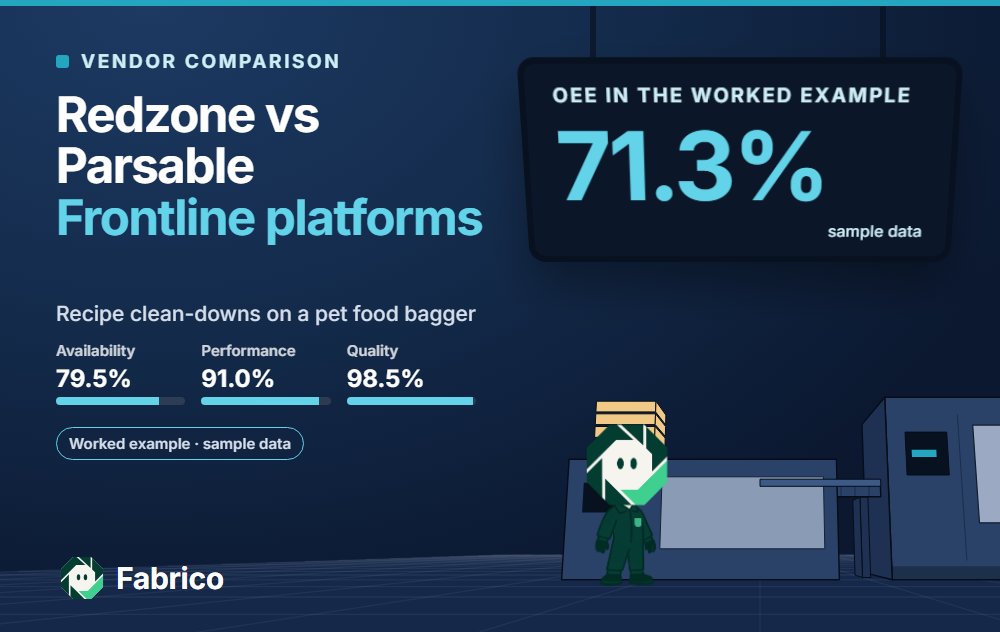
The OEE arithmetic. 135 minutes stopped leaves 525 minutes of run time, so availability is 525 / 660 = 79.5%. At 12 bags a minute, 525 minutes could fill 6,300 bags; the bagger filled 5,733, so performance is 91.0%. The checkweigher rejected 86 bags as underweight or torn, leaving 5,647 good, so quality is 98.5%. OEE is 79.5% x 91.0% x 98.5% = 71.3%, which matches 5,647 good bags out of 7,920 possible (how OEE is calculated).
Where Redzone or Parsable comes in. The stop record shows two clean-downs 8 minutes apart. It cannot show whether the morning crew skipped the magnet check, waited for a key or cleaned the scale twice. A guided procedure records those steps, and a skills record shows who is signed off. Redzone's pages describe OEE and Pareto views where such a gap would show; with Parsable, the procedure data explains it and the minutes come from wherever the plant measures OEE. Later shifts show whether clean-down A drops to 38 minutes (see the changeover time guide).
What 8 minutes are worth. Had clean-down A taken 38 minutes, run time would be 533 minutes and availability 80.8%. At the same speed and reject rate the line fills about 87 more bags (8 x 12 x 91%), and OEE comes to about 72.4%. For counting at manual or signal-less stations in food plants, see computer vision for food manufacturing.
The bagger shift in money. Suppose each good 15 kg bag earns EUR 3.00 of contribution margin, a figure invented for this page; swap in the plant's own. Against 7,920 possible bags the shift made 5,647 good ones, so 2,273 good bags were lost. The 8 minute clean-down gap is the 87 filled bags above less the 1.5% rejects, about 86 good bags (8 x 12 x 91.0% x 98.5%). Both clean-downs together, 84 minutes, cost about 904 good bags on the same basis. The table assumes two 12 hour shifts a day, 22 production days a month and 260 a year, so 44 shifts a month and 520 a year, with the same two recipe changes in each.
| Sample data, EUR 3.00 a bag | Each shift | Each month | Each year |
|---|---|---|---|
| All lost good bags, 2,273 | EUR 6,819 | EUR 300,036 | EUR 3,545,880 |
| Both clean-downs, about 904 bags | EUR 2,712 | EUR 119,328 | EUR 1,410,240 |
| Paper vs guided gap, about 86 bags | EUR 258 | EUR 11,352 | EUR 134,160 |
The bottom row is what a guided procedure has to win back to pay its way on this bagger; the middle row is the size of the prize if the clean-down itself gets shorter. Set the pilot target in euros before it starts, using the plant's real margin and shift pattern.
What to do this week
- Pick the procedure that costs the most line time, usually a clean-down or a recipe change, and pull its minutes for three different shifts from the stop log.
- Split its steps into two lists: those that need the bagger stopped and those a crew can do while it still runs, such as fetching tools and the next film reel. Move the second list ahead of the stop.
- Send Redzone and CAI's Parsable the same pack: that SOP, the skills list for the crew and one week of the stop log. Ask each to rebuild the procedure and show the record an auditor would read afterwards.
- List who may lock out the machine and when each qualification expires, then ask both vendors what the operator sees at the line when a name on that list has lapsed.
- Agree which system holds the stop minutes and the reason list, so the procedure tool and the OEE figure never count the same clean-down twice.
Questions to ask Redzone and Parsable
Hand both vendors the same clean-down SOP, skills list and stop log, then ask:
- Can you rebuild our clean-down SOP as a guided job, with a required photo and a reading that must be in range before the next step?
- Which signal starts and stops the downtime clock, and how does the operator add the reason?
- How is a qualification recorded, and who is told before it expires?
- What happens to a job when the tablet loses network halfway through a procedure?
- What does the AI read, and who approves the action it recommends?
- Which of our ERP and MES systems connect today, shown live, and which need integration work?
Already running Parsable and reviewing options? See Parsable alternatives. For counting packs with cameras, read computer vision in FMCG manufacturing.
What people ask next
Does Redzone or Parsable calculate OEE?
Redzone's productivity page lists real-time OEE dashboards by line and shift, with availability, performance and quality updating continuously. CAI's Parsable pages describe operational analytics, dashboards, exports and webhooks. For either, ask which machine signal drives the downtime clock and who enters the stop reason.
Do both offer digital work instructions?
Yes. Redzone places them inside its learning module, next to the skills matrix. CAI's Parsable describes a no-code builder with media, input fields and conditional logic, and workflows that capture data as work is done. Test both with the same SOP.
How do Redzone and Parsable handle skills?
Redzone keeps a digital skills matrix, verifies skills on the job and warns before a credential lapses. CAI's Parsable schedules, assigns and tracks jobs by role and skill, recurring or on demand.
Do they work on phones and without network?
Redzone says its platform is optimised for iOS and Android and puts training on tablets at the point of work, in 27 languages. CAI's Parsable runs jobs on mobile with fast user switching, and operators keep working on synced jobs without connectivity.
Can Fabrico run beside Redzone or Parsable?
Yes, as a separate OEE and light MES layer. Stop and count data come from the machine signal, the operator picks each reason, and results leave via webhooks, a REST API, or Excel and CSV exports. No ready-made connector to either product is claimed; prove the hand-off in a pilot.
Want to compare clean-down minutes and stop reasons on a sample line? Book a demo.
Related articles










Real Fabrico tiles, sample data.