


 Login
 Blog

Computer Vision for Fuel Cell Manufacturing: Stacking, Leak Test, Electrolyzers

In short: computer vision for fuel cell manufacturing earns its place as a counter at the hand steps: kitting MEAs and plates, stacking and banding, balance of plant (BoP) benches and crating, where no control logs what leaves. Coating lines, plate presses and leak test rigs already count through their own controls.
- MEA coating defects, leak results and cell voltages stay with inspection and test systems; Fabrico does no inspection.
- Stacks differ in cell count, so measure performance in standard minutes per stack type, not stacks per hour.
- Count stacks sent to the leak test, not only those it passes, so the queue in front of the rig shows.
- Fabrico's camera add-on counts kits, stacks and modules leaving a station. Where a camera add-on covers a station, the video for the minute of a stop can be opened from the shift timeline, streamed on request and not stored in Fabrico.
A slot-die coater knows how many metres of catalyst coated membrane it ran, and a pressure decay rig logs each stack it tests. Two people stacking 40 cells on a fixture by hand leave a signature on the traveller and nothing else.
This guide covers PEM fuel cell stacks and modules, and PEM electrolyzer stacks and skids. Battery cells, modules and packs, including electrolyte filling, are on computer vision for battery manufacturing.
Computer vision for fuel cell manufacturing: count stacks, leave testing to the rigs
Of the camera jobs in a stack plant, only counting feeds OEE output.
| Job in a stack plant | Done by | OEE camera? |
|---|---|---|
| Find bare spots or scratches on coated web | In-line inspection on the roll | No |
| Check plate flatness and channel depth | Gauges, CMM | No |
| Find external and cross-over leaks | Leak test rig | No, read its count |
| Log cell voltages during break-in | Conditioning station | No, read its hours |
| Count kit trays off the kitting bench | A tally sheet, if anything | Yes |
| Count banded stacks sent to the leak test | The traveller signature | Yes |
| Count BoP modules and crates out | The packing list | Yes |
| See why stacking went quiet at 15:20 | Memory | Open the video for the minute of that stop |
Inspection on the roll is a field of its own. NREL and Colorado School of Mines researchers wrote that in-line quality control diagnostics for roll-to-roll manufacturing will play a key role in commercializing PEM fuel cells, and found that bare spots shortened MEA life at the inlet regions but not at the electrode centre. Rejects from the roll scanner and fails at the leak rig enter OEE quality as counts from those systems; Fabrico itself inspects nothing.
What you see: the line screen, stops and waste on sample lines. The video shows the software, not the camera. Book a demo.
Plays from YouTube. Google may set cookies when you press play. Privacy policy.
What a stack is made of, and which machines already count
The repeat unit of a PEM stack is a membrane electrode assembly between two plates. The US Department of Energy's page on the parts of a fuel cell says MEAs are usually connected in series by stacking them on top of each other, with each cell between two bipolar plates. So the plant runs two feeder streams, MEAs and plates, into one stacking step.
MEA line
Catalyst ink is coated roll to roll onto the membrane, or onto a decal film that is hot pressed onto it. The coated membrane is then framed with a subgasket, bonded to gas diffusion layers and cut into MEAs; the order varies by line. The coater and laminator report metres and run state from their PLCs, and the cutter counts MEAs. Take the count from them; a camera adds nothing there.
What those controls do not record is why the web stood, and the reasons matter more than the run signal suggests. A Chalmers study of OEE data from 23 companies found that 90% of the classified stop time was tied to supporting activities performed by operators, not to the automatic process, and that almost half of the losses had no usable category at all. So code roll changes, ink batch waits, coating weight adjustments and cleaning on the coater before the first signal is wired.
Plate line
Metal plates are stamped from thin foil in halves, laser welded into pairs so the coolant flows between them, and coated before or after forming; graphite composite plates are compression moulded. The same DOE page says bipolar plates may be made of metal, carbon, or composites, which is why a plant may run stamping or moulding, and that gaskets around the MEA edges make the gas-tight seal and are usually made of a rubbery polymer. Seals are dispensed or moulded onto the plate or the MEA frame. Presses, welders and dispensers count strokes, welds and parts from their own controls.
Kitting and stacking: where the count goes missing
Before stacking, MEAs and plates are counted into kits, one per stack, at a clean bench. A camera add-on mounted over the outfeed of the kitting bench counts trays as they leave, so a stacking station that waits for parts shows whether the kits were late or the cutter was.
On a manual or semi-automatic station, an end plate, insulator and current collector go onto a fixture with guide rods, then plate and MEA in turn until the cell count is reached, then the far end. A press compresses the stack to its set load, and tie rods or bands hold it. A robot stacker reports its own cycles; at a manual station, a camera add-on watching the exit counts banded stacks leaving for the leak test.
Count stacks, not cells: a half-built stack is work in progress. Cell count drives the work content, because each individual MEA produces less than 1 V under typical operating conditions, according to the DOE, so a stack built for a higher voltage simply has more cells and earns more standard minutes. For mounting over a fixture with people around it, see the camera placement and lighting guide, and for hand stations in general, camera-based OEE for manual assembly.
Leak test and conditioning: the queue in front of the rigs
Each banded stack is checked for external leaks, cross-over between the anode and cathode sides, and coolant leaks, for example by pressure decay. The rig's PLC logs tested, passed and failed. A stack that fails goes back to the stacking station, where it is unbanded, the leaking cell is replaced, and it is restacked and compressed.
Stacks are then conditioned on test stations that run them on gas for a set time while a monitor reads the cell voltages. Those voltages and the pass or fail belong to the test system. For OEE, read station hours from the controller: hours with a stack running against hours available.
The rig and the stations count what they test, not what waits for them. The camera add-on count at the stacking exit gives stacks sent, and the gap between stacks sent and stacks tested is what waits at the rig. If that gap widens through the shift, the rig holds output back; if the rig sits idle with nothing waiting, stacking does.
Hydrogen, zones and where a camera may hang
Where hydrogen is piped to a test cell, the workplace rules come first. In the EU, EU-OSHA's summary of Directive 1999/92/EC says places where an explosive atmosphere may occur must be classified, and the employer must keep an explosion protection document up to date. Equipment inside a zone falls under the ATEX equipment directive: the European Commission's ATEX page says Directive 2014/34/EU covers equipment and protective systems intended for use in potentially explosive atmospheres. The zone rating is the plant's call; mount the camera add-on where the safety engineer allows, outside the zone and looking at the cell exit.
Electrolyzer stacks and skids: fewer, larger units
In a PEM electrolyzer the cell works the other way round. The Department of Energy's electrolysis page says that in a PEM electrolyzer the electrolyte is a specialized, solid plastic material that only allows protons to pass.
The size range is wide: the DOE describes electrolyzers ranging from small, appliance-size units to large-scale, central production facilities, so one plant may build very different stacks. The stacking order is the same, but the cells are larger and an end plate may need a hoist. A camera add-on over the station exit still records when each stack left for test.
The stack is then built into a skid with its water treatment, gas separators and dryer, and cabled to its power electronics, over several days in an assembly bay. In the skid bay, progress is better measured as finished operations against their standard hours than by a camera count; the method is set out in the guide to OEE on manual and hybrid assembly lines. Tools for electrolyzer plants are compared in OEE software for hydrogen electrolyzer manufacturing.
Balance of plant benches and crating
A fuel cell module adds an air compressor, humidifier, hydrogen recirculation, coolant pump, valves, sensors and a cell voltage monitor around the stack, assembled on benches with no counter of their own. One camera add-on per bench outfeed counts modules going to the end-of-line test, and another over the crating area counts closed crates, so modules tested but not yet shipped are visible on the day. The module test itself belongs to the safety standard the product is built to: IEC 62282-2-100:2020 sets safety requirements for the construction, operation and testing of fuel cell modules, and its results stay with the test system.
Which fuel cell and electrolyzer stations have a count today
The traveller below assumes coating, cutting, stacking and testing under one roof; walk the floor to confirm each signal. Sizing the number of units is covered in how many cameras a production line needs.
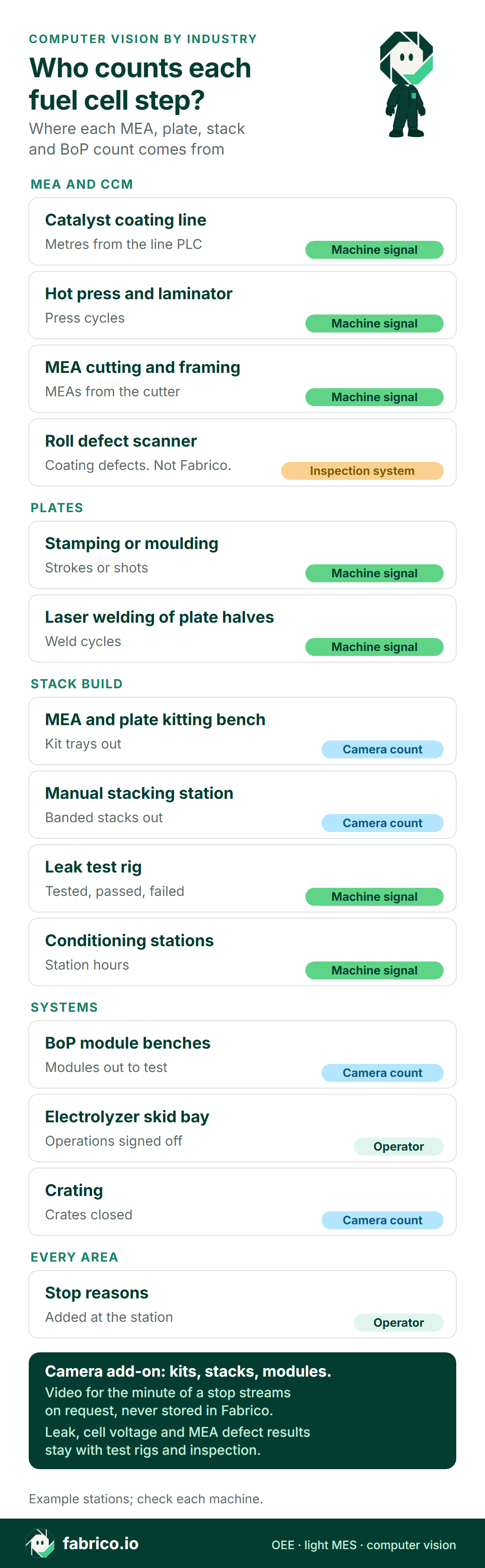
Text version of this infographic
- MEA and CCM: catalyst coating line: machine signal, metres from the line PLC
- MEA and CCM: hot press and laminator: machine signal, press cycles
- MEA and CCM: MEA cutting and framing: machine signal, MEAs from the cutter
- MEA and CCM: roll defect scanner: inspection system, coating defects, not Fabrico
- Plates: stamping or moulding: machine signal, strokes or shots
- Plates: laser welding of plate halves: machine signal, weld cycles
- Stack build: MEA and plate kitting bench: camera count, kit trays out
- Stack build: manual stacking station: camera count, banded stacks out
- Stack build: leak test rig: machine signal, tested, passed, failed
- Stack build: conditioning stations: machine signal, station hours
- Systems: BoP module benches: camera count, modules out to test
- Systems: electrolyzer skid bay: operator, operations signed off
- Systems: crating: camera count, crates closed
- Every area: stop reasons: the operator adds them at the station
- Footer: kits, stacks and modules are counted by the camera add-on; video for the minute of a stop streams on request, never stored in Fabrico
- Leak, cell voltage and MEA defect results stay with test rigs and inspection
Book a demo to see kitting, stacking and leak test counts on one shift timeline.
Worked example: a late shift at a manual stacking station
Example numbers, no real plant. One manual stacking station with two operators builds 40-cell and 80-cell PEM fuel cell stacks, fed by a kitting bench. Planned time is the late shift, 14:00 to 22:00, less a 30-minute break: 450 minutes. The standard is 50 station minutes per 40-cell stack and 95 per 80-cell stack. A camera add-on counts kit trays and banded stacks out, the leak rig's PLC reports passes and fails, and the operators type in stop reasons at the station.
Availability. The station stood for 80 minutes: 45 waiting for MEA kits, 25 changing the fixture, guide rods and tie rods from the 40-cell to the 80-cell stack, and 10 while the compression press was reset after a pressure fault. It ran 370 of 450 minutes: 82.2%.
Performance. It banded three 40-cell stacks, worth 150 standard minutes, and two 80-cell stacks, worth 190. That is 340 earned minutes in 370 minutes of running: 91.9%, with 30 minutes of slow stacking.
Quality. One 40-cell stack failed the external leak test before 22:00 and goes back to the stacking station for teardown on the night shift: its 50 standard minutes leave the good figure. 290 of 340: 85.3%.
OEE. 82.2% x 91.9% x 85.3% = 64.4%. Cross-check: 290 first-pass good minutes divided by 450 planned minutes also gives 64.4%.
The 45-minute wait did not start at the cutter. Its control showed enough MEAs cut by 14:50, but the camera add-on count at the kitting bench showed no trays leaving between 14:55 and 15:40, while the bench re-counted a short kit. Without the kitting and stacking counts, the station would carry that time as its own.
What the lost minutes cost
Minutes become money once each standard minute has a value. Take an example contribution margin of EUR 1,200 per 40-cell stack and EUR 2,280 per 80-cell stack; both work out at EUR 24 per standard minute. These are example inputs, not market figures: replace them with the plant's own margin per stack type, which is how Fabrico prices losses.
| Loss | Minutes | Example value |
|---|---|---|
| Leak test fail | 50 | EUR 1,200 |
| MEA kits late | 45 | EUR 1,080 |
| Slow stacking | 30 | EUR 720 |
| Fixture change | 25 | EUR 600 |
| Press fault | 10 | EUR 240 |
| Total | 160 | EUR 3,840 |
The 160 lost minutes are 450 planned minus 290 good, and 160 x EUR 24 = EUR 3,840 of contribution in one shift. Two cautions keep the figure honest. It holds only while stacking is the constraint; if the leak rig or conditioning limits what ships, a lost stacking minute costs less. And the leak fail costs more than its 50 minutes: the teardown takes station time on the night shift, and any MEA replaced is scrap, both left out here.
Ranked by money, the leak fail and the kit wait together are EUR 2,280 of the EUR 3,840. The first sends the team to the leak rig's fail record and seal seating at stacking, the second to the kitting bench, and neither shows up in the stacking station's own memory of the shift.
Five steps for this week in a stack plant
- Put last week's leak test log next to the stacking shift notes and mark every hour the rig stood with no stack waiting.
- Walk the floor with the station map above and write down, per station, whether a PLC, a test rig, an operator or nothing counts its output.
- Agree a standard in minutes per stack type with the stacking lead, and the margin per stack type with finance.
- Write the stop code list for stacking: kit wait, fixture change, press fault, leak fail teardown, waiting for the leak rig.
- Mark the planned camera positions on the zone drawing and send them to the safety engineer and the works council in the same email, before anything is mounted.
Eight questions to put to any fuel cell OEE or camera vendor
Each question has a checkable answer; a good vendor answers it for a stacking station, not a generic line.
| Question | What a good answer sounds like |
|---|---|
| How does a stack earn standard minutes by cell count? | A standard per stack type, credited at a leak test pass. |
| At a manual stacking station, what gets counted? | Banded stacks leaving the fixture, not cells or half-built stacks. |
| Who supplies the leak rig's pass and fail figures? | Its PLC or test computer, read directly, with no retyping. |
| How is a stack that is torn down and restacked counted? | Once, as rework, with the teardown booked at stacking. |
| How is the queue in front of the leak rig shown? | Stacks sent against stacks tested, by the hour. |
| How are conditioning stations measured? | Station hours running a stack against hours available. |
| How are coater, laminator and cutter signals read? | Metres, run state and MEA counts from their PLCs, interface named. |
| How is a skid that takes days to build tracked? | Finished operations against standard hours; no camera count. |
A sensible pilot is one stacking station plus the leak rig it feeds. For a side-by-side of vision-based tools, see machine vision software for manufacturing OEE.
Stacking stations, privacy and the works council
A camera over a stacking fixture or a kitting bench sees the people working there. Before anything is mounted, agree with the staff, and the works council where there is one, what the count is for, and write down who may open station video.
Aim at the exit of the fixture or the tray, not at the operator, and keep reports by station and shift, not by person; Fabrico's camera add-on is set up to count kits, stacks and modules rather than people. A full checklist is in cameras on the production line without surveilling people.
Where Fabrico fits in a fuel cell or electrolyzer plant
In a stack plant, Fabrico, a cloud OEE system with light MES features, does three things today:
- MEA and plate lines: run state and counts come from the coater, laminator, cutter, presses and welders through their PLCs, so roll changes, ink waits and die changes show up on the timeline under their own codes.
- Kitting, stacking, BoP benches and crating: the camera add-on counts kit trays, banded stacks, modules and crates. If stacking stopped at 15:20, the shift lead opens that stop on the shift timeline and the camera add-on streams the video for the minute of the stop on request; it is not stored in Fabrico.
- Leak rig and conditioning stations: tests, passes, fails and station hours are read from the PLC or controller, against the standard minutes set per stack type.
At the station, operators add the stop reason from a tablet or phone. Losses are priced in money per station and shift. It works in a web browser and on iOS and Android, and figures leave through a REST API, webhooks or Excel and CSV files.
Roadmap: alerts from the camera add-on when a stacking station goes quiet or the leak test queue grows, with a proposed stop reason that the operator confirms or changes.
Outside Fabrico: MEA coating inspection, plate gauging, leak and cell voltage results, test certificates and serial traceability. Their rejects arrive in OEE as counts.
More on the Fabrico computer vision feature, on turning camera add-on counts into OEE, on the ideal cycle time behind each standard, and on how to evaluate OEE software. Ask Fabrico the eight questions above as well.
Questions fuel cell and electrolyzer teams ask
Which station gets the first camera in a fuel cell or electrolyzer plant?
The manual stacking station, aimed at the point where banded stacks leave for the leak test. Only a traveller signature records them there, while the coater, cutter, plate press and leak rig count already.
Can a counting camera find pinholes or coating defects in an MEA?
No. Coating defects and pinholes belong to inspection on the roll and to the leak test, cell voltages to the conditioning station. Fabrico does no inspection, but those fail counts still feed OEE quality.
How do you count a stack that fails the leak test?
Once, as rework. It leaves the first-pass good figure, goes back to the stacking station for teardown and a cell swap, and the teardown time is booked there under its own stop code, not at the leak rig.
Can a camera be mounted near a hydrogen test cell?
The plant decides. In the EU, the explosion protection document and zone drawing say where equipment may go. Where the safety engineer allows it, a camera add-on outside the zone, aimed at the cell exit, can count stacks.
How is OEE measured on conditioning stations?
In station hours, not stacks: hours running a stack against hours available. That shows whether conditioning or stacking holds back output. Waits for a stack, for gas and for a stack swap get their own stop codes.
How do you track an electrolyzer skid built over several days?
By operations, not units per shift. Each finished step in the skid bay is booked against its standard hours, and time lost waiting for parts, a crane or a free test slot gets a stop reason.
Want to see kit trays, banded stacks and leak test results on one shift timeline? Book a demo.






Latest from our blog






Real Fabrico tiles, sample data.