


 Login
 Blog
Feed Mill Software: What a Compound Feed Mill Buys First

In short: feed mill software is really several products. A compound feed mill runs least-cost formulation for its recipes, batch control software for the scales and mixer, an ERP or feed mill management system for intake, orders, stock and delivery, medicated feed records where drugs go into feed, a dispatch system for bulk and bagged loadout, and line monitoring, OEE with a light MES, on the pellet mill and bagging line. Which to buy first depends on where tonnes or money go missing.
- Formulation and batch control are separate products: one decides the recipe, the other weighs and mixes it.
- In the US, medicated feed falls under the current good manufacturing practice rules of 21 CFR 225, and its records belong to batch control and QA.
- Feed mill management software usually means the business side, not the mill floor.
- Pellet mill and bagging line running time, stops and OEE are where Fabrico fits.
A feed mill turns grain, meals, minerals and premixes into formulas for poultry, pigs, cattle or fish, often hundreds of them. Raw material comes in by truck or rail, then goes through intake, grinding in hammer mills, batching and mixing, conditioning and pelleting, cooling, coating with fat or enzymes, and finally bagging or bulk loadout.
Integrators, co-operatives and commercial mills searching for feed mill software or feed mill management software find suites that claim the whole mill. In practice each step has its own kind of system, and the buying question is which one to fix first.
Fabrico's part is narrow: OEE and light MES on the pellet and bagging lines. Formulation, batch control and medicated feed records are other products, and the sections below say which.
Feed mill software, layer by layer
The layers split by question. Formulation asks what goes in. Batch control asks whether it went in. The ERP asks what was bought, made and sold. The line layer asks why the pellet mill was not running.
| System | What it does in a feed mill | Owner | Fabrico? |
|---|---|---|---|
| Least-cost formulation | Builds each formula from nutrient specs, ingredient prices and limits | Nutritionist | No |
| Batch control | Runs scales, micro-ingredient dosing, mixer cycles, liquids and batch sequence | Mill automation, production | No |
| ERP or feed mill management system | Grain intake and contracts, orders, stock, invoicing, delivery | Finance, sales, logistics | No |
| Intake lab | Moisture, protein and mycotoxin results on incoming grain | QA lab | No |
| Medicated feed and QA records | Master records, batch records, drug stock, assays, flush and sequence logs | QA | No |
| WMS and dispatch | Bulk bins, bagged stock, truck loading and delivery tickets | Logistics | No |
| OEE and light MES | Run time, stops and output at hammer mill, pellet mill, cooler and bagging line | Operations, CI | Yes, Fabrico's layer |
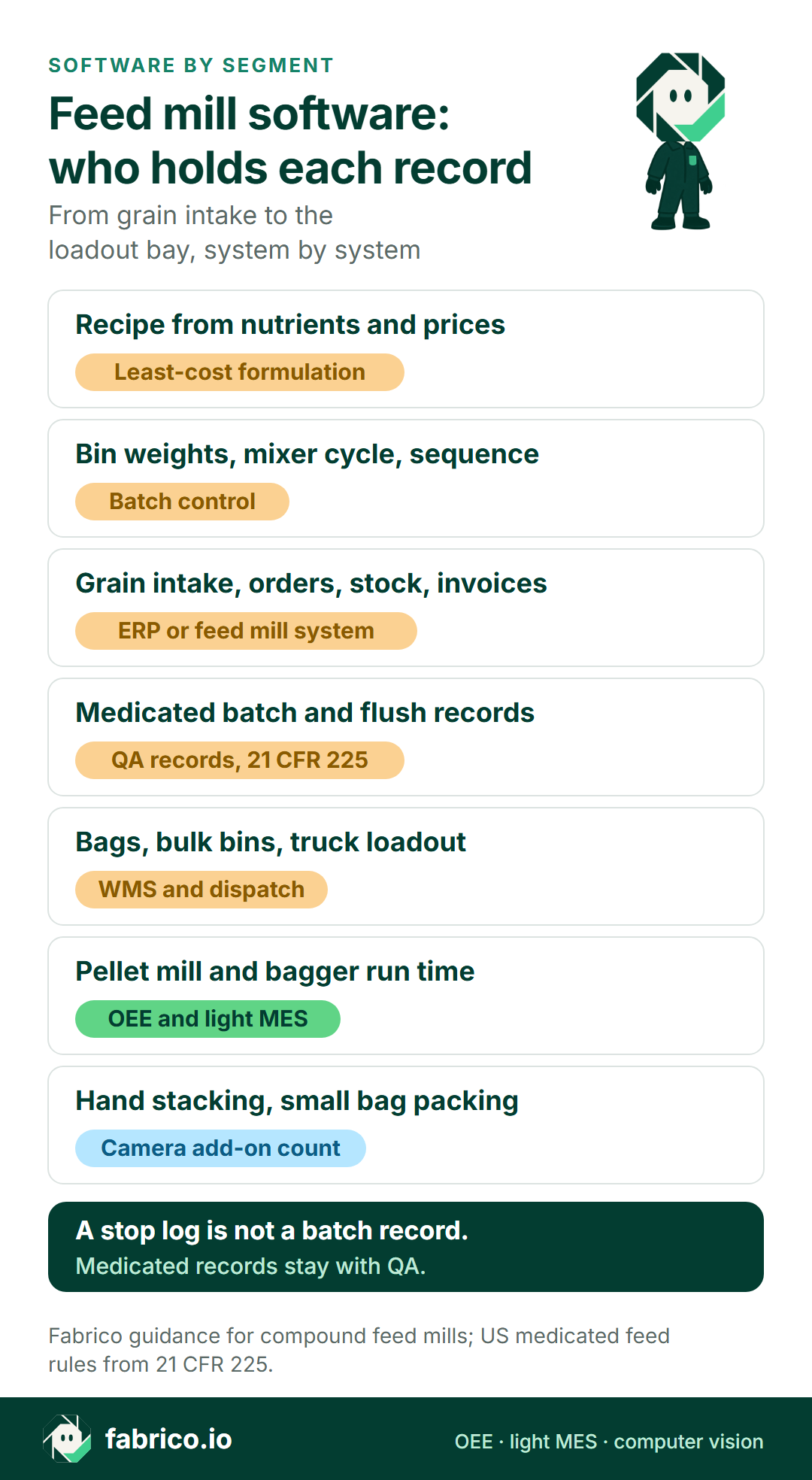
Text version of this infographic
- Recipe from nutrients and prices: least-cost formulation.
- Bin weights, mixer cycle and sequence: batch control.
- Grain intake, orders, stock and invoices: ERP or feed mill system.
- Medicated batch and flush records: QA records under 21 CFR 225.
- Bags, bulk bins and truck loadout: WMS and dispatch.
- Pellet mill and bagger run time: OEE and light MES (Fabrico's layer).
- Hand stacking and small bag packing: camera add-on count.
- A stop log is not a batch record. Medicated records stay with QA.
Least-cost formulation
The nutritionist sets nutrient specs per species and phase, and the software finds the cheapest mix of available ingredients that meets them. When soybean meal or wheat prices move, formulas are solved again. Test it with one price change and see how many formulas change, and how the new versions reach the mill.
Batch control
Batch control runs the weigh bins, micro-ingredient dosing, liquid addition and mixer cycle times, and decides the order in which batches run. It is the system that knows what actually went into each batch. It is usually bought with the mill automation, and it is its own category, separate from formulation and from the ERP.
What feed mill management software covers
Most products sold as feed mill management software cover the business side: grain contracts and intake tickets, customer orders, stock of raw materials and finished feed, invoicing and delivery routes. Some add batch control or a link to it. Ask each vendor to draw where its product stops, and test the parts separately.
Intake lab, dispatch and loadout
Incoming grain is sampled for moisture, protein and mycotoxins before it is binned. At the other end, bulk feed goes from outloading bins into trucks, and bagged feed goes to pallets. The dispatch system books the truck to a bin and prints the ticket. These records sit with QA and logistics.
Medicated feed: what 21 CFR 225 asks for, and where it lives
In the US, medicated feed is a regulated drug product as well as a feed. Under 21 CFR 225.1, the part sets "the criteria for determining whether the manufacture of a medicated feed is in compliance with current good manufacturing practice." The detailed rules in 225.10 to 225.115 apply to facilities making medicated feeds for which an approved medicated feed mill license is required. Outside the US, national and EU feed rules apply instead, and QA should name them.
- Batch records. 21 CFR 225.102 says the production record "includes the complete history of a batch or production run." It must show the quantity and name of drug components used, the theoretical quantity and the actual quantity of medicated feed produced, and it is retained on the premises for not less than 1 year.
- Cleanout between batches. 21 CFR 225.65 allows physical cleaning, or "flushing or sequencing or other equally effective techniques". Where sequencing is used, "it shall be on a predetermined basis designed to prevent unsafe contamination of feeds with residual drugs."
- Assays. Under 21 CFR 225.58, for feeds that need a medicated feed mill license, at least three representative samples of medicated feed containing each drug or drug combination are collected and assayed during the year.
These records come from batch control and QA. Pellet mill stop data is no substitute for a batch record, and line software should never pose as one. What the line layer can add is time: a flush batch run through the pellet mill takes minutes, and booking those minutes to their own reason shows what the medicated sequence costs, while the record itself stays with QA.
Pellet line losses, briefly
Most lost tonnes sit at the pellet mill. Die chokes and roll slips stop it, die changes take hours, and poor conditioning with wet or cold steam cuts the rate. The cooler and the crumbler can hold it back, and fines go back for re-pelleting. Upstream, hammer mill screen changes can starve the mixer. At the end, bagger jams and palletiser faults block the line. The rate per formula, die changes and fines rules are in OEE for animal feed mills.
Which feed mill software to buy first
Choose by the loss that is biggest today. A medicated record gap or an open audit finding goes first, whatever else hurts. After that, the choice is usually between batch control and the line layer.
Mill type changes the order. An integrator's mill making a few formulas for its own farms often has formulation in place and loses most at the pellet mill. A commercial mill with many customers and small orders needs the ERP and dispatch side first. A mill that makes medicated feed must have its batch control and QA records right before anything else.
In a demo, a week of pellet mill log sheets is enough to show what Fabrico would capture and what remains with batch control, QA and the ERP.
Worked example: one carry-over finding traced back through the mill
This case is made up for illustration. A test on a non-medicated broiler feed, made right after a medicated batch, finds drug residue. QA must show the formula version, the batch weights and the sequence, the flush batch, which bin and truck took the feed, and when the pellet mill ran. No single system holds all of it.
| Record | Held in | Where the hand-off breaks |
|---|---|---|
| Formula version and drug inclusion | Formulation software | Old version still loaded in batch control |
| Batch weights and sequence | Batch control | Sequence changed by hand on the night shift |
| Flush batch and production record | QA records | Flush logged on paper, not against the batch |
| Bin, truck and delivery ticket | ERP and dispatch | Bin reassigned after the batch was booked |
| Pellet mill run times and stops | OEE and light MES | Run data only; no batch or drug record |
Hand-typed sequences, flushes and bin moves are where this trace usually snaps. Fabrico is not part of it; its only row is pellet mill run time, stop time and output. The OEE arithmetic for a pellet line shift is in OEE for animal feed mills.
Who hands what between feed mill systems
The links decide whether the stack works. Agree each one, and who keeps it running, before go-live.
Units differ along the mill. The pellet mill runs in tonnes an hour, the bagger in bags a minute, and bulk loadout in tonnes a truck. Report each line in its own unit, then convert for the mill view; our page on OEE units covers the method.
Eight vendor questions for feed mill software
Use them in every vendor meeting, with a month of batch records, pellet mill logs and delivery tickets open.
| Ask | How to test the answer |
|---|---|
| Does the formulation tool hand recipes straight to batch control? | Ask to change one ingredient price and follow the new formula version to the mixer. |
| How does batch control enforce a medicated sequence? | Ask to see a non-medicated feed blocked after a medicated batch until the flush is logged. |
| Where do the 21 CFR 225 production records live? | Ask for one batch record with theoretical and actual quantity, signed, and how long it is kept. |
| What does the line layer take from the ERP, and send back? | Formulas, bag sizes and orders should flow in, tonnes bagged and stop minutes out. Name the person who keeps that feed alive. |
| Can the line layer count tonnes and bags? | Ask for the pellet mill in tonnes an hour and the bagger in bags a minute, side by side. |
| How is a flush batch shown on the pellet line? | Ask for its own reason, so the minutes are visible without moving the record out of QA. |
| What happens at the loadout bay? | Ask which system books a truck to a bin and prints the ticket. It should not be the line layer. |
| Who owns formula master data? | One owner, usually formulation or the ERP. Watch a new formula travel to the pellet line. |
Where Fabrico fits in a feed mill
In a feed mill, Fabrico, a cloud OEE and light MES platform, covers the line from the pellet mill to the palletiser, and the hammer mill if wanted:
- Pellet mill running time: run state and output come from the pellet mill and cooler signals, and operators tag the reason for a stop, such as die choke, die change, steam or no mash, on a tablet or phone.
- Bagging line stops: the bagger, sewing or sealing unit and palletiser get their own stops and counts, in bags, so bagging losses do not hide inside pellet mill tonnes.
- Flush and sequence minutes: a flush batch gets its own reason, so the cost of the medicated sequence shows in minutes and money while the record stays in QA.
Small bags packed or stacked by hand have no machine count; there, the camera add-on counts the bags. Video for that moment opens from the shift timeline, streamed on request, not stored in Fabrico. Camera counting is explained in the FMCG camera guide and on the computer vision add-on page.
Platform details sit on the OEE software page, and light MES vs full MES shows where a full MES would take over.
Outside Fabrico's scope: formulation, batch control, scales or mixer control, medicated feed records, drug inventory, assays, intake grading, ERP, invoicing, dispatch and truck loading, or inspection. Those stay in their own systems and with QA. The production schedule and the formula sequence stay with your planners, batch control and the ERP.
What feed mill buyers ask next
What does feed mill software include?
Several products: formulation, batch control, ERP or feed mill management, intake lab, medicated feed records, dispatch and line OEE, with one record type each.
Is feed mill management software the same as batch control?
No. Feed mill management software usually means the business side: intake, orders, stock, invoices and delivery. Batch control runs the scales and mixer. Some suites sell both; test each part on its own.
Does least-cost formulation software run the mixer?
No. It works out the cheapest formula that meets the nutrient specs. Batch control then weighs and mixes that formula, batch by batch.
Where do medicated feed batch records belong?
With batch control and QA. In the US, 21 CFR 225.102 sets what the production record holds and says it is kept on the premises for not less than 1 year.
Can a feed mill ERP show pellet mill downtime?
It books tonnes produced per formula after the run. It does not usually record when the pellet mill choked, for how long, or why. That is the line layer's job.
Does Fabrico hold medicated feed records?
No. Medicated feed records stay in batch control and QA. On the pellet and bagging lines Fabrico logs run time, stop time, output and the stop reason the operator picks.
Want to see where pellet line hours go? Book a demo and have a week of pellet mill logs and bagging shift reports ready.
Related articles

Latest from our blog


Real Fabrico tiles, sample data.