


 Login
 Blog
Mars Invests £161 Million in Its Melton Mowbray Pet Food Plant: Lessons for Line Upgrades

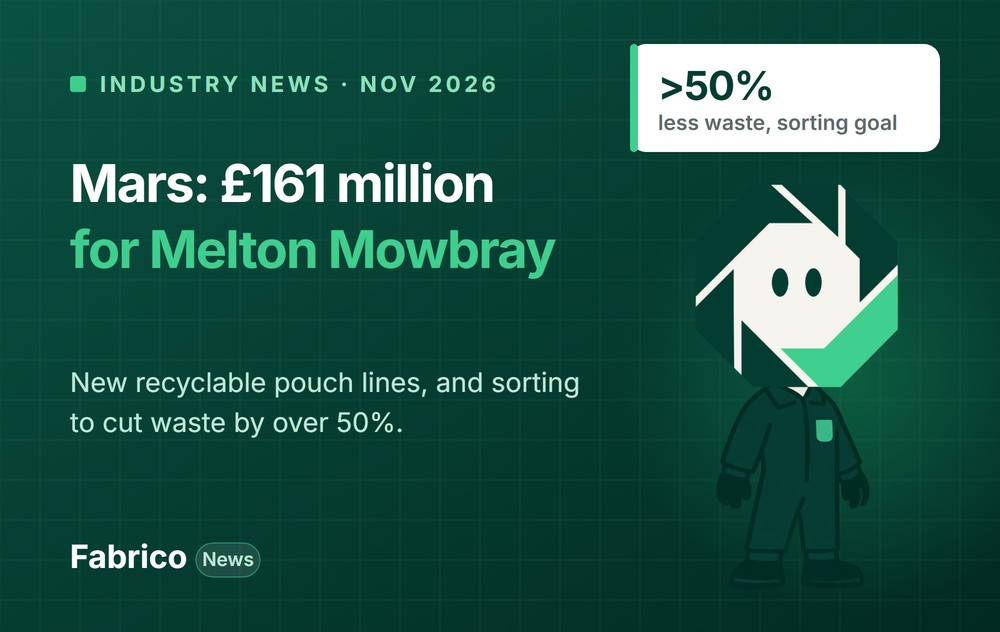
In short: On 10 November 2026 Mars announced a £161 million investment in its pet food factory in Melton Mowbray, the UK home of WHISKAS. The plan brings new high-speed pouch lines for fully recyclable mono-PP packaging, smart optical sorting to cut production waste by over 50%, and more than 30 skilled roles in the first year.
- This is an upgrade of a site that has made pet food for 75 years, not a new plant. Many line upgrades look like this.
- A target such as cutting waste by over 50% can only be proven if waste is measured the same way before and after.
- Below: what Mars announced, the numbers in context, what it means for plant, production and maintenance managers, three steps before the new line arrives and a checklist for this quarter.
News, 13 November 2026. Every news figure below comes from a linked source, and the full list is at the end.
What Mars announced on 10 November 2026
In its release, Mars said the £161 million will modernize its pet nutrition factory in Melton Mowbray. The upgrade includes:
- new high-speed pouch production lines, so the site can switch to fully recyclable mono-PP packaging;
- advanced manufacturing technologies, including smart optical sorting to cut production waste by over 50%;
- utility upgrades aimed at reducing waste.
On people, Mars said the investment will create more than 30 skilled technical and engineering roles in the first year, and grow the site's apprentice program from 26 to 33 permanent positions by 2027. Across the UK, Mars says it has more than 140 apprentices, with a curriculum that covers AI, digital systems and data analytics.
The investment takes Mars's total UK capital investment to £661 million since 2021. It follows a £190 million investment in its Slough chocolate factory announced earlier in 2026. Nick Foster, General Manager for Mars Pet Nutrition, Northern Europe, said "Melton Mowbray has been feeding the nation's pets for 75 years."
The numbers behind the news
Every figure below is from Mars's release of 10 November 2026.
| Item | Figure in the release |
|---|---|
| Investment in Melton Mowbray | £161 million |
| Production waste cut expected from optical sorting | over 50% |
| New skilled technical and engineering roles | more than 30 in the first year |
| Site apprentice program | 26 to 33 permanent positions by 2027 |
| Apprentices across Mars UK | more than 140 |
| Apprentices offered a permanent role on completion | 97% |
| Earlier 2026 investment in the Slough chocolate factory | £190 million |
| Upgrade at the Birstall pet nutrition R&D hub | £1.2 million |
| Mars UK capital investment since 2021 | £661 million |
| Mars associates in Britain | over 10,000 |
On our arithmetic, Melton Mowbray is about a quarter of everything Mars has put into UK sites since 2021 (£161 million of £661 million), and together with Slough it is more than half (£351 million). That is a lot of capital going into existing factories rather than new ones.
What the release does not give is just as useful to know. It names no output figure, no line speed, no date for the new pouch lines and no headcount for the site. The over 50% waste cut is an expectation, and the release does not say what the waste is measured against. Anyone who has run a line upgrade will recognise that last point as the one that decides whether the target can be checked later.
Background: recyclable is not the same as recycled
The move to mono-PP, a pouch made of one plastic instead of layers of different materials, is about making the pack recyclable at the end of its life. UK tax rules look at something else. Under the Plastic Packaging Tax, finished plastic packaging components with less than 30% recycled plastic are taxed, at £228.82 per tonne from 1 April 2026, and a business must register once it makes or imports 10 tonnes or more in 12 months. We make no claim about Mars's position under the tax. Recyclability is starting to carry its own price, though. Under the UK's extended producer responsibility (EPR) scheme for packaging, the year 1 base fee for plastic is £423 per tonne (2025 to 2026), and from year 2 the fees are modulated by recyclability: red-rated packaging pays more, green-rated packaging less. For any plant changing its pack, the point is practical: recyclability, recycled content and line waste are three separate numbers, and each one needs its own measurement.
Background: demand and output
The market the site serves is growing. UK Pet Food's 2026 survey of 8,951 adults, run by Kantar in January 2026, counted about 36.5 million pets in UK homes, including about 15.5 million dogs (12.5 million in 2021) and about 13.1 million cats, with 62% of households, around 18 million homes, owning a pet. Factory output in the sector was moving up too: the Office for National Statistics reported that food products, beverages and tobacco output rose 2.9% in September 2026, the largest positive contribution in manufacturing, which rose 0.7%. Waste is the other side of that volume. WRAP, the UK waste charity, reports that over half of the food waste generated by UK manufacturing and retail is avoidable.
Upgrading a running site: the hard parts
Much new capacity is added the way Mars describes here: new lines and new technology inside a site that is decades old, not a new building on a green field.
That kind of upgrade has two hard parts. The new lines have to reach speed while the rest of the site keeps shipping. And the gain has to be shown in numbers: waste, speed and output per shift, against how the old lines did.
A new pack format adds a third. A switch of packaging material is, for the line, close to a new product. It needs its own rated speed, its own reject limits and its own record of what stops the line. We do not know how Mars runs its lines and make no guess about it.
Proving a waste cut: a worked example
Example data, not Mars's. A pouch line makes 1.2 million pouches a week.
| Measure | Before | After |
|---|---|---|
| Waste, share of output | 3.0% | 1.5% |
| Pouches wasted a week | 36,000 | 18,000 |
| Pouches saved a week | - | 18,000 |
The cut in this example is only real if both columns count waste the same way: the same start and end points, the same scrap reasons, and start-up scrap included in both. If the "before" was estimated from purchase records and the "after" is counted at the line, the comparison says little.
In money (Example data). Assume a wasted pouch costs £0.35 in product, film and processing. Then 18,000 pouches saved a week is 18,000 x £0.35 = £6,300 a week, or £302,400 a year over 48 production weeks (48 x £6,300). Waste also has a disposal cost, which this example leaves out.
Upgrading a pouch or can line? Book a demo and see scrap and waste coded by reason per shift.
What it means for plant, production and maintenance managers
For the plant manager: make the target checkable
A headline target such as cutting waste by over 50% is a promise to the board, the customers and, often, the people who funded the project. It can only be checked if the plant agreed, before the upgrade, what counts as waste, where it is weighed or counted, and over what period. The plant manager's other decision is people: new lines need technicians who can run and fix them, and growing an apprentice program, as Mars plans, takes years to pay back. Linking the skills plan to the line start-up plan, line by line, avoids a new line that is installed but cannot be staffed on every shift.
For the production manager: a new pack behaves like a new product
Wet pet food lines often run many recipes and pack sizes, so changeovers and start-up waste are a real share of the loss. A new film adds its own behaviour on the sealer, the forming set and the filler. The production manager's job in the first months is to keep the old and new packs measured on the same list of stop and waste reasons, to watch seal rejects and fill weight per shift, and to plan changeovers by recipe family so the new line does not change over more than it needs to. Giveaway, product filled above the declared weight, is waste too, even if it leaves in the pouch.
For the maintenance manager: new machines and old utilities
Optical sorters, like any sensor-based machine, need cleaning and regular checks to keep sorting the way they did on acceptance day. High-speed pouch lines add wear parts on sealing and film handling that need their own spares and PM intervals from day one. The release also mentions utility upgrades aimed at reducing waste. Utilities are often owned by maintenance, and they are easy to overlook in a line project: metering steam, compressed air and power per tonne produced before and after the upgrade is the only way to show what changed.
Three steps before the new line arrives
- Measure the old line now. Four to eight weeks of OEE by shift, with waste split by reason: start-up, changeover, seal or fill rejects, and other. Our page on scrap reason codes has a simple starting list.
- Treat the new material as a new product. Give it a rated speed and reject limits, and record its stops under the same list as the old pack. Then the first weeks show whether the line or the material is the limit.
- Put the data in the operators' hands. Stop reasons entered at the line and a shift report the team reads every day matter as much as the new equipment. Our guide to OEE for pet food production shows the losses to watch on kibble and pouch lines.
What to do this quarter
- Write the waste definition down. Start and end points, what is counted (start-up, changeover, rejects, giveaway), and where it is weighed. Sign it off with finance.
- Measure giveaway. Example data: 2 g over the declared weight on 1.2 million pouches a week is 2.4 tonnes of product a week.
- Log seal rejects by film batch. When a new film arrives, this shows whether rejects follow the material or the machine.
- Group changeovers by recipe family. Plan the week so similar recipes run together, and record the minutes per changeover.
- Meter utilities per tonne. Steam, compressed air and power for the line, before any upgrade, so the gain can be shown later.
- Map skills to the new line. For each shift, who can run, clean and fix it. Fill the gaps before start-up, not after.
- Review waste monthly against the target. Same definition, same place, same people, every month.
Where OEE and light MES help
OEE splits a line's loss into stops, slow running and rejects. On a new pouch line, that shows which of the three holds the ramp-up back, week by week.
A light MES keeps the waste reasons and shift reports together with the output counts, so the before and after are measured the same way.
Some steps, such as hand-packed multipacks or case packing, have no machine count. There, an AI camera (an add-on) that counts output fills the gap, so the whole line has one baseline.
Planning the software for a pet food plant? See our guide to pet food manufacturing software.
Why OEE alone can hide a waste cut
Example data, continuing the worked example. A pouch line runs at 85% availability and 90% performance. Waste falls from 3.0% to 1.5%, so quality rises from 97% to 98.5%. OEE moves from 0.85 x 0.90 x 0.97 = 74.2% to 0.85 x 0.90 x 0.985 = 75.4%, a gain of about 1.2 points. On a dashboard that looks small. In product it is 18,000 pouches a week, as the table above shows. Track waste in units or kilograms next to OEE, so a quality gain is not lost in the rounding.
How Fabrico does it
Fabrico is a cloud OEE and light MES platform. Stops come from the PLC or a Fabrico IoT device with sensors, and operators add the stop and scrap reasons on a tablet or phone. Where a station has no signal, AI cameras (an add-on) count output. OEE, waste and losses show by line and shift. We have no link to Mars; the figures above are from its release.
Upgrading a line and need to prove the gain? Book a demo.
What people ask next
What is Mars investing in Melton Mowbray?
Mars announced £161 million on 10 November 2026 for its pet food factory in Melton Mowbray: new high-speed pouch lines for fully recyclable mono-PP packaging, smart optical sorting to cut production waste by over 50%, and utility upgrades aimed at reducing waste.
How many jobs does the Melton Mowbray investment create?
Mars says more than 30 skilled technical and engineering roles in the first year, and the site's apprentice program grows from 26 to 33 permanent positions by 2027.
How do you prove a waste reduction on a new line?
Measure waste on the old line first, with the same start and end points and the same scrap reasons you will use on the new one, and include start-up scrap in both. Then compare per shift. Our page on scrap reason codes has a starting list.
What is mono-PP packaging?
Mono-PP means the pouch is made from one plastic, polypropylene, instead of layers of different materials. Mars says its new Melton Mowbray lines will switch to fully recyclable mono-PP packaging. Whether a pack is actually recycled also depends on collection and sorting where it is thrown away.
Does recyclable packaging avoid the UK Plastic Packaging Tax?
Not by itself. The tax looks at recycled content, not recyclability: finished plastic packaging components with less than 30% recycled plastic are taxed, at £228.82 per tonne from 1 April 2026, according to GOV.UK. Businesses register once they make or import 10 tonnes or more in 12 months.
How much has Mars invested in the UK since 2021?
Mars says its UK capital investment since 2021 reaches £661 million with the Melton Mowbray project. That includes £190 million for its Slough chocolate factory announced earlier in 2026 and a £1.2 million upgrade at its Birstall pet nutrition research hub.
Sources
All sources accessed on 14 November 2026. Dates are the publication dates shown on each page.
- Mars, Mars announces £161 million investment in Midlands pet food manufacturing site, 10 November 2026
- GOV.UK, Extended producer responsibility for packaging: 2025 base fees, 30 June 2025 (last updated)
- UK Pet Food, Britain's dog ownership boom as 15.5 million dogs now live in UK homes, 31 March 2026
- Office for National Statistics, Index of Production, UK: September 2026, 12 November 2026
- WRAP, Quantification of food surplus, waste and related materials in the supply chain, undated web page
- GOV.UK, Plastic Packaging Tax: steps to take, 12 February 2026 (last updated)
Related articles

Latest from our blog


Real Fabrico tiles, sample data.