


 Login
 Blog
Honda's $3 Billion Ohio Plant: What Retooling Running Lines Means for Plants

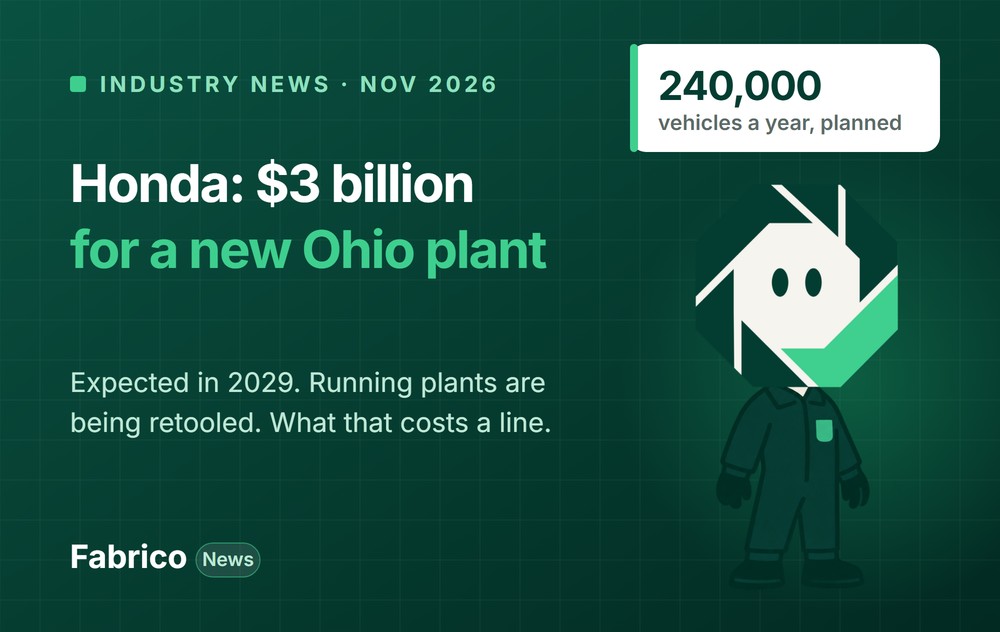
In short: On 9 November 2026 Honda said it will invest $3 billion in a new auto plant in Central Ohio, with more than 2,000 new jobs and capacity for 240,000 vehicles a year. Production is expected in 2029, pending final government approvals. The same plan retools plants that keep running today.
- The new plant is three years away. The work inside running plants in Ohio, Alabama and Georgia is the part that can touch daily output first.
- Converting a line while it still has to ship is where output quietly goes missing, unless someone measures it.
- Below: what Honda announced, the numbers in context, what it means for plant, production and maintenance managers, three steps to take first and a checklist for this quarter.
News, 13 November 2026. Every news figure below comes from a linked source, and the full list is at the end.
What Honda announced on 9 November 2026
In its announcement, Honda said the new plant will sit between its East Liberty and Marysville auto plants. It will be Honda's fourth auto plant in Ohio and its ninth auto-related production facility in the US. Honda announced the plan in Ohio on 9 November 2026; its global newsroom dates the release 10 November, Japan time.
The plant is planned for 240,000 vehicles a year and is built to make several vehicle types and powertrains: hybrid, gasoline and battery-electric. Honda says it will use leading-edge automation, data-driven technologies and flexible production systems. Together with the projects at its existing plants, Honda says its US auto production capacity will grow to about 1.3 million vehicles a year, and its North American capacity to about 1.9 million.
In the US, the plan also changes plants that are running now:
- Alabama Auto Plant: new equipment for a V6 hybrid engine and one of the most significant renovations of Line 1 since production began in 2001, so Line 1 can build the Passport, now made only on Line 2.
- Anna Engine Plant, Ohio: major retooling of existing engine equipment and a new parts consolidation center. Honda calls it its largest engine plant in the world.
- Honda Transmission Plant, Ohio: an existing transmission line is being turned into a second hybrid system line "even as the plant continues to support current vehicle production". Honda says hybrid system capacity in Ohio will increase 250% in the coming years.
- Honda Transmission Plant, Georgia: a new transmission assembly line for hybrid systems for larger vehicles.
Honda also said it works with more than 750 original equipment suppliers in North America.
The numbers behind the news
The figures below come from Honda's announcement and from the Ohio Governor's office release of 9 November 2026.
| Item | Figure | Source |
|---|---|---|
| New Ohio auto plant investment | about $3 billion | Honda, Ohio |
| Total new Ohio commitment, incl. other Ohio plants | $3.38 billion, 2,390 jobs | Ohio |
| New jobs at the new plant | more than 2,000 | Honda, Ohio |
| Planned capacity of the new plant | 240,000 vehicles a year | Honda, Ohio |
| Start of production | 2029, pending final government approvals | Honda, Ohio |
| Honda US auto capacity after all projects | about 1.3 million vehicles a year | Honda |
| Honda North American capacity after all projects | about 1.9 million vehicles a year | Honda |
| Hybrid system capacity in Ohio | up 250% in the coming years | Honda, Ohio |
| Honda associates in Ohio | more than 15,000 | Ohio |
| Original equipment suppliers in North America | more than 750 | Honda, Ohio |
Two things stand out. First, the new plant is about $3 billion of a $3.38 billion Ohio commitment; the rest goes into plants that already run. Second, on Honda's own figures the new plant's 240,000 vehicles are a little under a fifth of the roughly 1.3 million vehicles a year of US capacity after all the projects (our arithmetic). The rest of that capacity sits in existing plants, some of which are being changed while they keep building today's models.
The releases do not say how much output the existing plants will lose during their conversions, or how long each conversion takes. Ohio's Tax Credit Authority approved a tax credit on the day; the value of any JobsOhio support will be made public after a final agreement.
Background: a shift toward hybrids
Honda ties the plan to hybrids. It says it will introduce 15 new Honda and Acura hybrid models globally by 2030, and that its Ohio transmission plant will support two next-generation hybrid systems, with the next-generation hybrid system and a new parts consolidation center at the Anna Engine Plant due to start next year. Honda also says nearly 99% of the Honda and Acura vehicles it sold in the US in 2025 were made in North America. For suppliers, a mix shift like this matters as much as the new plant: different parts, different volumes, and the timing set by the customer's launch plan.
Independent data points the same way. The US Energy Information Administration reported on 19 October 2026 that hybrids reached 16% of US light-duty vehicle sales in the third quarter of 2026, while battery electric vehicles fell from 10% to 6% and plug-in hybrids from 1.8% to 0.7% after the federal tax credit expired. Argonne National Laboratory counted 209,456 hybrids sold in the US in April 2026, up 10.1% on April 2025.
The plants doing this work are busy but not full. The BLS employment report put motor vehicles and parts jobs at 965,500 in October 2026, up 4,100 on the month and about 9,900 on a year earlier. The Federal Reserve put US manufacturing capacity utilization at 75.9% in September 2026. With a quarter of capacity idle on average, many plants can find room for a converted line; the harder part is converting it while orders keep shipping.
The part that touches output first: running conversions
Most coverage will be about the new plant. For people who run lines, the harder part is the other one: changing a line that still has a shipping plan.
A retool on a running line takes output in small pieces. There are stops to fit new equipment, trial runs, slower speeds while people learn the new setup, and more scrap in the first weeks. Each piece looks small in a shift report. Over a conversion that lasts months, they add up to real volume.
We do not know how Honda manages this inside its plants and make no guess about it. The general point holds for any plant: if you cannot see what a conversion costs per shift, you cannot plan stock for it or tell when it is over.
Suppliers feel it too. A customer that adds capacity and changes models asks its suppliers for new parts, new volumes or both, often on lines that are already busy.
What a running conversion costs: a worked example
Example data, not Honda's. A machining line is rated at 2 parts a minute and runs two shifts of 450 planned minutes, so 900 planned minutes a day and 1,800 parts at 100% OEE.
| Period | Line OEE | Good parts a day |
|---|---|---|
| Before the conversion | 70% | 1,260 |
| During the conversion | 55% | 990 (-270) |
| After, if the target is met | 75% | 1,350 (+90) |
Over 40 working days of conversion, 270 parts a day is 10,800 parts. If you know that number before you start, you can build stock ahead, plan overtime, or phase the work. If you only find out at the end of the month, the customer finds out first.
In money (Example data). Assume each part carries $14 of contribution margin. Lost parts that are never made back cost 10,800 x $14 = $151,200 over the conversion. Making them back on overtime instead: at 2 parts a minute, 10,800 parts need 90 hours of line time; with a crew of 5 at an assumed $48 an hour overtime rate, that is 90 x 5 x $48 = $21,600, plus any expedited freight if stock runs short. Knowing the number in advance is what lets you choose the cheaper path.
Retooling while orders keep shipping? Book a demo and see start-up losses tracked from the first shift.
What it means for plant, production and maintenance managers
For the plant manager: two jobs at once
A plant that is retooled while it ships has two jobs: deliver this quarter's volume and prepare next year's products. Both compete for the same people, the same maintenance hours and the same line time. The plant manager decides how much output the plant will give up to the project, and when. That decision is much easier with a number on it: the expected loss per day during the conversion, how many days, and how much stock or overtime covers it. For suppliers to a customer that is changing its mix, the same question arrives from outside: new part numbers and volumes, often on lines that are already loaded.
For the production manager: moving a model between lines
Honda's Alabama plan is a clear case: Line 1 is being renovated so it can build the Passport, which today is made only on Line 2. Moving a product from one line to another, in any plant, means a period where both lines need parts, people and quality checks for it. The production manager plans trial builds into the schedule rather than squeezing them in, names the people who run them on each shift, and watches first-pass yield on the new line every day. The old line keeps its own numbers, so a dip there is not hidden by the start-up on the new one.
For the maintenance manager: two configurations to support
During a conversion, maintenance supports the old setup and the new one side by side. That means spares for both, drawings and PLC programs that match what is actually installed, and a clear list of which machines are under the supplier's commissioning and which are back with the plant. Capability runs on retooled machines, before they are released to production, catch problems that would otherwise show up as scrap. Each stop on new equipment in the first weeks should carry a reason, so repeat faults go back to the supplier quickly.
Three steps before you retool a running line
- Take a baseline first. Four weeks of OEE by shift, with stop reasons, speed against the rated speed and rejects. Without it, nobody can say whether the new setup is better. Our guide to start-up loss vs reduced yield explains how to split start-up scrap from normal scrap.
- Give the conversion its own stop reasons. "Installation", "trial run" and "waiting for the new tooling" should not hide under "other". Then the cost of the project shows per shift, apart from normal breakdowns.
- Agree when the conversion is over. Set the exit rule in numbers, for example two weeks at the baseline OEE or better, and track it shift by shift. Standard work for the new setup helps it stick; see line start-up standard work.
What to do this quarter
- Size the buffer. Divide the expected loss during the conversion by daily demand to get the days of stock to build first. In the worked example, 10,800 parts at 1,260 a day is about 8.6 days.
- Book trial runs in the schedule. Give each trial build a slot, a crew and a target, instead of fitting it into gaps.
- Freeze the spares list for the overlap. List the parts needed to keep both the old and the new setup running until the old one is gone.
- Ask suppliers in writing. For the 10 part numbers whose volume or design changes most, ask each supplier to confirm capacity and dates.
- Train the pilot crews first. Name the people per shift who will run the new setup and train them before the first trial, not during it.
- Review four numbers weekly. Availability, performance, quality and good output for the converted line, against the baseline.
- Write the new standard down. Settings, speeds and setup steps that worked, captured before the project team moves on.
Where OEE and light MES help
OEE splits the loss into availability (stops), performance (slow running and short stops) and quality (rejects), so the conversion's cost has a shape, not only a total.
A light MES keeps the stop reasons, shift reports and output counts in one place. The before and the after are measured the same way, which is what makes the comparison fair.
Manual stations, such as a hand-fed assembly step next to an automated cell, often have no count at all. There, an AI camera (an add-on) that counts output gives the whole line a baseline, not only the automated part.
Comparing tools to measure a retooled line? Our review of the best OEE software sets out what to check before you buy.
Which OEE factor a conversion hits, and which recovers first
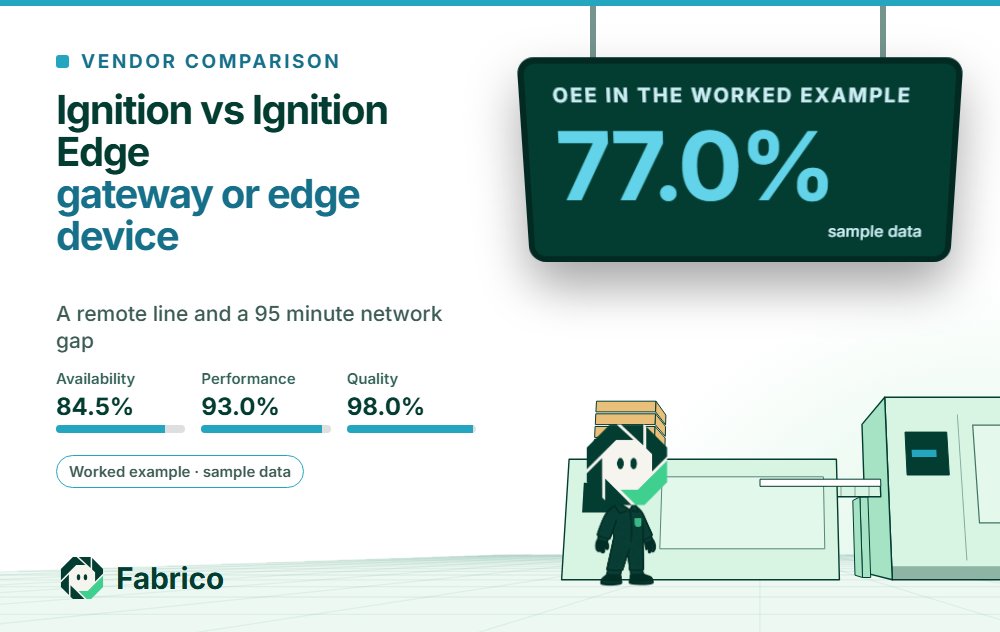
Example data, continuing the worked example. The line's 55% OEE during the conversion could split as 80% availability (installation stops and trial runs), 80% performance (slower running while people learn) and 86% quality (start-up scrap): 0.80 x 0.80 x 0.86 = 0.55. The split tells you what to expect. Availability usually comes back when the installation is done. Performance comes back with training and settled settings. Quality comes back when the process is stable. If performance is still at 80% four weeks after the last installation stop, the problem is training or settings, not the equipment.
How Fabrico does it
Fabrico is a cloud OEE and light MES platform. Stops come from the PLC or a Fabrico IoT device with sensors, and operators add the reason on a tablet or phone. Where a station has no signal, AI cameras (an add-on) count output. OEE and losses show by line and shift, before, during and after a project. We have no link to Honda; the figures above are from its announcement.
Planning to retool a line that still has to ship? Book a demo.
What people ask next
When will Honda's new Ohio plant start production?
Honda says production is expected to begin in 2029, pending final government approvals. The plant will sit between its East Liberty and Marysville auto plants.
How many jobs will Honda's new Ohio plant create?
More than 2,000 new jobs, according to Honda's announcement of 9 November 2026, with planned capacity of 240,000 vehicles a year.
How do you measure the cost of retooling a running line?
Take a baseline of OEE by shift before the work starts, give installation and trial runs their own stop reasons, and compare output per shift during and after the change against that baseline. See our guide to start-up loss vs reduced yield.
How much is Honda investing in Ohio in total?
The Ohio Governor's office said on 9 November 2026 that Honda's new commitment totals $3.38 billion of new investment and 2,390 new jobs, including related work at other Ohio plants. The new plant itself is about $3 billion and more than 2,000 jobs. Ohio's Tax Credit Authority approved a tax credit; JobsOhio support will be disclosed after a final agreement.
What changes at Honda's existing US plants?
Honda says the Alabama Auto Plant gets V6 hybrid engine equipment and a renovated Line 1 to build the Passport, the Anna Engine Plant in Ohio gets major retooling and a parts consolidation center, an Ohio transmission line becomes a second hybrid system line, and the Georgia transmission plant gets a new hybrid assembly line.
How long should a line take to recover after a conversion?
There is no standard figure; it depends on the equipment and the people. Set the exit rule in numbers before you start, for example two weeks at the baseline OEE or better, and track availability, performance and quality separately so you know which one is holding it back.
Sources
All sources accessed on 14 November 2026. Dates are the publication dates shown on each page.
- Honda, Honda to Boost U.S. Hybrid Production with New $3 Billion U.S. Auto Plant and Investments in Multiple Facilities, 10 November 2026
- US Energy Information Administration, Today in Energy: Hybrid sales rise while battery electric sales remain lower after tax credit expiration, 19 October 2026
- Argonne National Laboratory, Light Duty Electric Drive Vehicles Monthly Sales Updates, April 2026 data
- US Bureau of Labor Statistics, The Employment Situation, October 2026 (Table B-1), 6 November 2026
- Federal Reserve Board, G.17 Industrial Production and Capacity Utilization, September 2026, 16 October 2026
- Office of the Governor of Ohio, Governor DeWine, Honda, JobsOhio, One Columbus, and Union County Announce New Honda Auto Plant to Boost Hybrid Production, 9 November 2026
Related articles

Latest from our blog


Real Fabrico tiles, sample data.