


 Login
 Blog

Computer Vision for Bus and Coach Manufacturing: Shells, Line Moves, Fit-Out

In short: computer vision for bus manufacturing earns its place at the manual stations of a bus or coach plant: wall and framing jigs, the pulse stations of final assembly, and the benches that feed them. Tube saws, weld robots, the dip line and the paint booth already report cycles through their own controls.
- A bus plant releases a few buses a day, so OEE is counted in line moves against station takt, not parts per minute.
- Losses show up as waits for battery packs, seats, a harness or the station upstream, and as option work that overruns station takt.
- Weld, coating, leak, brake and alignment checks belong to inspection systems and test rigs. Fabrico does no inspection.
- The Fabrico camera add-on counts shells, buses and sub-assemblies. Where a camera add-on covers a station, the video for the minute of a stop can be opened from the shift timeline, streamed on request and not stored in Fabrico.
A city bus spends days in the plant that builds it: hours in a framing jig, a trip through a dip tank and a paint booth, then a pulse line. The robots and the dip line log their cycles; the jig crew leaves a signature on a route card, and a late line move leaves a gap on the whiteboard.
City buses, intercity buses and coaches are in scope. Cameras fitted on the bus itself, for passengers, drivers or bus lanes, are a different product. Component plants are covered in computer vision for automotive parts.
Computer vision in bus manufacturing: three jobs, one count for OEE
Inspection systems look for faults, test rigs prove the finished bus, and only the OEE camera, which counts output, feeds the OEE figure.
| Job in a bus plant | Done by | OEE camera? |
|---|---|---|
| Check MIG welds on the skeleton | Weld inspector, NDT | No |
| Measure dip coat and paint film | Coating gauge, paint lab | No |
| Find leaks at windows and hatches | Water test booth | No |
| Align axles, test brakes and lamps | Alignment rig, roller brake tester | No |
| Count body shells off the framing jig | A route card signature | Yes |
| Count line moves at the last station | A whiteboard tally | Yes |
| Show the wiring station at 10:40 | The team lead's memory | Open the minute of the stop from the shift timeline, streamed on request |
They run side by side: a bus sent back from the water test leaves the good count through the test station's rework record, and output comes from the camera add-on count.
What you see: the line screen, stops and waste on sample lines. The video shows the software, not the camera. Book a demo.
Plays from YouTube. Google may set cookies when you press play. Privacy policy.
Body shop: tube saws, wall jigs and the framing jig
A bus skeleton is built from steel, stainless or aluminium tube and profile. CNC saws, tube benders and laser cutters prepare the parts, and weld robots join nodes and sub-frames; their controls know each program and part count, so connect those signals. For robot cell losses, see OEE for robotic welding cells.
Side walls, roof frame and ends
Welders build the underframe with its axle and drivetrain mounts, the side walls, the roof frame and the front and rear ends in separate jigs, some with a robot doing part of the seams. A manual jig keeps no count. A camera add-on looking at the jig exit counts each frame the crane takes away, not people or arcs.
The framing jig
In the framing jig, sometimes called the marriage jig, the floor grid, side walls, roof and ends are welded into one body shell. It can set the pace of the body shop, and an articulated bus needs two shells. Count shells as they roll out. Mount the camera add-on out of the spatter path; the camera placement and lighting guide covers brackets, angles and glare.
Dip, sealing, skins and paint: the controls already know
Plants that protect the whole skeleton send it through a cathodic dip (e-coat) line and oven, logged carrier by carrier in the PLC. Then come seam sealing, underbody protection and the outer skin: aluminium or steel side sheets bonded to the frame, and GRP front and rear masks. A bonded part holds its fixture while the adhesive cures; put that cure time into the ideal cycle.
The paint booth and oven have their own controls; a multi-colour livery adds masking and passes. A shell queuing for the booth is a booth loss, not a body shop one. Devices near spraying fall under the site's explosion protection rules, so any count sits beyond the booth exit, where the safety lead agrees.
Final assembly: a pulse line that moves a few times a day
On a pulse line every bus moves one station forward at the same moment, once per station takt, so with a takt of two or three hours the line moves a few times a shift. In the US, the FTA's Buy America rule lists what final assembly of a new bus would typically include, at a minimum: Appendix D to 49 CFR 661.11 names the installation of "pneumatic and electrical systems, door systems, passenger seats, passenger grab rails, destination signs, wheelchair lifts", followed by "road testing, final inspection, repairs and preparation of the vehicles for delivery".
Roof and drivetrain stations
Axles, the engine or e-axle, the cooling pack and the HVAC roof unit go in early. On a battery-electric bus, a hoist lifts battery packs onto the roof or into a rear tower. A late battery pack stops the station with a full crew standing by, so it needs a stop reason of its own.
Wiring, air lines and floor
Harnesses are pulled through the shell, air lines laid for brakes, suspension and doors, and plywood floor panels go down under a glued covering. Options such as a second destination display add wiring time to one bus and not the next.
Glazing, doors and interior
Windows are bonded in, doors and the wheelchair ramp fitted, then side panels, ceiling, grab poles and seats. Every station moves at the same moment, so one camera add-on at the last station counts the line moves, and the team lead books the station that held a late move as its stop reason.
Benches beside the line
Door leaves, seat frames, front masks and harnesses come from benches next to the line; count kits out of each, so a missing set shows early. More on bench counting: camera counts for manual assembly OEE.
Coaches and articulated buses
A coach adds luggage bays, a toilet module, belted seats and a higher floor, and some coach builders body a chassis bought from a truck maker. An articulated bus adds a second shell and the joint with its bellows.
Zero-emission buses: the roof and high-voltage stations
The drivetrain mix is already shifting: ACEA registration data show "The share of EU electrically-chargeable bus registrations increased to 23.8% by the end of 2025." Under the revised CO2 standards for heavy-duty vehicles, the European Commission states that "90% of new city buses must be zero-emission by 2030", and from 2035 "all new city buses will have to meet the same requirements". Public buyers push the same way: under the Clean Vehicles Directive, a Member State has to meet "at least half of the procurement target for clean buses in each period through the procurement of zero-emission buses". The directive covers buses "(excluding coaches)", so a coach line feels it later than a city bus line.
On the line, high-voltage cabling, the charging socket and the HV junction box need electricians trained for high voltage, so that station has its own crew and its own ideal time per drivetrain. Book battery and HV waits under their own reasons, so a change in the mix shows in the losses instead of an average. HV insulation and function checks at the end of the line stay with the test rigs.
OEE at three buses a day: line moves against station takt
Parts per minute mean nothing here. Every station moves together, so count line moves once, at the last station, and give each model the station takt as its ideal cycle time. Availability: minutes the line ran out of the minutes planned. A wait for battery packs, a seat set or the bus from upstream is an availability loss under a named reason. Performance: counted moves times takt, out of run minutes. Quality: buses that pass the water test and the end-of-line checks first time.
Group models into a few ideal times: a 12 m city bus, an 18 m articulated bus, a coach. Configuration is tracked closely anyway: in the US, buses bought with FTA funds must be tested first: 49 CFR Part 665 requires a certification that "any new bus model acquired with such assistance has been tested and has received a passing test score", and a model "being produced with a major change in configuration or a major change in components" counts as a new one. One late move swings a shift figure, so read OEE per week too. For manual line OEE in general, see OEE on manual and hybrid assembly lines.
End of line: alignment, brake test, water test and the finish bay
Off the line come wheel alignment, a roller brake test, headlamp aim, an electrical check, a water test booth that sprays the body for leaks, a road test and the pre-delivery inspection (PDI) before handover. In the US, window retention and emergency exits have their own federal standard: FMVSS No. 217 sets requirements for "the retention of windows other than windshields in buses" and for the "operating forces, opening dimensions, and markings for bus emergency exits". Those checks and records stay with the test rigs and the quality team.
Faults go to the finish bay. A leak at a side window is resealed by the glazing team; a door that sticks goes back to the door fitters. The rework belongs to the station that caused it, not to the test that found it.
Signal, test rig or camera: a station card for bus plants
Station lists differ by plant and model; check each machine before buying.
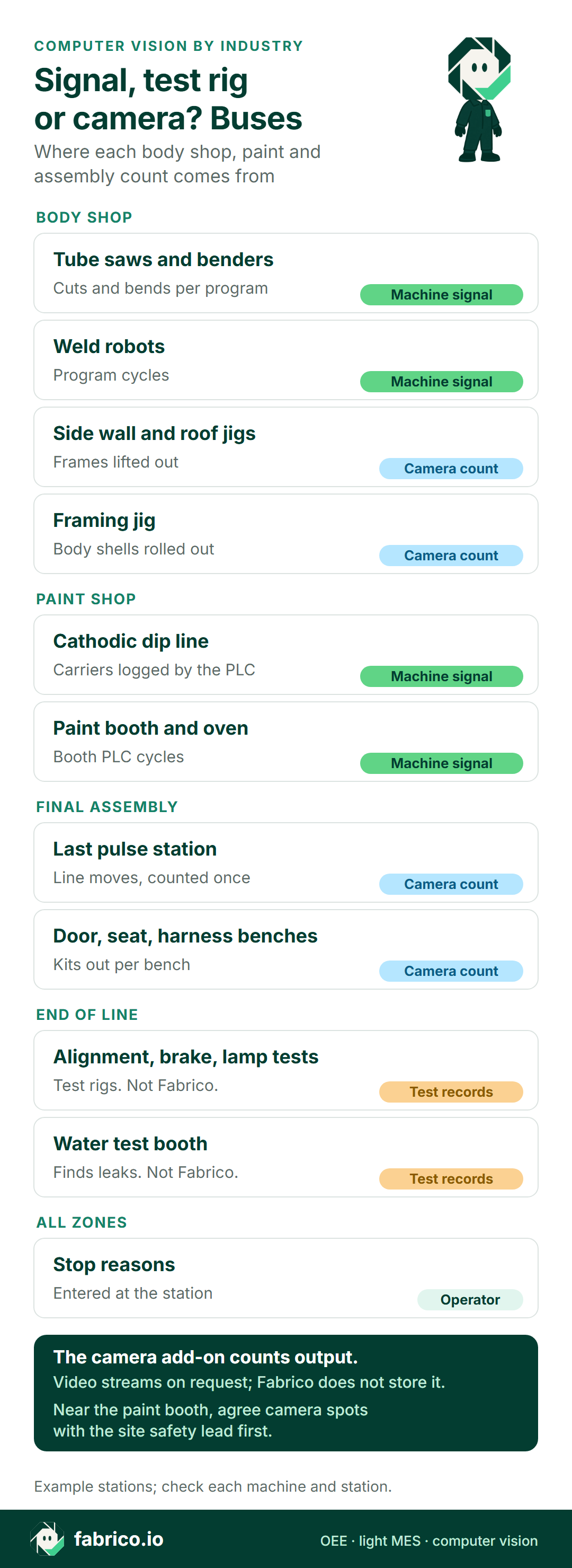
Text version of this infographic
- Body shop: Tube saws and benders: machine signal, Cuts and bends per program
- Body shop: Weld robots: machine signal, Program cycles
- Body shop: Side wall and roof jigs: camera count, Frames lifted out
- Body shop: Framing jig: camera count, Body shells rolled out
- Paint shop: Cathodic dip line: machine signal, Carriers logged by the PLC
- Paint shop: Paint booth and oven: machine signal, Booth PLC cycles
- Final assembly: Last pulse station: camera count, Line moves, counted once
- Final assembly: Door, seat, harness benches: camera count, Kits out per bench
- End of line: Alignment, brake, lamp tests: test records, Test rigs. Not Fabrico.
- End of line: Water test booth: test records, Finds leaks. Not Fabrico.
- All zones: Stop reasons: operator, Entered at the station
- The camera add-on counts output. Video streams on request; Fabrico does not store it.
- Near the paint booth, agree camera spots with the site safety lead first.
Book a demo to see the jigs, the last pulse station and the benches of a bus line counted on one shift timeline.
Worked example: one early shift on a city bus pulse line
Example numbers, no real plant: a plant builds 12 m battery-electric city buses on one shift, planned at 15 a week. Its final assembly line has eight stations and a 150-minute station takt, so a bus spends about three shifts on the line. The early shift runs 06:00 to 14:00 with a 30-minute break: 450 planned minutes, so the ideal is 3 line moves. A camera add-on counts buses leaving the last station, a second camera add-on sits at the wiring station exit, and the team lead adds stop reasons on a tablet.
Availability. After the wiring station had finished, the roof station still held the line: 40 minutes waiting for two battery packs that arrived late from the supplier, and 20 minutes with a roof hoist fault. The line stood 60 minutes, so run time was 390 of 450: 86.7%.
Performance. Two buses left the last station. Two times 150 is 300 takt minutes from 390 minutes of running: 76.9%. The team lead booked the 90 slow minutes to the wiring station: both buses carried a second destination display and extra ticket validators, and each held the line 45 minutes past takt.
Quality. Both buses passed the water test and the end-of-line checks first time: 300 of 300, or 100%. A window leak would send a bus to the finish bay for the glazing team and take its 150 minutes out of the good figure, so with two buses a shift, judge quality over the week.
OEE. 86.7% x 76.9% x 100% = 66.7%. Cross-check: 300 good takt minutes of 450 planned minutes is 66.7%.
Opening the minute of the stop at the first late move from the shift timeline, the team lead had the camera add-on at the wiring station exit stream it on request and saw the bus still in the wiring station while the next station stood ready, its extra display and validators not yet fitted.
What the shift cost in money
Example inputs, which a plant replaces with its own: 32 fitters on the line, four per station, at a loaded labour cost of EUR 40 an hour. That rate sits close to the 2025 euro area average, where Eurostat labour cost statistics show industry as the highest paying sector, at EUR 40.3 per hour. The crew is paid while the line stands or runs slow, so each lost minute costs 32 x 40 / 60, about EUR 21.33 of crew time.
| Loss this shift | Minutes | Crew cost, example rate |
|---|---|---|
| Slow wiring, option buses | 90 | EUR 1,920 |
| Battery packs late | 40 | EUR 853 |
| Roof hoist fault | 20 | EUR 427 |
| Total lost time | 150 | EUR 3,200 |
That is EUR 3,200 of crew time with no bus to show for it, or EUR 16,000 a week if every shift ran like this one. The bigger number is the missing bus: the shift was planned for three and built two. If the order book is full and overtime cannot recover it, add one bus times the plant's own contribution margin; at an example EUR 25,000 per bus, the shift cost EUR 28,200. Fabrico values each loss from the price or margin the plant enters per model, so the ranking uses real figures.
Option work at the wiring station is 60% of the lost crew time, more than the supplier and the hoist together, so a realistic ideal time for option buses, or an extra fitter on them, is the first fix.
Five steps a bus plant can start this week
- Pull one week of line-move times and mark each late move with the station the team lead remembers holding it.
- List the stop reasons that matter here: battery packs, seat set, harness, bus from upstream, hoist or crane, option overrun.
- Mark which machines already give a signal.
- Set ideal times per model family and drivetrain at the stations where they differ.
- Price one shift of losses with the plant's own crew rate and margin, as in the example above.
Eight questions for a bus and coach camera vendor
Ask each shortlisted vendor.
| Question | What a good answer sounds like |
|---|---|
| How does a line move earn station takt? | An ideal cycle time per model family, set to the station takt. |
| Can a 12 m bus, an articulated bus and a coach have different ideal times? | Yes, per station, so the joint or the luggage bays do not read as slow work. |
| What does the camera count at the framing jig? | A body shell rolled or lifted out, not welders or sparks. |
| How are late battery packs, seats or harnesses booked? | Their own stop reasons, kept apart from slow work. |
| How are weld robots, the dip line and the paint booth read? | Controller or PLC run state and cycles, with the interface named. |
| How does a bus sent back from the water test count? | Out of the good count, reworked in the finish bay, counted once. |
| Can door, seat and harness bench counts sit next to line moves? | Kits out per bench and shift, on the same timeline as the line. |
| Where does the video go, and who sees it? | A written data flow, with counts reported by station rather than by person. |
Start with two cameras: the framing jig exit and the last station. For a whole hall, see cameras per line for OEE.
Body shop crews, fitters and the works council
A camera over a jig or a station exit will see people, so talk to the crews and any works council before the first bracket goes up. Aim the lens at the jig exit or the line-move point, not at the hands doing the work, and report by station and shift, never by name. A longer checklist sits in cameras on the line without surveillance. The Fabrico camera add-on counts shells, buses and kits, not people; get each vendor's data flow in writing.
Where Fabrico fits in a bus and coach plant
In a bus or coach plant, Fabrico, a cloud OEE platform with light MES functions, covers three jobs today:
- Body shop and paint shop: it reads run state and cycles from saws, benders, weld robots, the dip line and the booth PLC, so a program change or a booth wait shows as stop minutes, and the crew types in why.
- Jigs, pulse stations and benches: the camera add-on counts frames, shells, line moves at the last station and kits. If the line stopped at 10:40 and a camera add-on watches that station, its video for that stop minute opens from the shift timeline, streamed on request; Fabrico keeps no copy.
- Takt: each model family gets the station takt as its ideal cycle time, so a counted line move earns its takt minutes.
Fitters, welders and team leads type stop reasons at the station, from a tablet or a phone. Station and shift views put a money value on each loss, in a browser or the iOS and Android apps. Data leaves through a REST API and webhooks, or as Excel and CSV files. For routings and job tracking in fabrication, see MES for metal fabrication.
Roadmap: a camera add-on that marks a station where a bus overstayed its line move and proposes a likely cause for the team lead to confirm; this is not live today.
Outside Fabrico: weld inspection, coating and paint checks, the water test, alignment, brake and lamp tests, emergency exit and window checks, certification paperwork and each bus's build record.
Product details: computer vision for OEE. To compare platforms, see the OEE software buying guide, and for the arithmetic from count to OEE figure, OEE with computer vision.
What bus and coach builders ask next
Where should a bus plant put its first camera?
At the framing jig exit, or where buses leave the last pulse station. Shells and finished buses leave there with only a signature or a tally, while saws, robots, the dip line and the booth log their own cycles.
Will an OEE camera spot leaks, weld faults or paint defects?
No. Leaks are found in the water test booth, welds by weld inspectors and NDT, film thickness with a coating gauge, and brakes, lamps and alignment on their test rigs. Fabrico does no inspection. Rework from those checks still feeds OEE quality.
How does OEE work when a bus stands at a station for hours?
Give each model family the station takt as its ideal cycle time, count line moves at the last station, and divide the takt minutes earned by the minutes the line ran. With a few moves a shift, read the weekly figure as well.
Should an articulated bus or a coach count the same as a 12 m city bus?
No. Give each model family its own ideal time at the stations where it takes longer, such as the joint and bellows on an articulated bus, or the luggage bays, toilet module and belted seats on a coach.
How should a late battery pack or seat set be booked?
As its own stop reason, entered by the team lead, such as battery packs not delivered. It is availability loss pointing at the supplier or stores, not slow work.
Want to see shells, line moves and kits counted together? Book a demo to see a bus line on one shift timeline.
Related articles




Latest from our blog





Real Fabrico tiles, sample data.