


 Login
 Blog
Guidewheel vs Mingo Smart Factory: Machine Data In, Plant Data Out

In short: Guidewheel vs Mingo Smart Factory comes down to how data first reaches the software and where it goes next. Guidewheel starts from sensors on a machine's power cable that show run, idle and down; Mingo starts from PLC hardware, retrofit sensors or operator entry, and ties counts to jobs from the ERP schedule. Both show downtime, reasons and OEE.
- Guidewheel adds machine-level energy, extra process inputs, CMMS work orders and its own manufacturing experts.
- Mingo, owned by Nulogy since October 2024, adds a managed ERP and CMMS integration and an operator work queue.
- For a plastics plant, both vendors name blow molding and injection molding.
- Every vendor fact links to that vendor's site, read on 14.11.2026.
A blow moulding cell runs a colour change. For 35 minutes the extruder purges resin, the heaters stay on, and no saleable bottle comes out. How a monitoring system books those minutes decides whether the shift report blames stops or speed, and that question separates Guidewheel and Mingo Smart Factory more clearly than a feature list.
Both sit in factory floor monitoring. Fabrico builds cloud OEE and light MES software in the same category, so it is a third option, with one short section near the end. For wider shortlists, see Guidewheel alternatives and Mingo Smart Factory alternatives.
Key takeaways
- Guidewheel's pages begin with current sensors on the power cable that report run, idle and down; Mingo's begin with PLC hardware, retrofit sensors or a tablet entry.
- Drawing current is not the same as making good bottles, so purges, warm-ups and heat soaks need a written booking rule before any trial.
- Guidewheel sets machine energy next to production; Mingo books counts against ERP jobs and posts them back.
- In the sample blow moulding shift below, 2,976 bottles go missing against the ideal, EUR 178.56 of sample margin a shift and EUR 128,563.20 over a year.
- Hand both vendors one identical sample shift and see where each puts the purge minutes.
Guidewheel vs Mingo Smart Factory at a glance
Sourced from each vendor's site on 14.11.2026; links to every page follow in the two sections below.
| Job | Guidewheel | Mingo Smart Factory |
|---|---|---|
| Self-description | The practical operating platform for manufacturing | A productivity and analytics platform, owned by Nulogy since 2024 |
| Machine data in | Sensors on the power conductor: run, idle, down | PLC hardware, retrofit sensors or wireless nodes |
| People at the line | Downtime reasons, scrap, support requests | Downtime, changeovers, scrap, quality |
| Jobs and plan | Planned against actual production | ERP or Excel schedule into a work queue |
| Maintenance link | MaintainX and Limble work orders (Bricks also listed) | Cycles and run time to the CMMS for PMs |
| Beyond run and stop | Machine energy; temperature, pressure, humidity, flow | Speed, pressure, temperature, weights by run |
| On a phone | Downtime and anomaly alerts | iOS and Android app |
Explainer presented by Iris, Fabrico's AI presenter: what OEE measures and how its three factors work. Book a demo.
Plays from YouTube. Google may set cookies when you press play. Privacy policy.
Guidewheel, per its own pages
Guidewheel describes itself on its homepage as "the practical operating platform for manufacturing", joining machine signals with the context people add. As of 14.11.2026:
- Data in. Its data starts at the power conductor: sensors read the machine's electrical activity and turn it into live run, idle and down states, so PLC integration can follow later. Temperature, pressure, humidity, flow or production inputs are added where an application needs them.
- Downtime work. The downtime page says operators or supervisors tag downtime reasons with a click, and lists scoreboards across lines, shifts and sites, an uptime view, mobile alerts, an operator dashboard, Pareto analysis and AI-powered anomaly detection.
- Production and energy. The homepage also covers OEE at machine and plant level, plan versus actual output, cycle times compared with targets, and machine-level energy beside production.
- After the line. The integrations page lists SAP Digital Manufacturing, work orders in MaintainX or Limble opened from a stop or downtime tag (Bricks is also listed), energy data into AVEVA CONNECT, and an open API for runtime, downtime, cycles and energy.
- People. Guidewheel's experts help the plant team validate the setup.
For plastics, the plastics and packaging page names injection molding, extrusion, blow molding, thermoforming and packaging, with current sensors fitted non-invasively to the power cable.
Mingo Smart Factory, per its own pages
The acquisition post, dated 1 October 2024, announces that Nulogy bought Mingo Smart Factory and calls Mingo a manufacturing productivity and analytics platform. A later Mingo post from April 2025 follows the name from SensrTrx through Mingo to Nulogy Smart Factory, with the same team still on the product. As of 14.11.2026, the Mingo homepage keeps the Mingo name, and Nulogy's Smart Factory page lists it in Nulogy's Manufacturing Operating System.
- Data in. The how Mingo works page names three ways in: a hardware link to the PLCs and controllers already on the machine, retrofit sensors or wireless nodes, and data typed by an operator on a PC or tablet where no machine exists. Data runs in a dedicated AWS environment, encrypted in transit and at rest.
- OEE and visibility. The OEE software page lists scoreboards, dashboards and a mobile app, with KPIs such as OEE, cycle time, downtime, utilization and throughput. The homepage adds emailed shift, day and week reports, alerts, and labour tracking against work orders.
- Jobs. The scheduling page builds a schedule from an ERP, an Excel sheet or manual entry; operators then work from a queue of the shift's upcoming jobs.
- After the line. On the managed integration page, parts, production data and schedules come in from the ERP, production and scrap counts go back, and cycle counts with run time go to the CMMS, where they can trigger PMs. Named systems include SAP, Epicor, Plex, Microsoft Dynamics, Fiix, UpKeep, IBM Maximo and Power BI.
For plastics, the blow molding page covers real-time temperature, pressure and cycle times, with alerts that can escalate by severity.
Guidewheel vs Mingo, job by job
The first signal. Guidewheel's pages put a current sensor on the power cable first and add inputs later. Mingo's pages offer several routes from the start: the PLC where there is one, a retrofit sensor or wireless node where there is not, and a tablet where a person is the source. On a plant with mixed equipment, ask each vendor to name its route for the same five machines.
What a state means. A power reading says the machine draws current; a PLC tag or count sensor says what it made. Ask how each tool turns its signal into run time and good count.
Jobs. Both take reasons and scrap from operators. Mingo's operators also move jobs through a queue, so counts land against a job; Guidewheel compares planned and actual output by machine and plant.
ERP and the level above. The exchange between production and business systems is the subject of ISA-95, which covers the interface between level 3 manufacturing systems and level 4 business systems, also published as IEC 62264-1. Mingo's managed integration works in both directions; Guidewheel describes SAP Digital Manufacturing and an open API. The ERP vs MES guide shows where each layer usually sits.
Maintenance. Guidewheel opens work orders in MaintainX or Limble from a stop or a downtime tag (its integrations page also lists Bricks). Mingo sends run time and cycles to the CMMS for preventive work. Ask both to show the flow your maintenance team plans by, stop-based or meter-based, in your own CMMS.
Match the first job
Machine states on older equipment, with no PLC project up front, point to Guidewheel. Counts booked against ERP jobs and posted back point to Mingo. When a plant needs both, a parallel trial on identical machines over identical weeks settles it.
| First job | Start with |
|---|---|
| Run, idle and down on mixed-age machines, no PLC work at the start | Guidewheel |
| Machine energy beside production | Guidewheel |
| Stop-driven work orders in MaintainX or Limble (Bricks also listed) | Guidewheel |
| ERP schedule to an operator queue, counts and scrap back to the ERP | Mingo |
| Run time and cycles to the CMMS for preventive work | Mingo |
| Process values such as temperature and pressure by run | Both, compared on one machine |
Want to see stops, reasons and good counts side by side for one shift? Book a demo.
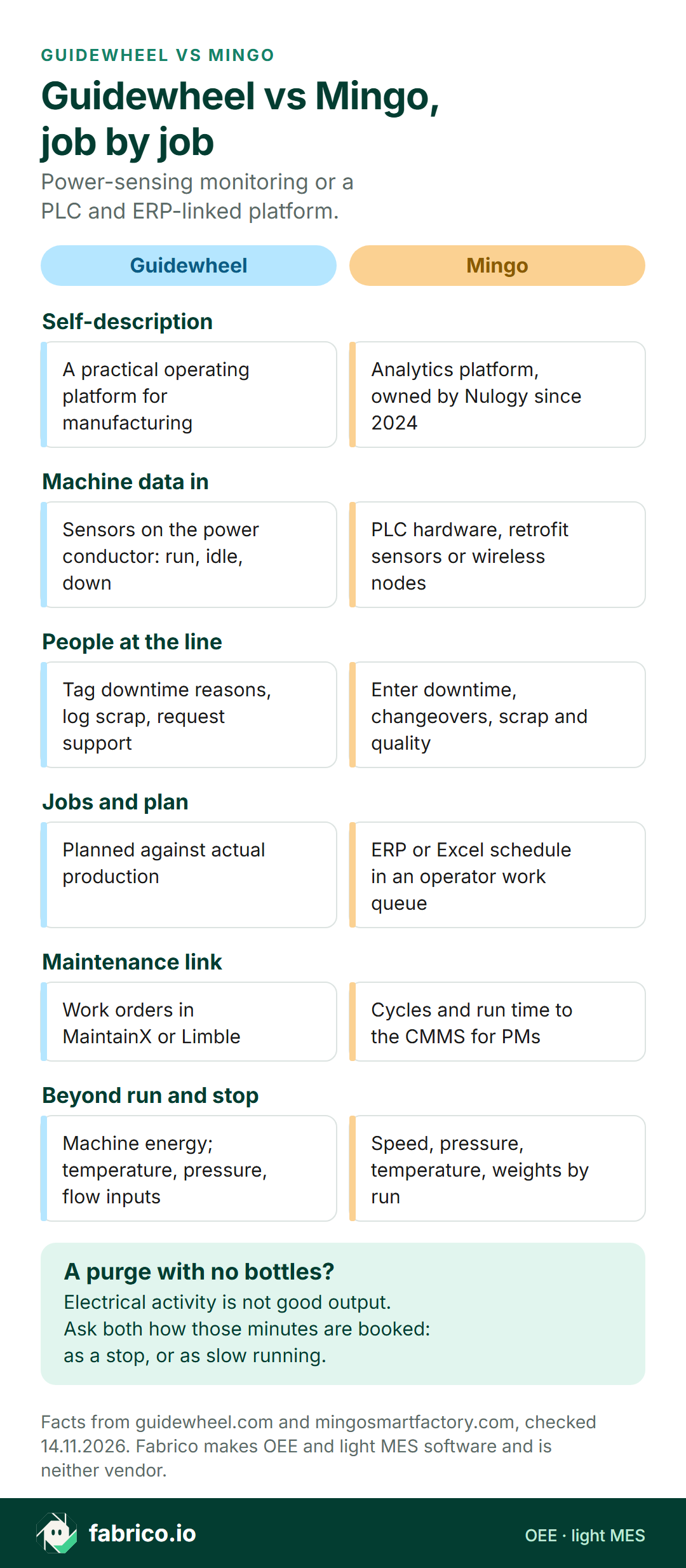
Text version of this infographic
- Self-description. Guidewheel: a practical operating platform for manufacturing. Mingo: an analytics platform, owned by Nulogy since 2024.
- Machine data in. Guidewheel: sensors on the power conductor give run, idle and down. Mingo: PLC hardware, retrofit sensors or wireless nodes.
- People at the line. Guidewheel: tag downtime reasons, log scrap, request support. Mingo: enter downtime, changeovers, scrap and quality.
- Jobs and plan. Guidewheel: planned against actual production. Mingo: ERP or Excel schedule in an operator work queue.
- Maintenance link. Guidewheel: work orders in MaintainX or Limble (Bricks also listed). Mingo: cycles and run time to the CMMS for PMs.
- Beyond run and stop. Guidewheel: machine energy, plus temperature, pressure and flow inputs. Mingo: speed, pressure, temperature and weights by run.
- A purge with no bottles? Electrical activity is not good output. Ask both how those minutes are booked: as a stop, or as slow running.
Decision matrix: Guidewheel or Mingo for your plant
Use it to route your situation to the vendor whose own pages address it, as read on 14.11.2026. Nothing here is a score. Where two rows point different ways, the right-hand column tells you what to test.
| If this sounds like you | Look first at | Why (from the vendor's page) | Prove it in the pilot by |
|---|---|---|---|
| Mixed-age moulders and no budget for PLC work this year | Guidewheel | Homepage: run, idle and down from the power conductor, PLC integration not the first step | Comparing its down minutes with the shift log on five machines |
| Newer machines whose PLCs already count cycles | Mingo | How Mingo works: hardware to connect existing controllers or PLCs | Checking the PLC count against the packed count for one shift |
| Energy per machine is on the site agenda | Guidewheel | Homepage: machine-level energy use alongside production; integrations: energy data into AVEVA CONNECT | Reading the kWh of one colour change beside the bottles it cost |
| Jobs come from the ERP and counts have to go back | Mingo | Managed integration: parts, data and schedule in; production and scrap counts out | Posting a shift of counts and scrap to the ERP and reconciling it |
| Maintenance runs MaintainX or Limble and wants a job raised from a stop | Guidewheel | Integrations: MaintainX and Limble work orders from a stop or downtime tag (Bricks also listed) | Raising a test work order from a downtime tag and checking what arrives |
| PMs follow cycles or run hours | Mingo | Managed integration: run time and cycle counts go to the CMMS, where they can trigger PMs | Comparing the CMMS meter with the machine counter after a shift |
| Supervisors want a phone alert when something drifts | Both | Guidewheel: downtime and anomaly alerts; Mingo: notified now of plant issues | Counting a shift's alerts and how many led to an action |
| Melt temperature or pressure should sit beside each run | Both | Guidewheel: temperature, pressure, humidity or flow inputs; Mingo: temperature, pressure and cycle times on blow molding | Logging the same parison temperature in both for one run |
| The team wants outside help to set up and validate | Both | Guidewheel: its experts help validate the setup; Mingo: a managed integration service | Writing who does which setup task into the pilot plan |
Where OEE fits: a state, a count and a reason
OEE needs three things from a shift: how long the machine ran, how much it made against its ideal rate, and how much of that was good. A run state answers the first; a count answers the other two; the stop reason, added by a person, tells the team what to fix. The OEE calculation guide walks through the formula.
Purges, warm-ups and heat soaks are where the two kinds of signal part. The machine draws power, so it may look busy, while a count shows zero. Ask each vendor how such minutes are booked before the pilot starts, and set the ideal cycle time per mould, since it decides how slow running is judged.
Machine energy: what a power signal adds
Because Guidewheel reads the power cable, energy arrives with the run signal, and its homepage frames machine-level energy as a way to judge the cost of each run. The scale is real. The European Commission's electric motors page says the motors it covers used "1326 TWh of electricity, which is 53% of the total EU27 electricity consumption in 2020" (accessed 14.11.2026). On a blow moulder, the extruder drive, the heater bands and the hydraulics draw power whether or not a bottle drops out of the mould.
Rules are moving the same way. The Commission's Energy Efficiency Directive page says Directive (EU) 2023/1791 "makes energy management systems a mandatory requirement for large industrial energy consumers" and extends energy audits "to all companies that consume energy above a certain threshold, regardless of their size" (accessed 14.11.2026). Ask your energy manager whether the site falls into either group; the answer sets how much weight an energy view deserves in this choice. If energy per bottle matters, ask both vendors to show it for the same sample shift.
Margin still carries more weight than kilowatt-hours. Plastics Europe reports that the European plastics sector "generated €398 billion in turnover in 2024", and that Europe's global market share fell from 22% in 2006 to 12% in 2024 (accessed 14.11.2026). Under that pressure, the bottles a purge costs matter more than the power it draws, as the numbers below show.
Worked example: one 690 minute shift on a blow moulder
Sample data, invented plant, no customer. An extrusion blow moulder makes 1 litre HDPE bottles on a 4-cavity mould with an ideal cycle of 12 seconds: 5 cycles, so 20 bottles, a minute. On 12-hour shifts, 30 minutes of planned briefings and cleaning leave 690 minutes of planned production time, room for 13,800 bottles.
| Sample data | Minutes | Note |
|---|---|---|
| Colour change purge | 35 | Heaters on, extruder turning, no saleable bottles |
| Parison faults | 25 | Curtain and wall issues, line stopped |
| Resin hopper empty | 15 | Dryer and loader refilled |
| Running | 615 | 690 less 75 minutes of stops |
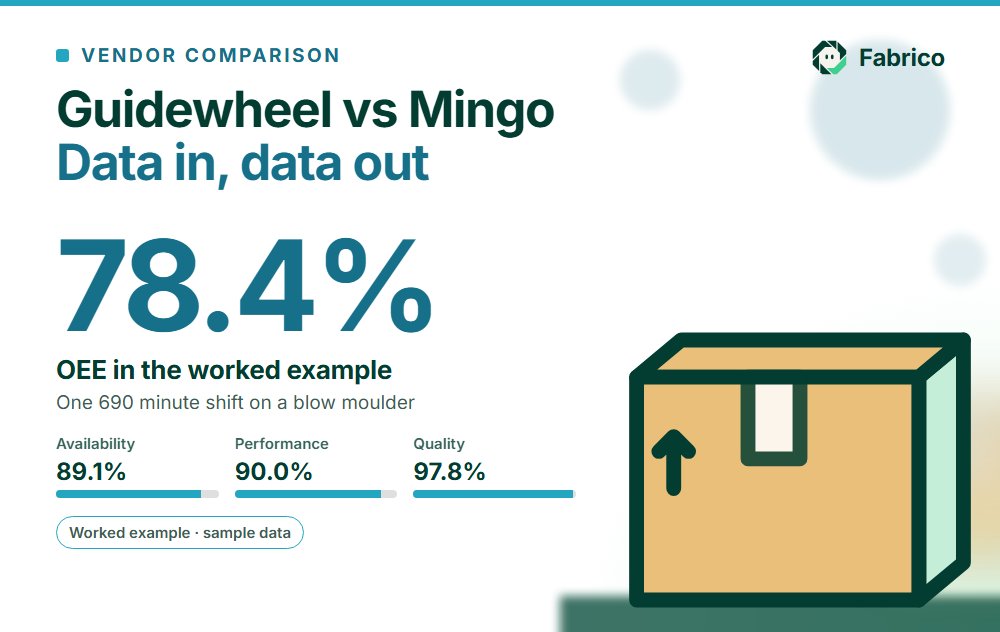
Purge booked as a stop. Availability is 615 / 690 = 89.1%. In 615 minutes the ideal is 12,300 bottles. The PLC counted 2,768 cycles, or 11,072 bottles, so performance is 11,072 / 12,300 = 90.0%. The leak tester rejected 248, leaving 10,824 good: quality 10,824 / 11,072 = 97.8%. OEE is 89.1% x 90.0% x 97.8% = 78.4%, which matches 10,824 good of 13,800 possible.
Purge booked as run time. Run time becomes 650 minutes, so availability reads 650 / 690 = 94.2%. The ideal in 650 minutes is 13,000, so performance drops to 11,072 / 13,000 = 85.2%. Quality holds at 97.8%, and OEE is again 78.4%.
The headline number is identical; the story is not. The first booking shows 75 minutes of stops and points to a faster colour change, a job for the changeover time playbook. The second shows a slow machine and invites cycle tuning on a cycle that was already on target. In a pilot, ask Guidewheel and Mingo to book this exact shift and show where the purge lands.
Carrying the shift to money
Sample margin, made up like the rest of this example: each good bottle earns EUR 0.06 of contribution margin. The moulder runs two 12-hour shifts a day, 30 days a month, all 12 months: 60 shifts a month and 720 a year. With the purge booked as a stop, the 2,976 bottles short of 13,800 break down as follows.
| Where the bottles went (sample data) | Bottles | Shift, EUR | Month, EUR | Year, EUR |
|---|---|---|---|---|
| Stops: 75 min at 20 bottles a minute | 1,500 | 90.00 | 5,400.00 | 64,800.00 |
| Slow cycles: 12,300 ideal, 11,072 made | 1,228 | 73.68 | 4,420.80 | 53,049.60 |
| Leak test rejects | 248 | 14.88 | 892.80 | 10,713.60 |
| All losses | 2,976 | 178.56 | 10,713.60 | 128,563.20 |
The colour change purge alone is 35 minutes x 20 = 700 bottles: EUR 42.00 a shift, EUR 2,520 a month, EUR 30,240 a year. Halving it is worth EUR 15,120 a year at this margin. The energy is smaller than it looks: at a sample 60 kW draw during the purge and a sample tariff of EUR 0.18 per kWh, 35 minutes is 35 kWh, or EUR 6.30 a shift and EUR 4,536 a year. Book the purge as run time instead, and the same EUR 90.00 of stop losses shrinks to EUR 48.00 while the slow-cycle line grows to EUR 115.68; the total does not move, but the purge stops looking like a changeover problem.
Where Fabrico fits for a Guidewheel or Mingo shortlist
Fabrico competes with these two rather than sitting above them. Its product is OEE in the cloud with light MES on top, as the product overview describes. Fabrico does not sell SCADA, HMI or inspection vision.
- Signals. Fabrico takes run, stop and count data from the machine's own PLC, sensor or counter (see machine connectivity). Operators pick stop reasons from a list on a phone or a line tablet.
- Stop to work order. A work order opens from a logged stop in one tap, and you can set chosen stop reasons to create that work order automatically as soon as the reason is logged.
- What the team sees. OEE, downtime and the money value of lost output for each line and shift, on desktop browsers and on iOS and Android.
- Camera add-on. Where a station gives no usable signal, such as hand packing after the moulder, the camera add-on counts output; camera add-on suggestions of stop reasons are Roadmap, not a live feature. See the computer vision add-on (and for packing stations, computer vision for FMCG).
- Data out. Through the REST API or webhooks, or exported to Excel and CSV.
To weigh all three on the same terms, use the checklist in the OEE software guide, and pick a signal source per machine with the signal source guide.
Questions to ask both vendors
Send Guidewheel and Mingo the same machine list and the same sample shift, then ask:
- Which signal on which machine? For five named machines, which route: power sensor, PLC, retrofit sensor or operator entry?
- How is a purge or warm-up booked? As a stop, slow running or its own category, and who sets the rule?
- Where does the good count come from? A PLC counter, a sensor after the trimmer or operator entry, and how are rejects taken off?
- How is the ideal rate held? Per machine, per mould or per product, and what changes it at a mould change?
- What reaches the ERP? The machine count, the good count or the packed count?
- What reaches maintenance? A work order per stop, or run hours and cycles for planned work, and who maps the assets?
What to do this week
- Sort your machines by signal. For each moulder, note whether the PLC exposes a cycle count and whether the power cable is easy to reach. That list answers the first vendor question before it is asked.
- Write the purge rule. Decide whether purges, warm-ups and heat soaks are stops, slow running or a category of their own, and put it on paper before either vendor fits anything.
- Price a bottle. Replace the EUR 0.06 sample with your real contribution margin and redo the euro table; the result shows what a pilot is worth chasing.
- Ask the energy manager one question: does the site fall under the audit or energy management duties of Directive (EU) 2023/1791?
- Talk to maintenance. Find out whether they plan from stops or from run hours and cycles, and which CMMS they use, because the two vendors link to maintenance in different ways.
- Send one sample shift from the worked example, plus the six questions above, to Guidewheel and Mingo, and ask each to book it.
What people ask next
What is the main difference between Guidewheel and Mingo Smart Factory?
The first data route. Guidewheel's pages lead with sensors on a machine's power conductor that give run, idle and down states, with more inputs added where needed. Mingo's pages list hardware for existing PLCs, retrofit sensors or wireless nodes, and operator entry, with a managed ERP and CMMS integration on top. Both show downtime, reasons and OEE.
Has Mingo Smart Factory become part of Nulogy?
Yes. The Nulogy deal was announced on 1 October 2024, and Nulogy's site now presents Smart Factory as one product in its Manufacturing Operating System. As of 14.11.2026, mingosmartfactory.com still serves the Mingo pages under the Mingo name.
Do Guidewheel and Mingo both need a PLC connection?
Each site describes more than one route in. Guidewheel says a team can begin with run, idle and down data from sensors on the power conductor, with PLC integration as a later step. Mingo offers a PLC hardware link, retrofit sensors or wireless nodes, and operator entry on a PC or tablet.
Which one fits a plastics plant?
Both name plastics work. Guidewheel's plastics page lists injection molding, extrusion, blow molding, thermoforming and packaging. Mingo has pages for blow molding and injection molding. Compare them on one machine over the same shifts, and check how each books purges and warm-ups.
How does Fabrico compare with Guidewheel and Mingo?
Fabrico is a third option in the same category: cloud OEE with light MES. It reads run, stop and count data from the machine's PLC, a sensor or a counter, operators pick stop reasons from a list, and at a station without a signal its camera add-on counts the output. Work orders are built in, and data leaves by REST API, webhooks, Excel or CSV.
Want to see how a purge and a parison fault would be booked on a real timeline? Book a demo.
Related articles

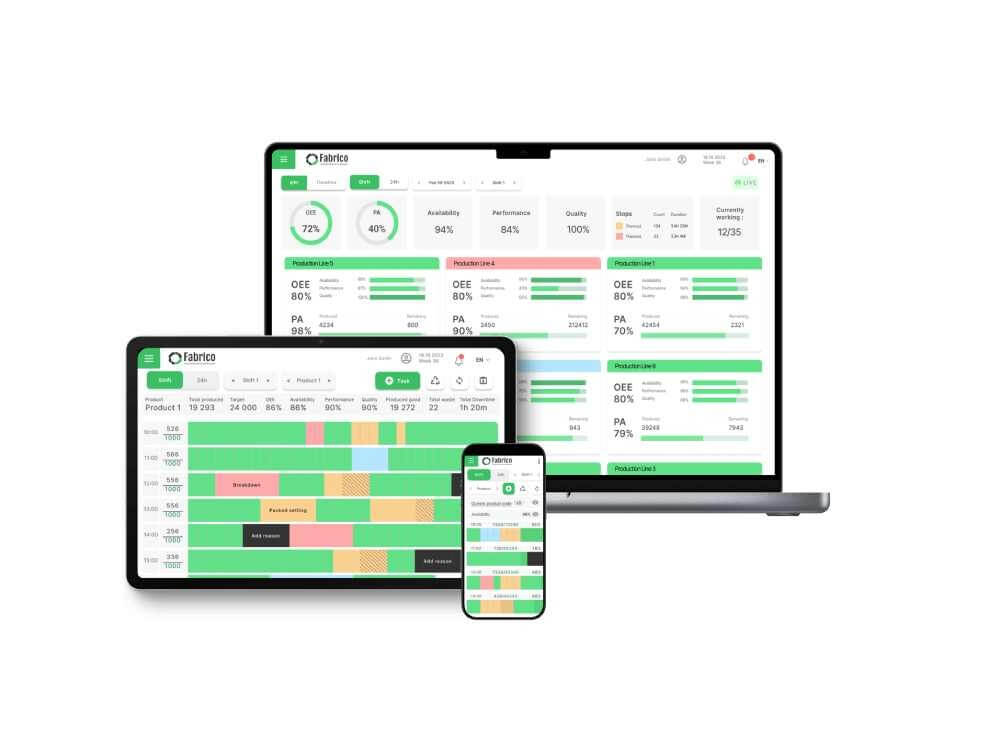




Real Fabrico tiles, sample data.