


 Login
 Blog
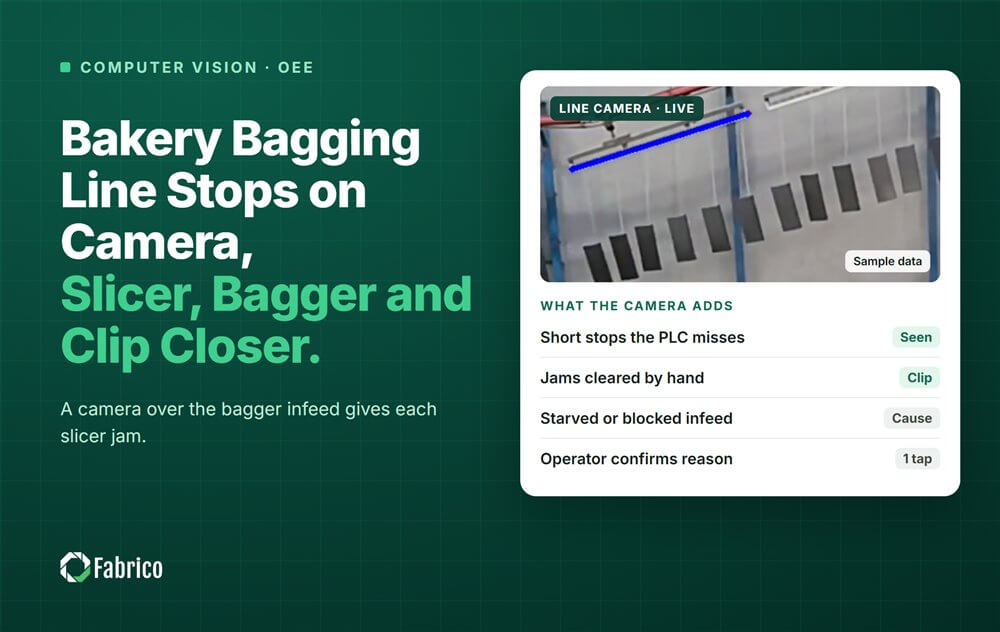
Bakery Bagging Line Stops on Camera: Slicer, Bagger and Clip Closer

Key takeaways
- Most lost minutes on a bread packing line are short stops at the slicer infeed, the bag opening and the clip closer. Few of them reach the downtime log.
- One camera over the bagger infeed marks each stop and keeps a short clip. The operator confirms the reason in one tap.
- On a sample line, the camera found 38 unlogged minutes a shift, and the most frequent stop cost no bread.
Short stops at the slicer, the bagger and the clip closer are where a bread packing line loses most of its minutes. A camera over the bagger infeed marks each one and keeps a short clip, so stops nobody wrote down get counted and priced.
Fabrico is OEE (overall equipment effectiveness) and light MES (manufacturing execution system) software, with AI cameras as an add-on. The camera marks each stop and keeps the clip, and the operator confirms the reason in one tap. This guide covers the packing end only, from the cooler to the crates.
Where does a bread packing line lose its minutes?
After baking, loaves cool on a spiral or a long conveyor. Then they pass the slicer, the bagger, the closer and the crate loader.
| Station | Typical short stops | What the machine records |
|---|---|---|
| Slicer infeed | Loaf turned sideways, two loaves stuck together, crumbs on the belt | Infeed jam, or nothing |
| Slicer | Loaf rides up on the blades, crumbs build up under them | Slicer jam |
| Bagger | Bag not opened, loaf misses the bag, bag stack empty | Bagger fault |
| Clip closer or twist tie | Clip not applied, clip or tie reel empty | Closer fault |
| Crate loader | No empty crates, full stack not taken away | Waiting |
The PLC (programmable logic controller) knows that a station stopped. It rarely knows what the loaf or the bag was doing. So the shift report reads "bagger fault", and nobody knows how much of it the bag stock caused.
Why do bagger and slicer stops never reach the downtime log?
Most are too short. An operator pulls a crushed loaf out of the infeed or loads a fresh bag stack, and the bagger restarts in under a minute. Nobody writes that down, and many OEE tools filter out stops under 60 seconds.
A bread line adds a second reason: the oven cannot stop for a packing fault, so a packing stop never shows as oven downtime. Our guide to micro stops on packing lines shows how these seconds add up.
Where should the camera go on a bakery bagging line?
Start with one fixed camera over the bagger infeed. Frame the end of the slicer outfeed, the loaf pusher and the open bag. Most bagging stops start inside that frame.
- Look down on the loaf path. The view is loaves and bags, not faces.
- Keep the lens clean. Flour dust settles on everything, so add the lens to the cleaning list.
- Avoid steam and changing light from warm bread or an open dock door.
- Check the view after a product change. A new loaf or bag size changes the scene.
A second view at the closer and crate loader helps when they sit out of sight. Our guide to camera placement and lighting covers angle and glare.
Which bagging stops does the clip tell apart?
One PLC code often hides several causes with different owners. Each stop is marked by the bagger signal or the camera, and a short clip stays with it as evidence. The screen suggests a reason from what was in the frame, and the operator confirms it in one tap.
| PLC code | What the clip shows | Owner |
|---|---|---|
| Infeed jam | A loaf turned sideways from the cooler | Cooler outfeed guides |
| Infeed jam | Two loaves stuck together | Baking and depanning |
| Bagger fault | The bag did not open: curled or stuck bags | Bag stock and storage |
| Closer fault | Bag left open, no clip | Closer settings |
| Closer fault | The clip reel ran out | Reel change routine |
| Waiting | No empty crates at the loader | Crate supply (blocked) |
Two loaves stuck together come out of the oven that way. Without a clip, that loss lands on the packing crew. Keep the reason list short enough for one tap: our guide to operator friendly reason codes shows how.
Worked example: what do short bagging stops cost on a sample bakery line?
Sample line (illustrative numbers, not a customer): a tunnel oven bakes 60 sliced loaves a minute, so one loaf a second reaches the slicer. The slicer and bagger can run at 70 a minute, so they catch up after a stop. Planned production time is 450 minutes a shift.
A table before the slicer holds 30 loaves, or 30 seconds of bread. Past that, the crew pulls loaves onto racks. Here, 1 in 3 rack loaves is scrapped, crushed or out of shape. The rest are fed back by hand. Assume the stops are spread out, so the table is empty when each one starts.
With each reason confirmed by the operator, the clips showed this:
| What the clip showed | Stops | Minutes | In the old log | Loaves to the racks |
|---|---|---|---|---|
| Slicer infeed jam | 24 x 45 seconds | 18 | No | 24 x 15 = 360 |
| Bag not opened | 30 x 20 seconds | 10 | No | 0 |
| Clip not applied | 15 x 40 seconds | 10 | No | 15 x 10 = 150 |
| Clip reel ran out | 2 x 3 minutes | 6 | Yes | 2 x 150 = 300 |
| No empty crates | 1 x 4 minutes | 4 | Yes | 210 |
| Total | 72 | 48 | 10 minutes | 1,020 |
- Packing end availability, old log = (450 minus 10) / 450 = 97.8%.
- With the camera = (450 minus 48) / 450 = 402 / 450 = 89.3%. The gap is 38 minutes nobody logged.
- Each second past the table sends one loaf to the racks. A 45 second jam sends 15.
- Scrapped: 1,020 / 3 = 340 loaves a shift. Fed back by hand: 680.
- At a sample $0.60 to bake and bag a loaf again (or €0.60 in a euro plant): $204 a shift, or $153,000 over 750 shifts a year.
Now rank by money. The slicer infeed jams scrapped 120 loaves: $72 a shift, or $54,000 a year. The 30 bag opening misses were the most frequent stop, but each ended inside the 30 second table and cost no bread.
A list sorted by stop count would send the crew to the bag stock first. The clips sent them to the cooler outfeed: a guide to square the loaves and a brush on the infeed belt. For the clip reel, a spare is staged at the closer before the old one runs out.
If scrapped loaves also leave an order short, add the margin of the lost sale. Agree that rule with your controller first.
What can a camera at the bagger not see?
- Inside the slicer: blade wear and drive alarms stay with the PLC.
- Through dust and steam: a dusty lens or steam from warm loaves causes false events.
- Behind an arm: anything in front of the lens hides the loaf for a moment.
- The cause on its own: it suggests, and the operator confirms.
How do you keep the camera on the bread, not the packing crew?
Frame the loaf path and the bag, not the operator's station. Report OEE by line and shift, never by named operator. The clip defends the crew: it shows a curled bag stack or two stuck loaves, not a "slow" person.
In Germany, the works council co-determines equipment that could monitor performance, even a camera that records nothing. Our works council approval guide covers the steps. Rolls on a flow wrapper have stops of their own; see our flow wrapper OEE guide.
Where Fabrico fits
Fabrico is a computer vision enabled Manufacturing Performance Platform. OEE and light MES come first, and cameras are an add-on.
- Automatic downtime logging, down to short stops.
- A camera clip as evidence for a stop at the bagger infeed or the closer.
- The operator confirms the reason in one tap.
- Every loss priced in money, so scrapped bread sits next to stop minutes.
- OEE live by line and shift, and one view across plants.
Named result: ABB, a Fabrico customer, reports 20% less downtime. You start with a pilot on one line. Devices are connected in about a month, and the full rollout takes 3 to 4 months. There is no free plan and there are no tiers: each plant gets a quote. See the computer vision OEE and MES page.
Frequently asked questions
Why do bagger stops not show in bakery OEE?
The oven sets the pace and keeps baking. A short packing stop is absorbed by the table before the slicer, so the oven loses nothing. A longer one sends loaves to the racks, and the loss shows up later as scrapped bread, a Quality loss with no stop attached.
Where should the first camera go on a bread packing line?
Over the bagger infeed. Frame the end of the slicer outfeed, the loaf pusher and the open bag, where most slicer jams and missed bags start. Add a second view at the closer and the crate loader only if they sit out of sight.
Does flour dust stop a camera from working?
It can, if nobody cleans the lens. Dust and crumbs on the glass cause false events. Put the lens on the cleaning list and mount the camera away from the crumb tray. Check the view after each deep clean, in case the camera was moved.
Does the camera watch the packing crew?
It should not. Frame the loaves and bags, keep faces out of view and report by line and shift. The camera marks stops and keeps the clip; it does not track people. In Germany, a works agreement comes before the first camera.
See your bagging line's stops in a demo
Bring one bread line and a week of its packing downtime log. We will show where its short stops hide and what each one costs in bread.
Latest from our blog



Real Fabrico tiles, sample data.