


 Login
 Blog
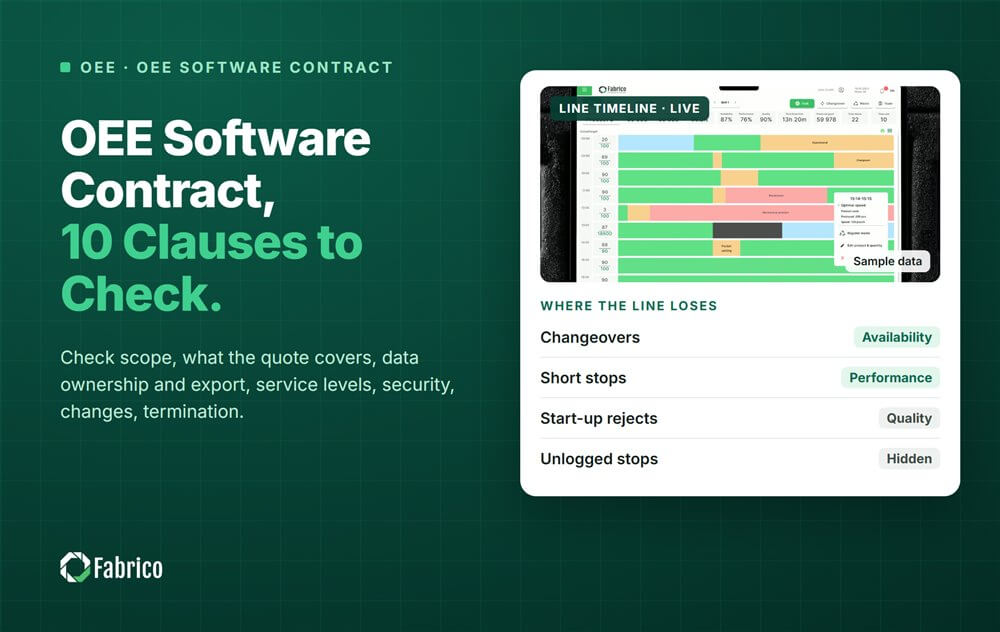
OEE Software Contract: 10 Clauses to Check

Key takeaways
- Before you sign an OEE software contract, check 10 clauses, from scope to who owns the devices.
- Name the lines, machines and sites in the scope, and what is out.
- Make sure the plant owns its data and can export it in a common format.
- Write down support hours, response times and security terms that match your shifts.
- Agree termination, handover and device ownership while everyone is still friendly.
An OEE software contract should cover 10 clauses. They are scope, what the quote covers, data ownership, data export, service levels, support hours, security terms, changes, termination and handover, and device ownership. Check each one before you sign, and ask for plain wording you can test.
A plant adds a fourth line after the first one goes well. Is the new line inside the contract, or a new deal? If the scope clause never named the lines, nobody knows.
This guide is for plant managers, IT and procurement teams reviewing a draft. It comes from Fabrico, a vendor of OEE and light MES software with computer vision on stops. It is a buyer's checklist, not legal advice: your legal team reviews the contract.
What should the scope clause name?
Exactly what is covered: the lines, the machines, the sites, the modules and the users. A scope that says "the plant" is no scope.
- Lines and machines, by name or number.
- Sites, if more than one plant is in view.
- Modules: OEE, downtime, reports and anything else you are buying.
- Users: roles and rough numbers.
- Out of scope: what is not included, in writing.
What does the quote cover?
Every item you expect to receive, listed in the contract, so nothing turns into an extra later. No price is needed in this checklist, only the list.
- Software access for the named lines and users.
- Devices or cameras, and their install.
- Setup, training and go-live support.
- Updates and new versions.
- What a new line or site would add, and how it is quoted.
For how vendors build their quotes, see our OEE software pricing guide and our comparison of pricing models.
Who owns the data, and how do you get it out?
The plant should own its production data, and the contract should say so in one sentence. Then it should say how the data comes out.
- Ownership: the plant owns the production data; the vendor may use it only to run the service.
- Export: a common format, such as a spreadsheet file, on request and at the end.
- What is included: stop history, reasons, counts and camera clips, if any.
- After the end: how long the plant can still export, and when the vendor deletes the rest.
Our cloud MES buyer's guide covers data ownership questions in more depth.
What service levels and support hours should you ask for?
Support that is open when your lines run, with response times written by how bad the problem is.
- Support hours that cover every shift, including nights if you run them.
- Response times by severity: a line-down problem first, a report question later.
- Language: support in the language your line leads speak.
- Planned downtime of the service: when it happens, and how much notice you get.
What security terms belong in the contract?
The answers IT gave you in the review, now in writing. If it matters to IT, it goes in the contract.
- Hosting region for the plant's data.
- Copies of the certificates the vendor claims, not logos.
- User roles and who at the vendor can see the data.
- How fast the vendor tells you about a security incident.
- What data leaves the plant network.
Our vendor security questionnaire lists the questions to ask first.
How should changes, termination and devices be handled?
Changes and additions
Say how a new line, site or module is added, and how it is quoted, before you need it.
Termination and handover
Write the notice period, the full data export, deletion confirmed in writing and closed accounts. A handover with no steps is no handover.
Who owns the devices
Say whether devices and cameras belong to the plant or the vendor, and who removes them after the end.
A worked example: a clause checklist with status
Sample line (illustrative numbers, not a customer): line 1 of a confectionery plant, the first line in a 3-line contract. The plant manager, IT and legal checked the draft clause by clause. The plant runs 3 shifts of 8 hours.
| # | Clause | What the draft said | Status |
|---|---|---|---|
| 1 | Scope | Lines 1 to 3, 14 machines, one site | OK |
| 2 | What the quote covers | Software and devices; training not stated | Fix |
| 3 | Data ownership | The plant owns production data | OK |
| 4 | Data export | "On request", no format named | Fix |
| 5 | Service levels | Line-down response within 4 hours | OK |
| 6 | Support hours | Office hours only, 9 hours a day | Fix |
| 7 | Security terms | Hosting region named; certificate copies attached | OK |
| 8 | Changes and additions | How a fourth line is added: not stated | Missing |
| 9 | Termination and handover | Notice period stated; handover not described | Fix |
| 10 | Device ownership | Not stated | Missing |
- OK: clauses 1, 3, 5 and 7, so 4 of 10.
- Fix: clauses 2, 4, 6 and 9, so 4 of 10.
- Missing: clauses 8 and 10, so 2 of 10.
- Back to the vendor: 4 + 2 = 6 of 10 clauses.
- Production: 3 shifts x 8 hours = 24 hours a day.
- Support gap: 24 minus 9 = 15 hours a day with no support.
Six clauses went back to the vendor with plain wording to add. The plant signed only after the export format, support for all 3 shifts and the device clause were written in.
Mistakes plants make with OEE software contracts
- A scope that names "the plant" but not the lines and machines.
- Data export "on request", with no format named.
- Support hours that end when the night shift starts.
- No clause on who owns the devices.
- Termination terms with no handover steps.
Where Fabrico fits
Fabrico is a computer vision enabled Manufacturing Performance Platform. OEE and light MES come first, so the scope starts with lines and machines.
- A pilot on one line: a small, clear scope before the contract grows.
- Automatic downtime logging: the stop history the export clause is about.
- OEE live by line and shift: the numbers your team uses each shift.
- One view across plants: for a contract that covers more than one site.
You start on one line, with a baseline and a decision date agreed in advance. Devices are connected in about one month, and the full rollout takes 3 to 4 months. There is no free plan and there are no tiers: each plant gets a quote.
See how stops are captured on the computer vision OEE page.
Frequently asked questions
What should an OEE software contract include?
At least 10 clauses. Scope, what the quote covers, data ownership and export, service levels, support hours and security terms come first. Then changes, termination and handover, and device ownership. Each should be plain enough that you can check it on the line, not only in a meeting.
Who owns the data in an OEE software contract?
The plant should, and the contract should say so in one sentence. Add that the vendor may use the data only to run the service. Then say how the plant exports it, and when the vendor deletes it after the end. Ask your legal team to check the wording.
What support hours should an OEE software contract have?
Hours that match your production, including night shifts if you run them. A line-down problem at night needs an answer at night. Write response times by severity, so a stopped line gets help before a report question does. Ask how a call in the middle of the night is answered, and by whom.
What happens to the devices if we cancel?
Only what the contract says, so write it down. Name who owns the devices and cameras, who removes them, by when, and who carries that cost. Without a device clause, an exit turns into a negotiation. Agree it before you sign, while both sides want the deal.
Should IT review the OEE software contract?
Yes. IT should check that the security terms match the vendor's answers in the security review. That means hosting region, certificates, roles, incident notice and what data leaves the plant. If an answer was given verbally, it belongs in the contract.
Bring your contract questions to a demo
Bring your draft contract's scope and your shift pattern. We will walk through the product and the questions behind each clause.
Latest from our blog


Real Fabrico tiles, sample data.