


 Login
 Blog
Waiting for Material in OEE: Is It an Availability Loss?

Key takeaways
- OEE measures the line against its planned time, whoever caused the stop.
- A planned line that waits for labels, film or ingredients loses Availability.
- Only a decision made before the shift, to take the line out of the plan, keeps the time out of OEE.
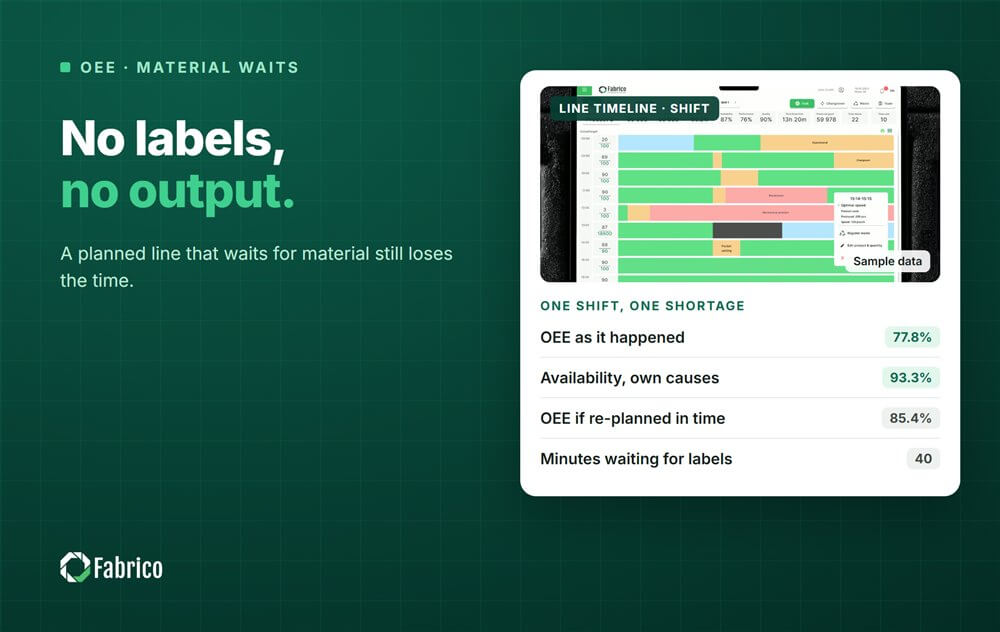
- In the worked example the same shift reads 77.8%, or 85.4% if the line had been re-planned in time.
Fabrico, OEE and light MES (manufacturing execution system) software with AI cameras, logs stops automatically. The operator gives each stop a reason in one tap.
Below: why material waits count, the one exception, a worked shift, and how to code the cause so the right team owns it. Test the numbers in the free OEE Lab calculator.
Why does waiting for material count against OEE?
OEE answers one question: how much of the planned time became good product? If the line was planned to run and stood still, that time was lost. The reason does not change the answer.
The reason does change who fixes it. So the stop belongs in Availability, with a code that names the material and the cause. Our OEE Availability guide covers the factor.
When is a material wait not an OEE loss?
When the plant decides, before the shift starts, not to run the line. Then the time is not planned production time at all. It lowers TEEP (total effective equipment performance), not OEE.
A decision made after the line was already waiting is not a re-plan. It is a stop with a new name. Our guide on planned vs unplanned downtime explains the cutoff.
What does a worked example of a label shortage look like?
Sample line (illustrative numbers, not a customer): a 450 minute shift, an ideal cycle time of 1.2 seconds, and 70 minutes of stops. Of those, 40 minutes were spent waiting for labels and 30 were the line's own faults.
The line made 18,000 units, and 17,500 were good.
- Run time = 450 minus 70 = 380 minutes, so Availability = 84.4%.
- Performance = 18,000 x 1.2 / (380 x 60) = 21,600 / 22,800 = 94.7%.
- Quality = 17,500 / 18,000 = 97.2%.
- OEE = 17,500 x 1.2 / (450 x 60) = 21,000 / 27,000 = 77.8%.
- Availability on own causes only = (450 minus 30) / 450 = 93.3%.
- If the shortage was known and the line re-planned for 410 minutes: 21,000 / 24,600 = 85.4%.
| View | Planned time | OEE |
|---|---|---|
| Line waited, as it happened | 450 min | 77.8% |
| Re-planned before the shift | 410 min | 85.4% |
The re-plan moves OEE by 7.6 points with the same output. That is why the cutoff must be firm. Otherwise every shortage becomes a re-plan after the fact.
What causes most material waits on packaging lines?
- Labels, film or caps not at the line when the new order starts.
- The wrong pack material picked for the product that is planned.
- Ingredients or bulk product held by quality before release.
- Empty pallets or cases running out at the end of the line.
Most of these sit outside production. That is exactly why they need a code. Without one they vanish into a general stop and nobody upstream ever sees them.
How should you code material waits?
| Code | Owner |
|---|---|
| Material late from the warehouse | Logistics |
| Wrong material delivered | Logistics or planning |
| Material on quality hold | Quality |
| Supplier short | Purchasing |
| Line used up its stock faster than planned | Planning |
Keep the list short enough to use on a busy shift, and review it once a quarter. Our guide to operator friendly reason codes shows how.
How do you report material waits fairly?
- Keep the material wait inside the line's OEE, so the number stays honest.
- Show Availability twice: all causes, and own causes only.
- Rank material waits by money next to the line's own faults.
- Review the top material code with logistics and planning every week.
Our TEEP guide shows how lines taken out of the plan still appear in capacity.
What mistakes do plants make with material waits?
- Taking material waits out of OEE because "it was not our fault".
- Calling a wait a re-plan after the line already stood still.
- One "no material" code for every cause.
- Never showing material waits to the teams that cause them.
Where Fabrico fits
Fabrico is a computer vision enabled Manufacturing Performance Platform. OEE and light MES come first. Automatic downtime logging and OEE live by line and shift put each material wait on record.
- Automatic downtime logging, so a material wait has a start, an end and a length.
- The operator confirms the reason in one tap, from the plant's own code list.
- Losses ranked by money, so the costliest material problem comes first.
Read what a light MES covers in our light MES guide. You start on one line, with a baseline and a decision date agreed in advance. There is no free plan and there are no tiers: each plant gets a quote.
Frequently asked questions
Is waiting for material an availability loss in OEE?
Yes, if the line was planned to run. OEE measures how much of the planned time became good product, so a line standing still for material loses Availability. Give the stop a material code so logistics, quality or purchasing can see and own their share of it.
Should material shortages be excluded from OEE?
Only when the plant decides before the shift starts not to run the line. Then the time is not planned production time, and it shows in TEEP instead. A decision made after the line was already waiting is still a stop and stays in OEE.
How do you show material waits without blaming production?
Report Availability twice: once for all causes and once for the line's own causes. In the worked example that is 84.4% against 93.3%. The gap is the material wait, and it belongs to the team named in its reason code.
What reason codes should material waits have?
Keep a short list that names the owner: late from the warehouse, wrong material, quality hold, supplier short, and stock used up faster than planned. Each code points to one team. A single "no material" code tells nobody what to fix.
How long is a material wait?
From the moment the line stops for lack of material to the moment it runs again. Start-up rejects after the restart count in Quality, and slow running in Performance. The reason code still names the material, so the team that owns it sees the whole cost of the wait.
Does re-planning a line change its OEE?
Yes. Taking time out of the plan shrinks planned production time, so OEE rises with the same output. In the worked example it moves from 77.8% to 85.4%. That is why re-planning needs a firm cutoff, written down, before the shift starts.
See your material waits in a demo
Bring one line and a month of stop reasons. We will show the material waits, their owners and what they cost.
Latest from our blog


Real Fabrico tiles, sample data.