Login
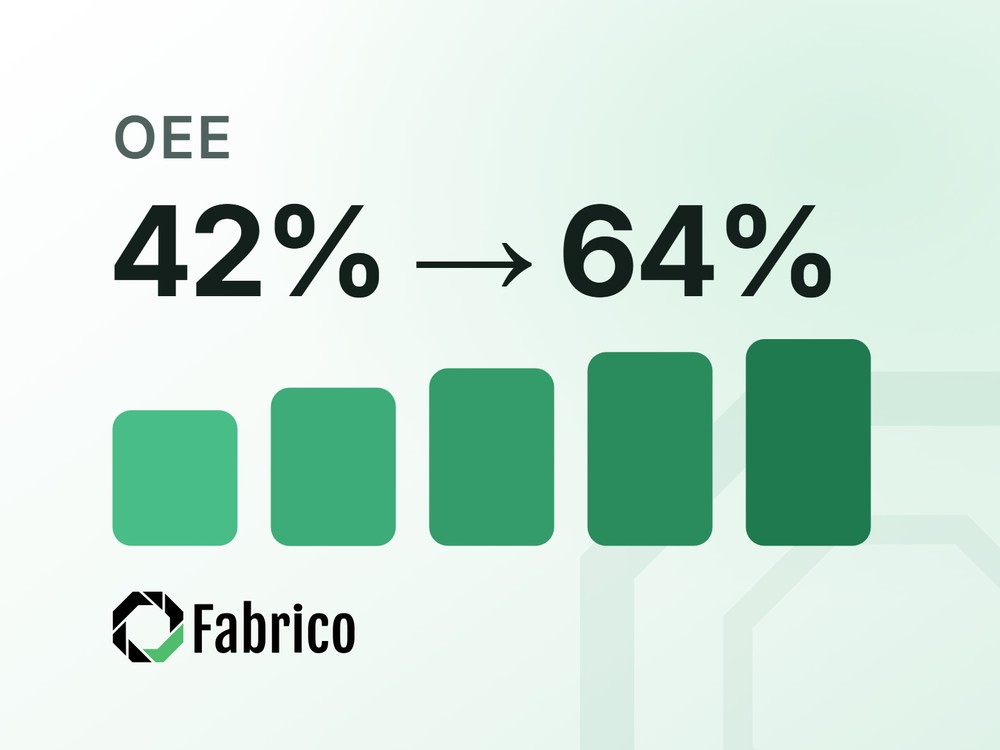
How HUS raised OEE from 42% to 64% on its first tube line
At HUS's tube plant in Lom, 9 lines run on Fabrico OEE, with maintenance on the same platform. Changeovers are now more than 50% shorter, 90% of stop reasons are recorded in real time, and OEE on the first connected line rose from 42% to 64% in five months. Same lines, same crews, no new machines.
- Company: HUS Ltd, steel tubes and hollow sections. Production plant in Lom, Bulgaria, running 24/7.
- Lines: 9 tube lines on Fabrico, connected with no PLC changes.
- In Fabrico: OEE and maintenance management (CMMS), live together on one platform.
- Rollout: the first lines in late April, all 9 by July, about 12 weeks from contract to full rollout.
- OEE result: 42% to 64% on the first connected line, over its first five months.
- Where the numbers come from: the HUS case study, approved by HUS.
- Platform: cloud SaaS on AWS; ISO/IEC 27001, ISO/IEC 20000-1 and ISO 9001 certified.
The problem: time nobody could see
The tube lines in Lom run around the clock, and before Fabrico there was no record of how their time was used. Stop reasons were not written down, so after a major failure the team had to investigate backwards.
Nobody recorded when a changeover started or when the line was running again. Production and maintenance each had their own version of events. And the lines had no data interface that a standard OEE tool could plug into.
The rollout: signals from the relays, no PLC changes
Fabrico connected the 9 lines straight from the relays that already sit in their control cabinets. No PLC was reprogrammed, and the lines' control logic was not touched.
The first lines went live in late April and all 9 by July, about 12 weeks from contract to full rollout. OEE and maintenance management went live together, on one platform.
What changed on the floor
Every line, live. Running, stopped, in changeover or without signal: everyone sees it the moment it happens.
A reason for the stop, straight away. When a line stops, a red pop-up on the operator's screen asks for the reason. Now 90% of stop reasons are recorded the moment the line stops, not guessed at the end of the shift.
Changeovers on the clock. Operators start and end each changeover in Fabrico, and the time runs on screen. Changeovers are now more than 50% shorter, with the same crews and the same tools.
One set of facts for two teams. A fault on the line can go to maintenance straight away, as a task with an owner, a status and a history. Late starts are now the exception, and when a line stops, someone reacts at once.
“The biggest change for us was discipline. As soon as people knew their work was visible in real time, everything moved faster: changeovers take less than half the time they used to, every task starts on time, and when a line stops, someone reacts immediately.”
Vladimir Markov, Production Director, HUS Ltd
The results on the first connected line
Five months after the first line was connected, its OEE had climbed from 42% to 64%, month after month, with no step back.
| Month | OEE | Change |
|---|---|---|
| Month 1 | 42% | starting point |
| Month 2 | 49% | +7 points |
| Month 3 | 55% | +6 points |
| Month 4 | 60% | +5 points |
| Month 5 | 64% | +4 points |
First connected line, its first five months in Fabrico: +22 points in total.
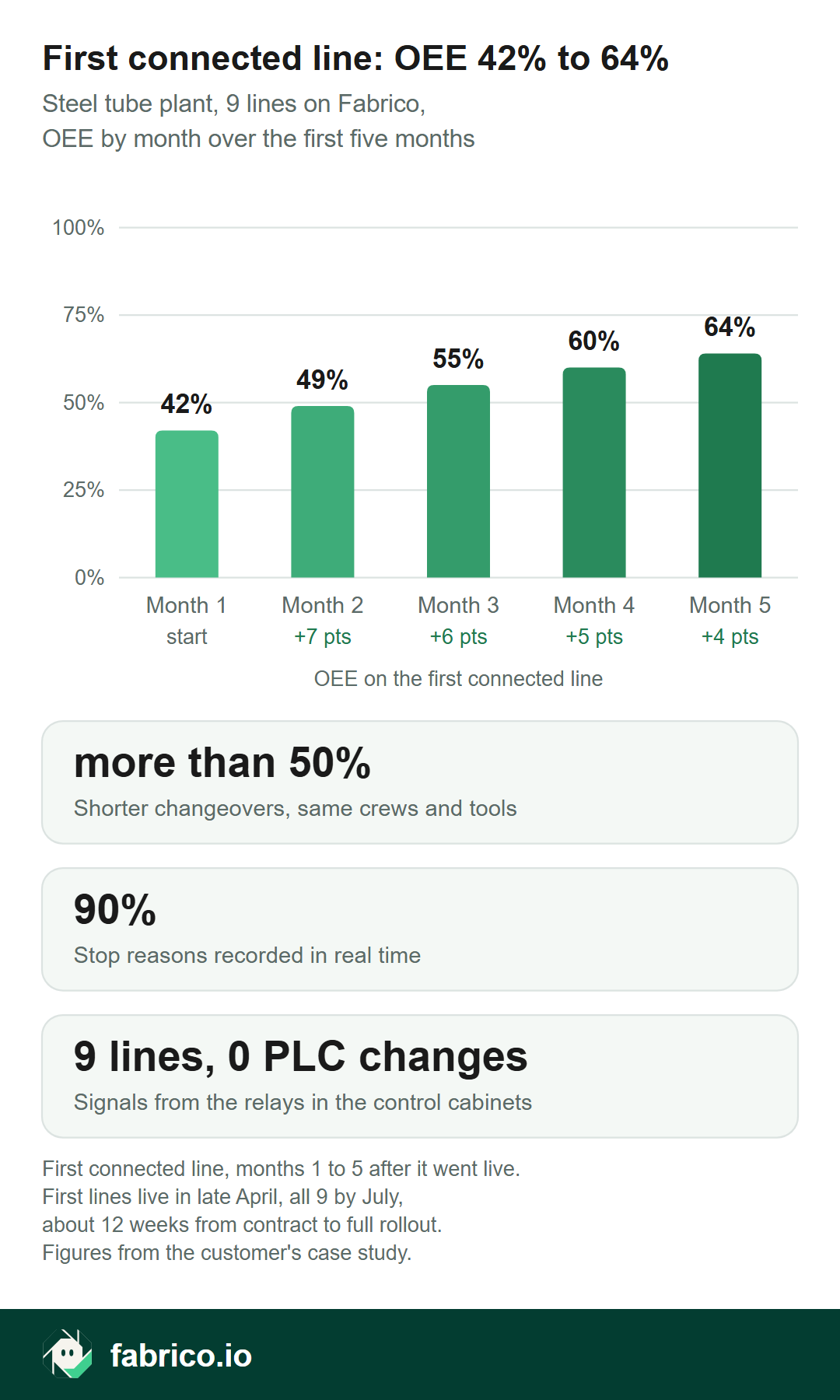
What the numbers mean:
- OEE: how much of planned production time became good product at the ideal rate (availability x performance x quality). At 42%, almost 60% of planned production time was being lost.
- Month 1: the baseline, the first month in which the line's real run and stop time was recorded automatically.
- Points: percentage points, the difference between two OEE values.
Two things to keep in mind:
- The OEE values are for the first connected line, over its first five months, not an average of all 9 lines.
- Fabrico provides the measurement. The gain came from how HUS's people worked once their time was visible.
Next step: one of your lines
Pick a line that loses time to changeovers or to stops nobody explains. On a demonstration line we show how a changeover is started and timed, how a stop gets its reason and, with the financial impact module, what each loss cost.
If your lines have no data interface, ask how HUS connected its lines from the relays in their control cabinets, with no PLC changes.
See how businesses benefit


Real Fabrico tiles, sample data.