


 Login
 Blog
Line Stopped With No Crew: How OEE Counts Staffing Losses

Key takeaways
- Most no-operator stops come from shared crews and late relief, not from absent people.
- A staffing code keeps those minutes apart from machine faults.
- OEE measures the line, not the person. Never use it to rank operators.
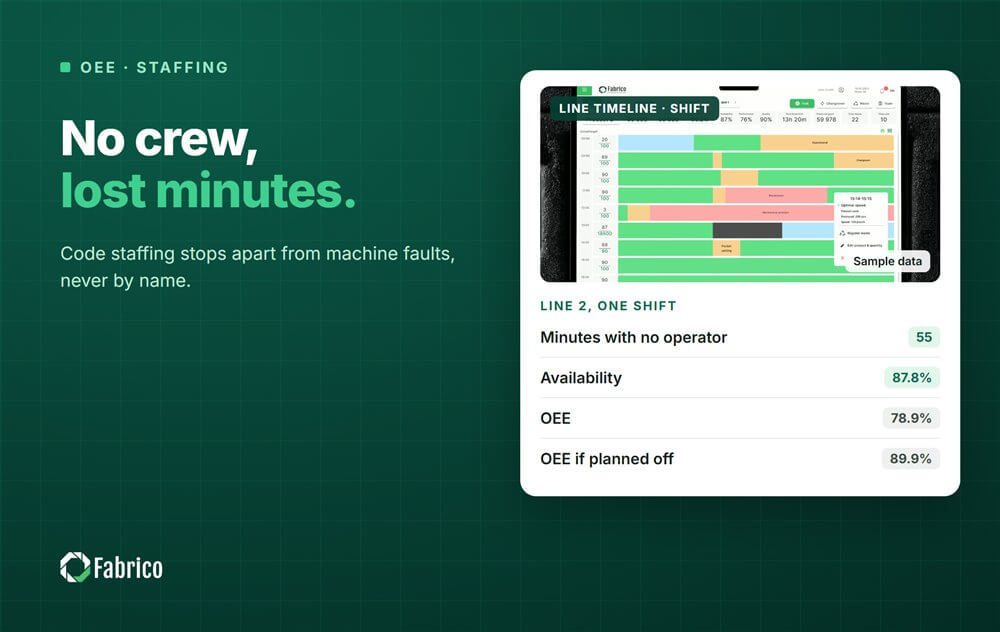
- In the worked example a 55 minute wait for an operator takes the shift to 78.9%.
Fabrico, OEE and light MES (manufacturing execution system) software with AI cameras, logs stops automatically. It measures the process, never the person.
Below: how OEE treats a line with no operator, a worked shift, the codes to use, and how this differs from labour measures. Check your figures in the free OEE Lab calculator.
Does a line with no operator count against OEE?
Yes, if it was planned to run. OEE asks how much of the planned time became good product. A line that stood still for lack of an operator lost that time, just like a line waiting for material.
It is an Availability loss. The cause is staffing, so give it a staffing code, not a machine code. Our OEE Availability guide covers the factor.
When is it not an OEE loss?
When the plant decides before the shift that the line will not run, because there is no crew for it. Then the time is outside planned production time. It shows up in capacity measures such as TEEP, not in OEE.
Our guide on planned vs unplanned downtime explains where that cutoff sits.
What does a worked example of a missing operator look like?
Sample line (illustrative numbers, not a customer): two lines share a crew. Line 2 has 450 minutes of planned time and an ideal cycle time of 1.5 seconds. It stood for 55 minutes while its operator helped with a changeover on line 1.
Line 2 made 14,500 units, and 14,200 were good.
- Run time = 450 minus 55 = 395 minutes, so Availability = 87.8%.
- Performance = 14,500 x 1.5 / (395 x 60) = 21,750 / 23,700 = 91.8%.
- Quality = 14,200 / 14,500 = 97.9%.
- OEE = 14,200 x 1.5 / (450 x 60) = 21,300 / 27,000 = 78.9%.
- If line 2 had been planned off for those 55 minutes: 21,300 / 23,700 = 89.9%.
The 55 minutes are the biggest loss on line 2 this shift, and none of them is a machine problem. Coded as staffing, they lead to a crew plan, not a maintenance job.
Which codes should a no-operator stop have?
| Code | What it means |
|---|---|
| Operator moved to another line | Crew shared between lines |
| Relief not arrived | Break or shift cover late |
| Absence not covered | Nobody available for the line |
| Training or meeting overrun | Planned activity ran long |
Keep the codes about the situation, never about a named person. Our guide to operator friendly reason codes shows how to keep the list short.
How do shared crews create these stops?
When one crew runs two lines, a changeover or a jam on one line pulls people from the other. The second line then stands, even though nothing is wrong with it.
Plan cover before it happens. Decide who stays with which line during a changeover, and which line may stop if both need help. Then the stops that remain are planned choices, and the code shows how often they happen.
How is this different from labour measures like OLE?
OEE measures the equipment against its planned time. OLE (overall labor effectiveness) measures how a workforce's time is used. A staffing stop shows in both, from two sides.
Use OEE to see what the gap cost the line. Use labour measures to plan the crew. Our article on OEE vs OLE compares the two.
Why should OEE never rank operators?
Because it measures the process. A line can lose time through a shared crew, a late relief or a planning gap, none of which is one person's fault. Ranking people by OEE kills honest stop logging. Measure the process, never the person.
What mistakes do plants make with no-operator stops?
- Taking staffing stops out of OEE as "not a machine problem".
- Coding them as machine faults, so maintenance chases nothing.
- Naming people in reason codes.
- Sharing a crew across lines without planning who covers what.
Where Fabrico fits
Fabrico is a computer vision enabled Manufacturing Performance Platform. OEE and light MES come first. Automatic downtime logging and OEE live by line and shift keep staffing losses visible.
- Automatic downtime logging, so a line standing for lack of crew is on record.
- The operator confirms the reason in one tap, with a staffing code.
- OEE live by line and shift, by line, not by named operator.
Read what a light MES covers in our light MES guide. You start on one line, with a baseline and a decision date agreed in advance. There is no free plan and there are no tiers: each plant gets a quote.
Frequently asked questions
Does no operator count as downtime in OEE?
Yes, if the line was planned to run. The time it stood still is lost planned time, so it lowers Availability. Give it a staffing code, such as relief not arrived or operator moved to another line, so it is not mixed up with machine faults.
Should operator absence be excluded from OEE?
Only if the plant decides before the shift not to run the line. Then the time is outside planned production time and shows in TEEP instead. If the line was planned and simply waited, the time stays in OEE as a staffing loss.
Is a no-operator stop the operator's fault?
Rarely. Most of these stops come from shared crews, late relief or gaps in the shift plan. That is why the code should describe the situation, not the person. OEE measures the line and the process, and should never be used to rank people.
How do you code and reduce stops with no operator?
Use a short list that describes the situation: operator moved to another line, relief not arrived, absence not covered, or a training overrun. Never put a name in a code. Then fix the biggest code first: crew cover for changeovers, or a better break plan.
Do staffing stops count in TEEP?
Yes. TEEP uses all calendar time, so any hour a line stands for lack of crew lowers it, planned or not. That makes TEEP a useful view for crew planning. It shows how much capacity the current staffing leaves unused, line by line and week by week.
Is a labour shortage planned or unplanned downtime?
It depends on when the plant decides. Say the line is taken out of the plan before the shift because there is no crew. Then the time is outside planned production time and shows in TEEP. If the line was planned and waited, it is unplanned downtime and lowers Availability.
See your staffing losses in a demo
Bring two lines that share a crew and a week of stops. We will show the minutes lost to staffing and what they cost.
Latest from our blog


Real Fabrico tiles, sample data.