


 Login
 Blog
Do Breaks Count in OEE? Lunch, Shift Change and Meetings

Key takeaways
- Lunch and breaks when the whole crew stops are planned downtime, outside the OEE time base.
- The minutes a break runs over are an Availability loss.
- If a relief crew keeps the line running, those minutes are planned time and count.
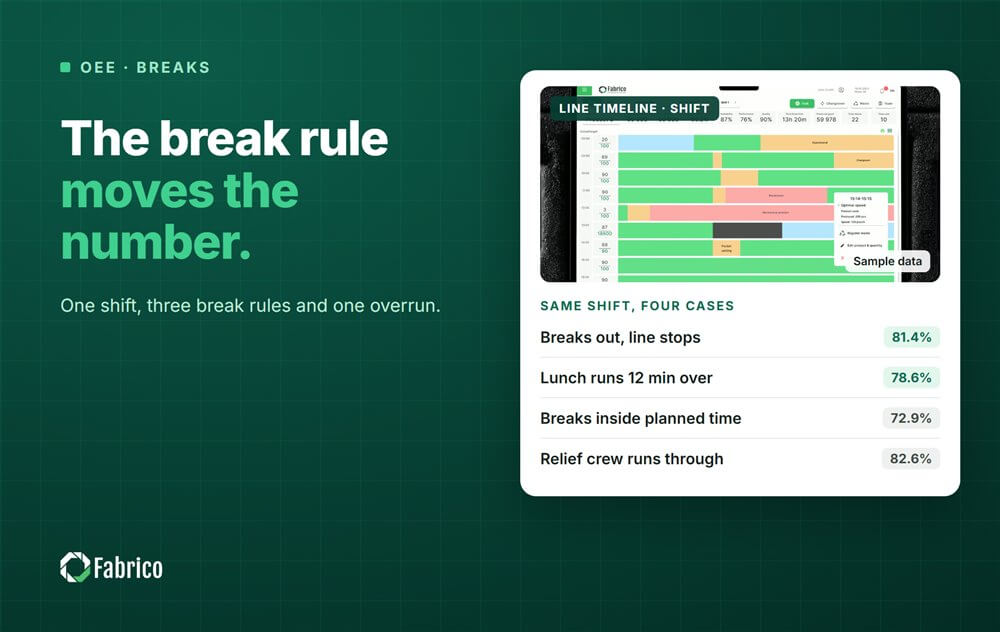
- In the worked example, the same shift reads 81.4% or 72.9% depending only on the break rule.
Fabrico, OEE and light MES (manufacturing execution system) software with AI cameras, logs stops automatically, so a break that runs long shows up.
Below: how OEE treats breaks, shift changes and meetings, a worked shift under three rules, and how to write the rule down. Try your own numbers in the free OEE Lab calculator.
Where do breaks sit in the OEE time model?
OEE starts from planned production time: the time the line was planned to make product. In ISO 22400 terms, planned busy time is planned operation time minus planned downtime.
A lunch break when the whole crew stops is planned downtime. So it is taken out before OEE starts counting. Our OEE time model guide shows each layer.
Which breaks count against OEE and which do not?
| Situation | Inside planned time? | Effect on OEE |
|---|---|---|
| Planned break, line stops | No | None |
| Break runs over its slot | The extra minutes | Availability loss |
| Relief crew runs through the break | Yes | Counts like any minute |
| Shift change with a fixed handover | Plant decides | Overrun is a loss |
| Scheduled team meeting, line stops | No | None |
The rule that matters most is the overrun. A lunch planned for 30 min that takes 42 has 12 minutes of unplanned stop in it. Those minutes belong in Availability, with a reason code.
What does a worked example of four break cases look like?
Sample line (illustrative numbers, not a customer): an 8 hour shift, 480 minutes. Planned breaks: a lunch of 30 min and two breaks of 10 min, so 50 minutes. The ideal cycle time is 1.0 second.
| Rule | Planned time | Good units | OEE |
|---|---|---|---|
| Breaks out, line stops | 430 min | 21,000 | 81.4% |
| Same, lunch runs 12 min over | 430 min | 20,280 | 78.6% |
| Breaks left inside planned time | 480 min | 21,000 | 72.9% |
| Relief crew runs through breaks | 480 min | 23,800 | 82.6% |
- 21,000 good units x 1.0 second = 350 minutes. 350 / 430 = 81.4%.
- The 12 minute overrun costs 720 units: 20,280 x 1.0 second = 338 minutes, and 338 / 430 = 78.6%.
- Same 350 minutes over 480: 72.9%. The line did nothing different; only the rule changed.
- Relief crew: 23,800 units = 396.7 minutes over 480 = 82.6%.
The third row shows why the rule must be written down. A plant that moves breaks in and out of planned time can move its OEE by 8.5 points without changing anything on the line.
Can the break rule be used to inflate OEE?
It can be, in either direction. Christoph Roser names shrinking the time base as one of the three classic ways OEE gets inflated, for example by turning stops into planned stops.
The honest rule: a break is planned only if it is in the shift plan, with a fixed length, before the shift starts. Anything longer is a loss. Our article on downtime definitions that keep OEE honest covers the wider rule set.
What about meetings and training during the shift?
Treat them like breaks. A team meeting or a training slot that is in the shift plan, with a fixed length, and stops the line, sits outside planned time. If it runs long, the extra minutes are a loss.
If people leave for a meeting while the line keeps running with fewer hands, the time stays in planned time. Any slower running then shows up in Performance, where it belongs.
How do breaks show up in TEEP?
TEEP (total effective equipment performance) uses all calendar time. Breaks lower TEEP even when they are outside planned production time. That is why running through breaks with a relief crew raises capacity. Our TEEP guide explains the time base.
How do you write the break rule down?
- List each break by shift: start time, length and whether the line stops.
- Take those minutes out of planned time only when the line really stops.
- Code any minute past the planned length as a break overrun.
- Use the same rule on every line and every shift, so the numbers compare.
Our guide on planned vs unplanned downtime has more examples of the split.
What mistakes do plants make with breaks in OEE?
- Taking breaks out of planned time while the line keeps running.
- Logging break overruns as part of the break.
- Different break rules on day and night shift.
- Changing the rule halfway through a year, so the trend breaks.
Where Fabrico fits
Fabrico is a computer vision enabled Manufacturing Performance Platform. OEE and light MES come first. Automatic downtime logging and OEE live by line and shift make a break overrun visible.
- Automatic downtime logging, so a stop that starts at the end of a break is on record.
- The operator confirms the reason in one tap, so an overrun gets its own code.
- OEE live by line and shift, on one break rule for every line.
Read what a light MES covers in our light MES guide. You start on one line, with a baseline and a decision date agreed in advance. There is no free plan and there are no tiers: each plant gets a quote.
Frequently asked questions
Do breaks count in OEE?
Usually not, when the line stops for them: planned breaks are taken out of planned production time. The minutes a break runs over its planned length are an Availability loss. If a relief crew keeps the line running, the break minutes stay in planned time and count normally.
Should lunch be included in planned production time?
Only if the line keeps running during lunch. If the whole crew stops, take lunch out of planned production time. Whatever you choose, write it down and use the same rule on every shift, or day and night OEE stop being comparable.
How do you count a break that runs long?
Take the planned length out of planned time, and count every minute after it as an unplanned stop. Give it a reason code such as break overrun. In the worked example a 12 minute overrun costs 2.8 points of OEE on one shift.
Does shift change count as downtime in OEE?
It depends on the plant rule. If the handover has a fixed planned length and the line stops, many plants treat that length as planned. Any time beyond it is a loss. If the line keeps running through the handover, those minutes are normal planned time.
Do breaks affect TEEP?
Yes. TEEP uses all calendar time, so every break lowers it, even when breaks are outside planned production time. That is why a relief crew that runs the line through breaks raises TEEP and capacity, even if OEE changes little.
Check your break rule in a demo
Bring one line and its shift plan. We will show the break overruns and what they cost each week.
Related articles







Real Fabrico tiles, sample data.