


 Login
 Blog
Best MES Software: 7 Systems Compared, and Who Needs a Full Suite

The short answer: there is no single best MES software. Ask first what hurt you most last month: a lost hour or a lost lot.
- Lost lot, audit records or the daily fight over what runs next: look at a full suite. Five are compared below: Siemens Opcenter Execution, DELMIA Apriso, AVEVA MES, SAP Digital Manufacturing and Critical Manufacturing. Ask each to show your case.
- Your own team wants to build it, app by app: Tulip.
- Lost hours on the line, and your ERP runs orders well enough: a light MES such as Fabrico.
We sell Fabrico, and it is a light MES, not a full suite. So this page also says who should buy a full suite instead of us.
This MES software comparison of 7 MES vendors uses each vendor's own site, read on 9 November 2026. The order is not a ranking, and nobody wins here.
This is not the whole market. Products such as Rockwell Plex also appear on MES lists, and we left out any site we could not read that day.
For how to run the selection itself, with cost drivers and a pilot plan, read our guide to choosing MES software. This page is the shortlist.
Lost hour or lost lot?
Think of your worst day last month. Did a line stand still while nobody could say why? Or did a customer ask which lot went into a unit, and it took two days to answer?
Those two days need different software. Answer in order and stop at the first yes.
Top MES software at a glance: 7 systems
| System, and how its site describes it | Focus and deployment, per its site |
|---|---|
| AVEVA MES A hybrid cloud MES | Focus: food and beverages, consumer goods, specialty chemical and other repetitive volume production Runs: on premises or hybrid cloud, with workflow and quality control on the edge |
| Critical Manufacturing An MES-powered Industrial Operations Platform for manufacturers of discrete products | Focus: semiconductor, electronics, medical devices, industrial equipment Runs: not stated on the pages we read |
| DELMIA Apriso A manufacturing operations management (MOM) solution that includes what is traditionally part of MES | Focus: global processes across sites Runs: on premise and private cloud |
| SAP Digital Manufacturing A MOM platform that connects the shop floor with the top floor | Focus: execution coordinated with planning and logistics Runs: cloud, on SAP Business Technology Platform |
| Siemens Opcenter Execution An MES family of products | Focus: separate products for discrete, process, electronics, medical device, pharma and semiconductor Runs: not stated on the pages we read |
| Tulip A composable frontline operations platform used to implement a composable MES | Focus: apps you build with no-code editing, often starting with one use case on one line Runs: not stated on the pages we read |
| Fabrico A cloud-based OEE and light MES platform (our product) | Focus: machine data, live monitoring, OEE and downtime analytics Runs: cloud, on AWS in Frankfurt for EU clients |
This is what each vendor's own site says, in our words, checked 9 November 2026. It is not a ranking, and a gap means only that we did not find it on the pages we read, so ask each vendor directly.
Each system: who should look, and one question to ask
AVEVA MES
What its site says: it can enforce bills of material and pre-weight recipes, and trace materials from finished product to raw material. It names batch-oriented and make-to-order production among its fits.
Look at it if: you make repeat volume in food, consumer goods or specialty chemicals.
Ask: what runs on the edge at our plant, and what runs in the cloud?
Critical Manufacturing
What its site says: equipment, IoT, ERP and PLM share a unified data layer, and you can create a single baseline MES and deploy it across sites.
Look at it if: you make semiconductors, electronics, medical devices or industrial equipment.
Ask: what can one site change in the baseline without the others?
DELMIA Apriso
What its site says: it connects ERP systems with shop floor automation to unify production across multiple sites. Quality, material synchronization and maintenance sit in one environment, with low-code configuration.
Look at it if: your main job is one way of working across many plants.
Ask: who does the low-code work after go-live, your people or a partner?
SAP Digital Manufacturing
What its site says: it runs on SAP Business Technology Platform, lets you define an S88 or S95 production model, and standardizes work instructions, scrap and rework processes.
Look at it if: your planning and logistics already live in SAP.
Ask: which of our current SAP modules does this connect to, and what work is left to us?
Siemens Opcenter Execution
What its site says: the family tracks and traces production, including forward and backward traceability of components. The pharma product covers electronic batch recording, and the medical product covers electronic device history records. Siemens also lists Opcenter X, a modular SaaS offer for the SMB market.
Look at it if: your industry has a named Opcenter product and you need its records.
Ask: which product in the family fits us, and what does it share with the others?
Tulip
What its site says: you create apps, add logic and build connectors with no-code editing. It says it captures genealogy as work happens, and that your ERP and PLM stay the systems of record.
Look at it if: you have people who want to build their own apps.
Ask: who keeps our apps running when the person who built them leaves?
Who should buy a full suite instead of Fabrico
A light MES is the wrong buy in these cases, and we would rather say so now.
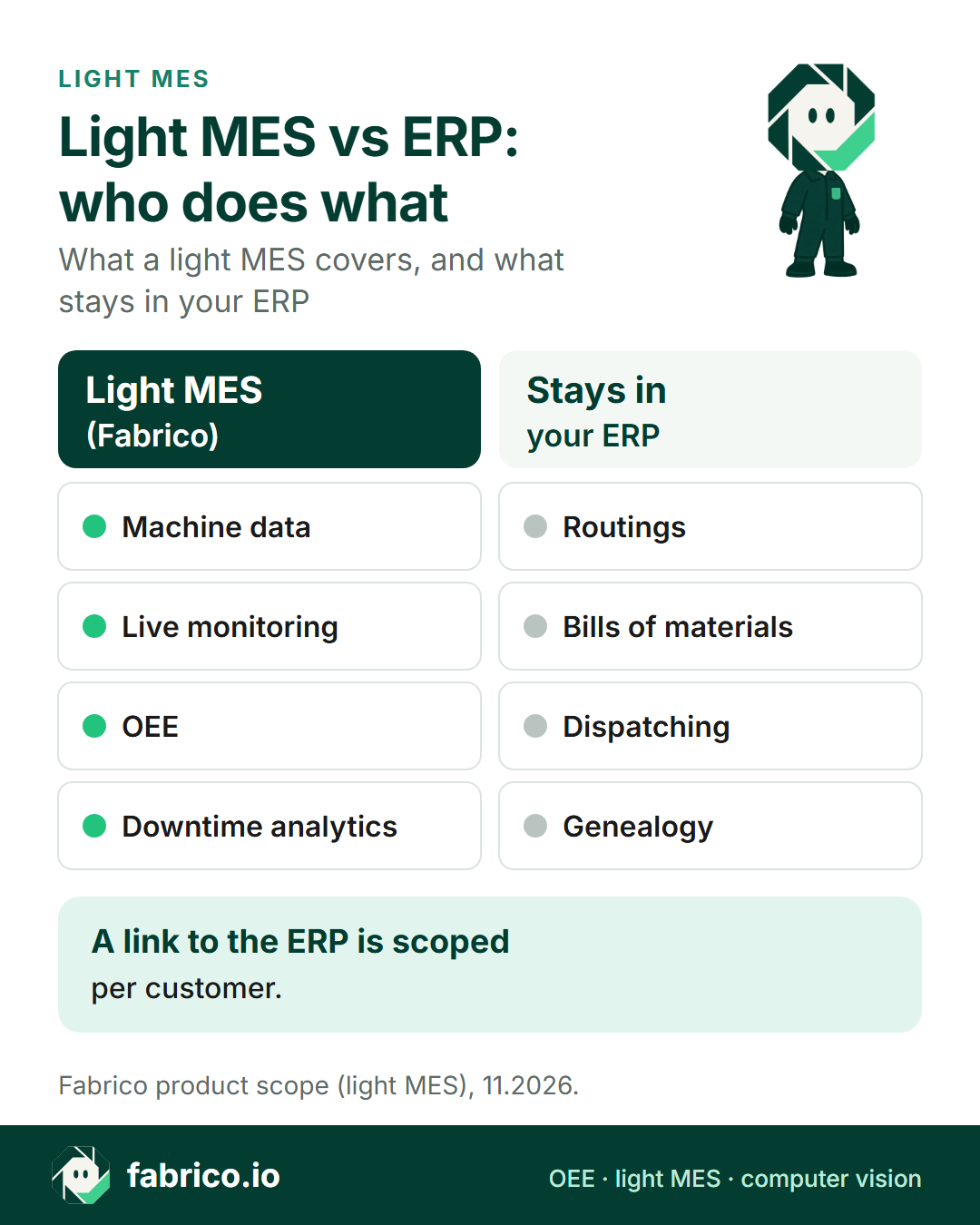
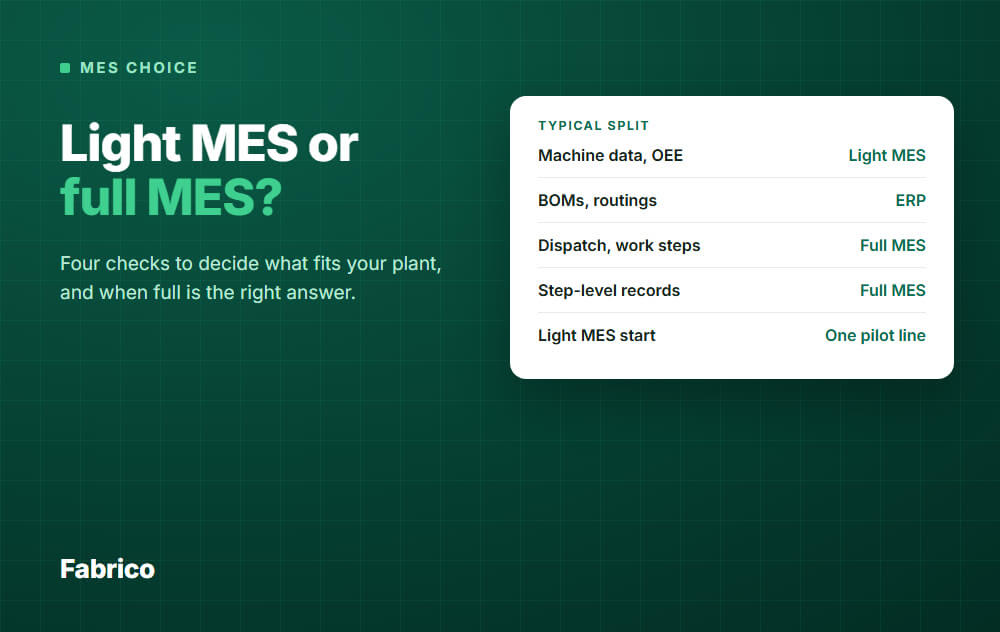
- You need records for an auditor. Fabrico does not keep electronic batch records, device history records or genealogy. Genealogy stays in your ERP.
- Your daily pain is what runs next. Production planning is on our roadmap, not in the product today. Dispatching and routings stay in your ERP.
- You need the MES to enforce steps. Forcing routings and work instructions at the station is not what Fabrico is for.
- You cannot use cloud software at the line. Fabrico is cloud software, and the app needs a working connection.
Fabrico fits when the question nobody can answer is where the time went on line 2 last night, and your ERP already runs orders well enough. Some suites measure OEE too. The question is whether you need the rest.
Those are not always either-or. If you add a suite later, Fabrico data can leave through the REST API or an Excel or CSV export.
If monitoring is all you want, see our machine monitoring software shortlist.
Where Fabrico fits
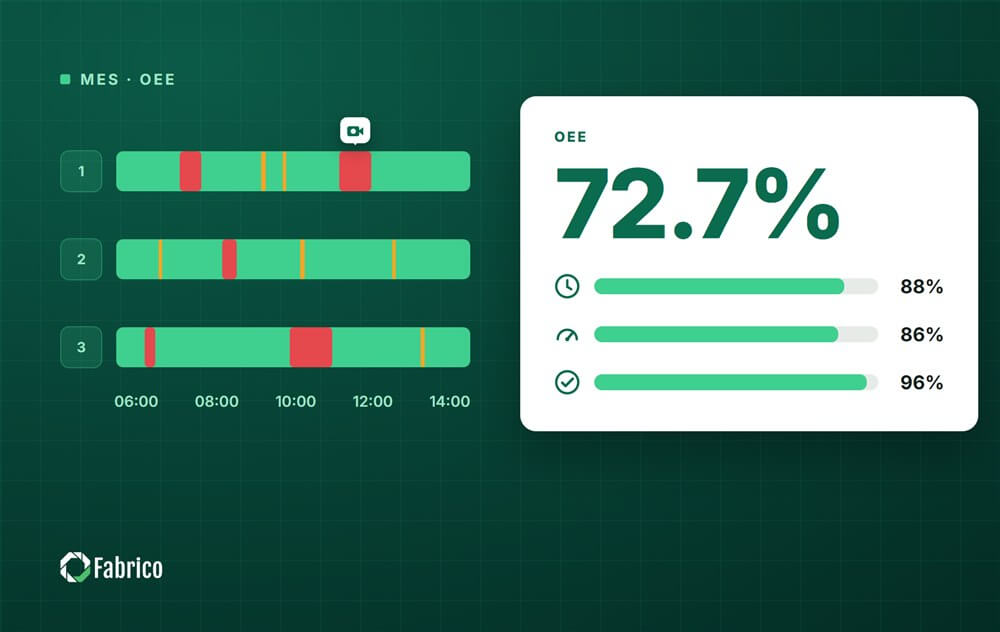
Fabrico is a light MES. It leads with OEE and downtime by line and shift, on the web, iOS and Android.
- Stops: they come from the machine signal, through a PLC or a Fabrico IoT device. The operator adds the reason on a tablet or phone.
- Parts: AI cameras (an add-on) count parts.
- Video: with a camera installed, you can open its video for that minute. In the standard setup it is streamed, not stored in Fabrico. Suggested stop reasons are on our roadmap, not in the product today.
- ERP: a connection to SAP can be scoped per customer.
- Maintenance: built in on the same machine data, as a complement.
Installing the devices and connecting the machines takes about one month. Full rollout across the lines you choose takes 3 to 4 months.
Want to see it on lines like yours? Book a demo or Contact us.
What people ask next
What is the best MES software?
There is no single best MES. The best MES systems for one plant can be wrong for another, because the fit depends on your worst loss, your industry and who runs the system. Use the path above to pick the kind first, then the product.
Who are the main MES vendors?
The MES vendors compared here are AVEVA, Critical Manufacturing, Dassault Systèmes (DELMIA Apriso), SAP, Siemens, Tulip and Fabrico, which is ours. This is not the whole market.
How do I compare MES software?
Give every vendor the same plant brief, the same questions and the same scoring. Our guide to choosing MES software has the checklist, and the 12 question MES selection guide goes deeper.
Is a light MES a real MES?
It covers the part of an MES closest to the machine. The name has no fixed definition, so ask what the system records without anyone typing it. Our light MES guide explains the three kinds.
Does the MES have to be in the cloud?
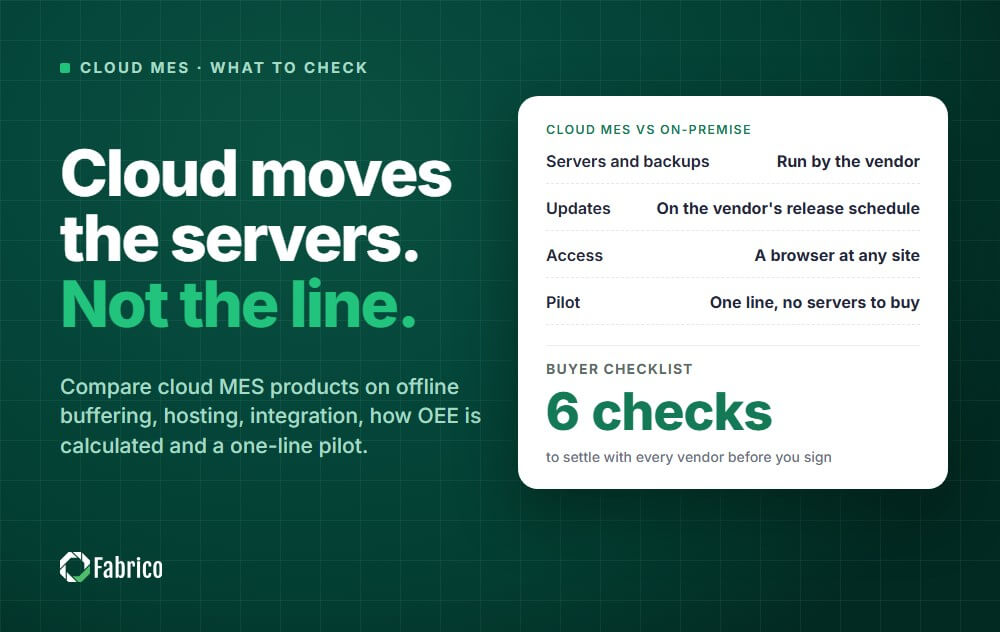
No. Sites in the table above describe cloud, hybrid and on premise options. Our cloud MES comparison covers what changes.
How much does MES software cost?
This page gives no vendor prices. Our guide to MES implementation cost shows what drives a quote. For Fabrico: Quoted per plant.
Is your worst day a lost hour? Book a demo or Contact us.
Related articles


Latest from our blog





Real Fabrico tiles, sample data.