


 Login
 Blog
MES vs IIoT Platform: Which One Does Your Plant Need?

In short: an MES runs production orders and keeps their records. An IIoT platform connects machines and gives you tools to build your own applications on that data. Buy for what is missing.
- Orders, lots or steps go wrong: a full MES.
- You have people who will build and keep apps, or machine data must reach many systems: an IIoT platform.
- You need to know where the hours go, and you do not want to build it: machine data plus operator stop reasons, such as Fabrico.
- A sensor tells you a machine stopped. It does not tell you why.
The MES vs IoT question usually starts like this: someone told you to buy sensors and a platform, and someone else says the plant needs an MES.
Both can be right, for different plants.
We sell Fabrico, which is neither of the two. It sits between them.
So this page also says when a platform or a full suite is the better buy.
What each one is
An MES (manufacturing execution system) sits at Level 3 of the ISA-95 model. It releases orders, follows the steps and records what went into what.
It comes with a model of production.
An IIoT platform connects machines and sensors, stores and models the data, and gives you tools to build on it. It comes with a model of your assets, and the applications are largely yours to define.
Some products sold as IIoT platforms come with ready OEE and stop screens. Judge those as ready-made monitoring, not a toolkit.
The short version: an MES tells the floor what should happen and records that it did. An IIoT platform shows what the machines did, and leaves the next step to what you build.
Here is how vendors describe their own products, read on 9 November 2026.
| Product | Sold as | In its own words |
|---|---|---|
| Siemens Insights Hub | Industrial IoT | "Connect critical assets and collect operational data from smart sensors, historian servers or other enterprise systems" |
| ThingWorx | Industrial platform | "ThingWorx enables organizations to rapidly build, deploy, and scale industrial applications" |
| AWS IoT SiteWise | Industrial data service | "Use asset models to organize and analyze data at the enterprise, site, area, and machine level." |
| Litmus Edge | Edge data platform | "Litmus Edge unifies connectivity, data operations, analytics, and applications in one edge-native platform" |
| Siemens Opcenter Execution | MES | "Opcenter Execution tracks and traces the status of production" |
| AVEVA MES | MES | "Trace materials from finished product to raw material in minutes." |
This is a sample of what each vendor's site says, not a ranking. Ask each vendor directly about anything not quoted here.
The line between them is moving. Critical Manufacturing, an MES vendor, says "Equipment, IoT, ERP, PLM, and enterprise systems share a unified data layer." Siemens says of its IIoT offer: "Track KPIs across production and identify trends and areas to improve overall equipment effectiveness." So judge what a product records, not what it is called.
MES vs IIoT platform side by side
| Point | IIoT platform | Full MES |
|---|---|---|
| Main job | Get machine data out and make it usable | Run production orders and prove how they were made |
| First thing you set up | Connections and asset models | Orders, routings and bills of material |
| Who defines the screens | You or a partner, on the vendor's tools | Largely the product, configured in the project |
| Who uses it daily | Engineers and data teams, then whoever gets the apps | Operators, quality staff, supervisors |
| The real work | Building apps, and keeping them running | Process mapping, master data, training |
| Typical risk | Lots of data, and no answer on the floor | A long project the floor never adopts |
What a sensor cannot tell you
Many buyers start with sensors, because that step is easy to picture. So follow one shift.
All numbers here are example data.
The line has 480 planned minutes and stops 9 times, for 62 minutes in total. The signal gives you that much with nobody typing.
If changeovers count inside planned time, availability is 418 / 480, about 87%. See OEE calculation for the full math.
That is a good start, and it does not tell you what to fix on Monday. For that, someone has to say why the line stopped.
A PLC fault code can name a technical fault. It rarely says no material.
| Stop reason (example data) | Minutes |
|---|---|
| Changeover | 24 |
| Infeed jam | 20 |
| No material | 12 |
| No reason given | 6 |
| Total | 62 |
Now you have a Pareto of downtime, and owners can act on it. The reason came from a person, not from the sensor.
This is the gap in the sensors and a platform plan. On a platform, the operator screen, the reason list and the report are often things you or a partner build.
An MES may have a reason field, so check where its stop times come from. If they are typed, short stops tend to go missing.
Which one first
When an IIoT platform is the better buy
- You have people to build and own it. Engineers or a data team who want this as their job, and will still be there next year.
- Machine data must reach many systems. For example a data lake, analytics tools or your own models, across mixed machines and sites.
- You need more than production data. Energy, temperature or vibration from many kinds of asset, for your own uses.
- You make connected products. You want data from machines you have sold, not only from your own floor.
In those cases Fabrico is the wrong buy. It is built for OEE and downtime, not as a toolkit.
Ask the vendor: show us an application at a plant like ours, and tell us who built it and who keeps it running.
When a full MES is the better buy
- You need records for an auditor. Electronic batch records, device history records or lot genealogy that your ERP cannot give.
- The system must enforce the steps. It must block a wrong material or a skipped step before work starts.
- What runs next is the daily fight. Dispatching and complex routings are where you lose the most.
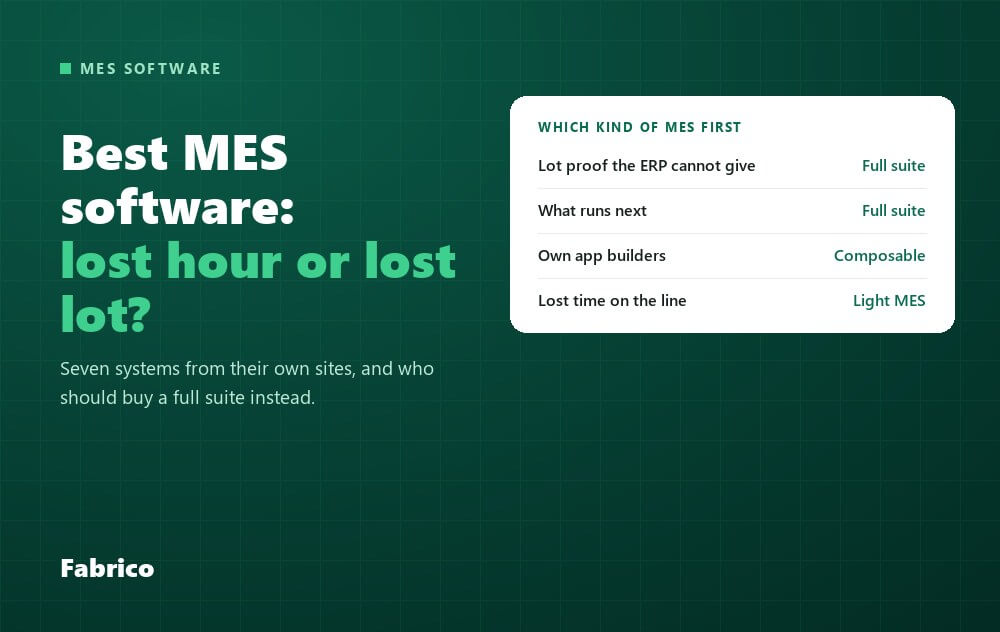
Fabrico does none of this, and scheduling is not in Fabrico. Start with our comparison of full MES systems, or read about choosing MES software.
Ask the vendor: where do your stop times come from, a machine signal or an operator typing them?
When the answer is both, or neither
Both: a regulated plant with an MES it must keep, and a group that wants machine data from every site in one place. The MES keeps the records, and the platform carries the data.
Neither: the question nobody can answer is where the time went on line 2 last night, and your ERP runs orders well enough. You do not need a build project or an order project for that.
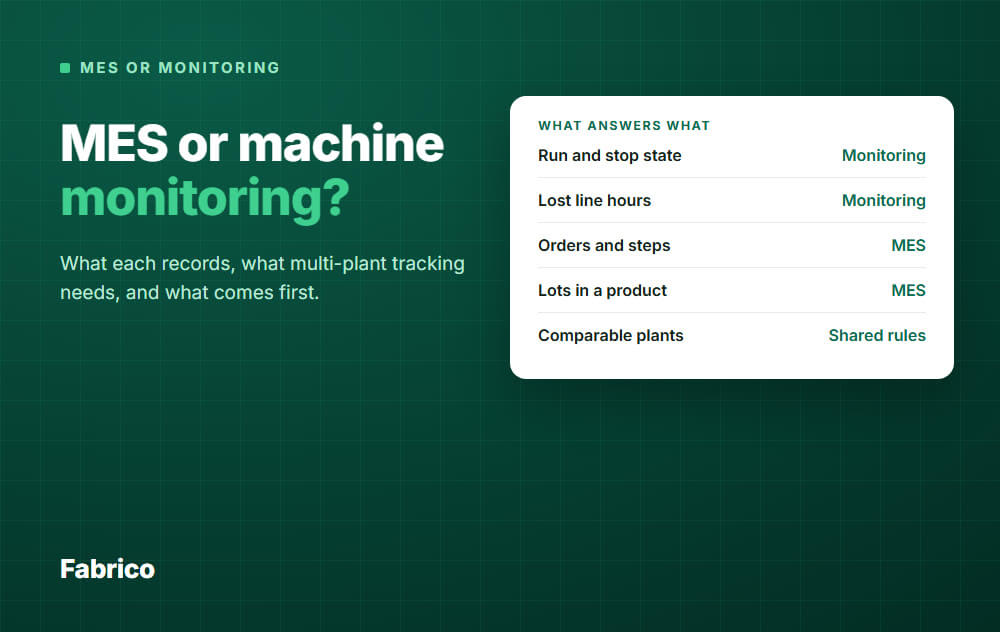
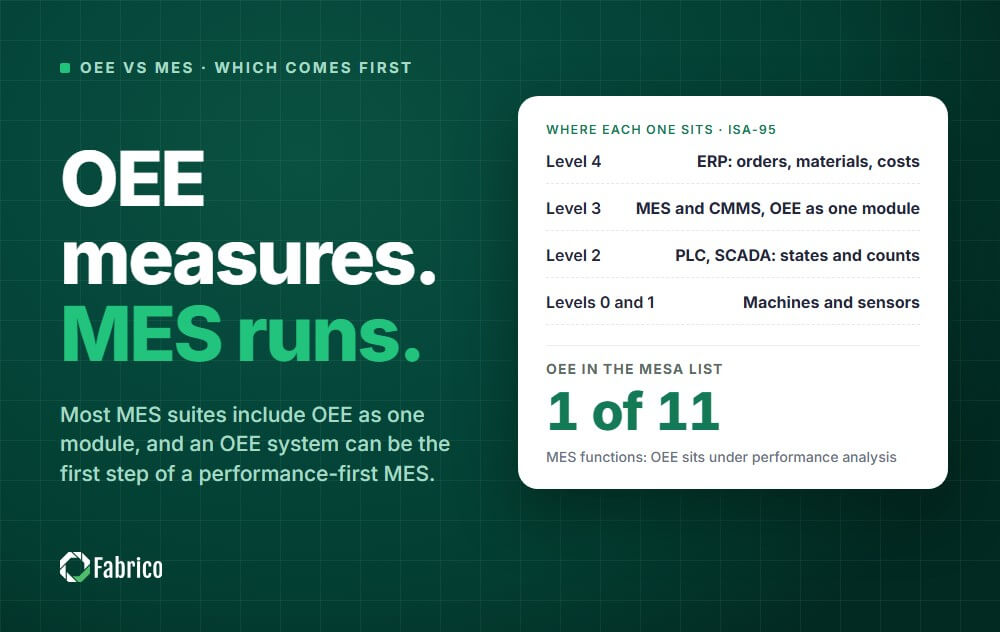
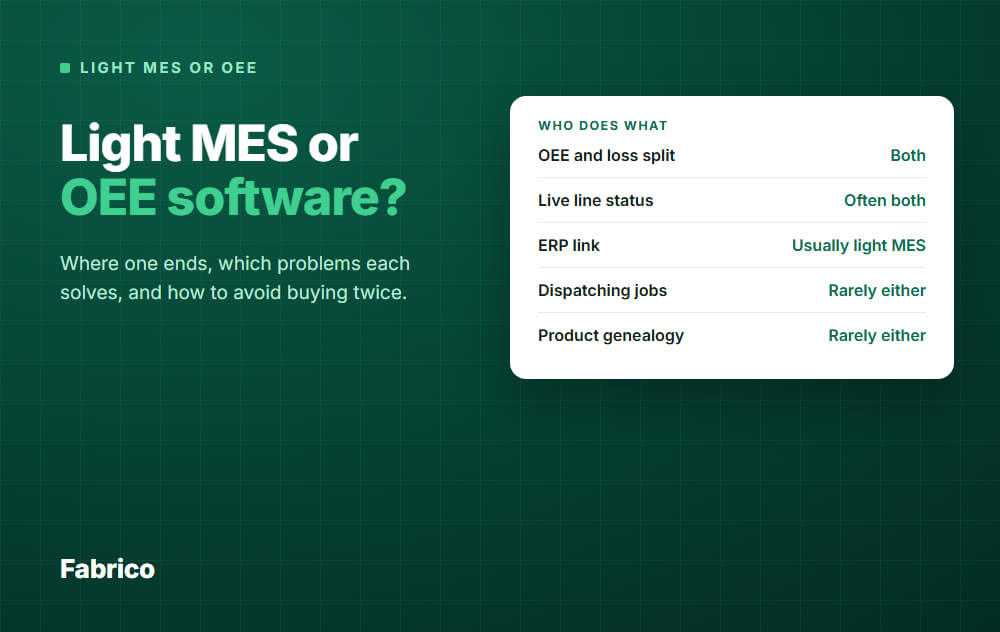
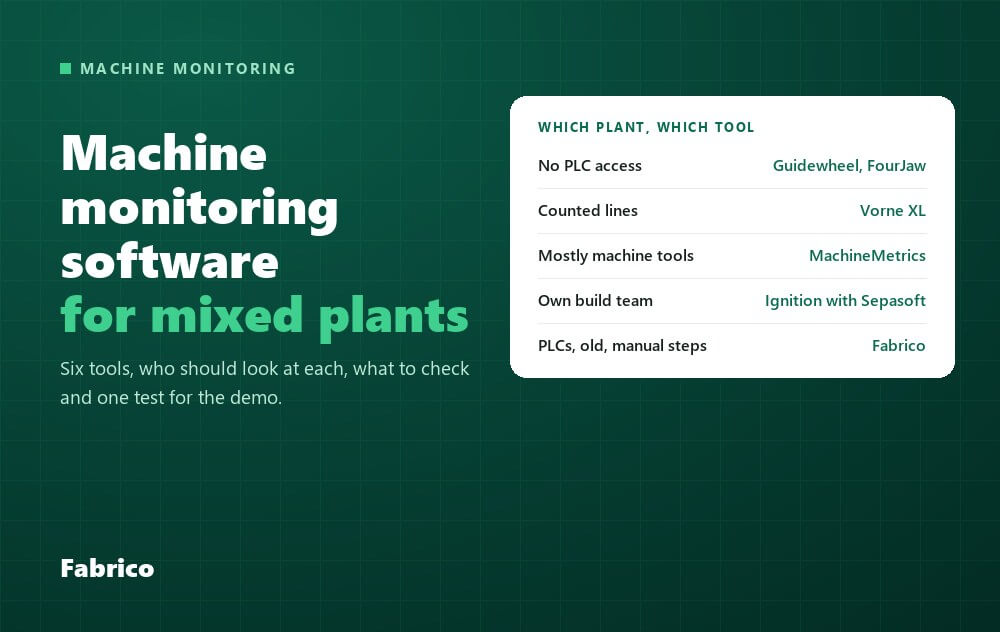
For that plant, read OEE vs MES and MES vs machine monitoring. If monitoring is all you want, see our machine monitoring software shortlist.
IoT vs SCADA vs MES: where SCADA fits
SCADA often comes up in the same meeting, and it does a different job.
| System | The question it answers |
|---|---|
| SCADA | What is the process doing now, and can I step in? |
| IIoT platform | Where does our machine data go, and what do we build on it? |
| MES | What did we make, from what, and was it made right? |
A platform does not take away the need to supervise a process. Products can span these jobs, though.
Inductive Automation sells Ignition as "Fully Integrated Modules for SCADA, IIoT, MES, and More", read 9 November 2026.
For the pair, read SCADA vs MES. For the controllers underneath, read PLC vs SCADA vs MES.
Common mistakes
- Buying sensors before the question. Write down the three questions you want answered first. Then see what data they need.
- Treating a platform as a finished product. Budget for the apps and for who keeps them, not only for the licence and the devices.
- Buying an MES to find lost hours. You then pay for a project around orders and lots when your problem is stops.
- Leaving out the operator. Without stop reasons you get an accurate chart of a problem nobody can name.
- Trusting the label. Ask for the stored record of one stop and of one finished order. What they show you is what the product is.
Where Fabrico fits
Fabrico is a cloud-based OEE and light MES platform. It is not an IIoT platform, and it is not a full MES.
It does the middle job: OEE and downtime by line and shift, on the web, iOS and Android.
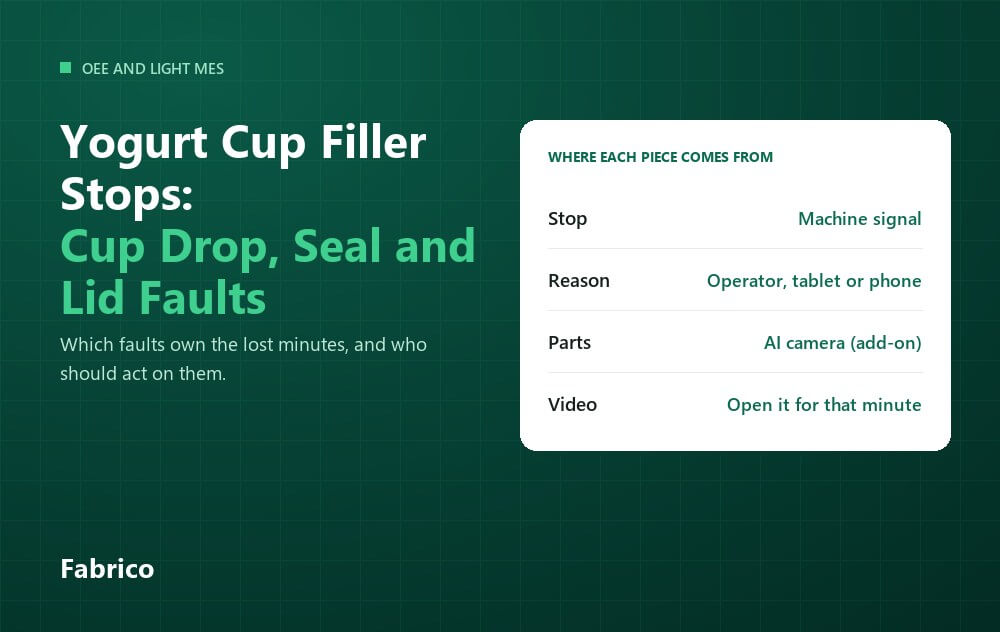
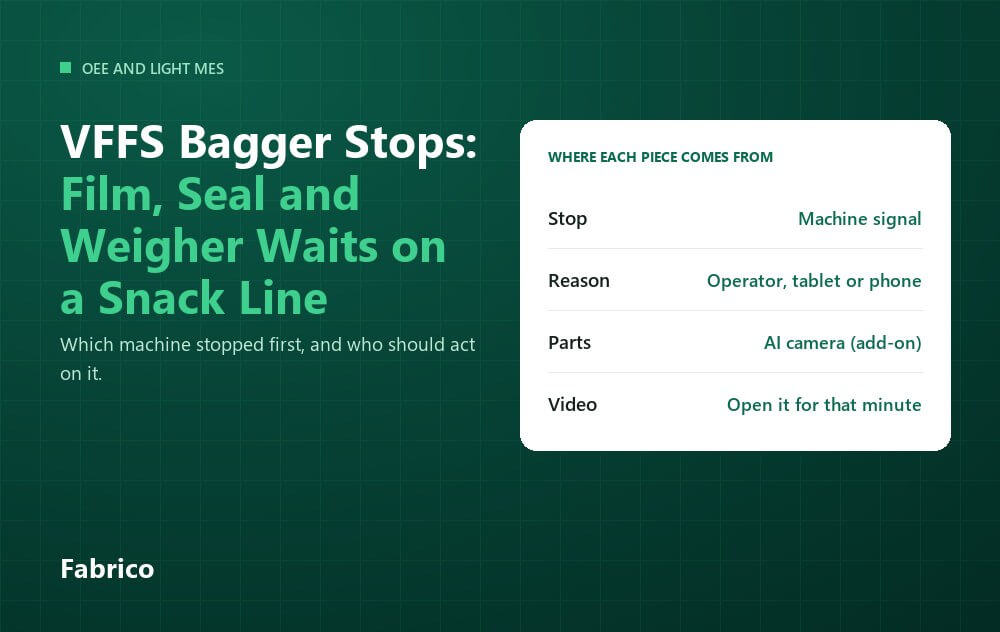
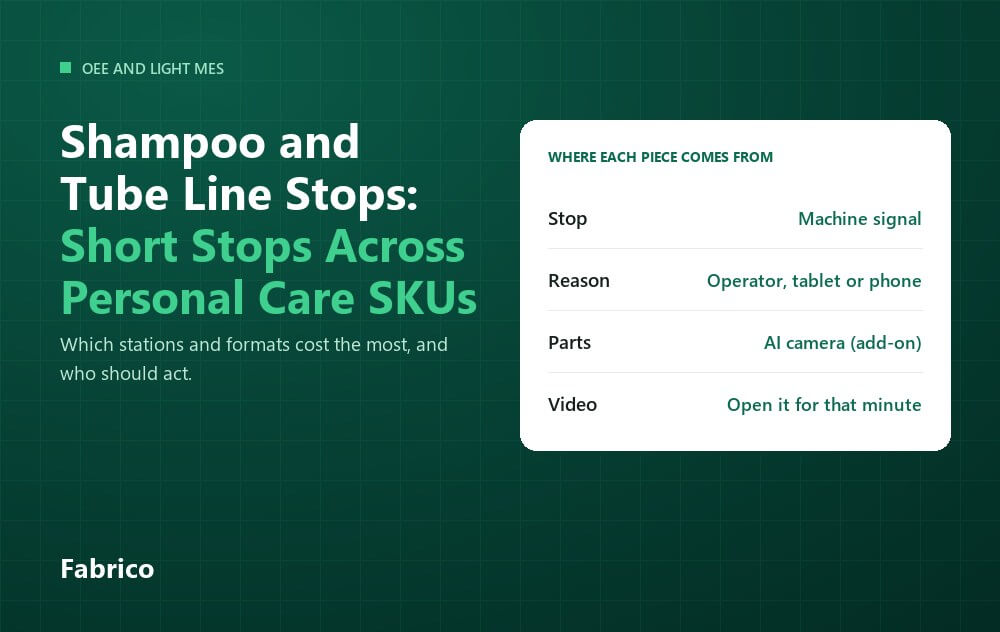
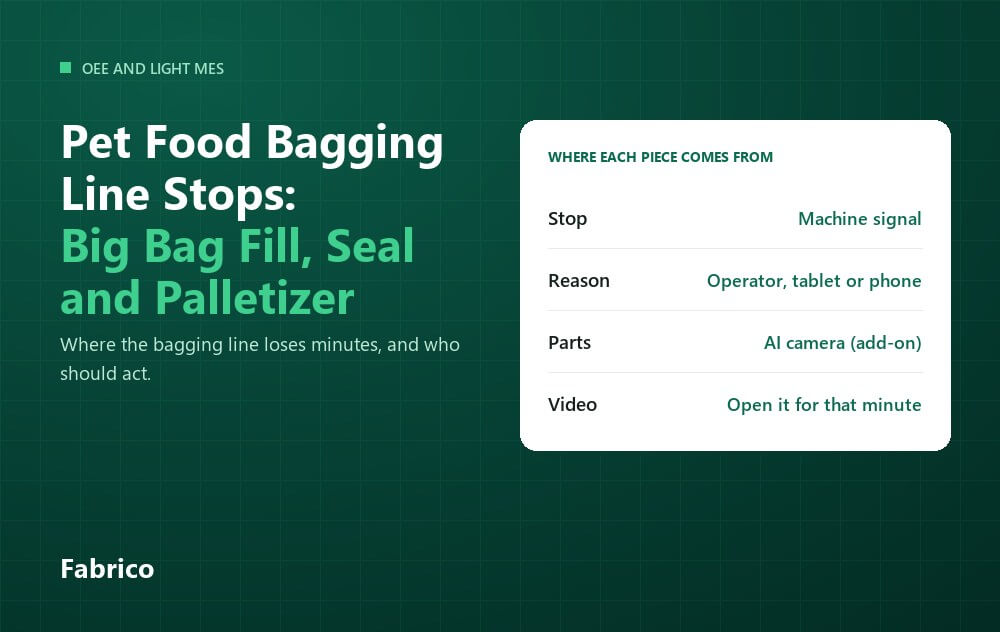
- Stops: they come from the machine signal, through a PLC or a Fabrico IoT device. The operator adds the reason on a tablet or phone.
- Parts: AI cameras (an add-on) count parts. You can open the camera video for that minute. In the standard setup it is streamed, not stored in Fabrico. If cameras fit your line, ask us to show them in the demo.
- Your data: it can leave through the REST API, webhooks or an Excel or CSV export, so a platform or MES can use it later.
- ERP: routings, BOMs, dispatching and genealogy stay there. A connection to SAP can be scoped per customer.
- Hosting: cloud, on AWS in Frankfurt for EU clients. The app needs a working connection.
- Maintenance: built in on the same machine data, as a complement.
Installing the devices and connecting the machines takes about one month. Full rollout across the lines you choose takes 3 to 4 months.
Want to see it on lines like yours? Book a demo or Contact us.
What people ask next
Can an IIoT platform replace an MES?
It can carry the data, and apps can be built on it. Tulip, for one, describes its platform as "used to implement a composable MES", read 9 November 2026.
So ask who builds the order and lot logic, who proves it to an auditor, and who keeps it running. That work does not disappear.
Can I run an MES and an IIoT platform together?
Yes. The MES keeps orders and records, and the platform carries machine data to it and to other systems.
Check which one owns each piece of data, so two systems do not report two numbers.
Do I need new sensors to track downtime?
Not if you can read the PLC. Older machines with no PLC you can read need a sensor signal.
In Fabrico that is a Fabrico IoT device with external sensors. Sensors alone do not give you the stop reason.
What is the difference between IoT and IIoT?
IIoT is the industrial case, where a lost signal can cost output or safety. Our IIoT vs IoT page covers it.
What drives the cost of an MES or an IIoT platform?
The licence is rarely the whole cost. On a platform, budget for building the apps.
On a full MES, budget for process mapping and master data. Our guide to MES implementation cost shows what drives a quote.
Is Fabrico an MES or an IIoT platform?
Neither in full. Fabrico is a cloud-based OEE and light MES platform: machine data plus operator stop reasons.
It is not a toolkit for building your own apps, and it does not run routings, dispatching or genealogy.
Not sure which one your plant needs? Book a demo or Contact us.
Related articles


Latest from our blog


Real Fabrico tiles, sample data.