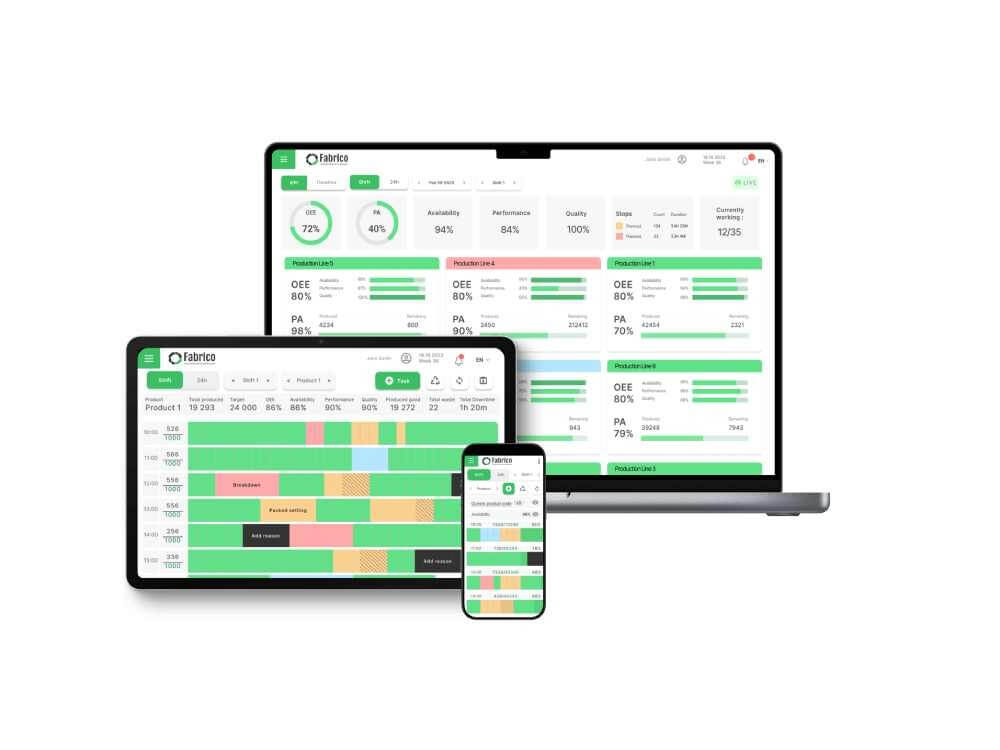
Producătorii cu linii rapide aleg adesea software-ul OEE după cum arată tablourile, dar un grafic frumos nu deblochează un transportor şi nu îţi gestionează stocul de piese.
Diferenţa de bază: Fabrico e un „Sistem de Acţiune" unificat — integrează nativ OEE cu un CMMS construit pentru hală. Evocon e un instrument vizual de OEE pentru conştientizarea pe podea şi tagare manuală a opririlor.
Pentru Mike (managerul tactic), Evocon arată clar câte ore au fost pierdute astăzi. Fabrico arată de ce, cine o repară şi când va fi gata.
Evocon se opreşte la „vezi problema". Fabrico o închide — dintr-o oprire detectată automat se naşte un ordin de lucru, ajunge la Tom (tehnicianul) cu cod QR pe utilaj, checklist şi PDF manual direct pe telefon.
Aşa Tom îşi petrece ziua cu wrench time real, nu căutând manualul prin birou.
Liniile de mare viteză mor din micro-opriri — prea frecvente ca operatorul să le tageze manual, prea rapide ca senzorii clasici să le explice.
Evocon se bazează pe operator să aleagă un motiv la fiecare oprire → cade des în capcana „Pencil Whip" unde „Necunoscut" devine codul standard.
Fabrico foloseşte Computer Vision — o cameră urmăreşte linia şi clasifică automat fiecare micro-oprire (capac blocat, format greşit, servo mut) fără ca operatorul să atingă ceva. Asta transformă Pareto din presupunere în date.
„Fabrica ascunsă" e diferenţa între OEE actual şi potenţial. OEE-ul vizual o arată. Sistemul de Acţiune o recuperează.
Pentru un producător FMCG sau de mase plastice cu €30M cifră de afaceri anuală, 5 puncte OEE = €1,5M venit recuperat. Fabrico recuperează aceste puncte prin reparaţii mai rapide, RCA mai precis şi mai puţine micro-opriri neexplicate — nu printr-un grafic mai frumos.
Concluzie: dacă linia ta e sub 75% OEE şi Evocon îţi arată deja cauzele, problema nu e vederea — e acţiunea. E timpul pentru un „Sistem de Acţiune".
Key Takeaways: Evocon is one of Europe's most widely-deployed OEE monitoring platforms — solid machine connectivity, competitive pricing, and a clean operator interface. The gap is maintenance: Evocon has no CMMS, no automated work order from OEE events, and no computer vision for micro-stops. Fabrico delivers everything Evocon provides plus the maintenance-production loop that turns OEE monitoring into operational improvement.
Evocon's genuine strengths deserve honest recognition. Its deployment across Central and Eastern European food, beverage, and discrete manufacturing operations has earned a strong reputation for:
Where Evocon stops: when OEE drops on a production line, the maintenance team has to be called manually. There is no CMMS. There is no automated work order. There is no field-ready mobile app for maintenance execution. The OEE data shows the problem — and then the loop ends.
This is the structural difference between a monitoring tool and a system of action.
| Capability | Fabrico | Evocon |
|---|---|---|
| Real-time OEE Monitoring | ✅ Full Six Big Losses | ✅ Strong |
| Machine Connectivity (EU PLCs) | ✅ Siemens, Allen-Bradley, Mitsubishi+ | ✅ Strong EU focus |
| Integrated CMMS | ✅ Native field-ready mobile | ❌ No CMMS capability |
| Automated OEE → Work Order | ✅ Under 60 seconds | ❌ Not available |
| Computer Vision (micro-stops) | ✅ Inefficiencies Zoom-In | ❌ Not available |
| AI Agent (bad actors + optimization) | ✅ Fabrico Agent + Assistant | ❌ Not available |
| Multi-language support | ✅ 7 languages | ✅ Multi-language |
| GDPR/EU data hosting | ✅ EU-hosted, GDPR-native | ✅ EU-hosted |
Manufacturers running Evocon alongside a separate CMMS — Fiix, Limble, MaintainX — pay three costs that never appear in the initial evaluation:
Combined licensing: Evocon mid-market pricing ($1,500–2,500/month) + CMMS ($1,200–3,000/month) = $2,700–5,500/month combined — consistently 30–50% more than Fabrico's integrated pricing for the same scope.
Integration development: Connecting Evocon OEE events to CMMS work orders requires custom API development — $10,000–30,000 one-time, plus $2,000–6,000/year in maintenance as both platforms update their APIs.
Data management overhead: Asset names in Evocon must match asset IDs in the CMMS. Downtime reason codes must be consistent between systems. OEE performance data and maintenance cost data must be combined manually for management reporting. This ongoing data governance overhead adds 2–4 hours per week of maintenance manager time.
The total three-year cost of Evocon + CMMS + integration: $120,000–270,000.
Fabrico for the same scope: $90,000–162,000 — with native OEE-CMMS connection, computer vision, and AI Agent included.
Both Fabrico and Evocon capture major OEE losses — equipment failures, large stoppages, and quality rejects. The performance losses below 30 seconds are different.
In a high-speed packaging or food production environment, micro-stops — events under 30 seconds that operators clear manually — represent 8–15% of available production time. PLCs don't register these events. Evocon's monitoring, which relies on PLC signals, doesn't see them either.
Fabrico's Inefficiencies Zoom-In uses computer vision cameras to capture every micro-stop event, regardless of duration, with a short video clip showing exactly what happened. Maintenance teams see the root cause directly — not just that a stop occurred, but which specific mechanical issue caused it and what the resolution sequence looks like.
In typical Fabrico deployments, computer vision surfaces 8–15% additional OEE performance losses that PLC monitoring — and therefore Evocon — classifies as normal operation. At $4,000/hour production value, recovering 10% additional OEE from a 10-line plant = $350,000+/month in production capacity that sensor-only monitoring leaves permanently hidden.
For manufacturers currently evaluating Evocon, the honest question is: will you need a CMMS and micro-stop visibility in the next 18 months?
If yes, starting with Fabrico eliminates the two-tool problem before it begins.
Programați o întâlnire individuală cu experții noștri sau înscrieți-vă direct în planul nostru gratuit.
Nu este nevoie de card de credit!