


 Login
 Blog
Food Manufacturing Software: Which Type to Buy First

In short: food manufacturing software is a shelf of six or seven products, not one. Which one you buy first depends on the problem that costs you most this year.
- Lines stop, crawl and change over slowly, and nobody can say where the hours go: start with a light MES with OEE.
- Recipes, lots, stock and costing are the pain: a food ERP comes first.
- Hazard plans, checks and audits are the pain: buy a quality and food safety system.
- Fabrico is the light MES with OEE only. It is not an ERP, and we make no traceability or food safety claim for it.
Type food manufacturing software into a search engine and you get ERP suites, audit apps and review sites in one list. They solve different problems.
The label changes too: food production software, food and beverage manufacturing software, FMCG production software, or a production management system for food processing plants.
This page is a map for a plant or operations manager who knows the pain, but not yet the product type. We sell one row of that map, a light MES with OEE, and we say plainly when another row should come first.
The software a food plant actually buys
Seven kinds cover almost every food and beverage plant we talk to. Each one owns a different problem.
- Light MES with OEE. Owns line time: stops, micro-stops, changeovers, line speed and rejects, per line and shift. It answers where the planned hours went.
- Food ERP. Owns orders, purchasing, stock, recipes, costing and lot traceability. It answers what you bought, made, sold and what it cost.
- Full MES or batch system. Owns enforced recipes on the floor, weighing and dosing checks, and batch records. It answers whether the batch was made the way the recipe says.
- Quality and food safety. Owns the hazard plan, checks, supplier files, complaints and audits. It answers whether the food is safe and how you show it.
- Planning and scheduling. Owns what runs on which line, in which order. It answers how to group products so allergen cleans and changeovers stay few.
- Warehouse (WMS). Owns locations, pallets, picking and stock rotation by date. It answers where the pallet is and which one ships first.
- Maintenance. Owns work orders, service plans and spare parts. If that is the row you are shopping for, see our page on maintenance software for food and beverage.
The split between office systems and floor systems is not our invention. The ISA-95 standard page describes MES at level 3 and lists ERP systems at level 4, where, in its words, "Level 4 describes all the activities related to running a business."
We name no suppliers for the other rows on this page. We have not tested them, and a list of logos would not help you choose a row.
What to buy first, by symptom
Buy against your most expensive problem, not against the best sales pitch. The table is our view: find your week in the left column.
| If this is your week | Start with |
|---|---|
| Orders ship late, overtime grows, and the shift report says the line "ran fine" | Light MES with OEE |
| The filler stops for a few seconds again and again, and nobody writes it down | Light MES with OEE |
| A customer asks which finished lots hold one ingredient lot, and the answer takes a day of paper | Food ERP with lot traceability |
| Audit week means binders, and a missed check is found only afterwards | Quality and food safety system |
| A wrong ingredient or allergen in the mixer is the risk that keeps you awake | Full MES or batch system |
| The plan is rebuilt by hand each morning, and allergen cleans pile up | Line data first, then a scheduling tool fed with real rates |
| Pallets go missing, or short-dated stock ships after fresh stock | Warehouse system |
Two rules of thumb, from our own view of plants. Traceability and safety come before efficiency, because a recall you cannot handle can cost more than a slow line.
Once those two hold, we would measure the lines before buying planning. A schedule built on guessed speeds and guessed changeover times soon drifts away from what the lines do.
Where a light MES with OEE sits
An ERP books what was made. A light MES records the minutes in which nothing was made, and why.
As we use the term, it takes one part of the full MES job, the line record, and leaves recipe enforcement and batch records to heavier systems. Our guide to MES for food manufacturing walks through the full function list.
On a food or beverage line, it makes five losses visible.
- Stops. Capper jams, sealer faults, no product from the kitchen, no film at the wrapper. Each one gets a start, an end and a reason.
- Micro-stops. A fallen jar at the infeed, a label sensor that trips, cleared in seconds and rarely logged. See our guide to micro-stops.
- Changeovers. Flavour, pack size and allergen changes, counted from the last good pack to the first good pack at speed. In the short-run FMCG plants we see, this is often one of the largest losses.
- Line speed. The line runs, but below the rated speed for this product.
- Rejects. Underweight packs, bad seals, crooked labels, start-up scrap after a clean.
OEE folds these into one figure: availability x performance x quality. The formulas, step by step, are in our OEE calculation guide.
Keep giveaway outside OEE
Giveaway is the product you put in the pack above the label weight. An overfilled jar is still a good jar, so OEE does not see it.
Track it next to OEE, in kilograms per shift, and keep it out of the quality factor. If you blend the two, neither number is easy to trust.
Worked example: one jar filling line, one shift
Example data, not a customer. A line fills 500 g jars of pasta sauce, and its rated speed for this jar is 80 jars a minute.
The shift is 480 minutes with 40 minutes of breaks, so planned production time is 440 minutes.
| Item (example data) | Value |
|---|---|
| Planned changeovers: one allergen clean (45 minutes), one label change (15 minutes) | 60 minutes |
| Starved: waiting for sauce from the kettles | 20 minutes |
| Unplanned: capper and labeller faults | 30 minutes |
| Run time | 440 - 110 = 330 minutes |
| Jars filled | 22,440 |
| Rejects | 440 |
| Good jars | 22,000 |
All three stop rows are availability loss. The changeovers are planned, but they sit inside planned production time, and the wait for sauce is booked as starved, not as a filler fault.
- Availability: 330 / 440 = 75.0%.
- Performance: 22,440 / (330 x 80 = 26,400) = 85.0%.
- Quality: 22,000 / 22,440 = 98.0%.
- OEE: 75.0% x 85.0% x 98.0% = 62.5%. Check: 22,000 good jars / 80 a minute = 275 minutes, and 275 / 440 = 62.5%.
What this shift tells you
The stops the crew remembers add up to 110 minutes. Another 49.5 minutes went to micro-stops and slow running, which a paper log rarely holds.
Now say the allergen clean drops from 45 to 30 minutes, and all else stays the same. Run time becomes 345 minutes, so at the same real speed of 68 jars a minute (22,440 / 330) the line fills 23,460 jars, and 23,000 are good.
That is 1,000 more good jars in the shift, and OEE goes from 62.5% to about 65.3% (23,000 / 35,200). It only pays if the sauce and the orders are there, so price it with the field guide to what a stopped hour costs.
Giveaway sits beside all this. If the 22,000 good jars average 6 g over the label weight, the shift gave away 132 kg of sauce, the contents of 264 jars.
What the food rules ask for, and which row holds it
This is not legal advice. It is a short reading of the regulators' own pages, to show which software row carries which duty.
In the US, the FDA's preventive controls rule for human food page says: "Covered facilities are required to have and implement a written food safety plan". Where the hazard analysis finds a hazard that needs a preventive control, the same page asks for "a written recall plan".
The FDA's food traceability rule page covers foods on its Food Traceability List. It says the core of the rule is that those who manufacture, process, pack or hold these foods "maintain records containing Key Data Elements (KDEs) associated with specific Critical Tracking Events (CTEs)".
That page gives January 20, 2026 as the original compliance date. It also says the FDA was directed not to enforce the rule before July 20, 2028, so check the page for the current position.
In the EU, the European Commission's food hygiene legislation page lists among its principles: "General implementation of procedures based on the Hazard Analysis and Critical Control Points principles (HACCP)".
For software, our reading is simple. Plans and checks sit in the quality and food safety row, lots and recall sit in the ERP row, and OEE software holds neither.
How to choose: a short checklist
- Write the problem as one sentence. "We cannot trace a lot" and "we lose two hours a shift" point at different rows.
- Ask where every number is born. A machine signal, a scale, a scanner, or a person typing after the shift.
- Ask for your worst changeover on screen. Last good pack to first good pack at speed, shown live, not on a slide.
- Ask what the product does not do. We think a clear answer here is worth more than a long feature list.
- Start small where you can. Line data can start on one line, which is hard to do with an ERP.
Common mistakes
- Treating a stop log as a food safety record. Knowing the line stopped for a clean does not show the clean was checked.
- Taking changeovers and cleans out of planned production time. OEE rises on paper, and the loss leaves the report.
- One rated speed for every product. Set it per product and pack size, or performance means little.
Where Fabrico fits, and where it stops
Fabrico is a cloud-based light MES with OEE. On the map above it is the highlighted row, and only that row.
- Stops: they come from the machine signal, through a PLC or a Fabrico IoT device. The operator adds the reason on a tablet or phone.
- OEE: availability, performance and quality per line and shift, so speed loss and rejects sit next to downtime.
- Changeovers: a changeover shows up as a stop with its reason, so you can see its time.
- Parts: AI cameras (an add-on) count parts. You can open the camera video for that minute.
- Camera video: in the standard setup it is streamed, not stored in Fabrico.
What Fabrico does not do: it is not an ERP, and production planning and scheduling are not part of Fabrico today.
What we do not claim: lot traceability, recall handling or food safety compliance. In our view those belong to the other rows.
Ficosota (also a Fabrico investor) raised OEE from 53.1% to 59.6% on 16 lines, June to September 2026, with monthly good output up 23.2%. That is one company, not a benchmark for your plant.
The screens are on the MES and OEE overview.
What people ask next
What is food manufacturing software?
It is a loose name for the systems a food or beverage plant runs: light MES with OEE, ERP, quality and food safety, planning and warehouse. In our view no single product does all of it well, so start from the problem.
Is a food ERP the same as an MES?
No. The ERP runs orders, stock, recipes, lots and cost, while the MES records what happened on the line.
Does OEE software cover traceability or HACCP?
No. It shows when a line stopped, for how long and why, but lot records and hazard checks live in your ERP and food safety system.
Which OEE software suits food and beverage lines?
That depends on how your stops and counts are captured. We compare options in our guide to OEE software for food and beverage plants.
Food lines losing hours you cannot name? Book a demo or Contact us.
Related articles
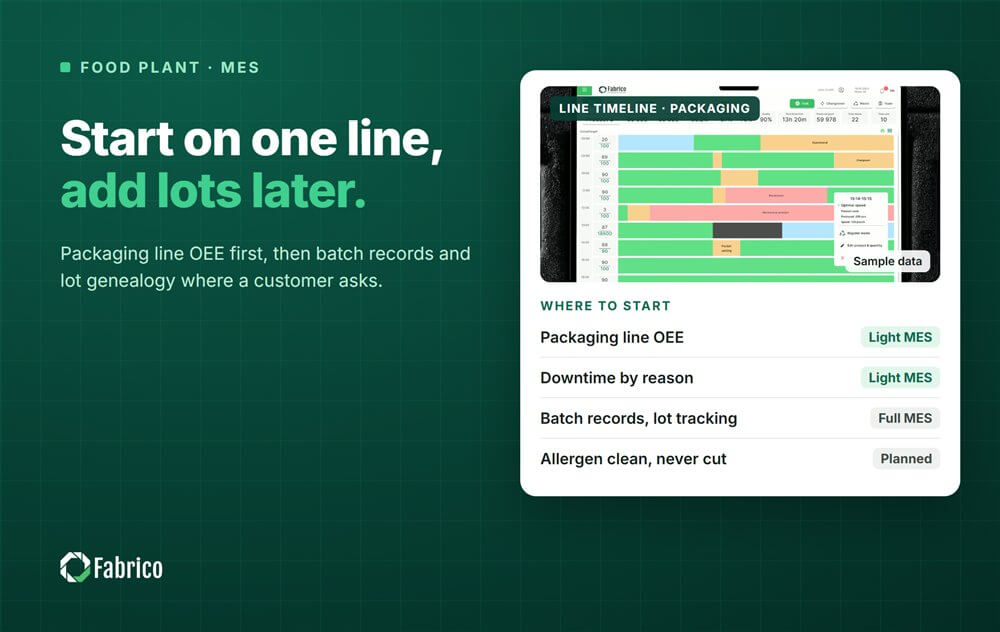





Real Fabrico tiles, sample data.