


 Login
 Blog

MES for Chemical Manufacturing: Batch Suite or Light MES on the Packing Line

In short: a chemical plant usually needs two different things from an MES. The batch side needs recipes and batch records, and the filling and packing side needs to know where the hours went.
- Recipes, material checks or electronic batch records are the problem: buy a batch suite.
- Filling and packing lines lose hours and nobody can say why: start with line data, OEE and stop reasons, such as a light MES.
- Fabrico fits the second job. It holds no electronic batch records and does no recipe execution, and we make no ATEX or GMP claim.
- Many plants need both. A light MES never replaces a batch suite, and some suites also reach the packing side.
An MES (manufacturing execution system) is the software between your ERP and your machines. It tracks what is being made, on which line, and how it went.
Most pages on chemical MES talk about reactors, recipes and compliance. That is half of the plant.
The other half is a line that fills drums, pails or cans. It stops, gets flushed and waits for the lab, and often nobody has a number for it.
We sell Fabrico, and this page puts it on that second half only. So it also says plainly who should buy a batch suite instead.
Two factories under one roof
The batch side and the packing side run on different clocks, and they fail in different ways. An MES question that does not separate them usually gets a muddled answer.
| Point | Batch side | Filling and packing side |
|---|---|---|
| Unit of work | A batch in a vessel | A pack: can, pail, drum or IBC |
| Clock | Hours per batch | Packs per minute or per hour |
| The fear | Wrong material, off-spec batch, a process upset | A line that stands still while the order waits |
| The proof | What went in, when, and who signed | What was filled, and how many good packs |
| The usual tools | Control system, recipes, lab system | Filler PLC, checkweigher, and often a paper log |
What a batch suite does that Fabrico does not
A batch suite runs the process side. Many work from models such as ISA-88, the batch control standards, which cover chemicals among other batch industries.
- Recipe execution: the steps of a recipe run in order, against the control system.
- Electronic batch records: a full record of what happened to each batch.
- Material checks: the right material goes into the right vessel, and a wrong one gets caught first.
- Lot trail: from raw material lot to finished lot.
- Lab links: sampling and test results tied to the batch.
Material checks are a real chemical problem. Automation World reported in July 2015 that many Dow production sites rely on small containers that "look alike from the outside but hold different chemical makeups."
The same article says "about half of all specialty chemical manufacturing batch processes are still paper-based batch instructions." It names no study and the figure is old, so read it as a signal, not a current number.
Here is how some suppliers describe their own products, read on 9 November 2026.
| Product | In its own words |
|---|---|
| Yokogawa OpreX Batch MES C1-T1 | "a manufacturing management solution designed for batch chemical processes" |
| AVEVA Batch Management | "provides recipe execution management and automatic capture and storage of all batch execution data" |
| Siemens Opcenter Execution Process | "the demands of secondary manufacturing operations, like packaging, labeling and palletizing finished goods" |
| Datacor Batch Production | "has been tailored to bulk blending, mixing, and reacting batch production processes" |
| ProLeiT | For chemicals: "Batch processes and hybrid processes" |
This is a sample of what each site says, not a ranking. Ask each supplier directly about anything not quoted here.
Note the Siemens line. Some suites reach into filling and packing as well, so ask how much of that is ready to use on your lines.
Who should buy a batch suite instead of Fabrico
- A wrong charge is your worst day. You need the system to stop a wrong material before it goes in.
- A customer or regulator wants electronic batch records. For example, you make products under GMP or supply a plant that does.
- Recipes must run in the system. Steps and parameters have to be enforced, not just written down.
- You need a lot trail your ERP cannot give. A recall would take you days of paper today.
- You have no packing line to speak of. Product leaves by pipe, rail or road tanker, so the losses sit in the process, not at a filler.
In all of these, Fabrico is the wrong first buy. Our comparison of full MES systems is a better next read.
Who can start with line data
- Your recipes already run well enough in the control system, the ERP or on paper.
- Your batch paperwork passes the audits and customers you have today.
- Orders ship late while tanks sit full, or you cannot tell which side is holding the other back.
- The filling line's numbers come from a shift log, and short stops never reach it.
- You want a light MES that a small team can run, without a project around every recipe.
Not sure? Light MES vs full MES has four checks to help you decide.
Where the hours go on filling and packing
A filling line is a packaging line with harder cleaning. These are the losses to code separately, using the three OEE factors.
| Loss | What it looks like | OEE factor |
|---|---|---|
| Product change | Drain, flush, clean pump and filter, first-off check | Availability |
| Pack change | Nozzles, guides, capper parts, new labels | Availability |
| Waiting for release | Nothing released to fill, or the tank is held for the lab | Availability (the cause sits before the filler) |
| No packs or pallets | Drums, pails, closures or labels are not at the line | Availability |
| Faults and jams | Denester, closure feed, labeller, conveyor | Availability, or Performance if very short |
| Slow filling | Speed cut for a foaming or thick product | Performance |
| Rejects | Leaks, wrong weight, wrong or crooked labels, first-off and restart scrap | Quality |
Very short stops rarely reach a paper log. Our guide to micro-stops shows how to count them, and how to set the limit between a stop and slow running.
Slow filling is easy to hide. If the rated speed is the same for thin, thick and foaming products, the number means little, so set it per product and pack size.
Keep the batch side and the filling side as two separate figures. Our page on OEE for batch processes covers the vessel side.
Changeovers and cleaning: where chemistry meets the clock
A pack change is mechanical. A product change may also be chemical, because the old product can spoil the next one, and the flush has to go somewhere.
A 2004 Akzo Nobel patent gives rare hard numbers from paint filling. The paint maker argues that it is "uneconomic to dedicate production lines to a single type of paint."
Here is what the patent reports for one 9,000 litre batch, filled into 2.5 litre containers.
| Step | Time | Water |
|---|---|---|
| Filling the batch, new design | 150 minutes | |
| Cleaning pump and filter, older design | 4 hours | 5,000 litres |
| Swapping in a clean pump and filter unit, new design | About 1 minute | |
| Washing the used unit away from the line, new design | 25 to 30 minutes | 200 litres |
Cleaning on the older design took 4 hours, against 150 minutes to fill the same size of batch on the new one. This is one test reported by the patent holder, so it is a picture of the problem, not a benchmark.
The lesson travels well, though. Moving the wash off the line turns stopped time into work done while the line runs, which is the core idea of SMED.
How to time it
Clock each change from the last good pack of one product to the first good pack of the next at full speed. Then split it, so each step has an owner.
- Drain and recover: how much product comes back, and how much goes to waste.
- Flush and clean: lines, pump, filter and nozzles. Note how much flush it took.
- Change parts: nozzles, guides and capper parts for a new pack.
- Clear the line: old labels and packs off the line, new ones on.
- First-off and release: weight, seal and label checks, then the sign-off.
- Back to speed: the slow first minutes after the restart. OEE books this part as Performance, not Availability.
"A lot of people still don't count set-up, start-up and clean-up time as part of the changeover, but they should," consultant John Henry told Food Engineering in March 2003.
He was talking about food lines, and the same trap sits on a chemical filler.
What not to cut
Line clearance matters more here than on most lines. In the US, OSHA's hazard communication page says labels for hazardous chemicals must include "a harmonized signal word, pictogram, and hazard statement," so a wrong label is more than a rework problem.
Cleaning steps, safety checks and sign-offs set by your site stay in. Measure them so you can plan around them, and change them only through your own quality and safety people.
Sequence is often the cheaper win: light before dark, and similar products together, so some flushes get shorter or disappear. That is a planning choice, and production scheduling is not in Fabrico.
Worked example: one pail line, one shift
Example data, not a customer. A line fills 20 litre pails from 10,000 litre batches, and its rated speed for this product and pack is 6 pails a minute.
The shift is 480 minutes with a 30 minute break, so planned time is 450 minutes.
| Item (example data) | Value |
|---|---|
| 2 product changes with flush, 50 minutes each | 100 minutes |
| Waiting for a released batch | 35 minutes |
| Faults and jams | 25 minutes |
| Run time | 450 - 160 = 290 minutes |
| Pails filled | 1,566 |
| Rejects | 31 |
| Good pails | 1,535 |
- Availability: 290 / 450 = 64.4%.
- Performance: 1,566 / (290 x 6 = 1,740) = 90.0%.
- Quality: 1,535 / 1,566 = 98.0%.
- OEE: 0.6444 x 0.9000 x 0.9802 = 56.9%. Check: 1,535 good pails / 6 a minute = 255.8 minutes, and 255.8 / 450 = 56.9%.
What this shift tells you
At rated speed, a 10,000 litre batch is 500 pails, or about 83 minutes. The shift's two product changes took 100 minutes, more than it takes to fill a whole batch.
Now say better sequence removes one flush, 50 minutes, and all else stays the same. Run time becomes 340 minutes, so at the same 5.4 pails a minute (90% of 6) the line fills 1,836 pails, and about 1,800 are good.
That is about 265 more good pails, or 5,300 litres, and OEE goes to about 66.7%. It only pays if released product and demand are there, so put your own margin on it with the field guide to pricing a stopped hour.
Notice what the batch record says about this shift: possibly nothing is wrong. Every batch can be on spec and fully documented while the line loses over three hours, which is why these are two separate questions.
Common mistakes
- One OEE figure for the whole plant. A vessel and a filler run on different clocks, so the blend tells nobody what to fix.
- Hiding cleaning in planned time. The OEE looks better, and the biggest loss disappears from view.
- Buying a batch suite to find lost hours. You take on a recipe and record project when the problem is stops.
- Using a line data tool as your batch record. OEE software is not proof of how a batch was made.
- Charging the wait to the filling crew. Code it as its own reason, then look at the lab and the batch side.
Where Fabrico fits, and where it stops
Fabrico is a cloud-based OEE and light MES platform. This page covers its use on filling and packing lines.
- Stops: they come from the machine signal, through a PLC or a Fabrico IoT device. The operator adds the reason on a tablet or phone.
- OEE: availability, performance and quality per line and shift. A changeover shows up as a stop with its reason, so you can see its time.
- Parts: AI cameras (an add-on) count parts. You can open the camera video for that minute.
- Camera video: in the standard setup it is streamed, not stored in Fabrico. If cameras fit your line, ask us to show them in the demo.
- ERP: routings, BOMs, dispatching and genealogy stay there. A connection to SAP can be scoped per customer.
- Connection: it runs in the cloud, on the web, iOS and Android, and the app needs a working connection.
- Maintenance: built in on the same machine data, as a complement.
What Fabrico does not do: it holds no electronic batch records and does no recipe execution. Production planning and scheduling are not part of Fabrico today.
What we do not claim: we make no ATEX claim and no GMP claim. Your site safety lead decides what equipment may enter a classified area.
Ficosota (also a Fabrico investor) raised OEE from 53.1% to 59.6% on 16 lines, June to September 2026, with monthly good output up 23.2%. That is one company, not a benchmark for your plant.
Installing the devices and connecting the machines takes about one month. Full rollout across the lines you choose takes 3 to 4 months.
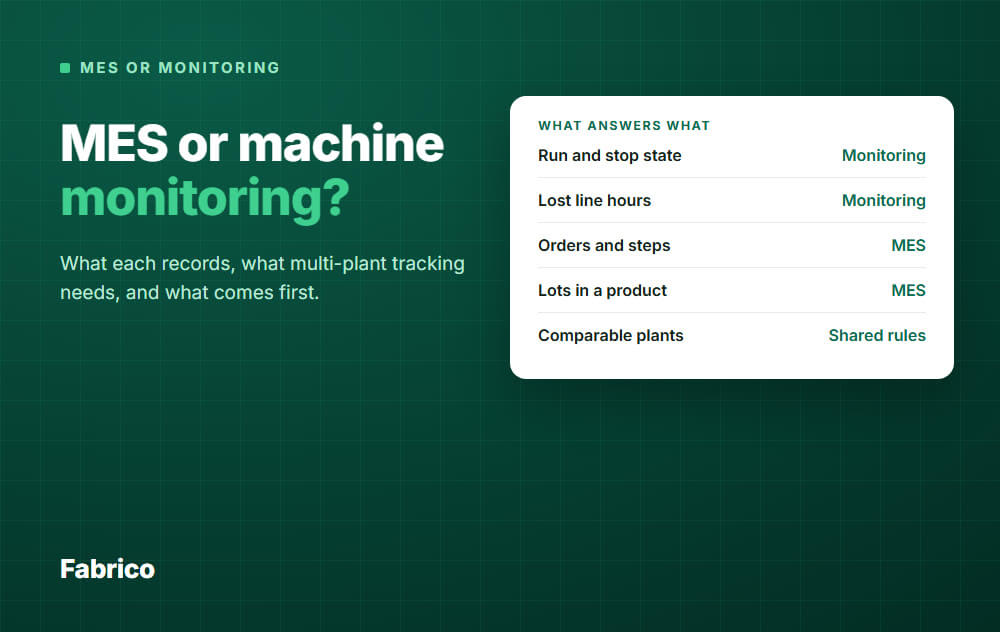
See the MES and OEE overview.
Want to see it on lines like yours? Book a demo or Contact us.
What people ask next
Can a chemical plant run a batch suite and a light MES together?
Yes, if each one has a clear job: the suite keeps recipes and records, and the light MES watches line time. Decide which system owns each number, so two reports do not disagree.
Fabrico data can leave through a REST API, webhooks or an Excel or CSV export. A link to a specific batch suite is something to scope, so ask for it to be shown.
Is an MES the same as a batch system or a DCS?
No. A DCS controls the process and a batch system runs the recipes on it, while an MES sits above them and below the ERP, in the layers that ISA-95 describes.
Products overlap, so ask what each one records.
Should I measure OEE on reactors as well?
You can, but as a separate figure, because a vessel has no parts per minute. See our list of OEE tools for chemical plants if that is the job you are shopping for.
Do I need electronic batch records by law?
That depends on your products, your regulators and your customers, so ask your quality lead, not a software seller. If the answer is yes, you need a system built for it, and Fabrico is not that system.
What should I ask a supplier in the demo?
Ask them to show one product change from last good pack to first good pack at full speed, split into steps. Ask where stop times come from: a machine signal, or someone typing.
Then ask who keeps recipes and records, and what happens on the day the network is down.
Does this apply to paint and coatings?
Yes, a paint plant has the same two sides, with colour changes as the big filling loss. Our page on OEE for paint and coatings goes through shading and lab time.
Filling lines losing hours you cannot name? Book a demo or Contact us.
Related articles

Latest from our blog




Real Fabrico tiles, sample data.