


 Login
 Blog

Micro-Stops in Manufacturing: The "Silent Killer" of OEE

A micro-stop in manufacturing is a short production stop, typically under 2 minutes, that the operator clears at the machine without calling maintenance: a jam, a misfeed, a blocked sensor. Because micro-stops are rarely logged by hand, in OEE they usually show up as lost speed (performance) rather than as downtime.
Key Takeaways
-
The 5-Minute Myth: A major breakdown grabs attention, but 50 stops of 30 seconds each (an illustrative shift) can cost more OEE than one 5-minute breakdown, and wear down operator morale.
-
Why manual logging fails: You cannot ask an operator to log a micro-stop. It is physically impossible to document a 10-second jam on a clipboard.
-
Performance vs. Availability: Micro-stops usually show up as "Speed Loss" or "Reduced Speed" in OEE calculations, disguising themselves as slow cycles.
-
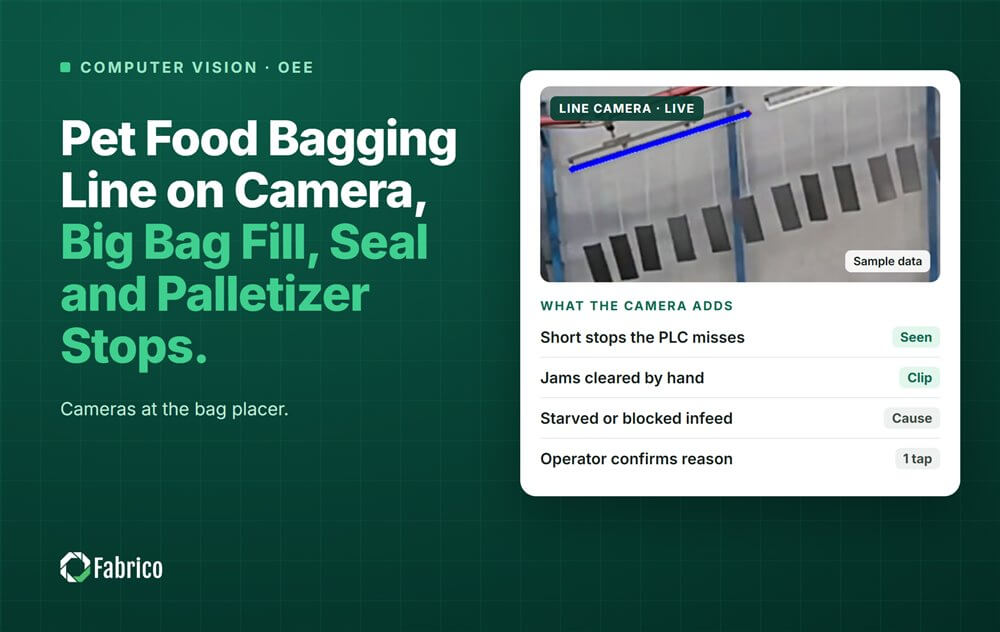
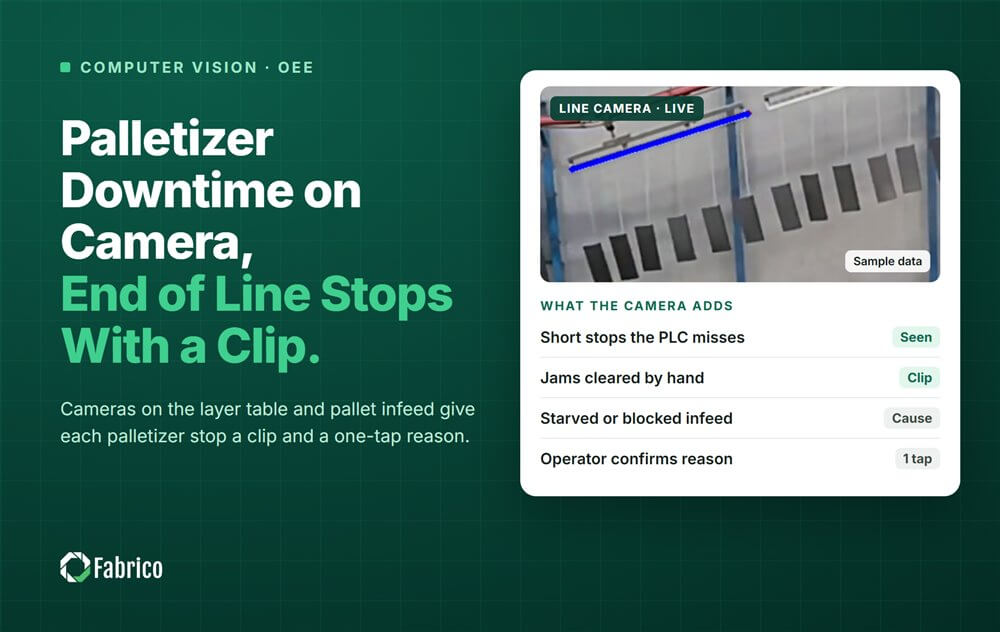
Video helps: To solve recurring micro-stops it helps to see them. Where an AI camera (an add-on) is set up, you can open its video for any moment on the timeline.
In the world of OEE (Overall Equipment Effectiveness), "The Breakdown" gets all the attention.
When a motor blows and the line stops for 4 hours, everyone reacts. Maintenance rushes in, the Plant Manager comes down to the floor, and a Root Cause Analysis (RCA) is filed.
But in reality, breakdowns rarely kill your efficiency. Micro-stops do.
A "Micro-Stop" (or Minor Stop/Idling) is any stoppage typically lasting less than 2 minutes. It is a bottle jamming on the rail, a sensor getting dusted over, or a box getting stuck in the taper. The operator walks over, kicks the machine, hits reset, and walks away.
Illustrative example. Total time down: 45 seconds.
Frequency: 60 times a shift.
Total Lost Time: 45 Minutes per shift.
That is nearly an hour of lost production that usually goes completely unrecorded. Here is how to find, track, and eliminate the "Silent Killer" of manufacturing.
What is a micro-stop?
A Micro-Stop (also known as a Minor Stop, Short Stop, or Idling) is a production interruption of short duration, typically under 2 minutes, that does not require maintenance intervention. Unlike a breakdown, the operator usually resolves it quickly (e.g., clearing a jam). However, because they are frequent and rarely documented, micro-stops are a leading cause of "Performance Loss" in high-speed manufacturing OEE.
Why "Paper Tracking" Fails at Micro-Stops
If you are using paper log sheets, you have zero data on micro-stops.
Imagine asking an operator to stop what they are doing, walk to a clipboard, and write down: "10:42 AM - Jam - 30 seconds"... sixty times a day. They won't do it. They can't do it. It would take more time to log the error than to fix it.
As a result, these stops vanish. An illustration:
-
The Data: Your manual OEE report says "95% Availability."
-
The Reality: Your output is only 70% of the target.
-
The Conclusion: Management assumes the operators are just running "Slow" (Performance Loss), when in reality, they are fighting a thousand tiny battles.
How to Detect Micro-Stops (The Technical Solution)
Since humans can't track them, you need automation.
Level 1: IoT / PLC Counting (The "What")
Connecting a system like Fabrico to the machine’s PLC or an optical sensor allows you to log every state change.
-
The Logic: If the machine speed drops to zero for >5 seconds but <2 minutes, categorize it automatically as "Micro-Stop."
-
The Benefit: You now see the quantity. "Line 4 stopped 142 times today." This is shocking, but it doesn't solve the problem.
Level 2: AI cameras (an add-on) and video on the timeline (The "Why")
Knowing that a line stopped 142 times is a start. Knowing why is what lets you fix it.
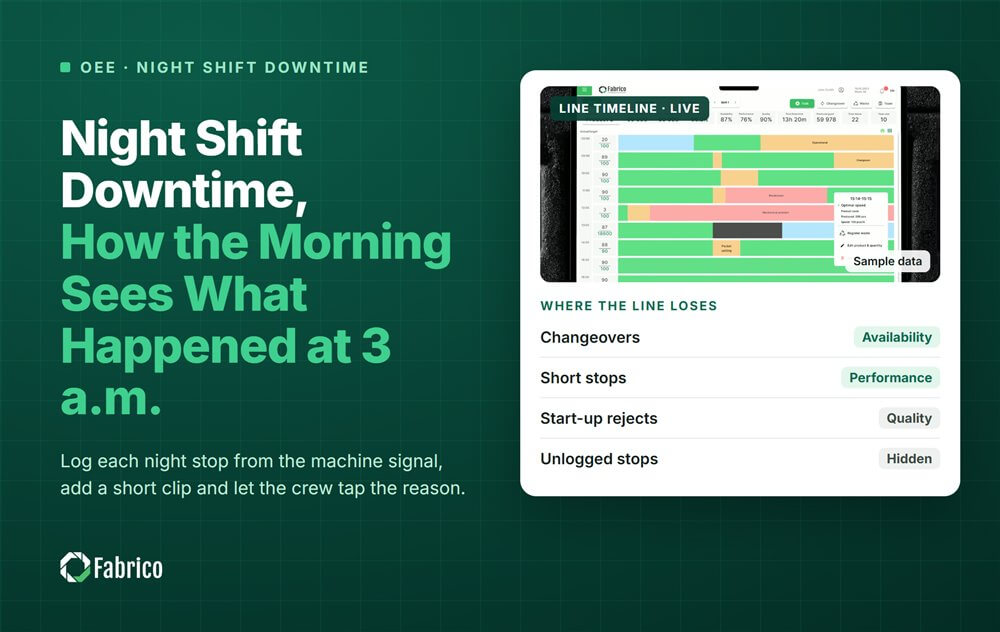
Operators add the stop reason. Where an AI camera (an add-on) is set up, you can open its video for any moment on the timeline; in the standard setup, the video is streamed, not stored in Fabrico.
-
The Event: The machine jams and the PLC or sensor reports the stop.
-
The Reason: The operator adds the stop reason on a tablet or phone.
-
The Diagnosis: The engineer opens the camera video for those moments on the timeline. In this illustrative case, most of the jams show "Guide Rail A" vibrating loose, so the bottle tilts.
-
The Fix: The team opens a work order from the stop: "Install Lock Washers on Guide Rail A."
The "Cycle of Frustration" (Operator Morale)
Micro-stops are the #1 killer of operator morale.
There is nothing more frustrating than standing at a machine that beeps and stops every 3 minutes. It prevents the operator from getting into a "Flow State." They become glorified babysitters.
By eliminating micro-stops, you don't just increase OEE; you decrease turnover. You turn a frantic, annoying shift into a smooth, predictable one.
3 Steps to Eliminate Micro-Stops
Step 1: The "Pareto" Attack
Do not try to fix everything. Use Fabrico to identify the Top 3 Assets with the highest frequency of stops (Count, not Duration).
-
Example: The Labeler stopped 200 times. The Filler stopped 5 times. Ignore the Filler. Focus on the Labeler.
Step 2: Open the video and find the pattern
Open the camera video (an add-on) for 10 of the Labeler's jams on the timeline. Is there a pattern?
-
Is it a specific SKU?
-
Is it a specific raw material batch?
-
Is it a mechanical wear issue?
Step 3: The "Centerline" Fix
Often, micro-stops are caused by improper setup (e.g., rails set too tight). Use a standard setup check, known as centerlining, at each changeover.
-
Action: Require operators to verify rail width with a gauge during changeover and record the value.
Conclusion: Stop Ignoring the Small Stuff
In high-speed manufacturing, there is no such thing as "Small Stuff." A 10-second stop, repeated enough times, will bankrupt you faster than a 10-hour breakdown.
You cannot fix what you cannot see. Stop relying on manual logs and start using Automated Detection to catch the silent killer.
Turn your micro-stops into major gains. Book a demo to see how micro-stops show up in OEE on lines like yours, or contact us.
See Fabrico live. Book a demo.
Book a demoRelated articles







Real Fabrico tiles, sample data.