


 Login
 Blog
PINpoint MES Alternatives: TrakSYS, Assembly MES or Light MES With OEE

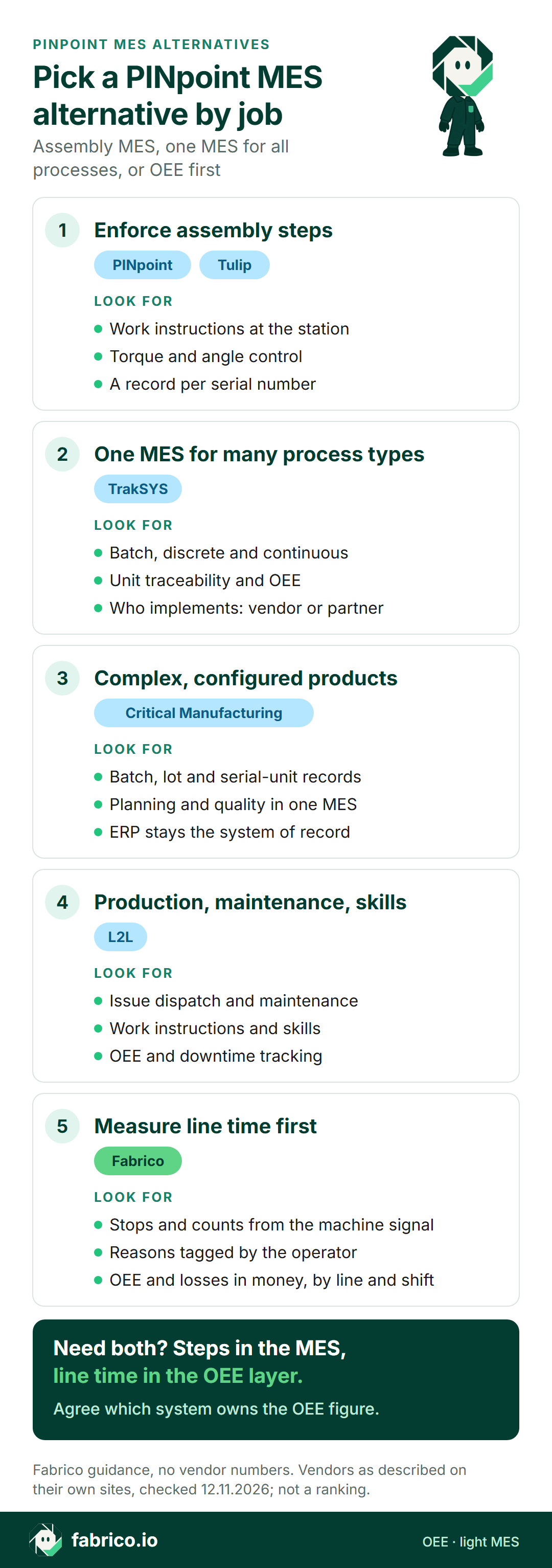
In short: the right PINpoint MES alternative depends on the job you need first. For enforced work steps, error proofing and serial records in discrete assembly, compare PINpoint with other execution systems such as TrakSYS, Critical Manufacturing, Tulip and L2L. If you first need to know why lines stop and what that costs, a light MES with OEE, such as Fabrico, measures it and leaves orders in your ERP.
- PINpoint is a no-code MES for discrete manufacturers, now sold by Advantive.
- Its pages put assembly control first: work instructions, enforced steps, fastening error proofing and quality status by serial number, plus OEE.
- TrakSYS vs PINpoint: TrakSYS describes one MES for batch, discrete and continuous plants; PINpoint describes an MES for discrete manufacturers.
- Vendor facts come from each vendor's own site, as of 12.11.2026, linked in place. No prices, no verdicts, no ranking.
A heavy equipment plant builds machines on twenty assembly stations, with torque tools, paper travelers and an ERP that runs orders well. One manager wants every bolt and serial number on record. Another wants to know why the line built fewer machines than planned last week.
Both are fair asks, and they lead to different tools. Below: what PINpoint is, per its own pages, how it compares with TrakSYS, and five alternatives grouped by job. Fabrico wrote this page and is one of the five. We sell Fabrico, so it is not ranked. For more light options, see our light MES alternatives review.
What PINpoint MES is (as of 12.11.2026, per Advantive's site)
PINpoint is sold by Advantive. The old PINpoint site, pinpointinfo.com, says PINpoint Information Systems is now an Advantive company, and Advantive's PINpoint page lists it as an out-of-the-box MES for discrete manufacturers. What that page says, as of 12.11.2026:
- No-code setup. Drag-and-drop configuration, so engineers change a process without custom code. The AIVA assistant answers natural-language questions from live PINpoint data.
- Between PLC and ERP. Built-in drivers, barcode scanning and API connectivity to ERP, PLC and QMS systems.
- Time data. A 5-Bucket Time Model and web-based dashboards for production goals. Its general industry section names bottlenecks, OEE and rework.
- Assembly control. Digital work instructions, enforced process steps, fastening error proofing that controls torque and angle, guided inspections, and live quality status for each serial number.
- Industries named. Automotive, heavy equipment, medical devices (eDHRs for FDA 21 CFR Part 820 and ISO 13485), MRO and power sports.
- IT. It runs on existing Windows-based equipment and standard server space.
Throughput and revenue results on the page are vendor-reported, so we don't repeat them.
Ask in the demo: how the 5-Bucket Time Model maps to availability, performance and quality, and which stations need smart tools to report.
When PINpoint is the right pick
Put PINpoint on your shortlist if most of these are true:
- Work happens at assembly stations, and each step must be done in order, with checks the operator has to pass.
- Bolted joints matter, and torque and angle should be controlled and recorded.
- Customers or auditors ask for a record per serial number, such as an eDHR for medical devices.
- Engineers want to change the process themselves, without a programmer.
If most are true, an execution MES is built for your plant; see when a light MES is not enough. If your first question is about stops, speed and output, read on.
PINpoint vs TrakSYS for manufacturing execution
Weighing TrakSYS against PINpoint usually means choosing between one MES for many process types and an MES built around discrete assembly. Both name OEE and connect to PLCs and ERP. Rows from each vendor's own pages, as of 12.11.2026:
| Question | PINpoint (Advantive) | TrakSYS (Parsec) |
|---|---|---|
| Built for, per its site | Discrete manufacturers | Batch, discrete and continuous |
| Setup | No-code, drag and drop | Templates, low-code and no-code tools |
| At the station | Work instructions, torque and angle | Workflow enforcement, digital signoffs |
| Unit records | Quality status per serial number | RFID-based unit traceability |
| Machine data | PLC data, drivers, barcodes | IIoT smart devices, PLCs |
| AI over live data | AIVA assistant | TrakSYS IQ |
Our TrakSYS review covers TrakSYS itself in more depth.
Assembly execution and line performance are different jobs
An execution MES watches the work: which step, part, tool reading and operator. A light MES watches the time: when the line ran, when it stopped, why, and what that cost. Our OEE vs MES guide covers the split.
Comparison table: PINpoint and five alternatives
This is what each vendor's own site says, in our words, as of 12.11.2026, linked in each section below. It is not a ranking, and a gap means only that we did not find it on the pages we read, so ask each vendor directly. Fabrico comes first because we wrote this page.
| Tool | Built around, per its site | Industries it names | Ask in the demo |
|---|---|---|---|
| PINpoint (for reference) | Assembly steps, error proofing, time model | Automotive, heavy equipment, medical, MRO | Which stations need smart tools? |
| 1. Fabrico | Machine signal and operator stop reasons | FMCG, electronics, automotive, more | How is a station with no PLC read? |
| 2. TrakSYS | One MES for batch, discrete, continuous | Food, life sciences, CPG, automotive, more | Parsec, partner or own team rollout? |
| 3. Critical Manufacturing | MES for complex discrete products | Semiconductor, electronics, medical, equipment | Which modules come first? |
| 4. Tulip | Composable apps for frontline work | Pharma, aerospace, medical devices, more | Who builds and maintains the apps? |
| 5. L2L | Production, maintenance and skills | Automotive, industrial materials, packaging | How is OEE calculated? |
Want to see the OEE side on a line like yours? Book a demo and bring one week's downtime log.
Fabrico: light MES and OEE, with orders left in the ERP
Fabrico wrote this page. It is a cloud-based OEE and light MES platform. Where PINpoint starts from the assembly step, Fabrico starts from line time: when the line stopped, for how long, why, and what it cost. Per our MES and OEE overview:
- Machine data, three ways. From the PLC, from a Fabrico IoT device with external sensors on older machines, or from AI cameras, an add-on, where there is no machine signal. Protocols include OPC UA, Modbus, PROFINET, MQTT and EtherNet/IP (machine connectivity).
- Stops with reasons. Connected machines report their own stops, including short stops too brief to log by hand. Operators add the reason on a tablet or phone.
- OEE and losses in money. Real-time OEE per line and shift, with revenue at risk and profit impact per loss, on the web, iOS and Android.
- The camera add-on counts output at manual stations, and its video opens for any moment on the shift timeline. In the standard setup, video from the camera add-on is streamed on request, not stored in Fabrico (how the camera add-on works).
- Maintenance built in. When a stop needs a repair, a technician opens a work order from the stop in one step, on the same machine record.
- Data out. REST API and webhooks, Excel or CSV export. A connection to SAP or another ERP can be scoped per customer.
- Rollout. Devices connected in about a month; full rollout in 3 to 4 months.
- Stays in your ERP: job dispatching, BOMs, routings and genealogy. Roadmap, not live: production planning and scheduling, and a camera add-on that detects stops and offers a likely reason.
Ask in the demo: how a station with no PLC reports its stops, and which data flows to and from the ERP.
Fits plants that want downtime ranked by cause and priced by line and shift, on lines that mix PLC machines, older machines and manual stations. EU customers are hosted on AWS in Frankfurt. Quoted per plant. Start with a one-line pilot. See our OEE software guide.
TrakSYS: one MES for batch, discrete and continuous plants
TrakSYS is the MES from Parsec Automation, according to Parsec's site, which lists support for batch, discrete and continuous manufacturing. What its pages say, as of 12.11.2026:
- For discrete plants, it tracks individual units from component to final assembly, enforces quality checks and digital signoffs, and lists RFID-based unit traceability (discrete page).
- Its performance page covers real-time OEE, downtime and changeover management.
- IIoT smart devices gather sensor data over an RF mesh network for a TrakSYS server, on premises or in the cloud (smart devices).
- Setup uses preconfigured templates and no-code tools (TrakSYS overview), and TrakSYS IQ answers questions from live operational data.
- Delivery can be led by Parsec, a system integrator, the customer's internal team, or a mix.
Compared with PINpoint: both enforce workflows and track units. TrakSYS's pages span batch, discrete and continuous processes; PINpoint's center on discrete assembly, with fastening control.
Fits plants that run several process types across sites and want one MES standard, with a choice of who implements it.
Critical Manufacturing: MES for complex discrete products
Critical Manufacturing describes an MES-powered industrial operations platform for discrete products, focused on semiconductor, electronics, medical devices and industrial equipment (criticalmanufacturing.com). Its headquarters and main technical center are in Porto (Maia), Portugal, and it has been a subsidiary of ASMPT since 2018 (who we are). As of 12.11.2026:
- Its industrial equipment page describes one system across process engineering, equipment engineering, quality, planning and logistics.
- Its material and resource models handle batch, lot and serialized-unit configurations, and equipment is blocked from use when maintenance or calibration is overdue.
- The same page says the ERP stays the system of record for the business, and the MES becomes the record of what happens on the floor.
Compared with PINpoint: both name medical devices and heavy or industrial equipment. Critical Manufacturing's pages also cover semiconductor and electronics plants. Ask both how a new product variant reaches the stations.
Fits plants that build complex, highly configured products and want engineering, quality, planning and execution in one MES.
Tulip: composable apps for frontline work
Tulip calls itself a composable platform that connects equipment, enterprise systems and frontline workers (OEE tracking page), and its homepage names pharmaceutical, aerospace and defense, industrial and medical device plants. As of 12.11.2026, its pages say:
- Engineers build guided instructions in Tulip's App Editor without writing code, and connect torque tools, scanners and calipers so readings land in the record (work instructions).
- OEE combines machine and PLC data over native OPC UA or MQTT with the reason codes operators enter, by line and shift.
- Barcode scans capture material, component and operator data at each step, with electronic signatures built for 21 CFR Part 11 and Annex 11 (genealogy).
Compared with PINpoint: both put guided steps and tool readings at the station. PINpoint describes an out-of-the-box MES; Tulip describes apps that your engineers compose. See our Tulip alternatives.
Fits plants that want their engineers to build and change station apps, one use case at a time.
L2L: connected operations, born in an auto plant
L2L calls itself a connected manufacturing operations platform, and its about page says it began as a dispatch tool in a single Utah auto plant. Its MES page says, as of 12.11.2026:
- It tracks status by site, operational availability, scrap, run rate, downtime, OEE and yield.
- It covers step-by-step visual work instructions, changeover management, maintenance and production scheduling in one system.
- It integrates with ERP, QMS, PLM, SCM or CMMS systems, and the homepage lists browser, Windows, Mac, Android and iOS.
Compared with PINpoint: both name automotive plants, work instructions and OEE. L2L's pages put maintenance, skills and issue dispatch next to production; PINpoint's put fastening control and serial-level quality first.
Fits plants that want production issues, maintenance and operator skills in one system.
Which PINpoint alternative fits your plant
- Enforced assembly steps, torque control and records per serial number, out of the box: PINpoint.
- One MES standard across batch, discrete and continuous sites: TrakSYS.
- Complex, highly configured products with planning, quality and execution in one MES: Critical Manufacturing.
- Station apps that your engineers build and change themselves: Tulip.
- Production, maintenance and skills in one connected system: L2L.
- Downtime by cause and OEE by line and shift first, with orders left in the ERP: Fabrico.
An execution MES and an OEE layer can run side by side if one system owns the OEE figure. See MES for automotive suppliers and light MES vs full MES. For food or consumer goods packaging lines, start from computer vision for FMCG manufacturing.
Worked example: one assembly line, two kinds of record
Sample data for one 8 hour shift on a final assembly line, not a customer's line or a product screen. Planned production time is 450 minutes after a 30 minute break. The slowest station sets the pace, with an ideal cycle of 2.4 minutes a unit.
Stops took 54 minutes, so run time was 396 minutes and availability 88.0%. In 396 minutes the ideal is 165 units. The line built 150, so performance is 90.9%.
Three units failed the end-of-line test and went to rework, leaving 147 good: quality is 98.0%. OEE is 88.0% x 90.9% x 98.0% = 78.4%, the same as 147 good units x 2.4 minutes over 450 minutes.
The execution MES holds 150 serial records, each with torque readings, step sign-offs and a test result: which unit, which bolt, which operator. The light MES holds the 54 minutes by cause, plus 36 minutes of slow running: where the time went. See OEE calculation for the formula and micro-stops for the short stops a paper log misses.
Questions to ask any vendor on this list
Put the same questions to every vendor, us included, for one representative line.
- Which job is it for? Enforcing the steps, measuring line time, or both.
- How does each station report? PLC, smart tool, sensor, barcode or operator entry, including stations with no signal.
- How is OEE calculated? Which station sets the ideal cycle, how changeovers count, and where stop reasons come from.
- Who changes the process? An engineer, the vendor, or an integrator.
- Which records stay in the ERP, and which data flows back.
- What drives the quote? Stations, lines, sites, devices, integration and training. Give every vendor the same list.
What people ask next
Who sells PINpoint MES today?
Advantive. PINpoint's own site says PINpoint Information Systems is now an Advantive company, and Advantive's product page lists PINpoint as an out-of-the-box MES for discrete manufacturers.
How does TrakSYS compare with PINpoint MES for manufacturing execution?
Per their own sites, TrakSYS is one MES for batch, discrete and continuous plants, with RFID-based unit traceability and OEE. PINpoint is a no-code MES for discrete manufacturers, with work instructions, fastening error proofing and quality status per serial number. Ask both to run the same assembly scenario.
Does PINpoint MES track OEE?
Its page names OEE among its continuous improvement tools and describes a 5-Bucket Time Model for production time. Ask Advantive how those buckets map to availability, performance and quality, and how stop reasons are captured.
How is Fabrico different from PINpoint?
PINpoint controls the work at each assembly station, per its site. Fabrico measures the line: stops and counts from the machine signal, reasons from the operator, and OEE and losses in money by line and shift, with orders, routings and genealogy left in the ERP.
Can a light MES run next to PINpoint or another execution MES?
Yes, if each record has one owner. The execution MES keeps steps, serial records and tool readings; the OEE layer keeps stops, reasons and line time. Agree which system publishes the OEE figure before you connect them.
What does PINpoint cost?
Advantive's PINpoint page offers a call with a product expert and a live demo. For any vendor here, the quote depends on stations, lines, sites, devices, integration and training, so give each one the same list.
Want to see the OEE side of a line like yours? Book a demo or contact us.
Related articles









Real Fabrico tiles, sample data.