

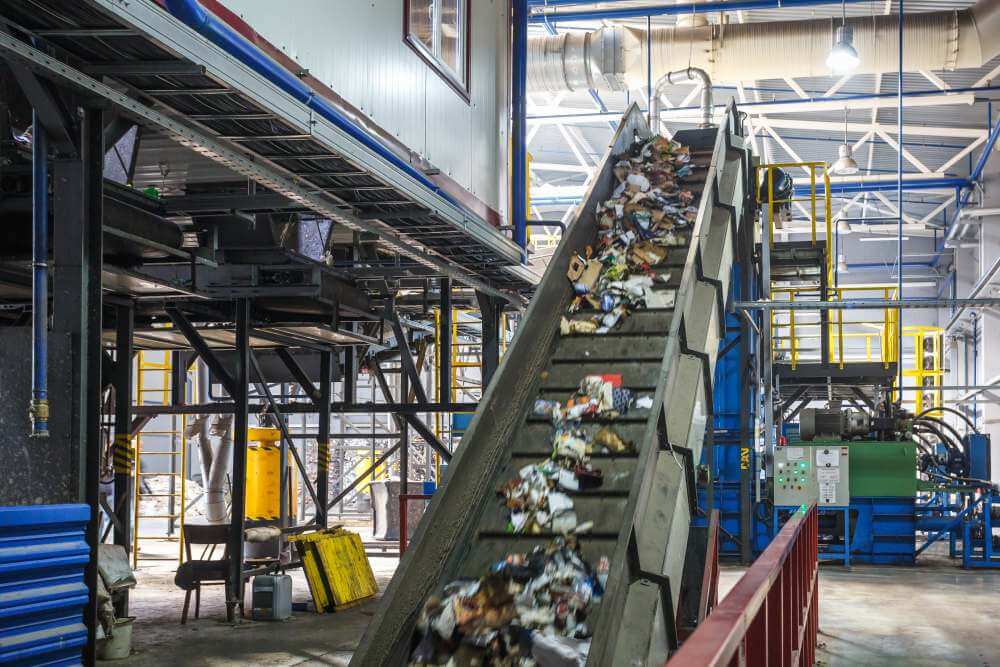

The "Abuse" Factor: Recycling equipment (Shredders, Balers, Sorters) destroys itself. Maintenance software must track Wear Parts and Amperage Spikes to predict failures.
The "Flow" Problem: A jam in the primary shredder stops the whole plant. You need OEE to track these micro-stops and optimize throughput.
The Top 7: We review Fabrico, AMCS, Maximo, and others to help you manage maintenance in a dirty, high-impact environment.
Curious what honest, real-time OEE looks like on your floor?
Watch a 15-min demoMaintenance in a Recycling or Waste Management facility is a constant battle against friction, debris, and jams.
Your assets, Optical Sorters, Magnetic Separators, Balers, and Conveyors, are subjected to extreme abuse.
Bearings get wrapped in wire.
Motors burn out from jamming.
Belts get sliced by sharp metal.
If you try to manage this with a generic "Facility" tool, you will fail.
You need software that understands Condition Monitoring (Motor Load) and Wear Part Lifecycle.
Here are the 7 Best CMMS Software Tools for Recycling & Waste Management in 2026.
Best For: Recycling plants that want to link Machine Jams to Maintenance Response.
Fabrico is the best choice for Materials Recovery Facilities (MRFs) because it integrates OEE with Maintenance.
It helps you see why the line stopped (Jam, Failure, or Blockage) and deploy the fix immediately.
Jam Detection (OEE): Fabrico connects to the PLC/SCADA. If the shredder amps spike and the belt stops, Fabrico records the "Jam" automatically. You get a true picture of Availability losses.
Wear Part Tracking: You can set triggers based on usage. "Replace Shredder Teeth every 500 hours." Fabrico tracks the runtime and alerts you before efficiency drops.
Mobile Agility: The environment is dirty. Fabrico’s mobile app is big, bold, and easy to use with gloved hands. Technicians can snap a photo of a wrapped bearing and log the repair in seconds.
Safety (LOTO): Clearing a jam is dangerous. Fabrico forces a Digital Lockout/Tagout checklist before the technician can close the work order, ensuring OSHA compliance.
The Verdict: If you want to maximize tons-per-hour by minimizing downtime, Fabrico is the operational standard.
Best For: Full Waste Management ERP.
AMCS is the giant of the waste industry. It handles everything from truck routing to billing.
Pros: Total business integration. It connects the "Collection" (Trucks) with the "Processing" (Plant). Excellent for weighing scale integration.
Considerations: The maintenance module is often an add-on to a financial system. It can be clunky for the technician on the shop floor compared to a dedicated maintenance app.
The Niche: Integrated Waste Companies.
Best For: Municipal Waste and Energy-from-Waste.
If you run a massive Energy-from-Waste (EfW) incinerator or a city-owned facility, Maximo is the standard.
Pros: Unmatched for regulatory compliance and safety management (HSE). It handles linear assets (sewer lines) and plant assets equally well.
Considerations: Expensive and slow to implement. It is overkill for a standard private recycling center.
The Niche: Municipalities & Power Generation.
Best For: Automated sorting lines.
Modern MRFs use high-tech optical sorters and robotics. Fiix connects well to these automation systems.
Pros: Strong integration with Rockwell hardware. Good AI analytics for predicting motor failure based on historical data.
Considerations: It moves up-market into enterprise pricing. Requires a good data connection, which can be spotty in metal-heavy recycling centers.
The Niche: Automated MRFs.
Best For: Fleet Maintenance (Trucks).
If your primary maintenance headache is the fleet of garbage trucks, not the plant, Routeware is the specialist.
Pros: Specialized for DOT compliance, tire tracking, and fuel usage.
Considerations: It is a Fleet tool, not a Plant tool. It struggles to manage complex stationary assets like optical sorters or eddy currents.
The Niche: Fleet Managers.
Best For: Vibration analysis on shredders.
Shredders and crushers are high-vibration assets. eMaint connects to Fluke sensors to monitor bearing health.
Pros: Early warning of catastrophic failure. If a bearing starts to wobble, eMaint flags it before the shaft shears.
Considerations: The user interface is dated. It is less focused on the modern "Production Flow" visualization of Fabrico.
The Niche: Condition Monitoring.
Best For: Quick communication and safety walks.
MaintainX is great for the "Safety Walk."
Pros: Easy to use for "Hazard Reporting." If an operator sees a pile of oily rags or a blocked exit, they can chat the safety manager instantly.
Considerations: Less focused on the heavy asset engineering data. It’s better for coordination than for predicting gearbox life.
The Niche: Safety & Communication.
| Feature | Fabrico | AMCS | Maximo | Routeware | Fiix | eMaint |
| Plant Focus | ✅ High | ✅ High | ✅ High | Varies Fleet | ✅ High | ✅ High |
| OEE/Throughput | ✅ Native | Varies ERP | Varies | Varies | Varies Add-on | Varies |
| Wear Part Logic | ✅ Native | Varies Basic | ✅ Deep | Varies | ✅ Good | ✅ Good |
| Mobile UX | Modern | Complex | Complex | Dated | Good | Dated |
| Implementation | Weeks | Months | Years | Months | Months | Months |
In recycling, a stop is a pile-up.
Choose Routeware if you are fixing trucks.
Choose AMCS if you need to bill customers for waste pickup.
Choose Fabrico if you manage the Processing Plant. If you need to keep the shredders shredding and the sorters sorting using real-time data and predictive wear tracking, Fabrico is the robust solution.
Handle the abuse.
[Book a Demo with Fabrico] to see how we help recycling plants survive the daily grind.
See OEE & CMMS live in 15 minutes.
Book a demo

















 Login
Login
 Blog
Blog