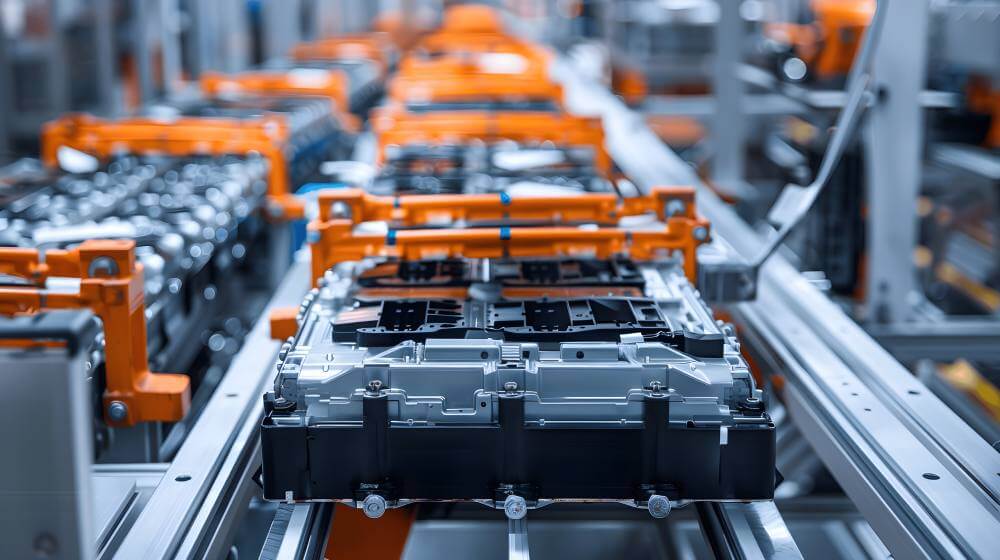

Lithium-ion battery manufacturing is one of the most demanding and fastest-growing manufacturing sectors in the world.
Cell manufacturing involves a series of highly sensitive process steps, electrode coating, calendering, slitting, winding or stacking, electrolyte filling, formation cycling, and aging, where process parameter control determines both the electrochemical performance and the safety characteristics of the finished cell.
At gigafactory production volumes (GWh per year), even small OEE improvements translate to billions of cells and billions of dollars of production value.Electrode coating is the first and most critical production step in battery cell manufacturing.
The coating process, applying electrode slurry (active material, binder, conductive additive in solvent) to copper or aluminium foil at high speed in a controlled drying environment, determines the energy density, capacity consistency, and cycle life of the finished cell.
Coating line OEE monitoring tracks coating web speed (Performance), planned versus unplanned coater downtime (Availability), and coating quality outcomes including thickness uniformity, loading accuracy, and defect rates from optical inspection (Quality).
Coating line OEE is frequently the primary constraint on cell manufacturing capacity, making it the highest-priority OEE monitoring and improvement target.Formation and aging are the most time-consuming production steps, cells must be charged and discharged through defined cycles to activate the electrode chemistry and characterize individual cell performance, typically taking 5-15 days of calendar time.
Formation chamber utilization, the proportion of available formation capacity running productive formation cycles, determines the production throughput pipeline beyond the electrode and assembly steps.
OEE monitoring of formation operations captures chamber availability, cycle protocol adherence, and cell failure rates during formation that indicate electrode or assembly quality issues upstream.
Whichever OEE platform you shortlist, the decisive question is data quality. Sensors and manual logs miss the short stops, micro-stops, and idle time that quietly erode availability.
Fabrico is computer-vision-verified OEE plus closed-loop maintenance execution : cameras catch the losses other systems miss, and maintenance work orders close the loop from detection to fix.
See our guide to OEE for manufacturing and how to calculate OEE , or book a Fabrico demo to see it on your line.
Cell manufacturing yield, the proportion of cells meeting performance specification, is the most important quality metric in battery manufacturing and the one most directly linked to production economics.
Yield losses occur at multiple stages: electrode defects (pinholes, coating streaks, edge damage) during slitting; assembly defects (cell winding/stacking failures, tab welding defects, electrolyte fill inaccuracies) during cell assembly; formation failures (cells not meeting capacity or impedance specification after formation cycles); and aging failures (cells showing excessive self-discharge or voltage degradation during aging).
OEE Quality tracking across all these yield loss points, attributing each defect type to the specific production stage and equipment where it originated, enables targeted yield improvement that addresses root causes rather than downstream symptoms.Electrolyte filling accuracy is a critical process control parameter with both safety and performance implications.
Insufficient electrolyte produces cells with reduced capacity and poor cycle life; excess electrolyte risks electrolyte leakage and potential safety issues.
OEE Performance monitoring for filling stations tracks filling accuracy and filling cycle time consistency, capturing the deviation events that indicate filling equipment wear or calibration drift before systematic filling accuracy problems affect cell quality across a production campaign.Module and pack assembly OEE is the final production stage where cells become battery modules and packs for automotive or stationary energy storage applications.
Cell sorting accuracy (ensuring that cells within a module are matched within defined capacity and impedance tolerances), busbar welding quality (laser weld or ultrasonic weld integrity), and thermal management assembly all contribute to module and pack quality.
OEE monitoring of pack assembly tracks throughput rate against takt time, end-of-line electrical test pass rates, and welding quality outcomes, providing the assembly efficiency and quality picture that battery pack manufacturers need to meet automotive customer quality and delivery requirements.
Battery manufacturers operating at scale require OEE software with industrial data infrastructure capable of handling high-frequency, high-volume production data from dozens of interconnected process steps.
Electrode coating lines, calendering equipment, and formation chamber systems generate continuous process data at sampling rates of seconds, requiring OEE platforms with edge computing architecture or high-throughput data pipeline capability that maintains data integrity without performance degradation as production volumes scale.Process historian integration is particularly important for battery OEE software.
Coating lines and formation systems are typically connected to process historians (OSIsoft PI or similar) that store the detailed process parameter data required for cell quality analysis.
OEE platforms that integrate with these historians to correlate production efficiency data (OEE rates, downtime events) with process parameter data (coating thickness profiles, formation temperature histories, electrolyte fill weights) enable the advanced process analytics that battery manufacturers need to drive yield improvement from gigawatt-hour scale production
data.Battery manufacturers supplying automotive customers operate under IATF 16949 quality management requirements and customer-specific production approval processes (PPAP) that require documented production process control evidence.
OEE software that maintains timestamped, traceable production records for every production lot, linking formation and aging results to the specific coating batch and assembly process conditions, provides the manufacturing traceability record that automotive battery supply agreements increasingly require.
As battery gigafactories scale, the manufacturers who have the best production data infrastructure will be able to demonstrate manufacturing excellence to automotive OEM customers in ways that competitors without structured OEE monitoring cannot match.


















 Login
Login
 Blog
Blog