
Power tools manufacturing, cordless drills, angle grinders, circular saws, impact drivers, and hand tools, is high-volume discrete manufacturing where production lines may produce hundreds or thousands of units per shift.
OEE monitoring in this environment focuses on assembly line throughput, motor winding and press-fit operations, and end-of-line functional test pass rates.
The combination of automated sub-assembly production with manual assembly operations creates the mixed production environment where OEE software must handle both data collection approaches within the same system.Motor and gearbox sub-assembly production is typically the highest-capital, most automated element of power tool manufacturing.
Motor winding machines, commutator turning, armature balancing, and press-fit operations each have defined cycle times and quality requirements.
OEE monitoring of these automated sub-assembly operations captures the downtime, changeover, and quality failure patterns that most affect sub-assembly supply to final assembly lines, identifying whether the sub-assembly area or the final assembly line is the primary production bottleneck on any given production day.Product mix management in power tools manufacturing creates frequent model changes on final assembly lines.
Switching between different tool models (different motor specifications, different gearbox configurations, different housing designs) requires fixture changes, program updates, and tooling adjustments on assembly line stations.
OEE changeover analysis that quantifies model change time per transition type enables production schedulers to optimize model sequencing, grouping similar models together to minimize total changeover time while maintaining production output mix requirements from the sales plan.
Whichever OEE platform you shortlist, the decisive question is data quality. Sensors and manual logs miss the short stops, micro-stops, and idle time that quietly erode availability.
Fabrico is computer-vision-verified OEE plus closed-loop maintenance execution : cameras catch the losses other systems miss, and maintenance work orders close the loop from detection to fix.
See our guide to OEE for manufacturing and how to calculate OEE , or book a Fabrico demo to see it on your line.
End-of-line functional testing is a critical quality gate for power tools, covering no-load speed, load performance, vibration levels, and electrical safety (insulation resistance, ground bond, dielectric withstand).
Test pass rate, the proportion of tools passing all functional tests on the first attempt, is a key OEE Quality metric that indicates the quality of the upstream assembly process.
Tools failing end-of-line test require diagnosis and rework, adding cost and production time; systematic test failures on specific tool models or assembly stations indicate process control issues that should trigger investigation and corrective action.Torque and press-fit assembly quality monitoring is relevant for power tool manufacturers using automated assembly stations for safety-critical joints.
Torque tool control systems and press-fit monitoring systems generate quality data per assembly operation that can be captured by OEE software with appropriate sensor integration.
Connecting assembly quality data to OEE performance records for the same assembly station, tracking whether high-speed production periods correlate with increased assembly quality failures, provides evidence for the operator speed-quality trade-off analysis that informs takt time and quality target setting.Battery pack assembly quality for cordless power
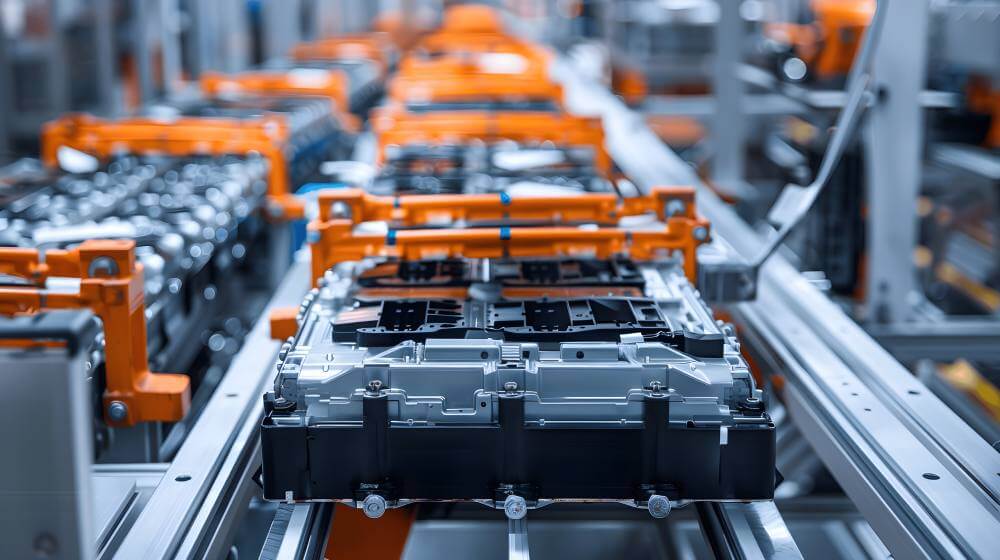
tools is a safety-critical process where OEE Quality monitoring extends beyond functional performance to cell matching accuracy (ensuring cell capacity and internal resistance are within matched tolerances) and weld quality for tab connections.
OEE platforms that capture battery pack assembly quality metrics alongside assembly line efficiency data provide the integrated production quality view that cordless tool manufacturers need to manage the increasing safety, performance, and regulatory compliance requirements of lithium battery powered products.
Power tools manufacturers require OEE software with strong final assembly line monitoring capability, tracking takt time adherence, station cycle times, and quality gate outcomes at the line level while maintaining the ability to drill down to individual station performance for line balancing analysis.
Real-time production dashboards that show current shift OEE versus target, remaining production forecast for the shift, and live downtime event status are the operational tools that shift supervisors use to manage assembly line performance and make real-time decisions about overtime or station rebalancing.Integration with end-of-line test equipment is a high-value capability for power tools OEE software.
Most power tool test systems (Kistler, ZF, GTM, or custom functional test systems) have data outputs that can be connected to OEE software via serial, Ethernet, or OPC-UA interfaces.
When test results are automatically captured alongside production counts, rather than manually transcribed from test station displays, the Quality component of OEE is calculated automatically and accurately, and test failure records are available for trend analysis without additional data management effort.For global power tools manufacturers with production facilities in multiple countries
OEE software with multi-site aggregation and cross-site comparison capability provides the global operations visibility needed to benchmark facilities and identify best practices for replication.
Production facilities in different regions often develop different operational practices, different changeover approaches, different maintenance routines, different quality standards for rework decisions, and cross-site OEE comparison makes these differences visible, enabling operations directors to identify which approaches produce the best outcomes and drive consistency across the global manufacturing network.


















 Login
Login
 Blog
Blog