


 Login
 Blog
Dozuki vs Poka: Which Fits a CI Lead Rolling Out Standard Work

In short: Choose Dozuki if your first gap is controlled documents with training tied to each revision: its pages have workers acknowledge an update before opening the revised instruction and re-enrol when a standard changes. Choose Poka if the gap is plant-wide communication: shift handovers posted to a translated Factory Feed and work routed to qualified operators. Choose neither first if you need machine stop minutes: the Dozuki and Poka analytics pages describe procedure, training, form and issue data.
- Price, both vendors: no public price; quote on request (checked 14.11.2026).
- User voice: public app-store evidence is thin for both, so a pilot carries more weight than ratings.
- Worked example: one seam spec change on a can seamer, traced through both tools, then priced at EUR 2,656.80 for the sample shift.
Dozuki vs Poka is a fair shortlist for a CI or operations lead: both put approved know-how on a tablet at the line. The split shows the day a standard changes. One tool is built outward from the document: who approved it, who read it, who is retrained. The other is built outward from the plant's daily conversation: the handover, the issue, the huddle, the person qualified for the job.
Key takeaways
- Start with Dozuki if audits find old versions in use: its pages tie a revision to acknowledgement, re-enrolment and a checkpoint in the task.
- Start with Poka if information dies at handover: its pages describe a translated feed, issue routing, tiered huddle boards and skills-based task routing.
- Neither pricing page shows a figure; ask both for a quote on one brief.
- In the sample shift, the handover loss is 27 minutes and the revision loss is 24 minutes plus 11,160 cans; together 29,520 good cans, or EUR 2,656.80.
On names: Poka here is the software company at poka.io, not the lean technique poka-yoke.
Dozuki vs Poka at a glance
Every cell comes from a vendor page or store listing opened on 14.11.2026 and linked later on this page.
| Job | Dozuki | Poka |
|---|---|---|
| Changing a standard | Multi-step review, sign-off, revision history with rollback | Central, version-controlled instructions that update across sites |
| Telling the floor | Teams notified; workers acknowledge before opening the revision | Factory Feed posts and notifications, translated |
| Retraining | Automatic enrolment when a standard changes or expires | Expiry dates, scheduled retraining, live skills matrix |
| Shift handover | Knowledge between shifts kept in one system | Structured handover posts, time-stamped and searchable |
| Problems on shift | Issue reporting inside the task; feedback routed for review | Issues tagged to equipment, routed to owners, raised on tiered huddle boards |
| Who gets the job | Skills matrix for supervisors; trainer verification | Tasks routed to qualified operators |
| Public price | No public price; quote on request (checked 14.11.2026) | No public price; quote on request (checked 14.11.2026) |
| App Store (US) | "Dozuki", 5.0 from 1 rating | "IFS Connected Worker" by Poka Inc., no rating overview yet |
Price, apps and reviews: what is public
Price. Dozuki: no public price; quote on request (checked 14.11.2026). Its pricing page shows no figure, plan name or free tier, and one button labelled "GET DOZUKI PRICING". Poka: no public price; quote on request (checked 14.11.2026). Its pricing page is headed "Poka Pricing", carries the browser title "Request Pricing" and shows no figure or plan. Give both vendors one identical brief (sites, named users, languages, systems to connect) and compare the quotes line by line.
Apps. Apple's US App Store lists the Dozuki app at 5.0 from 1 rating, with version 5.6.0 adding "Recent Workspaces" and video upload improvements (accessed 14.11.2026). Poka's platform page says "Poka is available as an iOS, Android, and web application"; the App Store listing from seller Poka Inc. carries the title IFS Connected Worker, and Apple shows no rating overview for it yet (accessed 14.11.2026).
User voice. One rating is not a sample. The handful of written reviews on the Dozuki listing point both ways: a 2025 reviewer praises a feature that automates document review and update, while a 2023 reviewer writes "Love the idea but the implementation is really bad." The larger review sites refused automated reading that day, so none is cited; ask each vendor for two reference plants and call them.
Dozuki vs Poka, job by job
Controlling the document. This is Dozuki's home ground. Its knowledge management page says "Enforce publishing standards with configurable workflows for multi-step reviews and stakeholder sign-off." and "Track every change with full revision history and rollback options to maintain compliance and accuracy." Poka's work instruction page has experts film the job on a phone while AI drafts the steps, and describes centralised, version-controlled instructions.
Telling people the standard changed. Dozuki's worker collaboration page says "Ensure workers see and acknowledge important process updates before accessing revised instructions." and its AI page names ChangeAware AI, which turns a procedure update into a clear message. Poka's communication page describes a social-style Factory Feed for "updates, announcements, and operational changes", real-time notifications and built-in translation across 70+ languages.
Retraining after the change. Dozuki's learning pathways page says "Workers are automatically enrolled when standards change or expire." and that a trainer's verification closes the path to qualification. Poka's skills management page has administrators set expiry dates and schedule retraining, and its learning page adds training modules with auto-scored assessments.
Handing over the shift. Poka writes most about this. Its communication page says outgoing shifts post structured updates into the Factory Feed, and "With handovers that are timestamped and searchable, critical information no longer disappears between shifts." Dozuki's collaboration page puts the same job this way: "Create clarity between shifts by capturing tribal knowledge in a centralized system."
Raising a problem. Poka's issues page has operators report from the point of work, with the issue tagged to equipment, line or process, and corrective actions tracked on one board. Its daily management page says "Poka pulls live SQDCP data, open issues, and form completions onto the huddle board before the meeting starts" and describes Tier 1, 2 and 3 reviews. Dozuki's operational workflows page puts issue reporting inside the task, alerting supervisors and tracking resolution.
Deciding who may do the job. Poka's skills page links skills data to task assignment, so work is routed to qualified operators. Dozuki's learning page says "A skills matrix brings qualifications and outstanding learning into a view supervisors can act on." One describes the system routing the task; the other, a supervisor reading the matrix.
Common ground. Both describe forms or checkpoints with required steps, QR access at the machine, AI drafting from video and old documents, many languages, and open APIs (Dozuki integrations, Poka integrations). Those rows are left out of the matrix because they do not separate the two.
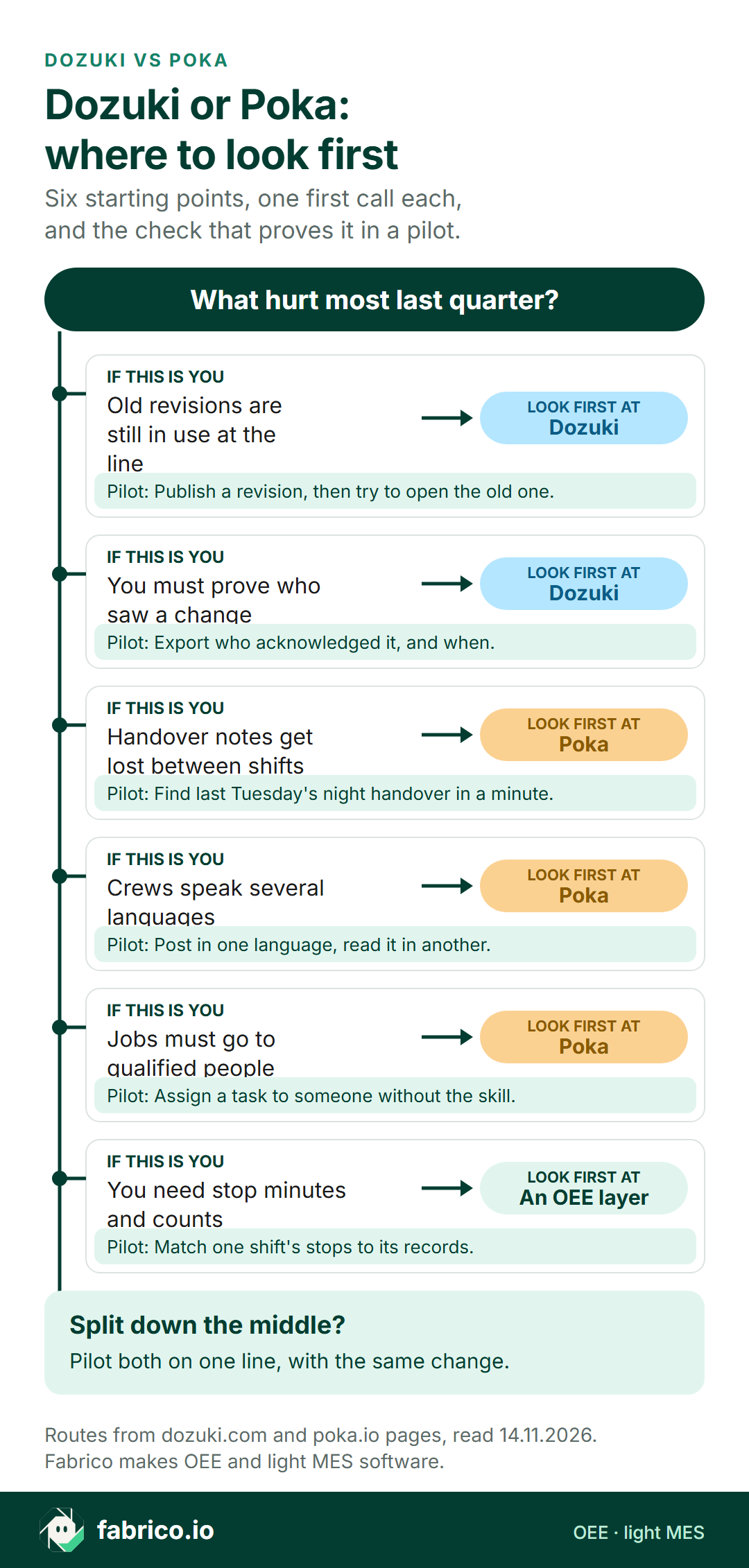
Text version of this infographic
- Start: What hurt most last quarter?
- If this is you: Old revisions are still in use at the line. Look first at: Dozuki. Pilot: Publish a revision, then try to open the old one.
- If this is you: You must prove who saw a change. Look first at: Dozuki. Pilot: Export who acknowledged it, and when.
- If this is you: Handover notes get lost between shifts. Look first at: Poka. Pilot: Find last Tuesday's night handover in a minute.
- If this is you: Crews speak several languages. Look first at: Poka. Pilot: Post in one language, read it in another.
- If this is you: Jobs must go to qualified people. Look first at: Poka. Pilot: Assign a task to someone without the skill.
- If this is you: You need stop minutes and counts. Look first at: An OEE layer. Pilot: Match one shift's stops to its records.
- Split down the middle? Pilot both on one line, with the same change.
Decision matrix: Dozuki or Poka for your plant
Seven rows where the vendors' own pages differ.
| If this is you | Look first at | Why (vendor page) | Prove it in the pilot by |
|---|---|---|---|
| Audits find old revisions in use at the line | Dozuki | Review workflows, revision history, rollback | Publishing a revision and trying to open the old one |
| You must prove each operator saw a change | Dozuki | Acknowledge before accessing the revision | Exporting who acknowledged, and when |
| A changed standard should trigger retraining by itself | Dozuki | Automatic enrolment when standards change | Changing one guide and counting new enrolments |
| Information is lost between shifts | Poka | Structured, searchable handover posts | Finding last Tuesday's night handover in a minute |
| Crews speak several languages | Poka | Handover posts translated automatically | Posting in one language, reading in another |
| Open issues should drive the morning meeting | Poka | Issues and SQDCP data on tiered huddle boards | Running one real Tier 1 meeting from the board |
| Jobs must go to qualified people automatically | Poka | Tasks routed to qualified operators | Assigning a task to someone without the skill |
Cost: neither vendor publishes a figure or a range, so cost enters through two quotes on one brief. If your rows split four to three, pilot both on one line for the same change. Unsure whether a frontline tool or line measurement comes first? Light MES vs connected worker platform covers that choice. A longer shortlist is in the connected worker platforms review; for either vendor alone, the Dozuki alternatives and Poka alternatives pages.
Worked example: one seam spec change on a can seamer, run through both tools
The plant, the shift and all figures in this example are invented sample data. A cannery fills chopped tomatoes into 400 g cans. A new supplier's can ends need a different seam setting, so at 13:20 the quality engineer approves revision 7 of the seamer setup instruction. The afternoon crew starts at 14:00 and loads the new ends at 16:10.
| Time and event | In Dozuki | In Poka |
|---|---|---|
| 13:20 Revision 7 approved | The draft passes a multi-step review and sign-off; revision 6 stays in the history | The version-controlled instruction updates for every site |
| 13:25 Crews are told | Teams are notified; each operator must acknowledge the update before opening the guide | A Factory Feed post with notifications, translated for each reader |
| 13:30 Retraining | Operators are enrolled automatically because the standard changed | Retraining is scheduled; the skills matrix updates as it is completed |
| 14:00 Handover: "head 4 chuck is worn" | Noted through issue reporting, which alerts the supervisor | A structured handover post, searchable later; the issue is tagged to the seamer |
| 16:10 New ends loaded, seam check | A digital checkpoint stops the step being skipped; a second check can be required | A form with required fields; an out-of-spec reading alerts the right people |
What happened without either tool. Revision 7 sat in the quality folder and the handover was spoken. The afternoon shift is 9.5 hours with 50 minutes of breaks, so 520 minutes are planned; at an ideal 400 cans a minute, 208,000 cans are possible. The operator set the seamer to the old values at 16:10. The teardown check at 16:41 failed, 11,160 cans went on hold and were scrapped, and resetting and re-checking took 24 minutes. Later head 4 jammed; the chuck swap cost 27 minutes.
| Sample data: stop | Minutes | Reachable by |
|---|---|---|
| Can end changeover | 18 | Planned |
| Seam reset and re-check | 24 | The revision route |
| Head 4 jam and chuck swap | 27 | The handover route |
| Filler starved of product | 13 | Neither tool |
| Can track jams | 9 | Neither tool |
| Total stopped | 91 | 51 reachable, 40 not |
The OEE arithmetic. Run time is 520 minus 91, or 429 minutes: availability 82.5%. In 429 minutes the ideal is 171,600 cans; the seamer closed 154,440, so performance is 90.0%. Rejects were 11,160 from the old setting plus 1,390 ordinary ones, leaving 141,890 good cans: quality 91.9%. OEE is 82.5% x 90.0% x 91.9% = 68.2%, which is 141,890 good of 208,000 possible. See OEE calculation for the factors and can seamer OEE for this machine.
Which route reaches which loss. The chuck note is a handover loss. Had the incoming crew read it, the chuck would have been swapped inside the 18 minute changeover, and the 27 minute jam would not have happened: 9,720 more cans at the same speed (27 x 360). Poka's pages write most about that job. The wrong seam setting is a revision loss: 24 minutes (8,640 cans) plus 11,160 scrapped cans, 19,800 in all. An acknowledgement before opening the guide, automatic re-enrolment and a checkpoint at the seam check is the route Dozuki's pages write most about. Each tool covers part of the other's route, so pilot both losses. The other 22 unplanned minutes are machine causes that no document or feed removes.
In euros. Without the two losses the line runs 480 minutes, closes 172,800 cans and, with ordinary rejects unchanged at 1,390, ships 171,410 good cans: OEE 82.4%. The gap is 29,520 good cans. Take a sample factory price of EUR 0.55 a can and a sample contribution margin of EUR 0.09, or 16.4% of the price. That sits inside a sourced range: for 78 US food processing firms, NYU Stern's margin dataset (January 2026 data, accessed 14.11.2026) reports a pre-tax operating margin of 10.63% and a gross margin of 23.23%, and a contribution margin normally falls between the two. At EUR 0.09 the gap is EUR 2,656.80 for the shift: EUR 874.80 from the handover note and EUR 1,782.00 from the revision. Assume a changed standard meets a spoken handover on 2 shifts a month: EUR 5,313.60 a month, and EUR 63,763.20 over 24 shifts a year. Replace the margin and the frequency with your plant's figures before setting either quote against it.
What a regulator expects when a standard changes
Three outside texts make good acceptance tests. The UK regulator's HSE shift handover guidance says handover should be "two-way, with both participants taking joint responsibility" and "done using both verbal and written communication", and that organisations should "provide procedures for shift handover" (accessed 14.11.2026). Test: can the incoming operator confirm, in the tool, that the note was read?
OSHA's process safety standard, 29 CFR 1910.119, is written for plants handling highly hazardous chemicals, yet its change rule is a sound test anywhere: affected employees "shall be informed of, and trained in, the change prior to start-up of the process or affected part of the process", and the training record must show "the means used to verify that the employee understood the training" (accessed 14.11.2026). For US food plants, 21 CFR 117.4 adds: "Records that document training required by paragraph (b)(2) of this section must be established and maintained." (accessed 14.11.2026). Ask each vendor to produce all three proofs for one operator. Wider method: management of change and the production shift handover log.
Where OEE and Fabrico fit beside Dozuki or Poka
Both tools explain why minutes were lost; the minutes themselves are counted at the machine. Fabrico is that measuring layer: cloud OEE software and a light MES, where the operator tags a stop with its reason at the line and losses are priced per line and shift (see the MES and OEE solution overview). Fabrico reads run, stop and count from the machine's PLC; see the OPC UA and OEE guide. Work instructions, training, skills records and shift feeds are not part of Fabrico.
At a manual step, or a machine without a usable signal, the camera add-on does the counting of output; a camera proposing the cause of a stop is Roadmap for that add-on, not a live feature. Where a camera covers the line, the video for the minute of a stop can be opened from the shift timeline; it is streamed on request and not stored. More: computer vision for OEE, computer vision for FMCG manufacturing and, for canneries, computer vision for canned food lines. No ready connector to Dozuki or Poka is claimed, so a pilot has to show the data passing between them. For a shift's lost minutes priced like the cannery above, book a demo.
What to do this week
- Pull the last three standard changes. For each, write down when it was approved, when the first operator used it, and how the crews were told.
- Read ten handovers. Take last week's handover notes for one line and mark each open item: acted on, repeated or lost.
- Write one pilot script. One line, one real revision, one handover note with a known fault. Give the identical script to both vendors.
- Fix the measure. From the machine: stop minutes and rejects around the change. From the tool: acknowledgements, training completed, handover items closed.
Four questions to put to Dozuki and Poka
- When a revision is published, what does an operator who has not acknowledged it see at the machine?
- How does an incoming shift confirm it has read the handover, and where is that kept?
- Can a task be blocked for a person without the skill, or is it a warning?
- Which records can we export for an auditor without your help?
What people ask next
Which should a plant choose, Dozuki or Poka?
It depends on the first gap. If old revisions and unproven retraining are the problem, Dozuki's pages describe review workflows, acknowledgement before access and automatic re-enrolment. If lost handovers, unrouted issues and mixed-language crews are the problem, Poka's pages describe a translated Factory Feed, tiered huddle boards and skills-based task routing.
What do reviews say about Dozuki and Poka?
Little that can be weighed. On 14.11.2026 Apple's US App Store showed the Dozuki app at 5.0 from 1 rating, and showed no rating overview for Poka's app, listed as IFS Connected Worker by Poka Inc. The larger review sites refused automated reading that day. Reference calls and a pilot tell you more.
How much do Dozuki and Poka cost?
For both: no public price; quote on request (checked 14.11.2026). Neither pricing page shows a figure, plan or free tier. Send both the same brief and compare the quotes.
Do Dozuki or Poka measure OEE?
Their analytics pages describe data from procedures, training, forms and issues, and Poka's also mentions OEE trends across sites. Before relying on either for OEE, ask which machine signal supplies run time, stops and counts.
Can Fabrico run beside Dozuki or Poka?
Yes. Fabrico measures the line: machine signals give stops and counts and the operator adds the reason. Webhooks, a REST API and spreadsheet exports carry the data out. A ready connector to Dozuki or Poka is not claimed, so test that link during the pilot.
Want the cost of one missed handover worked out in euros? Book a demo.
Related articles


Latest from our blog





Real Fabrico tiles, sample data.