


 Login
 Blog
Poka vs Augmentir: Work Instructions, Skills and Frontline AI

In short: Poka vs Augmentir is a choice between two connected worker platforms that cover much of the same ground: digital work instructions, frontline training and skills, forms and AI assistants. Poka's pages lead with daily management, huddle boards and skills tied to task assignment; Augmentir's with no-code procedures that capture data, Workforce Intelligence and AI agents. OEE is a separate job, measured from the machine signal beside either.
- Instructions: Poka captures know-how in video, photos and voice notes and has AI build the steps; Augmentir offers smart form fields, thresholds and conditional logic.
- Skills: both show a skills matrix; Poka routes work to qualified operators, Augmentir adapts instructions to each worker's skill level.
- AI: Poka AI Assistant and AI Studio; Augmentir's Augie suite, Agent Studio and Workforce Intelligence.
- Facts come from poka.io and augmentir.ai, as of 14.11.2026, linked in place.
When a plant decides to take standard work off paper, Poka and Augmentir often land on the same shortlist. Both put instructions, checklists and training on a tablet at the line, and both now sell AI that answers from the plant's own documents. Below, the two sit side by side by job, from each vendor's own pages.
Poka here means the software company at poka.io, not poka-yoke, the mistake-proofing method. Fabrico makes OEE and light MES software and resells neither product. For a wider field of tools, see the connected worker platform review.
Key takeaways
- Poka's pages lead with daily management, tiered huddles and skills that steer task assignment; Augmentir's with procedures that capture data, proficiency read from job execution, and AI agents.
- Both draft instructions from an expert's video or notes with AI, so the real test is the edit and approval path after the first draft.
- Stop minutes and OEE come from the machine signal; a connected worker platform carries the method that shortens them.
- In the sample tube filler shift below, a 24 minute gap between two operators' changeovers is worth EUR 190.50 of contribution, or EUR 91,440 a year at 40 shifts a month.
- Choose by the first job and the plant's constraints, such as weak Wi-Fi, gloved hands or many systems to connect, rather than by feature count.
Poka vs Augmentir at a glance
As of 14.11.2026, from each vendor's own pages, linked in the two sections below.
| Job | Poka | Augmentir |
|---|---|---|
| In the vendor's words | A platform to standardize how work gets done | One platform for connected work and AI-powered operations |
| Work instructions | Video, photos and voice notes; AI builds the steps; version control | No-code builder, smart form fields, conditional logic |
| Skills and training | Skills matrix, certificate expiry, work routed to qualified operators | Skills matrix, endorsements, personalised learning paths |
| Daily routines | Tiered huddle boards, translated Factory Feed | Issue Kanban board, CMMS escalation, remote expert video |
| AI | AI Assistant on the plant's own documents, AI Studio agents | Augie suite, Agent Studio, Workforce Intelligence |
| Devices | iOS, Android and web; QR codes at the point of use | Smart glasses, phones, tablets, desktops |
| Integrations | Pre-built connectors, open API and MCP | Standard two-way connectors, oData and APIs |
What Poka offers on the frontline
Poka's home page describes a platform industrial teams use to "standardize how work actually gets done", and its platform page lists iOS, Android and web apps. As of 14.11.2026:
- Digital work instructions. The work instructions page describes capturing expertise in video, photos and voice notes, having AI build the instructions from a process filmed on a mobile device, and built-in version control. QR codes open them at the point of use.
- Skills management. The skills page shows who is trained, endorsed and certified, sets certificate expiry and retraining, and connects skills data to task assignment so work goes to qualified operators.
- Forms and checklists. The forms page names maintenance and quality checklists, safety inspections and 5S audits. Forms can be completed offline and sync when the device reconnects.
- Daily management. The daily management page pulls live SQDCP data, open issues and form completions onto a huddle board for Tier 1, 2 and 3 reviews.
- Communication. Factory Feed carries updates and safety alerts, and translates shift handover posts into each worker's language.
- Industrial AI. The industrial AI page grounds Poka AI Assistant answers in the plant's own work instructions, issues and data. AI Studio builds agents, and Poka says they need operator approval before they act.
- Integrations. The integrations page lists pre-built connectors, an open API and MCP, with ERP names such as SAP and MES names such as Siemens Opcenter.
What Augmentir offers on the frontline
Augmentir's home page calls it "the unified platform for connected work and AI-powered operations". As of 14.11.2026:
- Digital work instructions. The work instructions page describes a no-code workflow builder; form fields for photos, e-signatures, numbers with thresholds and pass or fail answers; table cards for repeating rows such as torques; and conditional logic that shows or hides steps. Instructions adapt to each worker's skill level.
- Devices. The same page lists AR-enabled smart glasses, iOS and Android phones and tablets, and desktop computers, and work can go on with low or no network connectivity.
- Skills and training. The skills page shows a skills matrix by procedure, team or individual, automatic and manual endorsements, and AI that finds skill gaps and suggests personalised learning paths.
- Workforce Intelligence. Per the Workforce Intelligence page, every job execution feeds a model of each worker's proficiency at each task, and a True Opportunity view ranks improvement areas in quality, productivity and safety.
- Augie AI. The Augie suite page says Augie generates forms, checklists and work instructions from existing content, and Agent Studio builds custom agents. Per the knowledge management page, a Knowledge Capture Agent turns an expert's voice note, photo or video into a reviewable standard.
- Collaboration. The industrial collaboration page combines chat with live video, audio, file sharing and annotations for remote expert help.
- Issues, dashboards and integrations. The product overview lists a Kanban issue board with escalation to a CMMS, real-time line and machine status monitoring with KPI tracking, and standard two-way connectors for ERP, CMMS, QMS, MES, CRM, HCM and LMS systems.
Poka vs Augmentir, job by job
Writing instructions. Both start from material the plant already has: Poka has AI build steps from a filmed process, Augmentir's Augie generates them from existing content. What a step holds differs. Augmentir details fields with limits, e-signatures and conditional steps; Poka centres on video, photos and voice notes under version control. A fair test: hand both the same changeover video.
Skills and training. Poka ties skills to task assignment and certificate expiry. Augmentir ties instructions to skill level and draws proficiency from job execution data. If an auditor asks who may run a filler alone, ask each to show that record.
Daily routines. Poka's pages lead with tiered huddles, SQDCP boards and a translated feed; Augmentir's with an issue board that escalates to a CMMS and video calls with remote experts.
AI. Both ground their assistants in the plant's own documents and let teams build agents; ask who signs off an agent's action.
Devices and integrations. Augmentir's device list adds smart glasses and desktops to phones and tablets. Poka counts more than 1,000 connectable systems; Augmentir lists connectors by system type. Ask both for your ERP and HR connector by name.
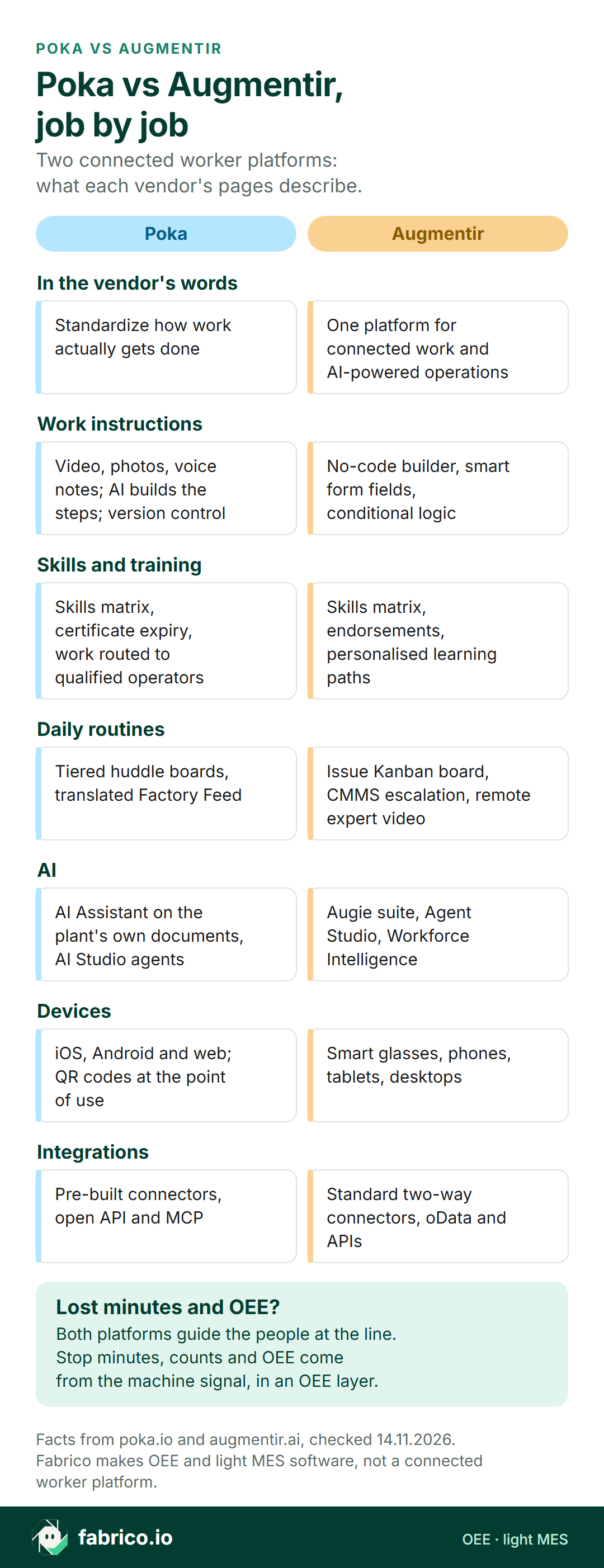
Text version of this infographic
- In the vendor's words. Poka: standardize how work actually gets done. Augmentir: one platform for connected work and AI-powered operations.
- Work instructions. Poka: video, photos, voice notes; AI builds the steps; version control. Augmentir: no-code builder, smart form fields, conditional logic.
- Skills and training. Poka: skills matrix, certificate expiry, work routed to qualified operators. Augmentir: skills matrix, endorsements, personalised learning paths.
- Daily routines. Poka: tiered huddle boards, translated Factory Feed. Augmentir: issue Kanban board, CMMS escalation, remote expert video.
- AI. Poka: AI Assistant on the plant's own documents, AI Studio agents. Augmentir: Augie suite, Agent Studio, Workforce Intelligence.
- Devices. Poka: iOS, Android and web; QR codes at the point of use. Augmentir: smart glasses, phones, tablets, desktops.
- Integrations. Poka: pre-built connectors, open API and MCP. Augmentir: standard two-way connectors, oData and APIs.
- Lost minutes and OEE? Both platforms guide the people at the line. Stop minutes, counts and OEE come from the machine signal, in an OEE layer.
Match the first job: Poka or Augmentir first
Match the one job you need fixed first to the vendor whose pages lead with it, then run the same test on the other.
| If the first job is | Look first at |
|---|---|
| Tiered huddles and shift handover in several languages | Poka: daily management and Factory Feed |
| Certificates that expire, tasks routed to qualified operators | Poka: skills management |
| Procedures that capture readings with limits and e-signatures | Augmentir: smart form fields and conditional logic |
| Proficiency measured from how jobs are done | Augmentir: Workforce Intelligence |
| Live video help from a remote expert | Augmentir: industrial collaboration |
| Senior operators' videos turned into instructions | Both: Poka's AI build, Augmentir's Knowledge Capture Agent |
| Minutes lost per line and shift, and why | An OEE or light MES layer beside either |
If the instruction job is the whole project, the digital work instructions vs paper guide and standard work vs work instructions cover the groundwork.
Decision matrix: Poka or Augmentir for your plant
The table above starts from the first job. This one starts from the plant's constraints: the floor, the people and the systems already in place. Vendor pages were checked on 14.11.2026; the last column is how a pilot settles each row.
| If this is your floor | Look first at | Why (Poka or Augmentir page) | Prove it in the pilot by |
|---|---|---|---|
| Cold stores, basements or yards with weak Wi-Fi | Both | Poka's forms page has operators complete forms offline; Augmentir's instructions page keeps work going with low or no connectivity | Putting a tablet in flight mode mid-checklist and checking what syncs once it reconnects |
| Technicians need both hands for the job | Augmentir | Its work instructions page lists AR-enabled industrial smart glasses among its devices | Running one changeover in glasses, with gloves on, and timing it against the tablet |
| New starters arrive faster than trainers can shadow them | Augmentir | The same page says smart work instructions adapt to each worker's skill level | Opening one instruction as a new and as an experienced user and comparing the two screens |
| No AI agent may act without a person approving | Poka | Its industrial AI page says agents need operator approval before they act | Asking an agent to close a checklist and recording who had to approve it |
| ERP, MES and quality systems all need a link | Poka | Its integrations page counts 1,000+ systems through pre-built connectors, an open API and MCP | Naming the plant's ERP and MES and seeing a working connection, not a logo |
| HR and learning systems stay the record of training | Augmentir | Its product overview lists standard two-way connectors for HCM and LMS systems, among others | Pushing one completed training to the LMS and reading it back |
| Paper 5S audits and safety inspections come first | Poka | Its forms page names safety inspections and 5S audits alongside quality checklists | Rebuilding one paper audit and timing a supervisor through it |
| Engineers want agents built for their own processes | Both | Poka's AI page describes AI Studio; Augmentir's Augie suite page describes Agent Studio | Building one agent on a pilot document set and checking which documents its answers cite |
Two or three rows pointing at "Both" is normal. Then the pilot, not the brochure, decides.
Skills, competence and new starters
Much of what both platforms sell is help for people who are new to a machine. Hiring is still open across Europe: Eurostat's job vacancy statistics (accessed 14.11.2026) report that "2.1% of jobs in the euro area and 2.0% of jobs in the EU were vacant in Q2 2026." Each vacancy that gets filled brings a new starter who needs the method for a filler or a changeover before running it alone.
Regulators frame that as competence, not attendance. The UK Health and Safety Executive's competence page (accessed 14.11.2026) says "Competence can be described as the combination of training, skills, experience and knowledge that a person has and their ability to apply them to perform a task safely." The EU's safety agency, on its young workers page (accessed 14.11.2026), adds: "Statistics show that 18- to 24-year-olds are more likely to have a serious accident at work than older adults," and "Young workers should be given appropriate work and provided with adequate training and supervision."
The two vendors answer that need in different ways. Poka's skills page links training and certificates to who gets which task. Augmentir's pages change the instruction a worker sees by skill level and read proficiency from completed jobs. In a pilot, put a second-month operator and a ten-year operator on the same machine and ask each vendor to show what each person sees and what the record says afterwards.
Where OEE fits beside a connected worker platform
A connected worker platform records what people did: steps, readings, sign-offs and skills. OEE records what the machine did: run time, stops, output and rejects against an ideal rate. The two records meet at the stop, most often at the changeover.
Both vendors already show plant numbers to frontline teams: Poka pulls live SQDCP data onto huddle boards, and Augmentir lists real-time line and machine status monitoring. If OEE is to be one of those numbers, ask where the run and stop signal comes from, which ideal rate applies to each product, and who enters the stop reason.
The split follows the usual layers. ISA's ISA-95 page says Level 3 describes manufacturing execution systems, where an OEE or light MES layer sits (see the ISA-95 guide). LNS Research, an analyst firm, lists workforce competency management among the core capabilities of connected frontline workforce applications. Different jobs, so plants often run one of each. Still deciding which kind to buy first? Read light MES vs connected worker platform.
Where Fabrico fits for a Poka or Augmentir buyer
Fabrico measures the machine side: OEE in the cloud plus a light MES, per the MES and OEE overview. Fabrico does not include a connected worker platform, SCADA, HMI or inspection systems, so it is no substitute for Poka or Augmentir on instructions, training and skills.
- Signal and reason. A PLC, sensor or counter gives Fabrico the stops and counts; at the machine, operators choose why it stopped on a tablet or phone.
- Camera add-on. For a manual step or an older machine without a signal, the camera add-on is the counter. Camera-suggested stop reasons are a Roadmap item, and video streams on request and is not stored (camera add-on details).
- Numbers. Each line and shift gets its OEE, downtime and the money that lost time cost, on the web and in the iOS and Android apps.
- Data out. Webhooks and a REST API for other systems; Excel and CSV exports for people.
- Work orders. A work order opens from a logged stop in one tap, and you can set chosen stop reasons to create that work order automatically as soon as the reason is logged.
Beside Poka or Augmentir: Fabrico shows which changeover or stop costs the most minutes; the connected worker platform carries the agreed method to the line. Both vendors describe APIs or connectors and Fabrico sends webhooks, but Fabrico claims no ready connector to either product, so prove that hand-off in a pilot.
Want to see stop minutes and reasons from a sample shift before you choose? Book a demo.
Worked example: a tube filler, two changeovers, two operators
Sample data for one shift on a cosmetics tube filler, invented for this page; no real plant, no product screen. The plant runs 10-hour shifts with 50 minutes of breaks, so planned time is 550 minutes. At an ideal 60 tubes a minute, the filler could make 33,000 tubes.
At 10:00 an operator with years on the filler switches hand cream from 50 ml to 75 ml tubes in 28 minutes. At 15:00 an operator in her second month switches body lotion back to 50 ml in 52 minutes. Other stops add 41 minutes.
| Sample data: stop | Minutes |
|---|---|
| Changeover 1, experienced operator | 28 |
| Changeover 2, new operator | 52 |
| Crimp jaw jam | 18 |
| Waiting for empty tubes | 14 |
| Cap feeder | 9 |
| Total stopped | 121 |
The OEE arithmetic. Stopped time is 121 minutes, so run time is 429 minutes and availability is 429 / 550 = 78.0%. In 429 minutes the ideal is 25,740 tubes; the filler made 23,166, so performance is 90.0%. The line's reject count shows 463 tubes, leaving 22,703 good, so quality is 98.0%. OEE is 78.0% x 90.0% x 98.0% = 68.8%, the same as 22,703 good of 33,000 possible (OEE calculation).
Where Poka or Augmentir comes in. The signal records a 24 minute gap between the two changeovers, not whether a step, a tool or a sign-off was missing. That is a method and skills question. The experienced operator's changeover becomes an instruction with photos or video, the new operator signs off each step, and her skill record shows she is still in training. The OEE layer then shows whether later changeovers close the gap (see the changeover time guide).
What the gap is worth. Had changeover 2 taken 28 minutes, run time would be 453 minutes and availability 82.4%. At the same speed, the 24 extra running minutes give about 1,296 more tubes (24 x 60 x 90%), and OEE comes to about 72.6%. On counting where a cosmetics line has no signal, see computer vision for cosmetics manufacturing.
Carried to money. Give each tube a sample contribution margin of EUR 0.15 (sample data, made up for this page; take the real figure from finance). The 1,296 extra tubes at 98% quality are about 1,270 good tubes, so the slower changeover cost EUR 190.50 of contribution on this shift. The plant runs 2 shifts a day for 20 days a month, 40 shifts in all, and the figures assume the second changeover each shift keeps running this slowly until the method changes.
| Sample data | Good tubes | EUR at 0.15 a tube |
|---|---|---|
| Changeover gap, one shift | 1,270 | 190.50 |
| Changeover gap, a month (40 shifts) | 50,800 | 7,620.00 |
| Changeover gap, a year (12 months) | 609,600 | 91,440.00 |
| Full gap to ideal, one shift (33,000 minus 22,703) | 10,297 | 1,544.55 |
The last row is a ceiling, not a target: it holds every loss on the shift, including the jam, the tube shortage and the rejects. The changeover gap is the part a connected worker platform is bought to close, which makes EUR 7,620.00 a month a fair yardstick for what the instruction and skills work has to return.
Questions to ask Poka and Augmentir
Send both the same video, skills list and audit form, then ask:
- Can you build our changeover instruction from our own video, and who edits it when the method changes?
- How is a skill or certificate recorded, and what happens on the day it expires?
- Which steps capture data, and what happens when a reading falls outside its limit?
- What does the AI read, where does it run, and who approves an agent's action?
- Which of our systems connect through a standard connector, and which need custom integration work?
- How would a stop or changeover event from our OEE system open a checklist or instruction at the right station?
What to do this week
- Film one changeover on the bottleneck machine with the most experienced operator, and mark which steps happen while the machine runs and which need it stopped.
- Pull the training records for that machine: who is signed off, whose certificates lapse this quarter, and who is in their first three months.
- Price the gap between the fastest and slowest crew: extra minutes times the ideal rate, the performance and quality rates, and the contribution margin from finance.
- Send Poka and Augmentir the same pack (video, skills list, one paper audit form and the matrix rows that fit) and ask each to build the instruction from the video before commercial talks.
- Write down how the pilot will be judged: changeover minutes from the machine signal over an agreed number of changeovers, not user satisfaction scores.
- Decide which system owns the stop reason list and line names before linking either platform to OEE data.
For the OEE side of the shortlist, see the OEE software guide. If Poka is already in place and you are reviewing options, see Poka alternatives. Packaged goods plants can read the computer vision hub for FMCG on counting with the camera add-on.
What people ask next
Is Poka the same as poka-yoke?
No. Poka is a software company at poka.io that makes a connected worker platform. Poka-yoke is the lean method of mistake-proofing a process. The names overlap; the products and the topics do not.
Do Poka and Augmentir both offer digital work instructions?
Yes, per their own pages. Poka captures know-how in video, photos and voice notes, can have AI build the steps, and keeps instructions under version control. Augmentir offers a no-code builder with smart form fields, conditional logic and instructions that adapt to each worker's skill level.
How do Poka and Augmentir handle frontline training and skills?
Both describe a digital skills matrix. Poka sets certification expiry dates, schedules retraining and routes work to qualified operators. Augmentir supports automatic and manual endorsements and uses AI to find skill gaps and suggest personalised learning paths.
Can Poka or Augmentir show OEE?
Both show plant numbers to frontline teams: Poka pulls live SQDCP data onto huddle boards, and Augmentir lists real-time line and machine status monitoring and KPI tracking. For OEE, ask each where the run, stop and count signals come from, which ideal rate applies to each product, and who enters the stop reason.
Which devices do Poka and Augmentir run on?
Poka lists iOS, Android and web apps, with QR codes that open instructions at the point of use. Augmentir lists AR-enabled smart glasses, iOS and Android phones and tablets, and desktop computers.
Can Fabrico run beside Poka or Augmentir?
Yes, as a separate layer for the machine side. Fabrico takes stops and counts from machine signals, operators add the reason, and results go out by REST API, webhook or Excel and CSV files. Prove any hand-off to either platform in a pilot.
Want to see changeover minutes and stop reasons on a sample shift? Book a demo.
Related articles

Latest from our blog


Real Fabrico tiles, sample data.