


 Login
 Blog
MasterControl vs Tulip: Digital Batch and Device Records Compared

In short: MasterControl Manufacturing Excellence vs Tulip for digital manufacturing comes down to where the regulated record starts. MasterControl's pages describe a life sciences platform built around paperless batch and device history records, joined to quality and asset management. Tulip's pages describe a no-code platform where a plant's own engineers compose those records as apps, station by station.
- Records: both show electronic batch records (EBR) and electronic device history records (eDHR), with review by exception.
- Building: MasterControl offers no-code workflows in a configurable MES; Tulip offers a no-code editor where engineers build the apps themselves.
- Validation: MasterControl names patented risk-based validation tools; Tulip names a validation package and validation of changes one at a time.
- Line data: both connect scales and equipment, and Tulip also has an OEE tracking page; ask both vendors how they measure stop minutes.
- Facts from mastercontrol.com and tulip.co as of 14.11.2026, linked in place.
A plant moving off paper batch records or paper device history records tends to end up with this pair on the table: MasterControl, often brought in by the quality side, and Tulip, often brought in by engineering. Both promise records that are right when the entry is made, instead of corrected at review. The differences that matter are who builds the record, how a change gets validated, and how close each sits to the machines. Fabrico, whose cloud software measures OEE and runs light MES functions, gets a short section of its own after the decision matrix.
Key takeaways
- Start from the record you must replace first: a drug batch record and a device history record put different loads on the same software.
- Part 11 puts the controls on the manufacturer that uses the system, so ask each vendor what validation evidence it hands over and what your team still writes.
- Review by exception appears on both vendors' pages; prove it by timing QA review of one real batch or build in the pilot.
- If line stop minutes matter, decide early where they are measured: in the execution platform or in an OEE layer next to it.
- Waits for line clearance and record catch-up are lost line minutes, so they can be priced before either contract is signed.
MasterControl vs Tulip at a glance
Checked against mastercontrol.com and tulip.co on 14.11.2026; the source for each row is linked in the two vendor sections below.
| Job | MasterControl Mx | Tulip |
|---|---|---|
| Own description | A next-generation digital manufacturing platform, for life sciences | Production systems that evolve as fast as operations do |
| Batch records | Paperless EBR; fully digital, compliant documentation | Composable EBR apps with guidance, data capture and alerts |
| Device history records | Digital DHRs to simplify submissions and speed release | eDHR compiled in real time as the build progresses |
| Review | Review by exception, in conjunction with production | Audit trail built as work happens; QA reviews exceptions |
| Who builds it | Configurable MES with no-code workflows | No-code editor: apps, logic, connectors |
| Validation | Patented risk-based validation tools | Validation package; apps validated change by change |
| Equipment and devices | Scales, scanners, equipment and IoT devices | Calipers, torque tools, sensors; OPC UA and MQTT |
| Wider platform | Quality, manufacturing and asset management connected | People, machines and agents on one platform |
What MasterControl Manufacturing Excellence offers
MasterControl's manufacturing page says "MasterControl Manufacturing Excellence (Mx) is a next-generation digital manufacturing platform" and sets the goal of "completely paperless manufacturing from production records (EBR/eDHR)". Its platform page describes an "innovative, compliant architecture connecting your quality, manufacturing, and asset management." The whole site speaks to life sciences manufacturers. As of 14.11.2026:
- Batch records. The batch records page sets out to "eliminate batch record errors and increase throughput with fully digital, compliant documentation" and calls paper systems "cumbersome and error-prone." It also gives the history: "With the advent of 21 CFR Part 11 in 1997, the FDA began to accept EBR systems".
- Device history records. On the eDHR page, "digitally managed device history records simplify submissions, improve compliance, and accelerate product release." The same page warns that paper DHR processes expose manufacturers "to unnecessary risks."
- Review by exception. The review by exception page aims to "eliminate line-by-line reviews at the end of production." It says reviews "happen in conjunction with production" and that teams can "fix data-entry errors in real-time and easily identify issues creating exceptions."
- Execution and instructions. The manufacturing page lists "no-code workflows", GMP work instructions that "embed operator guidance and training", and "automated data capture". The work instructions page lets authors build instructions "right alongside data collections" and embed videos, images and links.
- Equipment and systems. Per the manufacturing page, Mx integrates "with systems like ERP, LIMS, and QMS as well as assets like scales scanners, equipment, and IoT devices." The production operations page talks of "merging machine and human performance data all in one convenient interface," and electronic logbooks "plot equipment and facility activity and status over time."
- Validation and analytics. The validation page describes "patented risk-based validation tools" and invites plants to "tailor your validation to your business needs and to how your business uses MasterControl software." The MES page points to MasterControl Insights to "uncover trends and make better decisions faster".
What Tulip offers regulated plants
Tulip's home page leads with "Production systems that evolve as fast as your operations do." For regulated work, the records are apps a plant composes in Tulip's authoring tools, where "no-code editing" covers building apps, adding logic and making connectors. As of 14.11.2026:
- Batch records. The electronic batch records page says "Tulip's composable electronic batch records deliver step-by-step guidance, automated data capture, and real-time alerts." Apps can "validate inputs instantly, and stop a process if an operator enters an out-of-range value." The page describes paper as turning batch release into "a weeks-long reconstruction effort."
- Device history records. On the device history records page, Tulip says it can "automatically compile device history records in real-time as the build progresses" and "connect digital calipers, torque tools, and sensors to capture readings without operator typing." It also states: "Build FDA 21 CFR Part 820 and ISO 13485 compliance directly into execution."
- Signatures and review. Per the DHR page, "Tulip captures 21 CFR Part 11 compliant electronic signatures directly within the workflow," and the system logs the user, timestamp and action in a central audit trail. The EBR page says Tulip builds that trail "as the work happens so quality teams review exceptions, not paperwork." In its compliance wording, that EBR page names EudraLex Annex 11 next to FDA 21 CFR Part 11 for electronic records and signatures.
- Validation. The validation page says "Tulip provides a qualified platform with a validation package, including release testing reports and traceability," and that plants can validate apps and automations change by change, judging the impact of each change. The EBR page adds that Tulip "supports a Computer Software Assurance (CSA) approach" and that leaders can "build an app once, validate it, and deploy it globally".
- Machines and OEE. The DHR page says "Machines connect over OPC UA and MQTT." Tulip's OEE tracking page pulls data from PLCs, sensors and legacy machines over OPC UA, MQTT and Modbus, and "an operator picks a reason code the moment a line stops".
Already leaning toward Tulip? The Tulip alternatives guide and the Ignition vs Tulip comparison cover other pairings.
What the regulations ask of either system
No vendor page makes a plant compliant. Part 11 places the controls on the manufacturer: section 11.10, as published by Cornell's Legal Information Institute (accessed 14.11.2026), opens with "Persons who use closed systems to create, modify, maintain, or transmit electronic records shall employ procedures and controls designed to ensure the authenticity, integrity, and, when appropriate, the confidentiality of electronic records". The controls it lists include "Validation of systems to ensure accuracy, reliability, consistent intended performance, and the ability to discern invalid or altered records," "Use of operational system checks to enforce permitted sequencing of steps and events, as appropriate," and audit trails, where "Record changes shall not obscure previously recorded information."
FDA's guidance on the scope and application of Part 11 (accessed 14.11.2026) then adds: "This guidance explains that we will narrowly interpret the scope of part 11." So the QA lead decides which records fall under Part 11 and how much validation each needs, then asks each vendor what evidence it supplies toward that. For the wider picture, see the GMP data integrity guide.
For drug products, 21 CFR 211.192 (accessed 14.11.2026) states that "All drug product production and control records, including those for packaging and labeling, shall be reviewed and approved by the quality control unit to determine compliance with all established, approved written procedures before a batch is released or distributed." That review is the step both vendors aim to shorten with review by exception. For devices, FDA's QMSR page (accessed 14.11.2026) says the regulation "that became effective on February 2, 2026, amends the device current good manufacturing practice (CGMP) requirements of 21 CFR Part 820", incorporating by reference ISO 13485:2016. A device maker should ask both vendors how their device record maps to the amended Part 820, and get the answer in writing.
MasterControl vs Tulip, job by job
Who owns the build. This is usually the first fork. MasterControl presents Mx as a configurable product for life sciences, with no-code workflows inside it, so the starting shape is a batch or device record. Tulip presents an editor plus templates, so the starting shape is an app. A plant with two automation engineers and a busy QA team should ask a blunt question of both: when a master record step is wrong at 22:00, who edits it, who approves the change, and how long until the line can run again?
Batch records. Both describe guided, digital batch records that catch errors at entry. Tulip's page is specific about stopping a process on an out-of-range value; MasterControl's speaks of eliminating batch record errors and fixing data entry errors in real time. Give both the same master batch record, with one weigh step, one in-process check and one deviation, and watch what each does with a wrong entry.
Device history records. Tulip's eDHR page leans on connected tools at the bench, such as calipers and torque drivers, with readings arriving without typing. MasterControl's eDHR page leans on faster submissions and release. For a device assembler, the useful test is a traveler with serial numbers, a torque spec and a final functional test, built in both.
Review by exception. Both vendors' pages use the phrase. What matters is what counts as an exception and who sets the rules. Ask each to show the reviewer's screen for a batch with two exceptions and a clean batch, and time QA from opening the record to approval.
Validating changes. MasterControl points to patented risk-based validation tools tailored to how the plant uses its software. Tulip points to a qualified platform with a validation package and to validating each app change by its impact. Both framings fit a risk-based approach; the evidence pack for one real change is what tells them apart for your QA team.
Equipment and line data. MasterControl lists scales, scanners, equipment and IoT devices, and electronic logbooks that plot equipment status over time. Tulip lists OPC UA, MQTT and Modbus, edge connections to tools, and an OEE tracking page. The ISA-95 page from ISA describes the layers these sit in: "Level 3 describes manufacturing execution systems (MES)" (accessed 14.11.2026). Batch records, device records and OEE all live at that level, which is why the question "which system owns the stop minutes?" needs an answer before the pilot (more in the ISA-95 guide).
Wider platform. MasterControl ties manufacturing to quality and asset management on one platform, which suits a plant that wants deviations, training and equipment records in one place. Tulip ties people, machines and agents together and links to other business systems, which suits a plant that already has its QMS and wants the floor layer to plug into it.
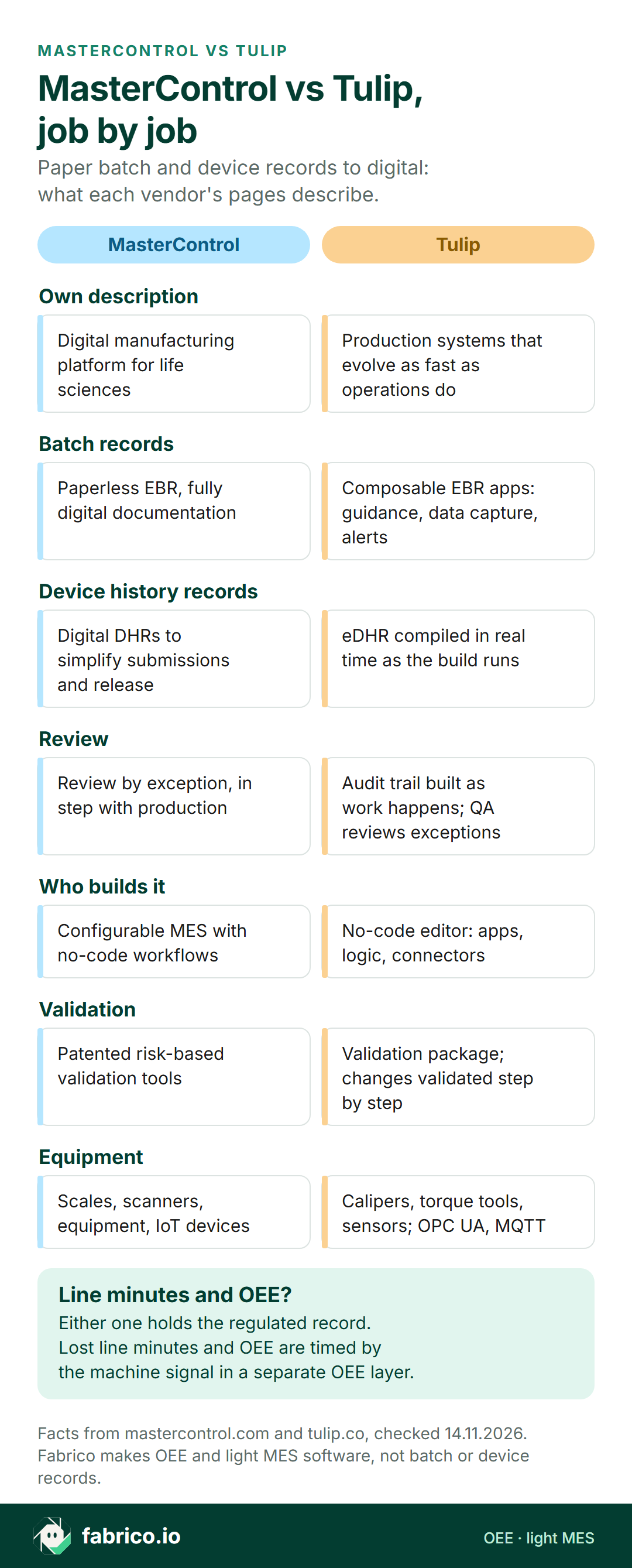
Text version of this infographic
- Own description. MasterControl: digital manufacturing platform for life sciences. Tulip: production systems that evolve as fast as operations do.
- Batch records. MasterControl: paperless EBR, fully digital documentation. Tulip: composable EBR apps with guidance, data capture and alerts.
- Device history records. MasterControl: digital DHRs to simplify submissions and release. Tulip: eDHR compiled in real time as the build runs.
- Review. MasterControl: review by exception, in step with production. Tulip: audit trail built as work happens; QA reviews exceptions.
- Who builds it. MasterControl: configurable MES with no-code workflows. Tulip: no-code editor: apps, logic, connectors.
- Validation. MasterControl: patented risk-based validation tools. Tulip: validation package; changes validated step by step.
- Equipment. MasterControl: scales, scanners, equipment, IoT devices. Tulip: calipers, torque tools, sensors; OPC UA, MQTT.
- Line minutes and OEE? Either one holds the regulated record. Lost line minutes and OEE are timed by the machine signal in a separate OEE layer.
Decision matrix: MasterControl or Tulip for your plant
Match the first job to the vendor whose own pages lead with it, then give the other vendor the same test. The matrix routes jobs; it does not rank either product.
| If this is you | Look first at | Why (vendor page) | Prove it in the pilot by |
|---|---|---|---|
| QA wants batch records, deviations, training and equipment in one quality system | MasterControl | Platform page: quality, manufacturing and asset management connected | Showing a training record gating an operator step in a live batch |
| Engineers want to build and change their own station screens | Tulip | Authoring page: apps, logic and connectors built without code | Your engineer changing one step and releasing it through approval |
| Device assembly with calipers and torque tools at the bench | Tulip | DHR page: readings captured without operator typing | A real caliper reading landing in the device record |
| Scales and scanners must feed the batch record | Both | Mx page lists scales and scanners; Tulip EBR captures data automatically | One dispensing step weighed and scanned on each system |
| End-of-batch review is the bottleneck | Both | Review by exception and Tulip EBR both target it | Timing QA review of one batch with two exceptions |
| Validation effort per change worries QA | Both, different routes | Risk-based tools vs validation package and change-by-change validation | The evidence pack each produces for one small change |
| Paper equipment logbooks for use and status | MasterControl | Logbook page: equipment and facility status over time | Logging one cleaning and one use entry, then pulling the history |
| The same process must run at several sites | Both | Tulip EBR: build once, validate, deploy globally; Mx instructions are reachable from multiple sites | Rolling one change to a second site and showing the version each site runs |
| Stop minutes and OEE by shift are part of the brief | Tulip, or an OEE layer beside either | Tulip OEE page: reason code when a line stops | A week of stop minutes checked against the machine signal |
Weighing a full MES against a lighter tool first? The light MES vs full MES comparison and the electronic batch record software guide set out the wider field.
Where OEE fits beside MasterControl or Tulip
A batch or device record answers "was this unit made as written, and who signed?" OEE answers a different question: "how many minutes did the line run, how fast, and how many good units came out?" The first comes from people at the line; the second comes from the machine signal. They meet whenever the record makes the line wait: a second-person check, a line clearance, a missing signature before the next step.
On paper, those waits rarely get logged as stops. They show up as a shift that produced less than planned, with no clear reason. Once the machine signal times the line, they surface as stop minutes with a reason, and the case for digital records can be made in line minutes instead of in opinion. That is also how to judge whether the new record system is helping after go-live: the clearance and catch-up minutes should fall. Sector guides cover the detail for OEE in pharmaceutical manufacturing and OEE in medical device manufacturing.
Where Fabrico fits beside either
Fabrico covers the line side with cloud OEE software and a light MES; the overview of its MES and OEE functions has the detail. Batch records, device history records, release signatures, a QMS and an app builder are outside its scope, so it replaces neither MasterControl nor Tulip.
- Where the numbers come from. The packer's PLC, or a sensor or counter fitted to it, tells Fabrico when the line runs, stops and counts. People at the line pick why it stopped, from a phone or a tablet.
- Camera add-on. For a manual station, or a machine whose signal is not worth wiring, the camera add-on handles the output count. Stop reason suggestions from a camera are a Roadmap item. Where a camera covers the line, the video for the minute of a stop can be opened from the shift timeline; it is streamed on request and not stored. See the computer vision add-on page; packing lines are covered in computer vision for pharmaceutical packaging.
- What managers see. Line and shift OEE, a Pareto of downtime reasons, and lost minutes turned into money, readable on desktops, tablets and phones.
- Maintenance follow-up. A work order opens from a logged stop in one tap, and you can set chosen stop reasons to create that work order automatically as soon as the reason is logged.
- Getting data out. Webhooks and a REST API feed other systems, while Excel and CSV exports serve the people who prefer files.
Beside MasterControl or Tulip: the record platform keeps the regulated record, and Fabrico ranks the line's stops by minutes and money. Fabrico lists no ready connector for MasterControl or Tulip; prove that hand-off in a pilot first, with real batches. The OEE software buyer's guide lists what to check, and for consumer health products made on FMCG-style packing lines, see computer vision for FMCG manufacturing.
To see a sample shift's stops ranked by lost minutes and money, book a demo.
Worked example: a tablet blister line waiting on paper
Sample data, made up for this page; no real plant or product screen sits behind it. A thermoform blister packer runs tablets on a 9 hour shift. Take away 40 minutes of breaks and 500 planned minutes remain. The ideal rate is 120 blister cards a minute, so the line could make 60,000 cards in the shift.
The shift has one batch change. Before the next batch may start, the line needs a clearance and a QA second check, and today the QA person was at another line. At the end of the first batch, the operator also stopped the packer to catch up on paper record entries and correct one missing initial.
| Sample data: stop | Minutes |
|---|---|
| Line clearance, waiting for QA second check | 34 |
| Batch record catch-up and correction | 21 |
| Forming film jam | 17 |
| Foil reel change | 14 |
| Tablet feeder starved | 12 |
| Total stopped | 98 |
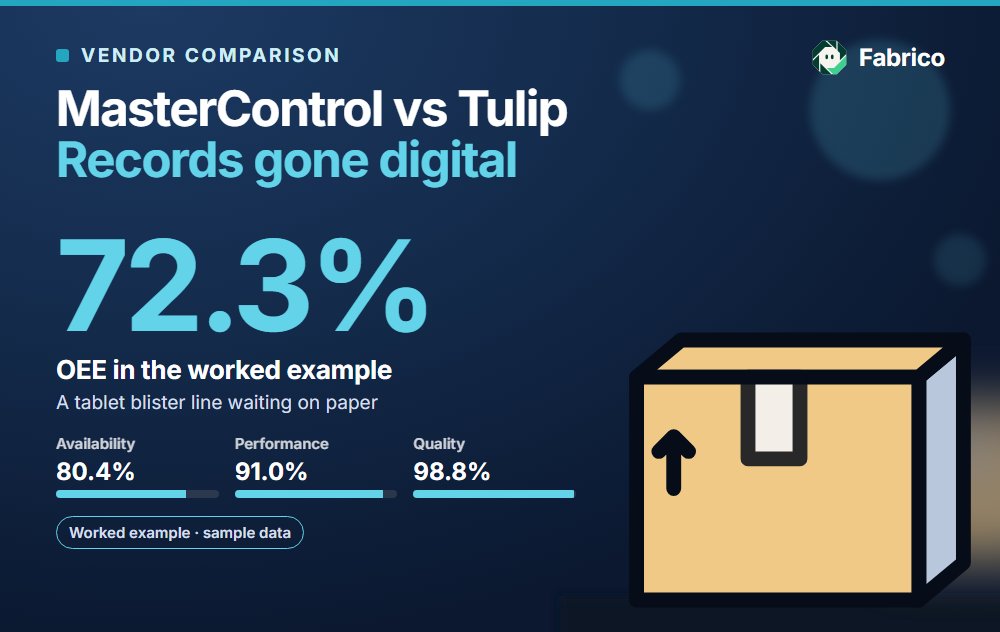
The OEE arithmetic. The packer stood still for 98 minutes, so it ran for 402 minutes and availability is 402 / 500 = 80.4%. In 402 minutes the ideal is 48,240 cards; the line made 43,900, so performance is 43,900 / 48,240 = 91.0%. The plant's own inspection system rejected 520 cards, leaving 43,380 good, so quality is 43,380 / 43,900 = 98.8%. OEE is 80.4% x 91.0% x 98.8% = 72.3%, the same as 43,380 good cards out of 60,000 possible (method in the OEE calculation guide).
What the record waits cost. The two record waits add up to 34 + 21 = 55 minutes. At this shift's speed and reject rate, each run minute yields 120 x 91.0% x 98.8% = about 107.9 good cards, so 55 minutes is about 5,935 good cards. At a sample contribution margin of EUR 0.40 a card, that is about EUR 2,374 a shift.
What a fix is worth. Suppose a digital record with in-line checks and review by exception brings the two waits down to 20 minutes in total: clearance sign-off in 15 minutes, record catch-up in 5. That target is an assumption to prove in the pilot, not a vendor claim. Run time rises by 35 minutes to 437, availability to 87.4%, and good output to about 47,157 cards, so OEE comes to about 78.6%. The gain is 3,777 good cards a shift, or about EUR 1,511 at EUR 0.40 a card.
Carried to a year. Assume two shifts a day and 20 production days a month, so 40 shifts a month and 480 a year. The gain is about 151,080 cards and EUR 60,432 a month, and about 1,812,960 cards and EUR 725,184 a year. If the record waits fall by half as much as assumed, every figure halves; a different margin moves them in step. Put the plant's own margin and shift pattern in before showing anyone.
One rule to set first. Some plants book line clearance as planned downtime, which takes it out of availability. Either choice works, but fix it before the pilot and keep it, or the before and after numbers will not compare.
Questions to ask MasterControl and Tulip
Give both vendors the same master batch record or device traveler, then ask:
- After go-live, which of our people edits the record, and what training does that person need?
- What validation evidence do you supply for the platform, and what do we write ourselves for one changed step?
- Which entries are checked at the moment of entry, and what happens to the batch when a check fails?
- What counts as an exception in review, who sets those rules, and can QA see a clean batch in one screen?
- How does your device record map to the amended Part 820, and can you show it on our traveler?
- Which scales, scanners and torque tools connect today, and which need custom work through the API?
- Where do line stop minutes and counts come from, and who enters the reason for a stop?
What to do this week
- Pick one record. Choose the batch record or device traveler that causes the most review loops or corrections, and copy a blank and a completed version for both vendors.
- Count the waits. For five shifts, log every minute the line stands still for clearance, second checks or record catch-up, using the machine signal or a stopwatch at the line.
- Price them. Multiply those minutes by good units per run minute and the product's contribution margin, as in the worked example, to put a EUR figure on the paper waits.
- Write the validation question. Ask QA to list what evidence it needs for one changed step, and send that list to both vendors before the first call.
- Book both pilots on the same record. Same record, same line, same exception cases, and the same measure of success: QA review time and line minutes lost to the record.
What people ask next
Which is better, MasterControl or Tulip?
Neither is better in general. MasterControl's pages describe a life sciences platform with batch and device records tied to quality and asset management. Tulip's pages describe a no-code platform where engineers compose those records as apps. Begin where the vendor's own pages put the record that has to go first, then run the other vendor through an identical pilot.
Is Tulip compliant with 21 CFR Part 11?
Tulip's device history records page says Tulip captures 21 CFR Part 11 compliant electronic signatures directly within the workflow, and its batch records page also names EudraLex Annex 11. Part 11 itself places the controls on the persons who use the system, so the manufacturer still validates its own use and keeps its own procedures.
Does MasterControl support review by exception?
Yes, per its review by exception page. Reviews happen in conjunction with production, data entry errors are fixed in real time, and the aim is to remove the line-by-line review at the end of production.
Can MasterControl or Tulip measure OEE?
Tulip publishes an OEE tracking page; it pulls data from PLCs, sensors and legacy machines and has the operator pick a reason code when a line stops. MasterControl's production operations page speaks of merging machine and human performance data in one interface. Ask both where run, stop and count signals come from and how stop minutes are classed.
What does Part 11 ask of an electronic batch record system?
Section 11.10 asks users of closed systems for procedures and controls, among them validation, secure time-stamped audit trails, operational checks on the sequence of steps, and authority checks. FDA's scope and application guidance says the agency will narrowly interpret the scope of part 11, so QA decides which records it covers and what evidence each needs.
Can Fabrico run beside MasterControl or Tulip?
Yes, as the OEE layer on the line side. Fabrico reads run, stop and count from the machine's controller or an added counter, operators record why the line stopped, and the results go out through webhooks, a REST API or Excel and CSV files. No ready connector for either product is listed by Fabrico, so a pilot has to prove the hand-off.
Want a sample shift's lost minutes broken down by reason, with OEE beside them? Book a demo.
Related articles



Latest from our blog



Real Fabrico tiles, sample data.