


 Login
 Blog

Computer Vision for Pharmaceutical Packaging: OEE Counting vs Validated Inspection

In short: computer vision for pharmaceutical packaging does two jobs that must never be confused. Validated inspection and track and trace systems check codes, print and packs; an OEE camera counts good output where no machine gives a usable count, and lets you open the video of a stop at the cartoner or the aggregation station.
- Serialization vision, OCR and OCV, code verification, aggregation and in-process inspection run on inspection and track and trace systems that your site has validated. Fabrico does not do them.
- Time goes to line clearance, format changes, rejects at the vision checks, and short stops at the cartoner and aggregation.
- Any camera in a GMP area goes through the site's own change control, and QA decides from its risk assessment whether it also needs validation. Fabrico is not a GxP validated system.
- Fabrico's camera add-on counts output and lets you open the video for any moment on the shift timeline. Video is streamed on request, not stored.
A pharma packaging hall already has plenty of cameras. The blister machine checks the pockets. The serialization station prints, reads and grades the codes. All of them are validated, and all of them belong to quality and the track and trace team.
This page is for pharma packaging managers and CI engineers who want a count they trust and a clear view of why the line stopped, without touching any of that.
Nothing here is regulatory advice. Your QA team owns what goes into a GMP record.
Computer vision for pharmaceutical packaging: whose job is which
Two kinds of camera system share one name. One decides, pack by pack, whether a unit may ship. The other counts what the line made and helps you see a stop.
| Job on a pharma line | Inspection or track and trace system | OEE camera add-on |
|---|---|---|
| Print, read and grade the 2D code | Serialization vision | No |
| Lot and expiry: OCR and OCV | Serialization or coder vision | No |
| Case and pallet aggregation | Track and trace system | No |
| Empty, broken or wrong tablet in a pocket | Blister machine vision | No |
| Leaflet present, carton weight | Inspection, checkweigher | No |
| Count cartons at a hand packing table | Not its job | Yes |
| Video of a cartoner or aggregation stop | Not its job | Open the video for that minute |
In the EU, the Falsified Medicines Directive brought obligatory safety features: a unique identifier and an anti-tampering device on the outer packaging. The European Commission notes that Delegated Regulation (EU) 2016/161, which sets out how they work, applies as of 9 February 2019. In the US, the Drug Supply Chain Security Act sets out how certain prescription drugs are identified and traced at the package level.
That work is done by serialization, track and trace and inspection systems, from specialist vendors or the machine builder, that your site has validated for their intended use.
Fabrico does none of it. Its camera add-on counts output. The two meet at the reject count: a reject signal or counter from those stations can feed the quality part of OEE. The page on label and code vision vs an OEE camera explains the split.
Where the losses hide on a pharma packaging line
On many pharma packaging lines, the lost time is not mainly breakdowns. Look in five places.
Line clearance
US cGMP requires written packaging and labeling procedures that include an inspection of the packaging and labeling facilities immediately before use, to make sure all drug products from previous operations have been removed, with the results documented in the batch production records (21 CFR 211.130(e)). EU GMP Chapter 5 asks the same: before packaging begins, the work area, packaging lines, printing machines and other equipment should be clean and free from any products, materials or documents previously used, checked against a line clearance checklist (point 5.50).
For OEE, clearing the cartoner magazine, leaflet feeder, reject bins and coder is real work. Waiting for QA to sign is a different loss. Give clearance its own stop reason, and split the waiting from the clearing.
A camera does not clear a line or sign for it. Live video from one fixed view can help whoever does the check, but it is not the clearance record. See line clearance and camera views during line clearance.
Format changes
Pharma runs many short batches: several strengths, pack sizes and market versions, each with its own carton, leaflet and code layout. A format change can mean new forming and sealing tools, carton size parts and a new serialization job loaded and checked.
Time it from the last good carton of the old batch to the first good carton of the new one, then split it into clearance, mechanical change, serialization job and first-off checks. The cartoner signal already gives the timing, so a camera adds little here. Our page on cartoner OEE covers the cartoner side.
Rejects at the vision checks
A reject at the pocket check, the code reader or the checkweigher is a unit made and lost, so it counts against quality. A burst of code rejects can also stop the line, because many serialization stations can be set to stop after a set number of consecutive rejects. That stop is availability, and it needs a reason such as print quality or a wrong job loaded.
QC and retained samples are not rejects, but a case packer count misses them. Book them as a known quantity per batch.
Short stops at the cartoner and aggregation
The cartoner is where blisters, leaflets and cartons meet, so short stops pile up there: a leaflet that did not fold, a blister that missed the bucket, a carton that did not open. Each takes under a minute to clear, and few get written down. See micro stops.
Aggregation adds its own: a case waiting for a scan, a code that did not read, a case pulled for rework. On semi-automatic lines a person scans the cases by hand, and the line waits when they fall behind.
Here a camera earns its place. The cartoner signal times the stop, often with a vague fault code. Video for that minute shows whether it was the leaflet feed, the blister transfer or the carton magazine. At a manual aggregation station, the track and trace system already logs the cases it aggregates. Ask whether that count can be exported before you add a camera.
Hand packing and visual inspection booths
Most pharma sites have work no machine counts: hand packing of kits, rework and relabelling under QA control, and on sterile sites, manual visual inspection of vials and ampoules in booths.
At a hand packing table, a camera over the outfeed can count finished cartons or kits at one fixed spot. See OEE at a manual packing station.
Leave inspection booths alone. Visual inspection there is a GMP step done by qualified inspectors, and its count goes into the batch record. Use that count for OEE. A camera would add equipment to a qualified setup and film the inspectors at close range.
Where a camera goes on a pharma packaging line
One example: a blister line to the case, plus two manual rooms.
Supplement plants run some of the same machines under lighter rules. See computer vision for supplement manufacturing, and OEE for blister packaging lines for ideal rates and units.
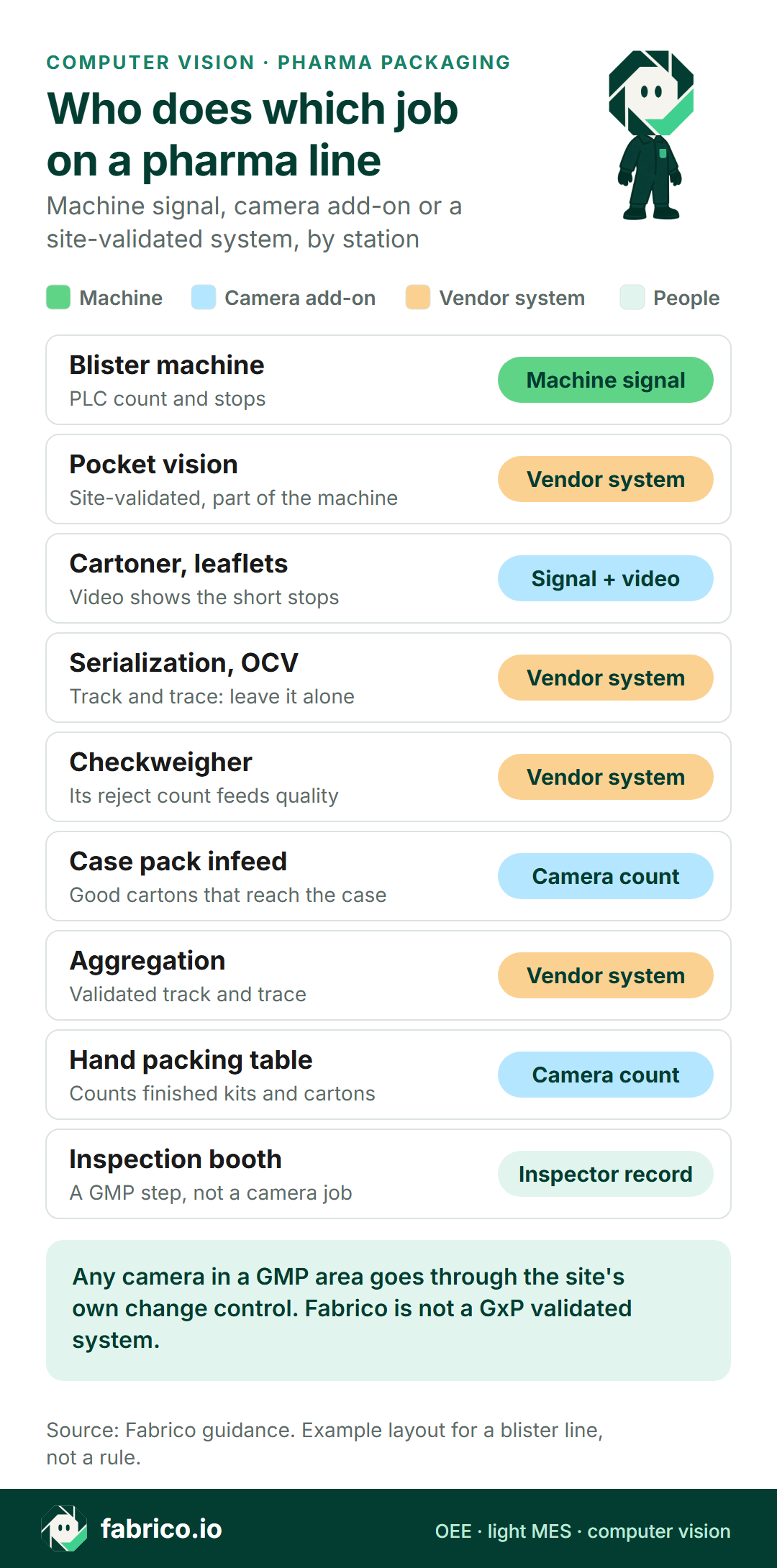
Camera, signal or operator: station by station
This is typical for a pharma packaging site, not a rule. Check each machine.
| Station | Count and stops from | What a camera adds |
|---|---|---|
| Blister machine | Machine PLC | Video of what led to a stop |
| Bottle line: counter, capper | PLC signal | Video when the fault code is vague |
| Cartoner and leaflet feeder | Cartoner PLC | Video of leaflet, blister and carton stops |
| Serialization, OCR and OCV | Site-validated system and its reject count | Nothing. Leave it alone. |
| Checkweigher | Its own reject count | Nothing. Feed rejects to quality. |
| Case packer, aggregation | PLC, or the aggregation system's case count | Good count at the case infeed, video of waits |
| Hand packing, kits, rework | Tally sheet | Count of finished units |
| Visual inspection booth | The inspection record | None. Use the inspection record's count. |
| Stop reasons, all lines | The operator, on a tablet or phone | Video to check a disputed reason |
You rarely need a camera at every station. The card below sums it up.
Bring your station list, marked with what each machine can signal today, to a demo, and we will go through it station by station.
GMP: change control and validation come first
Any camera in a GMP area goes through the site's own change control, even one that only counts. It is new equipment next to validated machines, and QA decides from its own risk assessment whether it also needs validation.
EU GMP Annex 11 applies to all computerised systems used as part of GMP regulated activities, says the application should be validated, and asks that changes, including configuration, are made in a controlled manner under a defined procedure. QA decides whether an OEE system falls inside that scope.
Fabrico is not a GxP validated system. Its data is for running and improving the line. It does not release batches, does not judge units and is not your batch record. Putting an OEE figure in a GMP record is a validation decision for your quality system.
Before an OEE camera goes into a packaging hall, agree three things with QA in writing: its purpose (counting and stop review only, no role in release or inspection), its position (outside the guarding, never above open product, easy to clean), and its network (kept apart from line control and serialization networks).
For the wider picture, see OEE for pharma packaging: serialization, line clearance and GMP records and our guide to OEE in pharmaceutical manufacturing.
Worked example: one cartoner shift with a format change
These are example numbers, and they describe no real plant. A blister line feeds a cartoner with an ideal rate of 150 cartons a minute. It runs one 480-minute shift with one batch change inside it.
The cartoner PLC gives the run state and the cartons made. A camera at the case packer infeed counts the cartons that reach the case. After the QC samples booked for the batch, the difference is the rejects at the code reader and checkweigher.
Stops took 120 minutes: line clearance 25, the format change 45, short stops at the cartoner 22, waits at aggregation 13 and one breakdown 15. Run time is 360 of 480 minutes, so availability is 75%.
At 150 cartons a minute, 360 minutes could make 54,000 cartons. The cartoner counted 48,600, so performance is 90%. The gap is 36 minutes of slow running.
The camera counted 47,385 good cartons at the case packer. That leaves 1,215 rejects, so quality is 97.5%. Those rejects are about 8 minutes of cartoner time.
OEE is 75% x 90% x 97.5% = 65.8%. Check it the short way: 47,385 good cartons of 72,000 possible is also 65.8%.
Book the clearance and format change, 70 minutes, as planned downtime instead, and OEE reads 77.0% on 410 planned minutes. Same cartons, a better number. Pick one rule and report clearance minutes on their own.
Cartoner short stops and aggregation waits add up to 35 minutes, more than twice the breakdown. That is where the video earns its place.
Seven checks for any pharma packaging camera or OEE vendor
Run these with every vendor, and with us, on one real batch from last week.
| Ask | How to test the answer |
|---|---|
| What exactly does the camera count? | Cartons, kits or cases? Run it next to the cartoner count and a hand count for one batch. |
| Does it touch any validated system? | Ask for a drawing that shows it reads nothing from and writes nothing to serialization or inspection. |
| Is it validated for GxP use? | Ask for a plain yes or no, in writing. Fabrico's answer is no. |
| How do rejects get in? | Ask how reject counts from the code reader and checkweigher feed quality, so a reject counts once. |
| How is clearance booked? | Ask for a clearance reason code, with the wait for QA split from the clearing. |
| Is video kept, and who can open it? | Ask where it lives, for how long, and which roles can see it. |
| How does a short batch look? | Ask to see the ideal rate change with the format, and one batch change on the shift timeline. |
Before you roll out across the site, test on one line first. See our guide to a computer vision OEE pilot.
Cameras, privacy and the works council
People work at cartoners, aggregation tables and inspection booths, and a camera aimed at a machine will see some of them. Tell staff before any camera goes up. In many European countries, talk to the works council first.
Frame the camera on the product and the machine, not the crew, and report by line and shift, not by person. Ask each vendor, us included, what privacy masking is live today and what is still roadmap. For a fuller checklist, read production line cameras without surveillance.
Where Fabrico fits
Fabrico is a cloud OEE and light MES platform. Here is what it does on a pharma packaging line today.
- Stops and counts: from the machine signal, through the blister machine, cartoner or case packer PLC, a sensor or a counter.
- Stop reasons: the operator adds them on a tablet or phone, with codes for clearance, format change and QA waits.
- OEE and losses: by line and shift, losses in money, on the web, iOS and Android.
- Camera add-on, on request: the camera add-on counts output at hand packing tables, kit and rework benches and machines with no usable count. You can open the camera video for any moment on the shift timeline. In the standard setup, video is streamed on request, not stored in Fabrico.
- Your data: it leaves through a REST API, webhooks and Excel or CSV export.
Roadmap, not live today: stops detected by the camera, jam zones on the video, and a camera suggesting a stop reason.
What Fabrico does not do: serialization, OCR or OCV, code verification, aggregation, in-process inspection, batch records or line clearance sign-off. It is not a GxP validated system. For planning and scheduling, ask us in the demo.
For the full product, see Fabrico computer vision for OEE and the MES and OEE solution overview. All seven checks above apply to us too.
What people ask next
Can Fabrico's camera add-on read serialization codes or check OCV?
No. Serialization vision, OCR and OCV, code verification and aggregation run on track and trace systems from other vendors, validated by your site. Fabrico does not do them. Its camera add-on counts output and lets you open the video for any moment on the shift timeline.
Which pharma packaging station should get the first camera?
Usually the one with the weakest count: a hand packing table, a kit or rework bench, or a case packer whose PLC you cannot reach. Next comes the cartoner, for video of short stops.
Does a camera that only counts need GMP change control?
Yes. Any camera in a GMP area goes through the site's own change control. QA decides from its own risk assessment whether it also needs validation.
Is Fabrico a GxP validated system?
No. Fabrico is a cloud OEE and light MES platform for running and improving lines. It is not a batch record and it does not release product.
Is the camera video stored?
Not in Fabrico. In the standard setup, video is streamed on request, and you can open it for any moment on the shift timeline. Ask every vendor the same question, and where their video lives.
What drives the cost of computer vision on a pharma packaging line?
Pricing is set per quote. The drivers are lines and cameras, mounting and housings, the network to the hall, change control effort and training. Give each vendor the same station list so the quotes compare.
Want to see it on a line like yours? Book a demo and bring one batch of stop sheets from a packaging line.
Related articles









Real Fabrico tiles, sample data.