


 Login
 Blog
L2L vs Tulip: Connected Worker Apps, Downtime and OEE Compared

In short: L2L vs Tulip is a choice between two starting points. L2L calls itself a Connected Manufacturing Operations Platform that syncs maintenance, production and skills in one system, and its pages put the stopped line and the person sent to fix it at the centre. Tulip describes a platform where people, machines and agents work together, and plants build their own station apps, digital work instructions included, without code. Both name downtime and OEE, and with either one, somebody on the floor still has to say why the machine halted.
- Work instructions: L2L has visual work instructions, digital checklists and Digital Work Guides; Tulip builds guided steps in its App Editor.
- Downtime: L2L alerts the right person when a machine goes down, with escalation; Tulip joins machine states to operator reason codes.
- Machine data: L2L names PLCs and SCADA or operator entry; Tulip names OPC UA, MQTT and its Edge devices.
- Sources: l2l.com and tulip.co, read on 14.11.2026 and linked where used.
The search usually starts with a familiar mess: supervisors hear about a stopped line late, the instruction binders are a few revisions behind, and the monthly OEE figure is a rough estimate. L2L and Tulip demos can look alike, a tablet at the station with a stop and a list of steps. Yet the product behind the tablet is shaped differently, and that decides who does the work after go-live.
Fabrico makes cloud OEE and light MES software, and it gets one section of its own further down, after the OEE part.
Key takeaways
- Start from the first job. L2L's pages centre on getting the right person to a stopped machine; Tulip's centre on apps the plant builds and edits itself.
- Both take machine data by different routes: PLCs, SCADA or operator entry on L2L's pages; native OPC UA, MQTT and Tulip's Edge devices on Tulip's.
- Instruction control takes two forms: a set review order before release at L2L, versioned apps with electronic sign-off at Tulip.
- In the sample shift below, 52 stopped minutes on one leak tester are worth EUR 436.80 of contribution, so the speed of the first response is worth testing in any pilot.
- With either platform, one owner for the stop reason list matters before go-live.
L2L vs Tulip at a glance
Rows summarise each vendor's own pages as of 14.11.2026.
| Job | L2L | Tulip |
|---|---|---|
| How each describes itself | A Connected Manufacturing Operations Platform | A platform where people, machines and agents work together |
| Work instructions | Visual work instructions, digital checklists and Digital Work Guides | Guided steps in the App Editor, built without code |
| Releasing new content | Reviewed by the right people in the right order | Version control; approvers sign off each new version |
| Downtime and OEE | Six Big Losses in real time; OEE Pareto and trend reports | Automated machine states combined with operator reason codes |
| When a line stops | The right person is alerted, with escalation; Execution AI suggests a fix | Triggers run logic on machine states or operator inputs |
| Machine data | PLCs and SCADA, or operator entry; SCADA/OPC and IIoT links | Native OPC UA and MQTT; Edge IO, Edge MC and a Machine Kit |
| MES | Downtime tracking, maintenance activities and production goals | Composable MES App Suite, a common data model and an open API |
| Where people use it | Browser, Windows, Mac, Android and iOS | A computer or tablet, with USB scanners, calipers and scales |
What L2L offers for frontline work and downtime
As of 14.11.2026, the L2L homepage describes a Connected Manufacturing Operations Platform with Shop Floor Execution, Maintenance, Production and Skills, and calls it a single system of action that syncs maintenance, production and skills in real time. Its product pages say:
- Connected workforce. The connected workforce page offers visual work instructions, digital checklists and automated event logging, inside L2L's Shop Floor Execution platform. Digital Work Guides standardize shift tasks, safety protocols and quality checks, and content passes the right reviewers in the right order before release. A dynamic skills matrix confirms who may run a given machine or process.
- Production and OEE. The production management page describes the Six Big Losses in real time, with data from PLCs and SCADA or from operator entry. When a line slows or stops, it says, L2L Execution AI suggests a fix and routes it to the right person.
- Maintenance and dispatch. The maintenance management page covers alerts to the right person the moment a machine goes down, escalation for changeovers that run long, routed work orders, and PMs triggered by time, cycle or condition.
- Reports and connections. The manufacturing intelligence page lists OEE Pareto, bar chart and trend reports. The integrations page names ERP, MES, EAM or CMMS, SCADA/OPC and IIoT links, and the MES page lists browser, Windows, Mac, Android and iOS.
For the L2L call: which modules phase one covers, and who writes the first work guides.
What Tulip offers for frontline apps and downtime
Tulip's homepage presents a platform where people, machines and agents work together, giving every site, team and system a single place to build, connect and improve. As of 14.11.2026, its pages describe:
- Apps the plant builds. According to the apps, agents and automations page, apps, logic and connectors are made through no-code editing, while triggers steer the operator's workflow and post data to tables or linked systems.
- Digital work instructions. The digital work instructions page builds an instruction as a run of steps in the App Editor, holding pictures, clips, PDF files or 3D STL parts, plus when-if-then logic. Every finished job keeps step durations, who did it, where, and which app revision ran. Apps are version controlled, named approvers e-sign each new version before it deploys, and a revision reaches the station once the job in progress finishes.
- OEE and stop reasons. The OEE tracking page combines automated machine states with operator reason codes. The same page says Tulip tracks production across entirely manual assembly lines.
- Machines and devices. The OEE page calls its OPC UA and MQTT connections native. The Edge devices page lists Edge IO (USB, GPIO, ADC), Edge MC (wireless, Node-RED, OPC UA), a current-sensor Machine Kit, and USB scanners, calipers and scales run by Tulip's device drivers.
- Composable MES. On the composable MES page, Tulip pairs app templates and its Library's Composable MES App Suite with a human-readable common data model and an open API.
Questions for Tulip: which Library apps run unchanged, and who edits apps after go-live.
L2L vs Tulip, job by job
Work instructions. L2L delivers work instructions, checklists and Digital Work Guides as part of its platform, with a review order before release. Tulip treats an instruction as an app the plant builds from steps and triggers, with version control and sign-off. Ask each to change one step live and show how it reaches the station.
Downtime response. L2L's pages put dispatch at the centre: the right person is alerted when a machine goes down, escalation is built in, and Execution AI suggests a fix. In Tulip, the response is logic the plant designs with triggers on machine states or operator inputs. Ask both who hears about a night-shift stop, and what they see.
OEE. Both name it: L2L through the Six Big Losses and OEE Pareto reports, Tulip through machine states joined to operator reason codes, manual lines included. Either way, agree the stop reason list before trusting the numbers.
Machine data. L2L names PLCs and SCADA, plus SCADA/OPC and IIoT links. Tulip names native OPC UA and MQTT plus its own Edge hardware. Both protocols are open standards: OPC UA is, per its foundation, a platform independent service-oriented architecture, and MQTT is an OASIS standard for IoT messaging. For how they differ, read OPC UA vs MQTT. Ask each to draw the path from controller to station screen.
Maintenance, skills and MES. L2L's pages add work orders, PMs and a skills matrix; Tulip's composable approach starts from an app suite and a data model. Give both the same written scope, sized with the light MES vs full MES guide.
Match the first job to L2L, Tulip or both
Getting a technician to a stopped line fast, with work orders and a skills matrix in one system? L2L's pages are written around that: dispatch, escalation and Execution AI on one platform.
Guiding people through varied manual work, with devices at the station and apps the plant changes itself? Tulip's pages are written around that: steps, triggers, tables and Edge devices, edited without code.
Running both raises one question first: which system owns the reason list for stops. Settle that before go-live, or the two will report different OEE for the same line. Ignition vs Tulip covers Tulip beside a SCADA product.
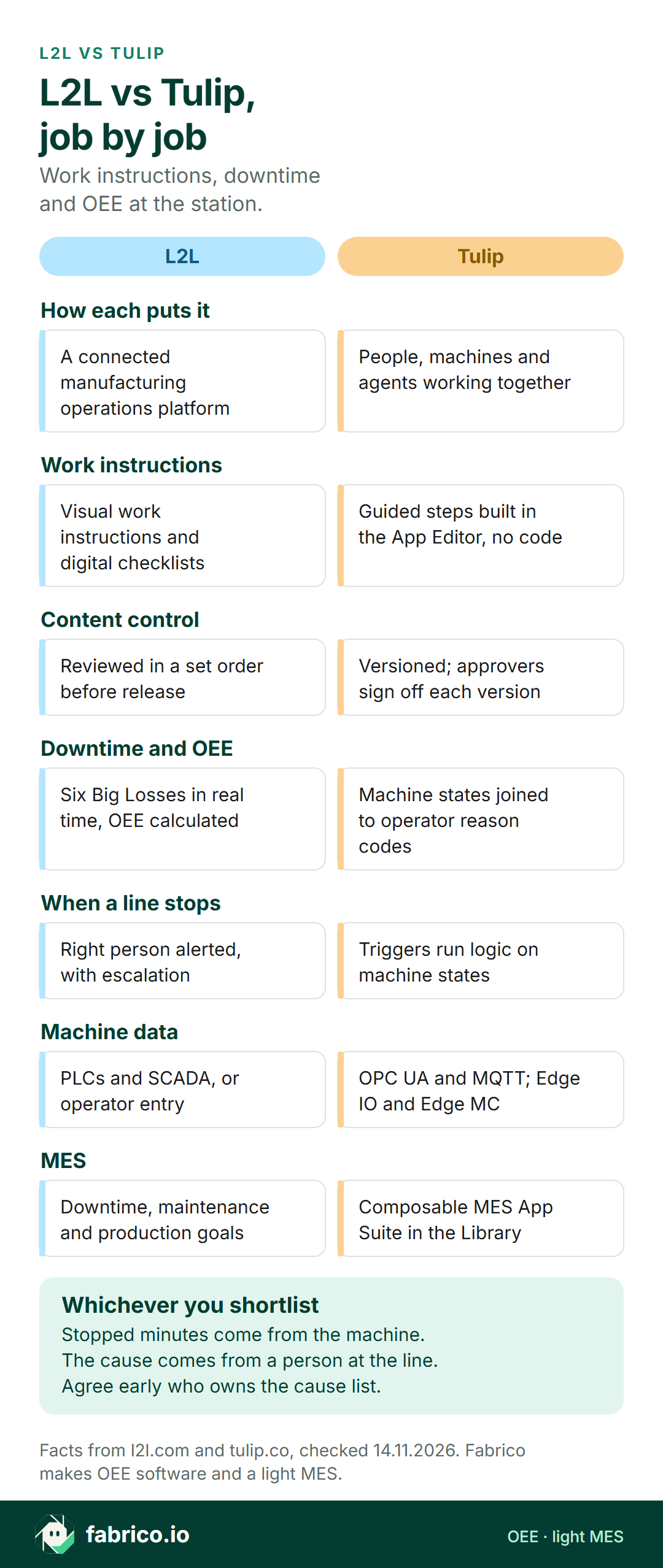
Text version of this infographic
- How each puts it. L2L: A connected manufacturing operations platform. Tulip: People, machines and agents working together.
- Work instructions. L2L: Visual work instructions and digital checklists. Tulip: Guided steps built in the App Editor, no code.
- Content control. L2L: Reviewed in a set order before release. Tulip: Versioned; approvers sign off each version.
- Downtime and OEE. L2L: Six Big Losses in real time, OEE calculated. Tulip: Machine states joined to operator reason codes.
- When a line stops. L2L: Right person alerted, with escalation. Tulip: Triggers run logic on machine states.
- Machine data. L2L: PLCs and SCADA, or operator entry. Tulip: OPC UA and MQTT; Edge IO and Edge MC.
- MES. L2L: Downtime, maintenance and production goals. Tulip: Composable MES App Suite in the Library.
- Whichever you shortlist: stopped minutes come from the machine, the cause comes from a person at the line, and the cause list needs one owner, agreed early.
Decision matrix: L2L or Tulip for your plant
Each row is a buyer situation, not a score. Read across to where to look first, the vendor page behind it (read on 14.11.2026) and the pilot test that settles the row before anyone signs a contract.
| If this is your plant | Look first at | Why (L2L or Tulip page) | Prove it in the pilot by |
|---|---|---|---|
| Night-shift stops go unnoticed until the morning meeting | L2L | Its maintenance management page alerts the right person the moment a machine goes down, with escalation built in | Stopping a test machine at 02:00 and timing the alert, the escalation and the first person at the machine |
| Changeovers overrun and nobody chases them | L2L | The same maintenance page names escalation for changeovers that run long | Letting one changeover overrun on purpose and logging who was called, and when |
| Process engineers want to change station steps themselves | Tulip | Its authoring page describes apps, logic and connectors made with no-code editing | Having a plant engineer, not the vendor, change one step and release it |
| Quality needs signed approval of each instruction version | Tulip | Its work instructions page has named approvers e-sign each new version before it deploys | Walking the quality lead through one revision, from edit to signature to the station |
| Operators must hold a skill before they run a machine | L2L | Its connected workforce page describes a dynamic skills matrix for machines and processes | Assigning a user without the skill and recording what the system does |
| Stations use USB scanners, calipers or scales | Tulip | Its Edge devices page lists scanners, calipers and scales run by its device drivers | Plugging in a plant caliper and reading a value into a step |
| Newer PLCs already speak OPC UA or MQTT | Tulip | Its OEE tracking page calls its OPC UA and MQTT connections native | Linking one PLC and comparing its stopped minutes with a stopwatch log |
| Older lines report through SCADA or operator entry | L2L | Its production management page takes data through PLCs and SCADA or operator entry | Running one shift on each input route and comparing the two stop logs |
| Whole assembly lines run by hand | Tulip | Its OEE page says it tracks production across entirely manual assembly lines | Counting one manual cell for a shift and checking the total against a hand tally |
Rows usually land on both sides. Then run both pilots on the same machine in the same weeks, and compare the stop logs minute by minute rather than the screens.
Signed instructions and audit trails
In a GMP plant, instruction control is a records question. EU GMP Annex 11 on computerised systems (accessed 14.11.2026) says "Electronic records may be signed electronically", and that such signatures should "be permanently linked to their respective record" and "include the time and date that they were applied." On change it says: "Any changes to a computerised system including system configurations should only be made in a controlled manner in accordance with a defined procedure."
Map that to the two products. Tulip's page describes approvers' electronic sign-off and a job record with step durations, operator, station and app version. L2L's describes a set review order before release and automated event logging. Both are product descriptions, not validation: ask each vendor which validation documents it supplies, and let the quality lead judge them before the pilot starts.
Where OEE fits beside L2L or Tulip
OEE multiplies availability, performance and quality. Stopped minutes and counts come from a machine signal; the reason comes from a person, because a PLC tag knows a tester halted, not that it waited for parts.
The ISA-95 standard (IEC 62264) gives this a frame: ISA says it integrates logistics systems with manufacturing control systems and sorts the work into layers by activity. Work instructions, dispatch and OEE all live in the operations layer between control and ERP, so both products reach into the same space. The ISA-95 guide walks through the levels.
| Your situation | Look first at |
|---|---|
| Technician dispatch and work orders hurt most | L2L's maintenance and dispatch pages |
| Stations need guided steps that change often | Tulip apps and digital work instructions |
| Lost time by cause is the ask, and nobody can build | Packaged OEE software next to either platform |
| Machines without a PLC signal | Operator entry, an Edge device, or a counting camera add-on |
Response time: the number to test in an L2L or Tulip pilot
Siemens' Senseye unit surveys large plants each year. Its True Cost of Downtime 2024 report (accessed 14.11.2026) says "An average large plant still loses 27 hours a month to unplanned downtime, down from 39 in 2019" and that plants "now suffer an average of 25 downtime incidents a month per facility, down from 42 in 2019." That is roughly 65 minutes per incident, and the report adds: "But the average plant is taking longer to get running again". It covers large plants in a few sectors, so read it as direction, not as a figure for a valve line.
The idea both products build on is old. Toyota's production system page (accessed 14.11.2026) calls jidoka "automation with a human touch": "the operator can stop the line by pulling the stop cord", and "When equipment stops, the andon (problem display board) lights up to notify workers of the abnormality." L2L's alerts with escalation and Tulip's triggers on machine states are software versions of that board. The demo shows the loop exists; the pilot shows how fast it closes.
Time three intervals per stop in the pilot: signal to alert, alert to a person at the machine, and person to running again. The first is software; the other two are people and parts.
Where Fabrico fits for connected worker buyers
Fabrico is a cloud OEE system with a light MES. Fabrico is not a connected worker suite, a no-code app builder, SCADA, connectivity software or an inspection vision system. Fabrico's part of this shortlist is downtime and OEE. Per the MES and OEE overview:
- The clock comes from the machine. A PLC, sensor or counter reports run, stop and count.
- The cause comes from the operator, who picks it on a tablet or phone beside the machine.
- OEE and lost time per line and shift, with each loss given a money value, in the web app plus iOS and Android.
- A counting camera add-on can be fitted on request where a hand station or older machine gives no usable signal; it tallies finished units. From the shift timeline, the video for that minute can be opened, streamed on request and not stored. Having the camera add-on propose a stop reason is on the Roadmap (camera add-on details).
- Figures leave Fabrico by REST API or webhooks, or as an Excel or CSV file.
Next to L2L or Tulip, Fabrico can be the system that holds the official OEE figure while instructions and dispatch stay in the platform you pick. Two pages go deeper on each pairing: Fabrico vs L2L and Fabrico vs Tulip.
To put a finished OEE screen next to what your shortlist would build, book a demo.
Worked example: a leak tester behind a hand assembly bench
Sample data, made up to show the method; it describes no real plant and no product screen. Valve bodies are assembled by hand at a bench, then pass a leak tester run by a PLC. A 490 minute shift less 35 minutes of breaks leaves 455 planned minutes. At an ideal 2 valves a minute, the tester could pass 910.
The tester's PLC logs 52 stopped minutes, so run time is 403 minutes and availability is 403 / 455 = 88.6%. In 403 minutes the ideal is 806 valves; the tester handled 712, so performance is 712 / 806 = 88.3%. Of those, 22 failed the leak test, leaving 690 good, so quality is 690 / 712 = 96.9%. OEE is 88.6% x 88.3% x 96.9% = 75.8%, and the cross-check 690 / 910 gives 75.8% too (OEE calculation).
The PLC records only that the tester sat idle for 52 minutes. People supply the split: 19 minutes waiting for valve bodies from the bench, 14 on a fixture seal change, 11 with nobody at the tester, 8 still uncoded at shift end. In an L2L setup, that halt would alert whoever is assigned to respond; in a Tulip setup, the bench's instruction app logs step durations that show why bodies arrived late. Bench and tester need one shared reason list.
Carried to money. Give each valve a sample contribution margin of EUR 4.20 (sample data, made up for this page; use the finance team's figure). At the ideal rate of 2 valves a minute, each stopped minute on the tester costs 2 x EUR 4.20 = EUR 8.40 of contribution.
| Sample data: cause | Minutes | Valves at ideal rate | Contribution (EUR) |
|---|---|---|---|
| Waiting for valve bodies | 19 | 38 | 159.60 |
| Fixture seal change | 14 | 28 | 117.60 |
| Nobody at the tester | 11 | 22 | 92.40 |
| Still uncoded at shift end | 8 | 16 | 67.20 |
| Total stopped | 52 | 104 | 436.80 |
The full gap to ideal is 910 possible minus 690 good, or 220 valves: 104 lost to stops, 94 to slow running (806 minus 712) and 22 to leak failures. At EUR 4.20 each that is EUR 924.00 a shift.
Assume two shifts on each of 21 working days, so 42 shifts a month, and 12 months a year. The stops alone come to EUR 18,345.60 a month and EUR 220,147.20 a year; the full gap, a ceiling rather than a target, to EUR 38,808.00 a month and EUR 465,696.00 a year. Watch the 19 minutes of waiting for bodies: EUR 159.60 a shift, EUR 6,703.20 a month, EUR 80,438.40 a year. That loss sits between an instruction problem at the bench and a response problem at the tester, where L2L and Tulip pitch different answers.
Questions to ask L2L and Tulip
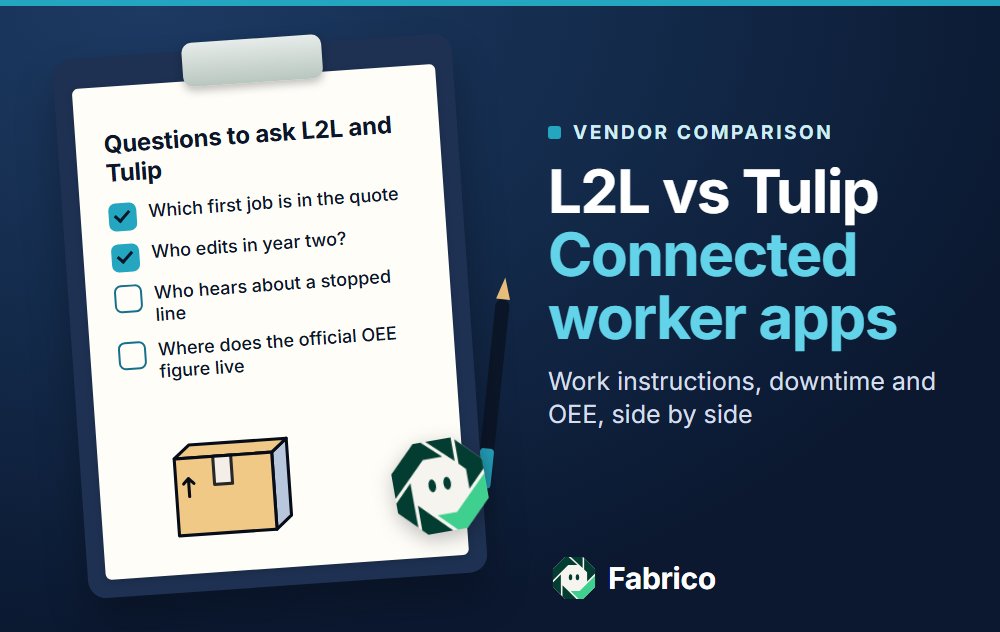
- Which first job is in the quote: dispatch and maintenance, work instructions, OEE, or all three?
- Who edits in year two? Name the person in the plant who changes a work instruction or a stop reason.
- How is a halt logged on a machine without a PLC, and how many taps does that take?
- Who hears about a stopped line, how does escalation work, and can we watch it live?
- How does a new instruction version reach the station, and who signs it off?
- Where does the official OEE figure live if another system also calculates it?
What to do this week
- Pick one machine with a known stop problem and pull last month's stop log, paper or not. Write down the stopped minutes and the top three causes.
- Price a stopped minute: ideal units a minute times the contribution margin per unit, as in the example above. Take the margin from finance, not from a vendor.
- Write a one-page scope naming the first job (dispatch, instructions or OEE), the owner of the stop reason list and the input route: PLC, OPC UA or MQTT, or operator entry.
- Send L2L and Tulip the same scope plus the decision matrix rows that apply, and ask each to show those rows live on a test machine rather than in slides.
- Put a night-shift stop test in the pilot plan: stop the machine, time signal to alert, alert to response and response to running, and check the reason lands in the OEE report.
- Name who signs off instruction changes (quality, production or engineering) before either vendor builds content.
Looking wider than this pair? See L2L alternatives and Tulip alternatives. If the plant packs consumer goods, the FMCG camera add-on guide explains where counting at a hand station fits, and the OEE software guide compares packaged OEE tools.
What people ask next
How do L2L and Tulip handle digital work instructions?
L2L offers visual work instructions, digital checklists and Digital Work Guides inside its Shop Floor Execution platform, reviewed by the right people in the right order before release. Tulip builds instructions as apps in its App Editor, with media, triggers, version control and approver sign-off.
Do L2L and Tulip track downtime and OEE?
Both name it on their pages. L2L describes the Six Big Losses in real time, OEE calculation and OEE Pareto reports. Tulip combines automated machine states with operator reason codes. With either, someone has to set up the reason list and keep it current.
Do L2L and Tulip read data from PLCs?
Per their pages, yes. L2L names data from PLCs and SCADA, or operator entry. Tulip names native OPC UA and MQTT connections, plus its Edge IO and Edge MC devices.
What is Tulip's Composable MES?
It is Tulip's way of assembling MES functions from apps. Its page names app templates, the Composable MES App Suite from its Library, a human-readable common data model and an open API.
Can I measure OEE without L2L or Tulip?
Yes. Fabrico, for one, reads machine run, stop and count signals from a PLC, sensor or counter, while operators pick the reason for a halt on a phone or tablet. Where a step has no usable signal, the Fabrico camera add-on counts output.
Want to see stop reasons and OEE from the machine signal before you choose between L2L and Tulip? Book a demo.
Related articles

Latest from our blog



Real Fabrico tiles, sample data.