


 Login
 Blog

Computer Vision for Motorcycle Manufacturing and Bicycles: Fix the Output Miscount

In short: a camera add-on counts output at hand stations in two-wheeler plants, so frames, wheelsets, repairs and crates are not counted twice or missed.
Weld, alignment, paint and road test checks are inspection, done by inspectors and test benches; Fabrico does no inspection and only counts.
- Count a frame once, at one owner station; the paint line hanger count is not a frame count.
- First-pass quality comes from the end-of-line test log; the boxing count also holds repaired bikes.
- Each e-bike drive and frame family needs its own ideal cycle time, taken from the build order.
- Where the camera add-on covers a station, the video for the minute of a stop is streamed on request and not stored in Fabrico.
The weld shop counts frames, the paint line hangers, the test bench passes and the boxing table cartons. Each is right about its own station; swapped for one another, they give OEE the wrong output. Eurostat counted 9.7 million bicycles produced in the EU in 2023, 24% fewer than in 2022. Among the countries whose figures are published (Germany and France are withheld as confidential), Portugal made the most, 1.8 million units. That count covers non-motorised bicycles only, so a plant building e-bikes and pedal bikes on one line already splits its output for the statistics return.
Bicycle and motorcycle output miscounts: the audit table
Six miscounts turn up in two-wheeler plants again and again. Each has a fix and one station that owns the count. The last column is the question for any camera vendor.
| Miscount | What goes wrong | Fix | Station that owns the count | Ask the vendor |
|---|---|---|---|---|
| Frames at weld and at paint | One frame counted at the jig, on a paint hanger and at decals | Count frames once; the rest are checkpoints | Decal bench exit | Which station is the frame count? |
| Wheelsets built ahead | Truing cycles and tomorrow's wheels read as today's output | Count wheelsets at the tyre bench | Tyre bench exit | Pairs or singles? |
| Repaired bikes counted twice | A repaired bike's retest pass is counted as good | Quality from the first test only | End-of-line test log | How do test fails reach quality? |
| E-bike drive variants | One ideal time makes a slow model look like a slow crew | Ideal cycle time per model family | Line exit, family from the build order | How is ideal time set per family? |
| Boxed vs shipped | Cartons hold repaired bikes and dock stock | Count closed cartons; shipping stays in the ERP | Boxing or crating station | Can it count a carton with parts packed loose? |
| Motorcycle engine sub-assembly | Engines or nutrunner cycles reported as motorcycles | Engines are a feeder count | Engine test bench; main line exit | How are nutrunners and test benches read? |
Only some of these counts need a camera. Robot weld cells, CNC benders, truing machines and a motorcycle main line PLC count through their controllers. A manual TIG jig, a tyre bench, the rework bay and the boxing table leave a tally sheet or a counter display at best; there a counting camera gives OEE an output figure where no machine counts. Which of those counts is good and which is total is set out in good count vs total count.
Explainer presented by Iris, Fabrico's AI-generated presenter: how an add-on camera counts output where a machine has no signal. Book a demo.
Plays from YouTube. Google may set cookies when you press play. Privacy policy.
Miscount 1: frames counted at the weld jig and again at paint
Butted or hydroformed tubes are cut, mitred and bent on saws, end formers and CNC benders that count in the controller; motorcycle trellis frames and swingarms add bracket machining. A robot weld cell reports through its controller too, with fixture loading, wire and tip changes and parts waits as its losses (OEE for robotic welding cells). Many plants still TIG weld frames by hand in a jig, for aluminium bicycle frames, small series and low-volume motorcycle frames. The jig has no counter. A camera add-on aimed at the jig exit counts frames lifted off. Aim the lens away from the arc: weld flash blinds a sensor.
Many aluminium frames then go through solution heat treatment and ageing, and the furnace keeps a batch log (OEE for heat treatment). Around it, frames are checked on an alignment table and cold set by hand, which is inspection work. The paint or powder line PLC counts hangers, not good frames: an empty hook and a frame sent back for repaint pass the same counter. Decals go on by hand, often before a clear coat.
The miscount. Add the jig count, the hanger count and the decal count into one "frames made" figure and one frame is counted three times; a repaint adds a fourth. The fix. Name one station as the owner of frames made. The decal bench exit is a sound choice, because a frame that leaves it is released to assembly, and a camera add-on there counts frames sent on. The jig and furnace counts become checkpoints: the gap between the jig count and the decal count is the stock of frames sitting in heat treatment and paint. Book empty hangers as a loss of their own, and log repaints from the paint line's reject list; across several frame stations, rolled throughput yield shows what each one costs.
Miscount 2: wheelsets built ahead of the bike line
Spokes are laced by hand or on a lacing machine; nipple tightening and truing run on automatic machines that count their own cycles. Rim tape, tyre, sealant, inflation, cassette and brake rotor then go on at a bench, often by hand.
The miscount. Truing cycles are read as wheels ready, though a wheel trued twice adds a cycle and no wheel. Wheels built ahead for tomorrow's model look like today's output while the line waits for the wheel it needs. Singles read as pairs double the figure.
The fix. Count wheelsets at the exit of the tyre fitting bench with a camera add-on, and decide before the first shift whether the count is pairs or singles. Truing cycles stay machine data for the truing machine's own performance. Wheels built ahead are a buffer: count them as wheel output when they leave the bench, never as bike output, and cap how far ahead the wheel shop builds (see kanban vs CONWIP). A wheel shortage then shows up when it starts, before it starves the assembly line.
Miscount 3: repaired bikes counted twice
The end-of-line bench for e-bikes logs a pass or a fail per bike, using the drive maker's diagnostic tool, which reads out the condition of the drive components. The bench's pass and fail log is the first-pass quality count. A bike that fails goes to the rework bay, is fixed, and comes back to the bench for a second test.
The miscount. Count passes, and the repaired bike is a good bike twice: once in the rework bay's tally and once in the second bench pass. The boxing table then counts its carton like any other. Report the carton count as good output and quality looks better than the line ran.
The fix. OEE quality takes the first test of each bike only (see yield vs first pass yield). A camera add-on at the rework bay exit counts units repaired and sent on, so rework has its own number. Price rework at the crew time it took, not as lost margin, because the repaired bike still ships (scrap vs rework). On a motorcycle line, the roller test bench, brake and ABS checks and headlight aim produce inspection results whose fails go to the quality count, and the repair bay gets its own count.
Miscount 4: e-bike drive variants under one ideal time
CONEBI, the European bicycle industry body, notes that the production of pedal assist e-bikes is predominantly a European business. An e-bike adds the drive unit, battery mount, display, harness and an end-of-line test, so a mid-drive trekking bike and a city bike do not take the same minutes. Battery packs have their own page, computer vision for battery manufacturing, and drive motors sit closer to computer vision for electrical equipment manufacturing.
In the US, the CPSC bicycle rules count a two- or three-wheeler with working pedals and a motor under 750 watts, whose top speed on the motor alone is under 20 mph, as a bicycle, so such an e-bike must meet the same frame and fork requirement as a pedal bike: 890 N (200 lbf) or at least 39.5 J without visible fracture. That is a lab test on sample frames, run by the quality team, not a count.
The miscount. One ideal cycle time for the whole line makes a shift of full-suspension e-bikes look slow and a shift of city bikes look fast, though both crews ran at pace. The fix. Set an ideal cycle time per model family and take the family from the build order, so each counted bike earns the right minutes.
Staffing matters too. Line balancing research by Koltai and Tatay published in Periodica Polytechnica sets out low skill constraints for workers able to perform only some simple tasks and high skill constraints for tasks that need above-average skill. A cockpit station routing cables inside the frame is a high skill task. Keep its ideal cycle time fixed when a new fitter takes it over, so the gap shows up as slow running, where the line lead can see it.
Miscount 5: boxed is not shipped
Bikes go into a carton part-assembled: bars turned, pedals off, sometimes the front wheel out. Motorcycles leave in a steel crate or a carton, with mirrors, screen or bars packed loose, and crating is hand work with a tally sheet. The miscount. The carton count at the boxing table is what shipping sees, and it also holds bikes repaired in the rework bay. Cartons may sit on the dock for days, and a carton opened again for a missing part and closed again passes the table twice.
The fix. A photo eye on a carton conveyor counts whatever breaks the beam; a camera add-on at the boxing table or crating station counts closed cartons and crates, whatever is packed loose inside. That count is boxed output. Shipped output stays in the ERP, and boxed minus shipped is the dock buffer. Cartons reopened for a missing part go on the rework list, so they can be taken off the boxed count.
Miscount 6: motorcycle engines counted at the sub-assembly line
A motorcycle is built on a paced main line: frame onto the carrier, engine fitted into the frame, swingarm and suspension, wheels, harness, tank and bodywork, fluids, then the end-of-line checks. The line PLC knows each takt, so the exit count is already there. ACEM, the European motorcycle makers' association, lists 17 member brands operating 21 factories. A plant that builds its own engines feeds them to the main line from an engine sub-assembly line.
DC nutrunners log torque and angle for the tightenings they make, and engine test benches log their runs. The miscount. A nutrunner log counts tightenings, and a joint tightened again after a fault adds cycles but no engine. Engines built ahead of the main line, or waiting for frames, get reported as motorcycles made. The fix. Count engines from the engine test bench pass, as a feeder count. Count motorcycles at the main line exit from the PLC. The camera add-on earns its place around the main line: the wheel and bodywork kit benches, the repair bay after end-of-line test, and crating.
Suppliers that also make parts for car makers have their own page, computer vision for automotive parts manufacturing.
Example plant flow: one owner for each count
An example layout, not a real plant: frames run down the main flow, wheels and engines feed the line, repaired units loop through the rework bay.
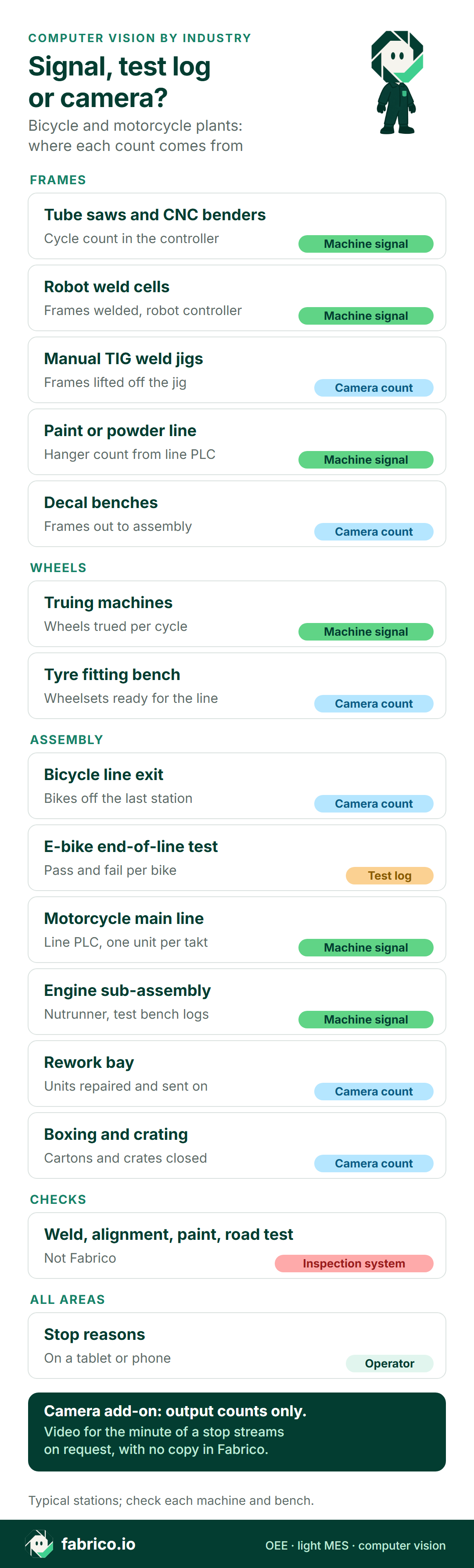
Text version of this infographic
- Frames: tube saws and CNC benders: machine signal, cycle count in the controller
- Frames: robot weld cells: machine signal, frames welded, robot controller
- Frames: manual TIG weld jigs: camera count, frames lifted off the jig
- Frames: paint or powder line: machine signal, hanger count from line PLC
- Frames: decal benches: camera count, frames out to assembly
- Wheels: truing machines: machine signal, wheels trued per cycle
- Wheels: tyre fitting bench: camera count, wheelsets ready for the line
- Assembly: bicycle line exit: camera count, bikes off the last station
- Assembly: e-bike end-of-line test: test log, pass and fail per bike
- Assembly: motorcycle main line: machine signal, line PLC, one unit per takt
- Assembly: engine sub-assembly: machine signal, nutrunner and test bench logs
- Assembly: rework bay: camera count, units repaired and sent on
- Assembly: boxing and crating: camera count, cartons and crates closed
- Checks: weld, alignment, paint and road test: inspection system, not Fabrico
- All areas: stop reasons from the operator, on a tablet or phone
- Camera add-on: output counts only. Video for the minute of a stop streams on request, with no copy in Fabrico
Book a demo to see weld jigs, tyre benches and the boxing table counted on one shift timeline.
Audit shift: one e-bike line, recounted
Example numbers, no real plant. An e-bike line works the early shift, 06:00 to 14:00. Take out the half-hour break (breaks are not planned time) and 450 minutes remain. The ideal cycle time at the line exit is 3 minutes per bike for this model family, or 20 bikes an hour. One camera add-on counts bikes leaving the last station, a second counts closed cartons at the boxing table, the test bench logs pass and fail, and stop reasons come from the line lead.
Availability. The changeover from a trekking model to a city model, with a different frame, drive and colour, took 25 minutes of changeover time. Brake sets for the city model reached the line 20 minutes late. The test bench PC hung for 10 minutes and the line stopped behind it. The line ran 395 of 450 minutes, with 55 lost: 87.8%.
Performance. The camera add-on at the line exit counted 120 bikes. 120 bikes at 3 minutes is 360 ideal minutes, set against 395 minutes run: 91.1%.
Quality. Six bikes failed the end-of-line test: four with a drive error from a pinched sensor cable, two with a display that would not pair. That leaves 114 first-pass bikes of 120: 95.0%.
OEE. 87.8% x 91.1% x 95.0% = 76.0%. The quick check: 114 good bikes x 3 minutes = 342 minutes, and 342 of 450 planned minutes is 76.0%.
The recount. The boxing table count was 119 cartons: the 114 first-pass bikes and 5 of the 6 repaired in the rework bay. Boxed output is 119, and OEE quality stays at 114, because a repaired bike was built twice. Had the shift report taken the 119 cartons as good bikes, quality would read 99.2% (119 of 120) and OEE 79.3% (357 of 450 minutes): three points of OEE that the line never ran.
In money. No public margin figure for an e-bike line was found, so the input is an example. The 108 minutes between 342 and 450 are 36 bikes at 3 minutes each. At an example contribution margin of EUR 150 per bike, a figure each plant replaces with its own, the shift left EUR 5,400 of contribution capacity unused, and the changeover and the late brake sets (45 minutes, 15 bikes) account for EUR 2,250 of it. The five repaired bikes shipped, so they cost rework crew time, not margin. Fabrico prices each loss the same way, from the plant's own SKU price or margin.
The hourly line exit counts put 24 of the 35 slow minutes in the two hours after the changeover, when the line made bikes at 16 an hour of running instead of 20. The city frame routes its brake hose and cables inside the frame, and the cockpit station could not keep pace, a pattern covered in stops after changeover. The line lead marked those two hours on the shift timeline and booked the cause against the cockpit station.
What a camera count can and cannot settle
A counting camera settles how many units left a station, not whether a weld, frame or paint film is good; that is work for inspectors, gauges and test benches, whose fail counts reach OEE quality.
Published evidence on count reliability is thin, and none comes from a bike plant. A peer-reviewed study in Sensors by Ye and colleagues tested a camera portal that checks car components on transport racks; over four days, 294 racks and 5,880 parts, it reports that the system achieves a comprehensive accuracy of 97.3%. That is recognition accuracy for parts sitting on a rack, not a count of units leaving a station, and more limits come with it. The racks stopped inside an enclosed portal lit by its own LED lights before four cameras took images, so neither moving parts nor open shop-floor light was tested. The authors say the baseline detector found it hard to identify "densely stacked components in complex backgrounds". And they write that "its static architecture is incapable of recognizing newly introduced parts that were not present in the original training data".
For a two-wheeler plant: count one unit at a fixed exit spot, not a stacked rack; expect a new frame or drive variant to need teaching before it is counted; keep hands, the arc and glare out of the counting zone. The 97.3% belongs to a car-parts portal, not a bike line, and is not a Fabrico accuracy figure.
Welders, fitters and the works council
Any lens over a weld jig or a fitting station takes in welders and fitters. Settle the purpose of the count with the people on the line first, and with the works council if the plant has one. In Germany this is a legal duty: section 87 of the Works Constitution Act gives the works council co-determination over technical devices designed to monitor the behaviour or performance of employees, so a lens over a jig needs that agreement before it goes up. Point the camera at the jig exit, the line exit or the closed carton, not at the person, and report by station and shift only, never by name.
Where Fabrico holds the count
Fabrico runs in the cloud as OEE software with light MES functions. Today, in a bicycle or motorcycle plant, that means:
- In the tube shop, weld cells and on the main line Fabrico reads run state and cycles from benders, robot controllers, truing machines and the line PLC, and changeovers, parts waits and faults land on the timeline as stops that need a reason.
- At weld jigs, tyre benches, the line exit, the rework bay and the boxing or crating station the camera add-on counts frames, wheelsets, bikes, cartons and crates. If a station falls quiet, the video for the minute of that stop can be opened from the shift timeline, streamed on request from the camera add-on and not stored in Fabrico.
- Per model family you set an ideal cycle time, so a counted bike or motorcycle earns the minutes its family takes.
Welders, fitters and line leads enter the stop reason at the station, from a tablet or phone. Dashboards on the web, iOS and Android give OEE and losses per station and shift, each loss priced in money. Counts and stops go to the ERP over a REST API or webhooks, or as Excel and CSV files.
Roadmap only: the camera add-on spotting an idle weld jig or boxing table by itself and offering a probable cause.
Outside Fabrico: weld, alignment and paint inspection, end-of-line and roller test results, drive configuration, and serial and VIN records, which stay in the test systems and the ERP.
Read more on Fabrico computer vision for OEE, the product page, and OEE software, the wider buying guide. For the bike line itself, see OEE on manual and hybrid assembly lines.
Bicycle and motorcycle miscount questions
Where should a bicycle or motorcycle plant put its first camera?
A good first camera goes at the boxing or crating station, or at the exit of a bike assembly line that has no PLC count, because finished units leave there and the only record is a tally sheet. Robot weld cells, truing machines, nutrunners and a paced motorcycle main line already count through their controllers.
Does a repaired bike count as good output?
Not for OEE quality. A bike that failed the end-of-line test and was fixed in the rework bay was built twice, so quality uses the first-pass count. It still counts in boxed output, and shipped output comes from the ERP.
Should frames be counted at the weld jig or at paint?
Pick one station for frames made and treat the others as checkpoints. The paint line counts hangers, including empty hooks and repaints, so it is never the frame count. The decal bench exit, where frames are released to assembly, is a sound owner.
Want to see a bike line exit, its test bench results and the boxing table on one shift timeline? Book a demo.
Related articles




Latest from our blog







Real Fabrico tiles, sample data.