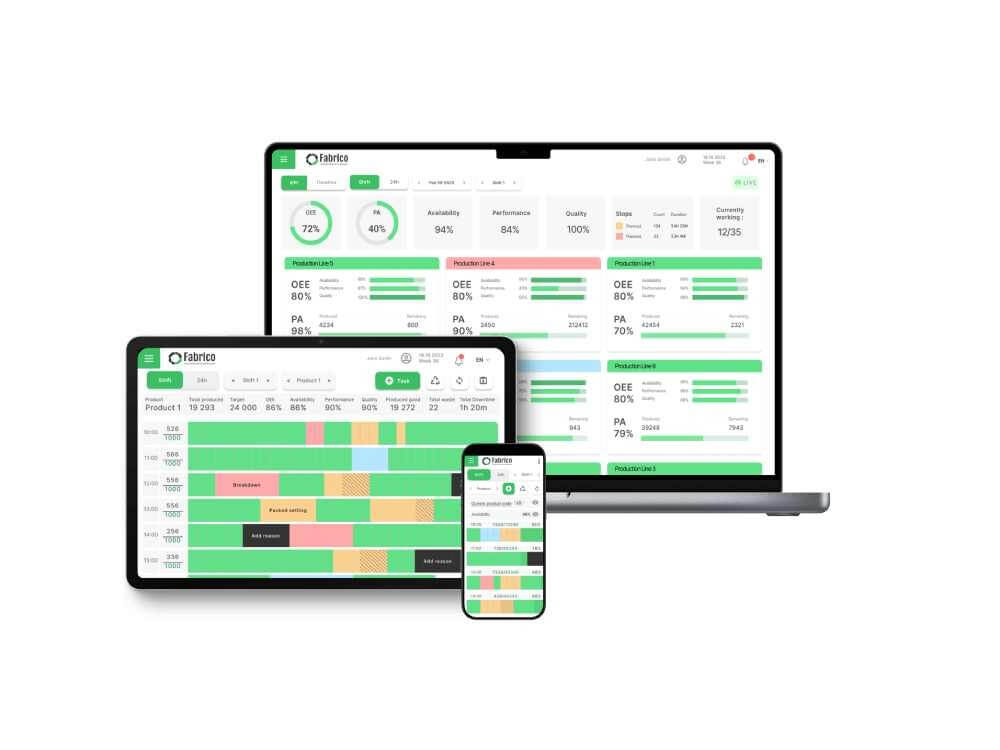

The fundamental difference between Fabrico and eMaint is not feature parity, both platforms provide maintenance management, work order handling, and equipment tracking.
See our roundup of affordable CMMS software.
The difference is whether OEE and CMMS data live in the same system or in two systems connected by an integration.
Fabrico is built as a combined OEE and CMMS platform where production efficiency data and maintenance management data share the same database, the same equipment records, and the same analytical layer.
eMaint is a CMMS platform that integrates with OEE and condition monitoring tools (particularly Fluke instruments) via connections, where the two data streams remain in separate systems.This architectural difference matters most for manufacturers who want to understand the relationship between maintenance decisions and production efficiency outcomes.
When a planned maintenance event is scheduled in Fabrico, the OEE system automatically accounts for it as planned downtime in the efficiency calculation.
When a corrective work order is raised from an OEE downtime event, the maintenance record is created directly from the production event without manual data re-entry.
In an eMaint plus OEE integration architecture, these workflows require data to flow between systems, which adds latency, creates synchronization dependencies, and requires ongoing integration maintenance as both systems evolve.For manufacturers whose primary driver is condition monitoring integration specifically with Fluke instruments, vibration meters, thermal cameras, ultrasonics, eMaint's native Fluke connectivity is a genuine advantage that Fabrico does not replicate.
Fluke instrument users who want direct sensor-to-CMMS data flow for CBM work order triggering will find eMaint's Fluke integration more seamless than connecting Fluke instruments to a non-Fluke CMMS platform.
In core CMMS functionality, preventive maintenance scheduling, work order management, parts inventory, and purchasing, both Fabrico and eMaint cover the standard requirements for mid-market manufacturers. eMaint has a longer track record as a pure-play CMMS and some manufacturing organizations find its PM scheduling configurability and reporting more mature for dedicated maintenance management workflows.
Fabrico's maintenance management capability is designed around the integrated OEE use case, which means it is optimized for maintenance teams managing equipment that is also monitored for production efficiency, the dominant scenario in OEE-deploying manufacturing plants.OEE capability is where the comparison diverges most clearly.
Fabrico provides full OEE monitoring, automated machine state collection via PLC/OPC-UA, real-time OEE dashboards, shift performance analysis, downtime Pareto reporting, and OEE trend analytics, as core platform functionality. eMaint's OEE capability is limited to what can be constructed from its work order and downtime tracking features, supplemented by Fluke condition monitoring data.
For manufacturers whose OEE monitoring requirements go beyond basic downtime tracking, automated data collection, real-time dashboards, performance rate calculation from machine speed data, eMaint requires integration with a dedicated OEE platform to match Fabrico's native OEE capability.Mobile capability in both platforms supports field maintenance execution, but the design philosophy differs.
eMaint's mobile app is a mature CMMS field execution tool; Fabrico's mobile experience is designed for both production floor operators monitoring OEE and maintenance technicians executing work orders from the same production equipment context.
For manufacturing organizations where OEE monitoring and maintenance management are performed by different teams but on the same equipment, Fabrico's unified mobile context is more natural than eMaint's maintenance-only mobile focus.
Choose Fabrico when:
In Fabrico, this workflow happens within a single system with shared data at every step.
In eMaint plus OEE integration, each step crosses a system boundary. The operational friction of crossing that boundary, for every downtime event, every shift, on every line, is the cost that Fabrico's integrated architecture eliminates.



















 Login
Login
 Blog
Blog