
Oracle Enterprise Asset Management (Oracle EAM), part of Oracle E-Business Suite and Oracle ERP Cloud, provides maintenance management functionality deeply integrated with Oracle's financial, purchasing, and inventory modules.
See our broader guide to EAM vs CMMS.
For manufacturers running Oracle ERP, Oracle EAM offers the same primary advantage as SAP PM: native ERP integration that eliminates the data synchronization complexity of a standalone CMMS.
Work order costs post to Oracle GL automatically, maintenance parts consumption updates Oracle Inventory in real time, and purchase requisitions from parts reorder flow into Oracle Purchasing without custom integration.The production floor limitations of Oracle EAM mirror SAP PM's limitations: a user interface designed for ERP users rather than production operators and maintenance technicians, a lighter native OEE monitoring focus capability, and configuration complexity that requires Oracle functional consultants for routine changes.
Oracle EAM is used by finance and maintenance planning teams who work within the Oracle environment
it is rarely the system that production floor operators interact with directly, and it puts less emphasis on real-time visibility into production efficiency that line supervisors use for shift management decisions.Fabrico enters the Oracle manufacturing environment as the production floor layer that Oracle EAM is less focused on
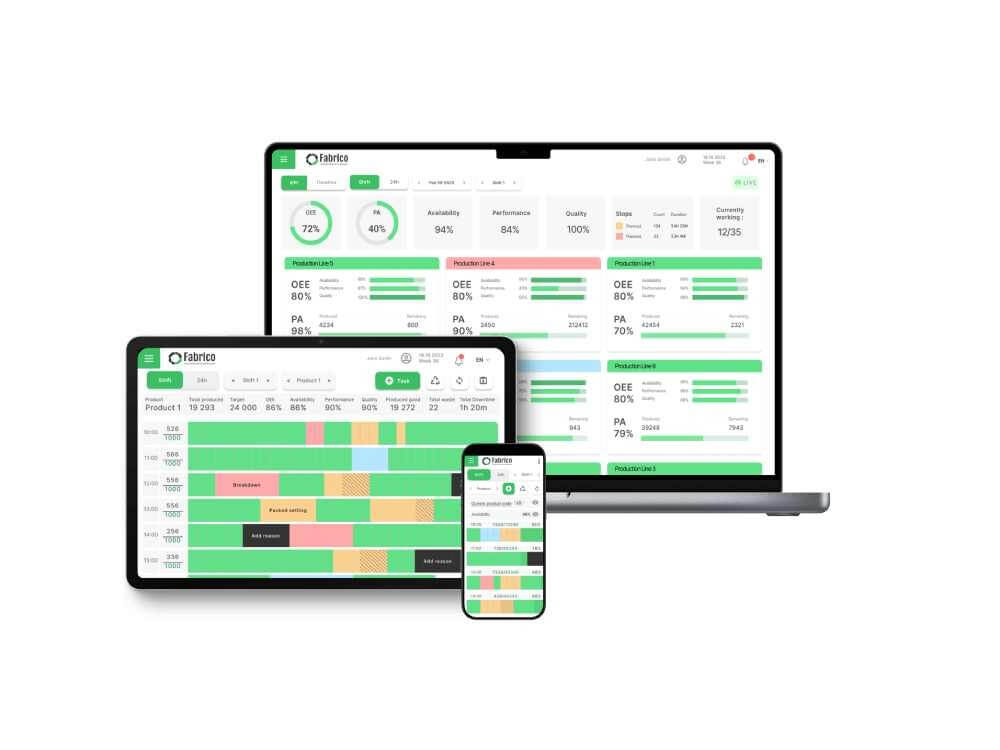
real-time OEE dashboards, automated machine state collection, downtime event acknowledgment for operators, and work request submission that creates maintenance events visible to the Oracle EAM team.
The integration question is the same as the SAP case: whether connecting Fabrico's production floor data to Oracle EAM's back-office maintenance management creates sufficient value to justify the integration investment and dual-system management overhead.
OEE monitoring is the gap Fabrico fills in Oracle EAM environments.
Oracle EAM is not positioned to calculate Availability, Performance, or Quality in real time from production data, these metrics must be calculated externally and reported into Oracle's analysis tools if manufacturers want them.
Fabrico's automated OEE monitoring provides these metrics continuously, from PLC-connected production data, on the dashboards that production managers need for shift-level decision-making.Production-maintenance integration is the second value layer.
When a production line stops and an operator acknowledges the downtime reason in Fabrico's operator interface, the maintenance team can see the pending work request in Fabrico alongside the OEE impact of the ongoing stoppage.
When the maintenance technician resolves the issue and closes the work order in Fabrico, the OEE system automatically records the downtime as resolved.
This closed-loop workflow, from production event to maintenance response to OEE recovery, is only possible when OEE and CMMS are integrated in the same platform or closely linked systems.For Oracle manufacturers evaluating Fabrico, the deployment model typically involves Fabrico running on the production floor for OEE monitoring and field maintenance workflows, with work order summary data syncing to Oracle EAM for financial cost posting.
Oracle remains the financial system of record; Fabrico is the operational production floor system. This hybrid architecture gets the best of both systems.
Oracle's financial integration quality and Fabrico's production floor usability, at the cost of integration complexity that is manageable but not trivial.
Oracle manufacturers should evaluate Fabrico versus Oracle EAM enhancement options (Oracle ME, Oracle IoT Asset Monitoring Cloud) before committing to a Fabrico deployment.
Oracle's own production monitoring and IoT asset management cloud products have improved significantly in recent years and provide Oracle-native integration that third-party platforms like Fabrico require custom integration to achieve.
For Oracle manufacturers who want to stay within the Oracle ecosystem and benefit from tight ERP integration throughout the stack, evaluating Oracle IoT Asset Monitoring Cloud alongside Fabrico is the responsible due diligence step.The evaluation criteria that favor Fabrico over Oracle's own production monitoring tools are: time-to-value (Fabrico deployments typically go live in weeks versus Oracle cloud product implementations that can take months)
OEE-specific functionality depth (Fabrico was purpose-built for OEE whereas Oracle's products are more generic IoT asset monitoring)
and production floor usability for non-Oracle users (Fabrico's interface is optimized for operators who do not work in Oracle, while Oracle products assume Oracle familiarity).The key financial question is whether the OEE visibility and maintenance responsiveness improvement Fabrico provides is worth the integration investment and ongoing dual-system management cost in an Oracle environment.
For Oracle manufacturers without current OEE monitoring, the answer is usually yes, the productivity gains from OEE visibility and better maintenance-production coordination are substantial and well-documented. For Oracle manufacturers with adequate existing OEE monitoring via Oracle tools, the marginal benefit of switching to Fabrico may not justify the migration cost and integration complexity.


















 Login
Login
 Blog
Blog