





 Login
 Blog
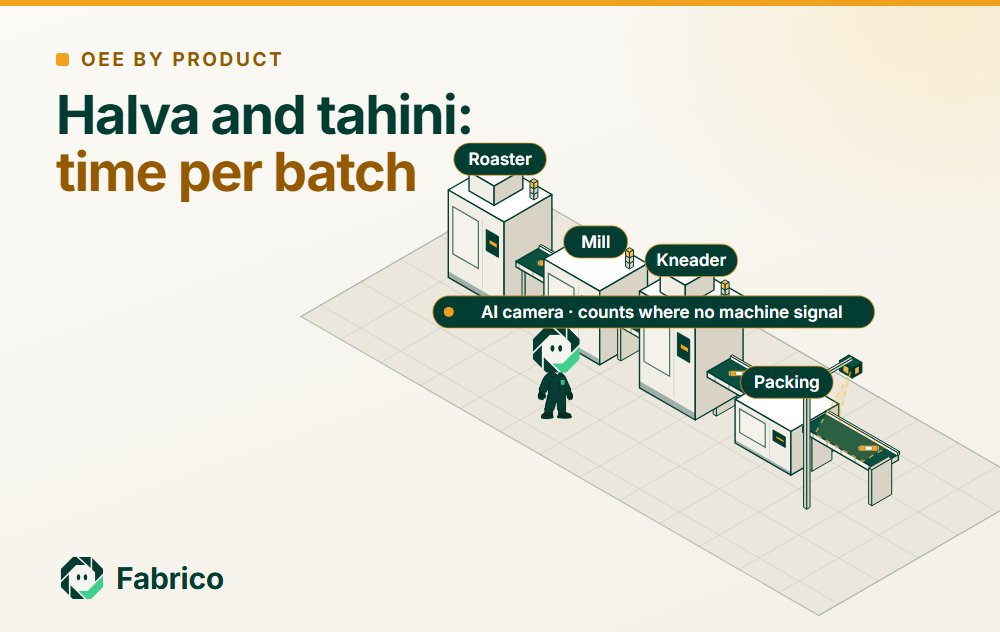
OEE in halva and tahini production: time per batch

In short
- Halva is made in batches, so OEE is measured in batches. The ideal is a cycle time for one batch. A slow batch is speed loss, not downtime.
- The syrup sets the pace. If the syrup boiler is not ready, the kneader waits, and in the report this looks like the kneader's own downtime.
- In the example below, the shift loses 580 EUR. The biggest causes are slow batches and the changeover from pistachio halva to cocoa halva.
- Tahini is a separate process with a separate OEE: hulling and roasting the sesame, then grinding. It feeds the halva and should be measured before it.
OEE in halva production measures how much of the planned time the kneader turns into good halva (a sweet made of tahini and sugar syrup) that is formed, cut and packed. The main losses are waiting for syrup, changeovers between halva types with cleaning, slow batches, stops at forming and cutting, and rejects for separated oil, broken bars and weight.
This article is for owners, production directors and process engineers in plants that make halva, tahini and sesame products. It shows how to measure a batch process, how syrup and tahini are recorded against the kneader, and a worked example of one shift in euros.
Halva in the Bulgarian confectionery industry
According to Eurostat structural business statistics, in 2024 the group "Manufacture of cocoa, chocolate and sugar confectionery" in Bulgaria had 197 enterprises with 3,683 people employed (accessed 26.11.2026). Halva makers belong to this group.
Tahini halva is a traditional product in Bulgaria. A halva plant may also make tahini, from sesame or sunflower seeds, either as a product of its own or only for its own halva.
From sesame to bar: the stages
| Stage | What it does | Losses |
|---|---|---|
| Hulling and roasting the sesame | Prepares the seed for grinding | Unevenly roasted seed, oven stops |
| Tahini mill | Grinds the sesame into a paste | Overheating, changing the stones |
| Syrup boiler | Boils the sugar syrup and whips it with soapwort root extract | Syrup not ready on time |
| Kneader | Mixes the tahini with the syrup in batches | Slow batch, waiting for syrup |
| Forming, cutting, packing | Shapes bars or tubs, packs them | Jams, broken bars, weight |
The definitions of availability, performance and quality follow ISO 22400-2 (accessed 26.11.2026). In halva, the core machine is the kneader: it decides how much halva comes out of the shift. Syrup and forming are recorded as reasons for its stops.
OEE of a batch process
On a continuous line, the ideal is a rate: pieces per minute. On a kneader, the ideal is a cycle time for one batch: loading, kneading, emptying. If the ideal 100 kg batch takes 20 minutes, the ideal rate is 5 kg per minute.
Batch processes have their own standard for models and terms, ISA-88 (accessed 26.11.2026). It describes the recipe, the phases and the batch so that every batch has a start, an end and a record. For OEE this means one thing: record the start and the end of every batch.
A batch that takes 24 minutes instead of 20 is not downtime. The kneader is running, only slowly. Those 4 minutes are speed loss. If the time of each batch is not recorded, the loss only shows up as fewer kilograms at the end of the shift, with no explanation.
Why are batches slow? Check temperature first. With cooler syrup and thicker tahini, kneading goes on longer until the halva turns fibrous. Record the syrup temperature at every load and the link becomes visible. If slow batches cluster in the first hours of the shift, the boilers and pipes may still be warming up.
The syrup: the boiler that sets the pace
The sugar syrup for halva is boiled to a set temperature and density. Soapwort root extract, whipped into the syrup, gives the white colour and the fibrous texture. Boiling takes time and cannot be sped up much without changing the halva.
If there is only one syrup boiler and it cannot keep up, the kneader waits after every batch. On the kneader this is recorded as "starved (waiting for product)" with a syrup sub-reason. The report then shows that the bottleneck is the boiler, not the kneader.
It also helps to record the moment the syrup is ready. The gap between "syrup ready" and "kneader ready for the next load" shows who is waiting for whom. If the syrup waits for the kneader, the boiler has spare capacity. If the kneader waits for the syrup, a second boiler or an earlier start to boiling wins the minutes back.
Tahini: a separate process, a separate number
Tahini is made from hulled and roasted sesame, ground into a smooth paste. The tahini mill is a separate machine with a separate OEE. It has to stay ahead of the halva. If the tahini runs out, the kneader stops, and again the cause sits outside it.
Measure the OEE of the mill in kilograms of tahini, and separately the OEE of the kneader in kilograms of halva. Together the two numbers show whether the problem is in the tahini, in the syrup or in the halva itself. If the mill also makes tahini for sale, the plan has to leave enough for the halva.
Halva types and allergens
Sesame is an allergen. Annex II to Regulation (EU) No 1169/2011 lists sesame among the substances that cause allergies, together with nuts and peanuts (accessed 26.11.2026). Sesame halva contains sesame, so sesame is not a reason to clean between sesame types. Sunflower halva is another case: after sesame halva, the line is cleaned completely.
Nuts, however, are such a reason. The changeover from plain halva to pistachio halva is short: the pistachios are added. The opposite direction, from pistachio halva to plain or to cocoa halva, needs a full clean of the kneader and of forming. Order the week from the types without nuts to the types with nuts.
Set a standard for each direction of the changeover. More on the changeover table by allergen is in the article allergen changeover matrix.
Batches, syrup, changeover: one shift in euros
The numbers are an example, not from a real customer. The kneader makes 100 kg batches with an ideal cycle of 20 minutes, which is 5 kg per minute. The shift has 450 planned minutes. Stops between batches longer than 2 minutes are downtime. The ideal for the shift is 2,250 kg. In the middle of the shift, the line moves from pistachio halva to cocoa halva, the expensive direction, with a full clean.
The price in the example is 1.00 EUR contribution per kilogram of halva. It is deliberately set low. For comparison, data from Aswath Damodaran (NYU Stern) gives a gross margin of 23.23 % for American listed food processing companies (data as of January 2026, accessed 26.11.2026). Replace it with your own.
| Reason | Stops | Minutes | Recorded as | Kg of halva | EUR per shift |
|---|---|---|---|---|---|
| Slow batches, over 20 minutes | 10 batches × 3 min | 30 | speed loss | 150 | 150.00 |
| Changeover from pistachio to cocoa | 1 × 30 min | 30 | downtime | 150 | 150.00 |
| Waiting for syrup | 4 × 6 min | 24 | downtime, syrup sub-reason | 120 | 120.00 |
| Forming and cutting | 5 × 4 min | 20 | downtime | 100 | 100.00 |
| Rejects: separated oil, broken bars, weight | 60 kg | quality | 60 | 60.00 | |
| Total | 104 | 580 | 580.00 |
How the numbers add up:
- Downtime: 30 + 24 + 20 = 74 minutes, run time 376 minutes. Availability: 376 / 450 = 83.6 %.
- In 376 minutes, the ideal is 1,880 kg. Slow batches take away 150 kg. Output is 1,730 kg (the last batch is unfinished at the end of the shift). Performance: 1,730 / 1,880 = 92.0 %.
- Rejects 60 kg, good 1,670 kg. Quality: 1,670 / 1,730 = 96.5 %.
- OEE: 83.6 % × 92.0 % × 96.5 % = 74.2 %. Check: 1,670 / 2,250 = 74.2 %.
- The loss: 580 kg × 1.00 EUR = 580.00 EUR per shift.
By value, slow batches and the changeover come first, at 150.00 EUR each. Slow batches stay invisible unless the time of every batch is recorded. The changeover depends on the order of the week: in the opposite direction, from cocoa halva to pistachio halva, it takes a few minutes.
At 500 shifts a year (two shifts, 250 days), slow batches cost 75,000 EUR and waiting for syrup 60,000 EUR. The changeover also costs 75,000 EUR, but it is solved by the order of the halva types. The first task is the temperature of the syrup and the tahini, the second is the boiler. The money is only real if all the output is sold; agree the estimate with finance.
Forming: bars, tubs, slabs
After the kneader, the halva goes to forming. Bars are cut from a slab, tubs are filled by a dosing unit, and large rounds are shaped in moulds. Each format has its own pace and its own stops: the knife clogs with fibres, the doser leaves halva on the rim of the tub, the lid does not sit.
Forming comes after the core machine. When it stops, the kneader can only go on while there is room in the buffer. If the buffer is small, every forming stop becomes a kneader stop. On the kneader this is recorded as "blocked" with a forming sub-reason, and forming itself has its own stop reasons.
If one kneader feeds two forming lines, for example bars and tubs, the plan decides which batch goes where. A batch that waits for an open line cools down and becomes harder to cut. So it is good to plan batches together with the format, not only with the halva type.
The tahini mill up close
Stone mills for tahini wear, and the stones have to be adjusted, dressed or replaced. Adjustment on a schedule is a planned stop; a stone failure is unplanned. Record them separately, so it is clear whether the schedule is right.
The temperature of the tahini during grinding is also a quality parameter. Overheated tahini is darker and later releases oil in the halva. Record it with the tahini lot. If the mill is old and has no PLC signal, the output counter can be a simple scale at the outlet, with stops recorded by the operator.
Separated oil and quality
Separated oil is a defect the customer can see: oil from the tahini comes out on the surface of the bar or at the bottom of the tub. The causes sit in the process. The tahini was overheated during grinding, the syrup was below the right temperature, or the kneading was too short.
Bars with separated oil are rejected at packing or later in the warehouse. Record rejects from packing per kneading batch, not only per shift. That shows whether rejects come from certain batches, for example the slow ones or the first ones after a changeover.
Weight and lot
Under Directive 76/211/EEC on prepackaged products (consolidated text of 11.04.2009, accessed 26.11.2026), the tolerable negative error for a pack of 200 to 300 g is 9 g, for example for a 250 g bar, and the batch average may not be below the nominal quantity. Halva is cut into bars from a slab, and the bar weight depends on the slab thickness and the accuracy of the knife.
Every bar carries a lot number. A lot indication is required by Directive 2011/91/EU (accessed 26.11.2026), except in the cases in Articles 2 and 5 (for example, when the best-before date shows the day and the month). For halva it helps if the lot points to the day and to the tahini lot, because with a complaint about separated oil, the first question is which tahini went in.
Who owns the syrup, the tahini and the kneader
| Loss | Owner | What data they need |
|---|---|---|
| Slow batches | The process engineer | Time of every batch and syrup temperature |
| Waiting for syrup | The head of boiling | Minutes "starved (waiting for product)" with a syrup sub-reason |
| Changeover | Planning | Minutes against the standard per direction |
| Forming and cutting | The mechanic | Stops by reason and hour |
| Separated oil | Quality and the tahini mill | Rejects per kneading batch and tahini lot |
Mistakes in recording batches
| Mistake | What you see later | How to avoid it |
|---|---|---|
| Only the number of batches per shift is counted | Slow batches stay hidden | Start and end of every batch |
| Waiting for syrup is "kneader downtime" | The kneader looks like the problem | "Starved (waiting for product)" with a sub-reason |
| Tahini is not measured separately | No one sees which process is the bottleneck | A separate OEE for the mill |
| Rejects are counted per shift | No one sees which batches give separated oil | Rejects per kneading batch |
The morning review in the halva plant
Four numbers from yesterday are enough: kneader OEE, the average batch time against the ideal, the minutes of waiting for syrup, and the rejects for separated oil.
If batches are slow, check the syrup temperature. If the waiting grows, check the boiler. If oil separates, check the tahini. The syrup, the tahini and the kneader have different owners, and each one sees their own number.
What to choose for a halva plant
| Method | Fits when | What it misses |
|---|---|---|
| Paper batch log | One kneader, few types | Batch times and sub-reasons |
| PLC counter into a spreadsheet | A first estimate | The reasons and the link to the syrup |
| OEE software with a signal and reasons from the operator | Several types and boilers | Nothing important, if batches are recorded |
Questions to ask the vendor:
- Can the ideal be set as a cycle time per batch?
- How is "starved (waiting for product)" recorded with a syrup sub-reason?
- Can the changeover standard depend on the direction?
- How are rejects shown per kneading batch?
- Are the start and end of batches lost if the plant network drops?
More on confectionery lines is in the article OEE in confectionery and chocolate production, and more on batch production in the article continuous vs batch production.
How to start
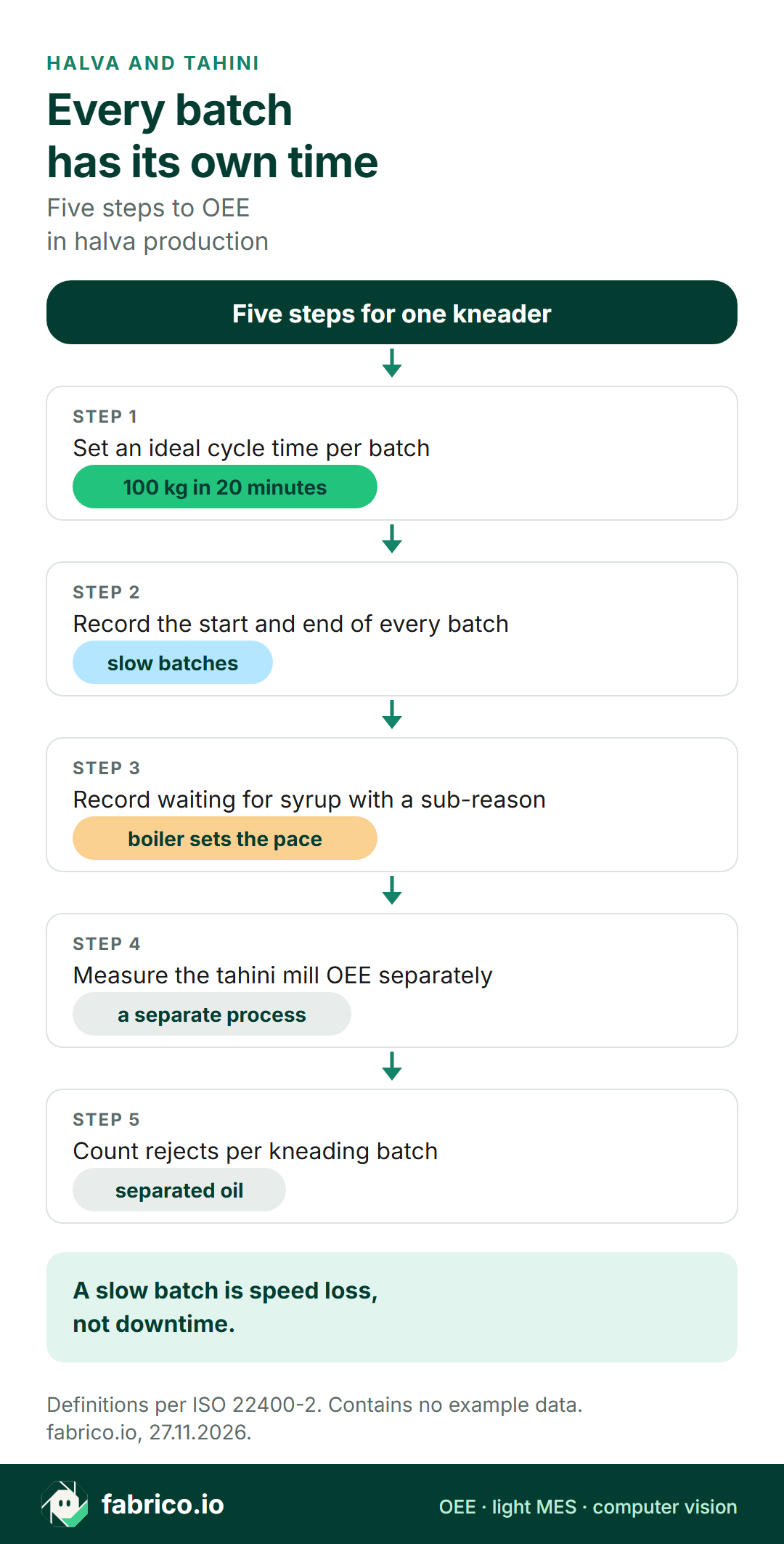
Text version of the diagram
- Set an ideal cycle time per batch.
- Record the start and end of every batch.
- Record waiting for syrup with a sub-reason.
- Measure the OEE of the tahini mill separately.
- Count rejects per kneading batch.
Fabrico provides the measured rates per line; the plan itself is made in the ERP, the APS or the planning spreadsheet.
This week: record the start and end of every batch for three shifts; record when the syrup is ready; time one changeover with a full clean.
This quarter: a PLC signal from the kneader, reasons from the operator; a separate OEE for the tahini mill; a plan ordered from the types without nuts to the types with nuts.
Where Fabrico fits
Fabrico is made by the publisher of this article.
- What it is: an OEE platform and light MES with built-in maintenance management. It shows live OEE by line and shift.
- Linked line: OEE is read at the core machine, and starved (waiting for product) and blocked are recorded as stop reasons.
- Data: machines connect through the line PLC or a Fabrico IoT device; where there is no signal, a camera counts the output.
- Reasons: stops above the threshold get a reason in a few taps, and stops under the set threshold (up to 10 minutes) count as speed loss. The camera does not decide the reason.
- Money: with the Financial Impact module, every loss has a price in EUR.
- Video: where a camera covers the line, the video for the minute of a stop opens from the shift timeline, is streamed on request and not stored in Fabrico.
- Hosting and security: EU customers are hosted on AWS in Frankfurt. Certified to ISO/IEC 27001, ISO/IEC 20000-1 and ISO 9001. The gateway keeps the data for up to 30 days if the network drops.
- Price: one quote per plant, based on the machines and modules (pricing).
For food plants, see also the article MES for food manufacturing.
A result from a Bulgarian plant
At Ficosota, a maker of home care, hygiene and consumer goods rather than food, the time with no recorded stop reason fell from 3.20 % to 0.40 % between June and September 2026.
The result comes from 16 lines with OEE and the Financial Impact module, and OEE rose from 53.11 % to 59.62 %. The numbers are approved by the customer.
Ficosota is also an investor in Fabrico (since January 2025) and an industrial partner in developing the OEE module; keep that in mind when reading the results.
See the batches, syrup and rejects of one shift in Fabrico. In a demo you will see the line stops by reason and what each one costs in euros.
Frequently asked questions
How is OEE measured on a halva kneader?
With an ideal cycle time for one batch. A slow batch is speed loss, a stop between batches is downtime, and rejects are counted in kilograms.
Whose loss is waiting for syrup?
The syrup boiler's. On the kneader it is recorded as "starved (waiting for product)" with a sub-reason.
Should tahini have its own OEE?
Yes. The tahini mill is a separate machine that feeds the halva. Together the two numbers show which process is the bottleneck.
Why does halva separate oil?
The causes sit in the process: overheated tahini, syrup below the right temperature or kneading that was too short. Rejects per batch show which batches cause it.
Is cleaning needed between halva types?
Not between sesame types without nuts. The line is cleaned completely after pistachio halva or other nut types before a type without nuts, and after sesame halva before sunflower halva.
How much lighter can a 250 g bar of halva be?
Under Directive 76/211/EEC, the tolerable negative error for packs of 200 to 300 g is 9 g, and the batch average may not be below the nominal quantity.
Latest from our blog





Real Fabrico tiles, sample data.