





 Login
 Blog

Cost of rush orders in production: what a late change costs the line

In short
- A rush order costs more than the time it takes to make. Its cost is the difference from the normal lead time: extra changeovers, a slow start, start-up scrap, express materials and freight, and hours outside the roster.
- Count only the difference. The run time of the order itself is not a rush cost: the order would have gone through the line at the normal lead time too.
- In this example 12,000 bottles of 1 l sunflower oil, ordered for two days later, bring EUR 1,371 of extra direct cost and 90 minutes of lost line time. On a full line the total rush cost is EUR 1,533 or EUR 2,883.
- The surcharge per bottle in this example is EUR 0.1143 to 0.2403, or 6.2% to 13.0% of the price. Without it, the rush eats 82% to 172% of the order's margin.
- In Bulgaria, overtime is prohibited as a rule and allowed only in the cases listed in Art. 144 of the Labour Code, capped at 150 hours per person in a calendar year. Get a lawyer's or the labour inspectorate's view before planning rush orders on overtime.
What does a rush order cost a production line? Exactly the difference between making it now and making it at the normal lead time. That difference is the extra changeovers, the slow start after them, the start-up scrap, the express materials and freight, and the hours you spend to win back the lost capacity.
Work these lines out once, for one real order, and you have a basis for a surcharge, a minimum quantity or rush rules in the supply agreement.
The maths below is for food and FMCG producers whose retail and distributor customers order at a few days' notice. It runs through an oil bottling line to EUR for one order, for the month and for the year, then on to a surcharge calculator, zones in the plan and the Bulgarian overtime rules.
Where the cost of a rush order comes from
A rush order is an order that does not fit the current plan.
Wu and Chen describe rush orders as immediate customer demand beyond what the current master production schedule expects. They propose a model that computes the cost of accepting one, to decide whether to accept it and how to price it (Wu and Chen, International Journal of Production Research, 1996, accessed 27.11.2026).
On the line, that cost is built from six items:
| Cost item | What happens on the line | How to measure it |
|---|---|---|
| Extra changeovers | A campaign is broken for the rush SKU and restarted after it | Changeover minutes outside the plan |
| Slow start | After each format change the line starts below full speed | Minutes of lost speed |
| Start-up scrap | The first units after the change fail the checks | Count and EUR at material cost |
| Express materials | Labels, film or raw material arrive faster | The supplier's express charge |
| Freight and admin | A separate truck, re-planning, batch release | EUR per invoice and hours |
| Lost capacity | The minutes from the first two items are missing from the plan | Overtime or lost margin |
Hall and Potts describe the same thing in scheduling terms: new orders that arrive after the schedule is set disrupt it. Inserting them means trading the cost of the schedule against the cost of the disruption (Hall and Potts, Operations Research, 2004, accessed 27.11.2026). On the line, the disruption shows up as minutes, scrapped units and other orders that slip.
The difference rule
The hours the line spends making the order itself are not a rush cost. If the order would have run at the normal lead time anyway, those hours are covered by the normal price. Urgency costs only what the normal lead time would not have cost.
So the sheet has two columns: "at the normal lead time" and "as a rush order". The cost is the gap between them, not the total of the second column.
Four kinds of last-minute change
A last-minute change is the same problem in another form: the customer changes an order that is already in the plan. The effect on the line depends on the kind of change.
| Change | What happens on the line | Main cost |
|---|---|---|
| Larger quantity | The campaign runs longer and pushes out the next SKU | Lost capacity for other orders |
| Smaller quantity | Packaging and labels are left over, the line finishes early | Leftover materials, idle time |
| Earlier date | The order is inserted into another format's campaign | Two extra changeovers |
| Different SKU | The planned changeover is swapped for another | Materials and start-up scrap for the new SKU |
The earlier date is the most expensive change in the example below, because it breaks a campaign on another format.
Worked example: 1 l private-label oil, ordered for two days later
The line, prices and order are made up for this example; they are not a customer's data.
The line and the order
- A sunflower oil line filling PET bottles of 1 l and 2 l. The core machine is the filler: ideal speed 7,200 bottles/h on 1 l and 4,200 bottles/h on 2 l.
- Two shifts, each with 7.5 h of production after the break, five days a week, 6 people per shift. Line OEE in this example is 75%.
- Labour costs EUR 12.00 per person-hour. That is Eurostat's average hourly labour cost for Bulgaria's economy in 2025, against EUR 34.9 for the EU (Eurostat, Hourly labour costs, accessed 27.11.2026).
- On Tuesday at 10:00 the chain asks for 12,000 bottles of its own-brand 1 l for loading on Thursday at 6:00. The normal lead time in the agreement is 10 working days.
- The price to the chain is EUR 1.85 per bottle. The margin after materials and direct labour is EUR 0.14 per bottle.
- The line is running a 2 l campaign until Wednesday night. The next 1 l campaign is on Monday. At the normal lead time the order would go there after the producer's own brand, with a label change only.
The difference from the normal lead time
| Item | Normal lead time | Rush order | Difference |
|---|---|---|---|
| Changeovers | 1 label change, 12 min | 2 format changes, 2 × 45 = 90 min | +78 min |
| Slow start | 0 | 2 × 15 min at 60% speed = 12 min lost | +12 min |
| Start-up scrap | 40 × 1 l bottles × 1.10 = EUR 44.00 | 200 × 1 l × 1.10 + 200 × 2 l × 2.10 = EUR 640.00 | +EUR 596.00 |
| Labels | Delivered to schedule | Express print | +EUR 450.00 |
| Freight | Shared truck | Separate truck | +EUR 280.00 |
| Re-planning and release | Part of normal work | 3 h × EUR 15.00 | +EUR 45.00 |
A check on the slow start: 15 min at 60% speed gives the output of 9 min, so each format change loses 6 min, or 12 min for both. Start-up scrap is valued at material cost: EUR 1.10 for a 1 l bottle and EUR 2.10 for a 2 l bottle.
In this example the extra direct cost is 596 + 450 + 280 + 45 = EUR 1,371.00. The line also loses 78 + 12 = 90 min.
A minute on a full line has a price of its own; the method has its own article: cost of downtime per minute. Scrap and slow running after the change are separate losses, covered in the article on start-up losses.
The price of the 90 minutes: three cases
What the 90 minutes cost depends on how full the line is that week.
- The line has spare capacity: the minutes cost nothing extra. Total rush cost: EUR 1,371.00.
- The line is full and the minutes are won back with overtime, if overtime is lawful in the case (see below): 1.5 h × 6 people = 9 person-hours. With a 50% premium an hour costs 12.00 × 1.5 = EUR 18.00, so EUR 162.00 in total. Total rush cost: EUR 1,533.00.
- The line is full and the minutes are not won back: the margin on the 2 l bottles that are not made is lost. A minute of the 2 l campaign gives 4,200 × 0.75 / 60 = 52.5 good bottles. At a EUR 0.32 margin that is EUR 16.80 a minute, and 90 × 16.80 = EUR 1,512.00. Total rush cost: EUR 2,883.00.
For simplicity the example applies the 50% premium to the whole hourly labour cost. That is an upper estimate: under Art. 262(2) of the Bulgarian Labour Code, unless agreed otherwise, the premium is calculated on the pay set in the employment contract.
How much of the margin is left
The order's margin is 12,000 × 0.14 = EUR 1,680. The table sets the rush cost against it.
| Case | Rush cost, EUR | Per bottle, EUR | Share of margin |
|---|---|---|---|
| Spare capacity | 1,371.00 | 0.1143 | 82% |
| Full line, overtime | 1,533.00 | 0.1278 | 91% |
| Full line, no overtime | 2,883.00 | 0.2403 | 172% |
Per-bottle figures are rounded at the end: 1,371 / 12,000 = 0.11425, 1,533 / 12,000 = 0.12775 and 2,883 / 12,000 = 0.24025 EUR. In the third case a rush order without a surcharge loses 2,883 - 1,680 = EUR 1,203.
Per month and per year
If the chain sends an order like this twice a month, the rush cost in this example is:
- With spare capacity: EUR 2,742 a month and EUR 32,904 a year.
- With overtime: EUR 3,066 a month and EUR 36,792 a year.
- On a full line without overtime: EUR 5,766 a month and EUR 69,192 a year.
These totals hold if the number and size of the orders stay the same. The example leaves out penalties under other contracts if the displaced 2 l bottles reach their own customer late.
Rush order surcharge calculator
The surcharge has to cover the difference, not the whole price of the order. There is one formula:
Surcharge per unit = (extra direct costs + cost of lost time) / quantity in the rush order
- Extra direct costs: start-up scrap, express materials, separate freight, re-planning and batch release.
- Cost of lost time: zero with spare capacity; the overtime hours at their cost; or the margin on the output that is not made.
- Quantity: the units in the rush order, not the weekly volume of the SKU.
Changeovers and start-up scrap do not depend on the quantity, so a small rush order costs more per unit. The table shows the overtime case from the example, EUR 1,533, for three quantities. It assumes that up to 24,000 bottles, or 30 pallets of 800 bottles, go on one truck.
| Quantity, bottles | Surcharge per bottle, EUR | Share of the EUR 1.85 price |
|---|---|---|
| 6,000 | 0.2555 | 13.8% |
| 12,000 | 0.1278 | 6.9% |
| 24,000 | 0.0639 | 3.5% |
That is why a fixed fee per rush order is simpler to put in a contract than a percentage. In this example it is EUR 1,533 on a full line with overtime and EUR 2,883 if there are no extra hours. The fee does not depend on the quantity, and the buyer sees the cost of urgency before ordering.
Check the calculator against real minutes once a quarter. If the team cuts the format change from 45 to 30 min, the extra time in the example drops from 90 to 60 min and the fee drops with it. The standard these minutes are measured against is set with the method in the article on changeover standards in FMCG.
The check: two format changes of 30 min give 60 min instead of 90. Minus the 12 min label change, plus 12 min of slow start: 60 - 12 + 12 = 60 min of extra time.
Zones in the plan: which changes are accepted, and at what price
Planners call this freezing the schedule: the part of the plan closest to today does not change, or changes only under written rules. Zones give sales a ready answer when the customer calls.
| Zone | Time to loading | What is accepted | Price in the example |
|---|---|---|---|
| Frozen | Up to 2 working days | Only with spare capacity or with a fee | EUR 1,371 to 2,883 per order |
| Slushy | 3 to 9 working days | Goes into the next campaign of the same format | No fee if no campaign is broken |
| Free | 10 working days or more | Normal sequence | No fee |
The zone limits come from your own planning cycle. If 1 l campaigns repeat every week, the slushy zone is about a week. What matters is that the rules are in the agreement before the first call comes.
Zones do not replace a good SKU sequence. The better the week is sequenced, the less each insertion costs. Ordering the week for fewer format changes is the subject of a separate article on SKU changeover sequence.
Overtime: what the Bulgarian Labour Code says
The Labour Code was read on 27.11.2026 in its version last amended by State Gazette No. 99 of 30.10.2026 (Labour Code on lex.bg, accessed 27.11.2026). The reading is for planning, not legal advice.
- The ban: Art. 143(2) says that overtime is prohibited.
- The exceptions: Art. 144 allows it as an exception in seven cases only. They include emergency repair work on premises and machines (point 5), finishing work already started that cannot be done in regular working hours (point 6), and intensive seasonal work (point 7).
- The limits: one person may work at most 150 hours of overtime in a calendar year (Art. 146(1)). A collective agreement under Art. 51b can raise this, to no more than 300 hours (Art. 146(2)). Separately, Art. 146(3) caps daytime overtime at 30 hours in a month, 6 in a week and 3 across two working days in a row.
- The pay: Art. 262(1) sets a premium of no less than 50% for a working day, 75% for a rest day, 100% for a public holiday, and 50% where working time is calculated on a summarised basis.
- The record: the employer keeps a special overtime book and reports the year's overtime to the labour inspectorate by 31 January of the next year (Art. 149).
A rush order is not named among the seven cases. Whether a given shift falls under point 6 depends on the facts, so the example treats overtime as one of three cases, not as the default move.
Before the first rush order with hours outside the roster, ask a lawyer or the labour inspectorate for a view on your case.
The cap has a production side too. In this example each rush order on overtime takes 1.5 h from each of the six operators. Twenty-four such orders a year use 36 of each person's 150 hours, before breakdowns and the season are counted.
Fatigue has a cost as well. A study of 10,793 people in the United States and 110,236 job records (NLSY, 1987 to 2000) found a 61% higher injury hazard rate in jobs with overtime.
Days of 12 hours or more carried a 37% higher hazard and weeks of 60 hours or more a 23% higher hazard (Dembe and co-authors, Occupational and Environmental Medicine, 2005, accessed 27.11.2026).
Changes by the buyer: what EU and Bulgarian rules say
Food adds a second set of rules. Art. 3(1) of Directive (EU) 2019/633 requires Member States to prohibit at least the practices it lists, and two of them touch rush orders (Directive (EU) 2019/633 on EUR-Lex, accessed 27.11.2026):
- Point (b): cancelling orders of perishable agricultural and food products at such short notice that the supplier cannot reasonably be expected to find another outlet; the directive counts any notice under 30 days as short, though Member States may set shorter periods for specific sectors.
- Point (c): unilaterally changing terms of the supply agreement on the timing, volume, place or method of supply (the point lists other terms too).
Bulgaria's competition law, in Art. 37b(1), prohibits any act or omission by a buyer contrary to good commercial practice that damages or may damage the supplier, and then gives examples. Points 2 and 3 of that list carry the two practices above (the act on lex.bg, accessed 27.11.2026; last amended by State Gazette No. 58 of 26.06.2026).
The Bulgarian rules cover sales of agricultural and food products in the six groups of Art. 37g: five pairings of supplier and buyer annual turnover, and sales to a buyer that is a public authority.
Outside these texts:
- A rush order the supplier has accepted is not among the listed practices, and the texts set no surcharge for one.
- Point (b) is for perishable products only and does not touch the oil in the example; point (c) covers long-life food as well.
- Detergents, cosmetics and other non-food goods are out of scope; the supply agreement decides there.
On this reading, a change that both sides accept in writing is not unilateral. So the zones and the fee belong in the agreement, and each rush order should have a written confirmation. Have a lawyer or the competition authority look at the chain agreement before relying on point (c).
What to record for every rush order
One order with a worked-out cost persuades a buyer more than a general "rush orders are expensive". For every rush order or change, record:
- Who asked, when, and for when: date and time of the request and of loading.
- What changed: SKU, quantity or date.
- Changeover minutes outside the plan and minutes of slow start.
- Start-up scrap as a count and in EUR.
- Express costs per invoice: materials and freight.
- Overtime hours, if any, and who worked them.
- What was pushed out of the plan, and whether another order slipped.
Point seven is the knock-on effect. If the displaced 2 l bottles reach another customer late, one buyer's rush order becomes another buyer's late order.
After three months you have a table by customer: number of rush orders, cost, and share of margin. With it, the conversation with the customer is about forecasts, minimum quantities, a fee or buffer stock. The minutes and scrap per order come from the line's own records; that is what shift analytics are for.
Fee, buffer stock or the next slot: how to choose
One call for a rush order has at least four possible answers. The last column carries the numbers from the example.
| Answer | When it makes sense | In the example |
|---|---|---|
| Fee or surcharge from the calculator | Rush orders are one-offs and hard to predict | EUR 0.1143 to 0.2403 per bottle |
| Buffer stock of the SKU | The same SKU is requested at short notice again and again | EUR 306.50 a month |
| Next slot on the same format | The customer can wait for the campaign | No fee, loading on Tuesday of the next week |
| Partial delivery | Part of the quantity is in stock | No fee for the stock; the rest at the normal lead time |
The buffer stock in the example: 12,000 bottles of 1 l are 15 pallets. Storage costs EUR 0.45 per pallet per day, so 15 × 0.45 × 30 = EUR 202.50 a month. The cash tied up is 12,000 × EUR 1.30 unit cost = EUR 15,600. At an 8% annual cost of capital that is 15,600 × 0.08 / 12 = EUR 104.00 a month.
In total the stock costs EUR 306.50 a month, while two rush orders with overtime cost EUR 3,066. The risk is different: if the chain changes the label or delists the SKU, the stock is stranded. So buffer stock suits repeat SKUs, and the fee suits one-off cases.
The decision fits on one page that the commercial director takes to the customer meeting. Zones and fee come from planning, minutes, scrap and hours from production, and the financial controller checks the sums once a quarter.
An OEE system can supply the calculator's data. How to choose one is covered on the OEE for FMCG page and in the review of OEE software for consumer goods manufacturing.
Questions for the customer before the rules go into the agreement
- How many rush orders and changes were there in the last six months, and on which SKUs?
- Can the private-label forecast come every week together with the orders?
- Is a fixed fee per rush order acceptable, or a surcharge by lead time?
- Below what quantity is a rush order not accepted?
- Is a partial delivery from stock, with the rest at the normal lead time, acceptable?
- Will the zones and the fee be written into the agreement and confirmed in writing?
Where Fabrico fits
Whether, and at what price, to accept a rush order is a sales decision, and the plan lives in the ERP or the planner's spreadsheet. Fabrico combines OEE and a light MES, and gives the calculator measured minutes and counts instead of estimates.
On the oil line, Fabrico shows live OEE by line and shift, read at the core machine, the filler. Each format change and label change is measured against its standard time, and start-up scrap is recorded by product and reason. Operators add the stop reason in a few taps, so the 90 minutes in the calculator have a name.
Analytics by hour, shift, day, week and month add up the rush orders over a quarter, and the Financial impact module puts a EUR figure on the loss for each SKU and orders the stops by what they cost.
How a light MES handles changeovers and scrap on one line is described separately. The quote covers the whole plant and depends on machines and modules (pricing).
A rush order on one page
The sheet below is for the table where sales, planning and production settle one rush order. Step 6 depends on the agreement and, for food, on the legal reading above.
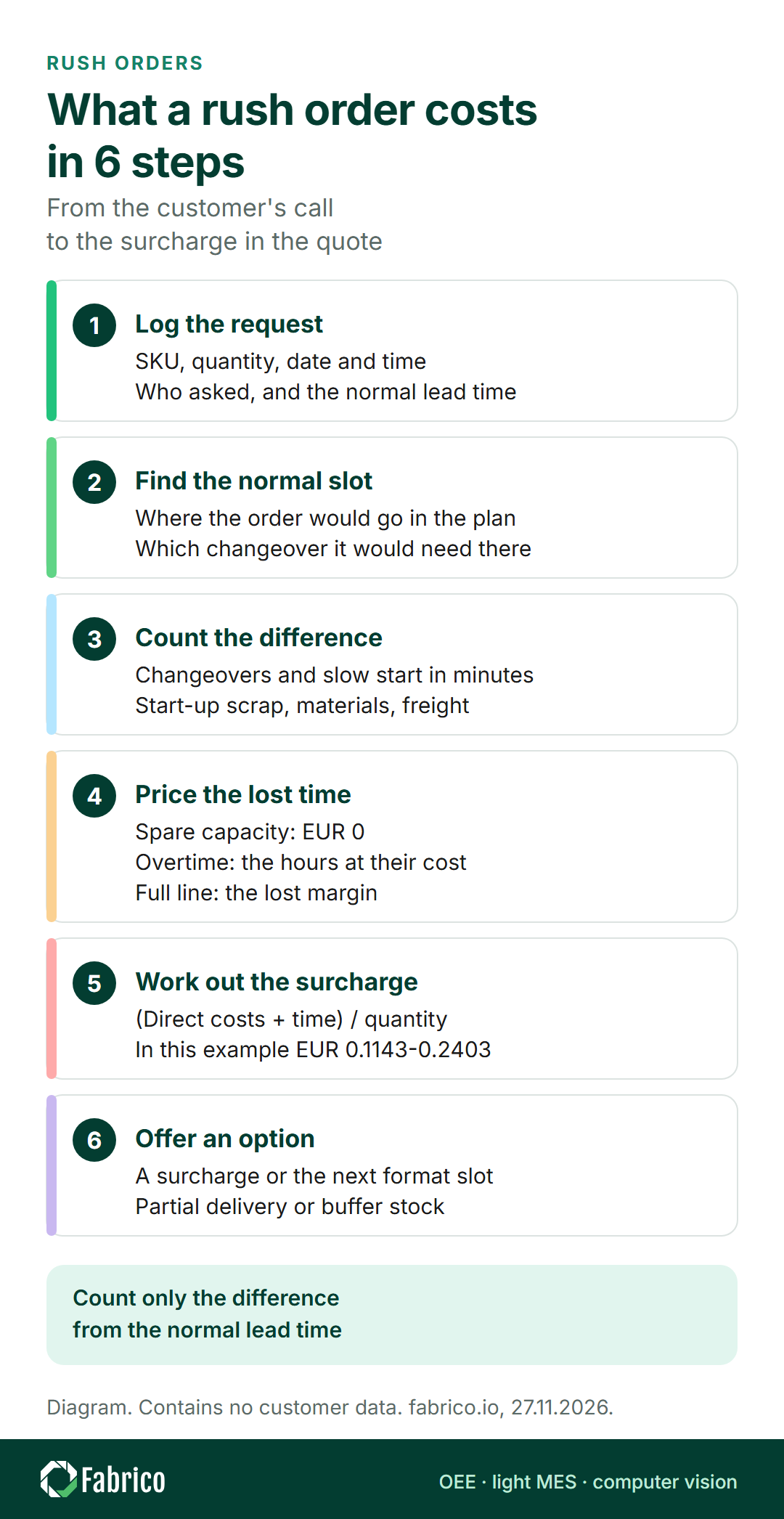
Text version of the diagram
- Log the request: SKU, quantity, date and time; who asked and what the normal lead time is.
- Find the normal slot: where the order would go in the plan and which changeover it would need there.
- Count the difference: changeovers and slow start in minutes; start-up scrap, materials and freight in EUR.
- Price the lost time: EUR 0 with spare capacity; overtime hours at their cost; the lost margin on a full line.
- Work out the surcharge: (direct costs + time) / quantity; in this example EUR 0.1143 to 0.2403 per bottle.
- Offer an option: a surcharge, the next slot on the format, a partial delivery or buffer stock.
Frequently asked questions
What does a rush order cost a production line?
The difference from the normal lead time: extra changeovers, a slow start, start-up scrap, express materials and freight, and the cost of lost time. In this example 12,000 bottles of oil cost EUR 1,371 to 2,883 more.
How is a rush order surcharge calculated?
Extra direct costs plus the cost of lost time, divided by the quantity in the order. Lost time costs zero on a line with spare capacity, the cost of the overtime, or the margin on the output that is not made.
Can a rush order be run on overtime in Bulgaria?
Art. 143 of the Labour Code prohibits overtime, and Art. 144 allows it in seven cases only; a rush order is not named among them. The cap is 150 hours per person in a calendar year. The specific case is one for a lawyer or the labour inspectorate.
Is a retailer allowed to change an order at the last minute?
For food, Directive (EU) 2019/633 and Bulgarian competition law treat as unfair a buyer's unilateral change to the timing or volume of supply, and the cancellation of perishable orders at less than 30 days' notice. A change both sides accept in writing is not unilateral.
When is buffer stock cheaper than rush orders?
When the same SKU is requested at short notice again. In this example 12,000 bottles of stock cost EUR 306.50 a month, while two rush orders with overtime cost EUR 3,066. The risk is a label change or a delisting.
What is a frozen zone in a production plan?
The part of the plan closest to today, which does not change, or changes only under written rules and for a fee. In this example it is the two working days before loading.
Price the next rush order with measured minutes, not an estimate. The demo walks through one line: format changes against the standard, start-up scrap by product and reason, OEE by line and shift and the loss in EUR for the SKU.
Latest from our blog




Real Fabrico tiles, sample data.